Good Reads
Fix pipeline pains. Solve GTM puzzles. Read strategic brain dump.
Written for marketers who want real solutions to a leaking pipeline (and their dark circles).
Want to read more from us?


I’m looking for…
The Principles Of Modern B2B Marketing: Brand Building Vs. Sales Activation
Maximize B2B marketing potential with Factors Professional Services and marketing stratergy. Tailor-made analytics, consulting and support to optimize ROI.

B2B marketing strategies that maximize growth
B2B marketing may be in trouble. Research suggests that B2B organizations are inadvertently transforming marketing into a supporting tool for the sales function. In reality, however, marketing is at the very core of a business. With the right principles securely in place, B2B marketing may well transform into the growth engine of B2B organizations.
It’s about time we rethink the principles of marketing
Linkedin’s B2B institute recently conducted wonderful research using B2B effectiveness data in collaboration with Peter Field, Les Binet and the IPA. The primary motivator of this research was to identify the best marketing principles that correlated with growth. Keep in mind that in this case, growth does not mean improving CTR, impressions, engagements or other traditional digital marketing metrics. Instead, we’re referring to growth in terms of market share, revenue, profitability, and other bottom line business metrics.
What makes this research especially special is the fact that it's never been done before through the lens of B2B marketing. That is, of course, until now. The following series will delve into each of these principles one article at a time with hopes of providing an intuitive, straightforward explanation of cutting-edge B2B marketing research.
If you had to take away one thing from this series, it’s this:
Extensive research and anecdotal evidence point to one thing — The key to marketing-sourced growth is balance. While this may seem obvious, the truth is that modern B2B marketing is almost always unbalanced. They tend to involve solely short-term, volume-based endeavors that play to logic and reasoning as opposed to a balanced view of short AND long term strategies that consider volume AND price, logic AND emotion, awareness AND fame.
With that out of the way, let’s finally move on to the first principle of B2B marketing strategies that maximize growth.
Brand Building Vs. Sales Activation
A. Have Your Cake & Eat It Too: Brand Building and Sales Activation I
In their research, Binet and Field identify two types of marketing:
1. Sales activation: Sales activation definitely provides short-term growth. But while sales activation captures existing demand, it does not create it. Results with sales activation often produce results that decay just as fast they appear – which isn’t necessarily a bad thing, just something to keep in mind for the long term.
2. Brand building: Brand building provides long-term growth. In a sense, this creates and captures demand together. Note that when executed well, brand building delivers short-term growth as well. So the big takeaway is that you don’t have to pick between one or the other. In a sense, brand building contributes to future demand to ensure a durable pipeline of future sales and profits.
Ideally, a combination of both types of marketing will yield the best results. If you had to pick one, however, the choice is easy. Brand building is the only strategy that delivers both short-term and long-term growth.
B. The 60/40 Rule: Brand Building & Sales Activation II
In B2C marketing, organizations with the most short-term and long-term growth spend most of their budget towards branding (60%) as opposed to sales activation (40%). In most B2B orgs, this marketing investment is skewed in the opposite direction; with most spend being allocated towards activation (54%).

What might explain this variation? Put simply, B2B sales is harder. It involves several touch points across several stakeholders over several months. It also necessitates far more exposition around the product, use-cases, functional benefits, and more. There’s no doubt that in B2B, sales activation, especially in early-stages, has an important (albeit expensive) role to play. But as the novelty and needs of a new business fades, marketing needs to mature towards a brand-focused distribution to ensure sustainable growth.

C. Flip The Funnel: From ToFu/BoFu To In/Out Market
The funnel is a well-known construct in B2B marketing. The conventional B2B funnel depicts a voluminous top-of-the-funnel that wittles down along each step of the funnel towards the bottom of the funnel. Interestingly, Binet and Field suggest flipping the funnel. Rather than ToFu and BoFu, they recommend thinking of the funnel as “in market” buyers and “out market” buyers. In this case, activation spend is mostly for limited market buyers while branding spend is for the much larger, out market buyers.

This approach tends to be more customer-centric because:
- Customers don’t think of themselves as being in the “brand building” phase or “sales activation phase”. Instead, customers think of themselves as being “in-market” to buy a product or “out-market” to not buy a product at this moment.
- Marketers have two customers: Your external customers and your internal finance team. Thinking about the funnel as current cash flow customers and future cash flow customers will help align marketing with the CFO or finance team as well.
D. Different Stroke For Different Folks:
Of course, in-market buyers are inherently very different from out-market buyers. This necessitates different approaches for creative, distribution, and measurement.
For in-market approach:
- Rational Messaging - for immediate ROI and value
- Narrower targeting - for a narrower market
- Sales metrics - revenue and pipeline are the most relevant KPI for in-market
For out-market approach:
- Emotional Messaging - for long term brand retention
- Broder targeting - for a larger market
- Memory metrics - brand sense is an example of a relevant memory metric
And there you have it. The first principles delved deep into the pros and cons of Sales Activation and Brand Building. While employing both approaches in unison are crucial to long-term success, the verdict is that, at the end of the day, the goal should be to prioritize brand building. We also highlight an unconventional perspective of the good old sales funnel. Join us next week to go over the second principle: Awareness vs Fame.
Balancing Brand Building and Sales Activation in B2B Marketing
In modern B2B marketing, balancing brand building and sales activation is essential for sustainable growth.
1. Sales Activation focuses on short-term gains by capturing existing demand, delivering quick but often temporary results.
2. Brand Building creates new demand and strengthens market presence, driving long-term success.
While both strategies play a vital role, prioritizing brand building ensures lasting growth and a strong competitive position in the market.
Step-by-Step Guide to SaaS Content Marketing
Strategically create & distribute valuable SaaS content to attract, engage, & retain your audience. Elevate your SaaS Content Marketing game
.avif)
“The global SaaS market is projected to grow from $273.55 billion in 2023 to $908.21 billion by 2030 at a CAGR of 18.7%.”
With such growth figures, comes great marketing responsibility. And what’s a better tool than SaaS Content Marketing to take your organic marketing efforts to the next level? If you’re a little iffy about creating content for your SaaS company, this blog is written for you!
Without much ado, let’s get right into clarifying the basics before we jump into the step-by-step guide for SaaS content marketing.

But, what is SaaS Content Marketing?
SaaS Content Marketing is the strategic creation and distribution of relevant, valuable, and consistent content to attract, engage, and retain a target audience within the SaaS industry.
Unlike traditional marketing approaches that emphasize direct selling, SaaS Content Marketing centers around providing information and insights, positioning the brand as a trusted advisor. It serves as the bridge between a SaaS company and its audience, fostering a relationship built on trust and authority. SaaS Content Marketing stands apart due to its focus on delivering targeted, highly informative content tailored to the needs of a tech-savvy audience. Effective content marketing positions the brand as an industry leader resonates with the pain points of the target audience, and ultimately drives customer loyalty and advocacy. It focuses on educating users, offering in-depth insights into the product's functionality, and guiding them through the complexities of the software.

Building a Value Proposition and Demonstrating the Brand's Authority
A compelling value proposition is at the core of successful SaaS Content Marketing. Content should articulate not only the features of the SaaS solution but, more importantly, the value it brings to users. Whether through whitepapers, webinars, or interactive demos, SaaS content should communicate how the product addresses specific pain points, enhances efficiency, and delivers tangible benefits. Establishing the brand's authority involves consistently offering valuable insights, staying abreast of industry trends, and showcasing thought leadership through authoritative content.
Step-by-Step Guide To Content Marketing
Since you’ve made it this far into the article, we’d like to think you’re considering SaaS content marketing. So, as promised, here’s the step-by-step guide that will enable you and your teams to create a framework and scale your content marketing efforts.
Step 1
Market Research: Laying the Foundation
The first step in building a formidable SaaS Content Marketing strategy is laying a strong foundation through thorough market research. This step includes identifying market trends, understanding customer pain points, and analyzing competitors. The goal is to unearth insights that will inform content strategies and ensure they align with the dynamic needs of the target audience.
Market research in SaaS Content Marketing should address the following key aspects:
- Audience Persona Development
Define and understand the various personas within the SaaS target audience. Recognizing their challenges, preferences, and decision-making criteria lays the foundation for tailored content.
- Competitor Analysis
Evaluate the content strategies of key competitors. Identify content gaps, assess engagement levels, and discern successful tactics. This analysis informs the creation of content that stands out in a space that may already be cluttered with content.
- Trend Identification
Stay abreast of industry trends and emerging technologies. This not only showcases the brand's commitment to staying current but also provides valuable content ideas that resonate with a tech-savvy audience.
- Content Consumption Patterns
Understand how the target audience consumes content. Whether through blog posts, videos, webinars, or interactive experiences, aligning content formats with audience preferences enhances engagement.
- SEO
Analyze the way SEO works within the SaaS domain. Identify high-performing keywords, assess competitors' keyword strategies, and uncover opportunities to enhance search engine visibility.
Step 2
Keyword Research: Unlocking Visibility
Keyword research is the cornerstone of an effective SaaS Content Marketing strategy. In fact, a survey conducted among startup founders indicated that 90% consider SEO to be a crucial factor in driving brand awareness and generating leads for their businesses.
SEO involves identifying and targeting the specific terms and phrases that potential users will likely use when searching for SaaS solutions.
A robust keyword research process encompasses the following key steps:
- Identifying Core Keywords
Begin by identifying primary keywords that align with the SaaS offering. These should encapsulate the core functionalities and unique selling propositions of the product.
- Long-Tail Keyword Exploration
Explore long-tail keywords that reflect specific user queries and intent. This is mainly because long-tail keywords are less likely to have high competition and can drive traffic that is relevant to the brand’s target audience.
- Competitor Keyword Analysis
Analyze the keyword strategies of competitors. Identify keywords they are ranking for and evaluate the competitiveness of these terms.
- User Intent Understanding
Consider the intent behind user searches.
Are they searching for some information?
Are they seeking solutions to a problem?
Are they set to buy?
Align keywords with the various stages of the customer journey.
- Seasonal and Trend-Related Keywords
Factor in seasonal trends and industry-specific events. Creating content around timely keywords enhances relevance and visibility during peak periods.
- Localization Strategies
If applicable, incorporate localization into keyword research. This is crucial for SaaS providers targeting specific geographic regions.

Step 3
Choosing the Right Formats for SaaS Marketing: Navigating the Sea of Content
Within SaaS content marketing, the choice of content formats is akin to selecting the sails for a seafaring vessel. Each format serves a distinct purpose, resonates with varying audience preferences, and contributes uniquely to the overarching content strategy. Let's embark on a journey to explore the sea of content formats available for SaaS marketing:
- Blog Posts:
Purpose: Inform, Educate, and Build Authority.
Why? Blogs are the workhorses of content marketing. They offer a platform for in-depth exploration of industry trends, product features, and thought leadership. Regular, well-optimized blog posts enhance SEO and keep the audience engaged.
Did you know?
Approximately 36% of sizable SaaS enterprises employ their blog posts to educate readers on various industry topics. - Whitepapers:
Purpose: Thought Leadership and In-Depth Insights.
Why? Whitepapers dive deep into complex topics, providing comprehensive insights, research findings, and expert opinions. They are instrumental in establishing the brand as a thought leader and a go-to source for industry knowledge.
- Webinars:
Purpose: Engagement, Education, and Interactivity.
Why? Webinars bring a dynamic, interactive element to SaaS marketing. They allow real-time engagement with the audience, facilitating product demonstrations, Q&A sessions, and discussions. Webinars forge a more personal connection with potential users.
Did you know?
In the B2B sector, it is strongly believed that webinars contribute to generating nearly 75% of sales leads.
- Video Tutorials:
Purpose: User onboarding and product understanding.
Why? Visual learners rejoice with video tutorials. These concise, visually appealing guides help users navigate software interfaces, understand features, and maximize the value of the SaaS product. Video tutorials enhance user onboarding and reduce the learning curve. - Case Studies:
Purpose: Showcase real-world successes.
Why? Case studies are testimonials on steroids. They delve into real-world scenarios where the SaaS solution has addressed specific challenges and delivered tangible results. Case studies provide social proof, instilling confidence in potential users. - Infographics:
Purpose: Visual representation of information.
Why? Infographics distil complex information into visually appealing, easily digestible graphics. They are perfect for conveying statistics, processes, and key data points. Infographics enhance content shareability on social media platforms. - Ebooks:
Purpose: In-depth guides and resources.
Why? Ebooks offer a comprehensive exploration of a topic, often serving as downloadable resources. They are valuable assets for lead generation, requiring users to provide their information in exchange for in-depth content. - Interactive Content:
Purpose: Engage and entertain.
Why? Interactive content, such as quizzes, assessments, and interactive guides, adds a layer of engagement. It not only captures attention but also provides users with a personalized experience. - Podcasts:
Purpose: Audio-based thought leadership.
Why: Podcasts are a versatile format for conveying industry insights, interviews, and discussions. They cater to audiences who prefer consuming content while on the go.
Did you know?
Podcasts serve as a marketing tool for a minimum of 18% of the leading SaaS app businesses.
Choosing the right mix of content formats depends on various factors, including the target audience, the complexity of the SaaS solution, and the goals of the marketing strategy. The next segment will illuminate the significance of distribution channels and amplify the reach of SaaS content.

Step 4
Creating a Content Outline in SaaS Content Marketing: Crafting the Story
As we embark on the intricate journey of SaaS Content Marketing, the creation of a content piece is akin to sketching the blueprint of a masterpiece. A well-structured outline lays the foundation for an engaging and informative piece that resonates with the audience.
Here's a step-by-step guide on crafting a content outline for your SaaS marketing endeavours:
- Define Your Objective:
Clearly articulate the purpose of your content piece. Whether it's to educate, entertain, or persuade, a well-defined objective guides the entire creation process.
- Know Your Audience:
Know more about your target audience, including their likes, needs preferences, and even their pain points. Tailor your content to address their specific challenges and provide valuable insights.
- Research Thoroughly:
Dive deep into the subject matter. Conduct thorough research to gather relevant data, statistics, and examples. A well-researched piece enhances credibility and authority.
- Choose the Right Format:
Based on your objective and audience preferences, select the most suitable content format. Whether it's a blog post, whitepaper, webinar, or video tutorial, the format should align with your goals.
- Craft a Compelling Title:
The title is the gateway to your content. Craft a compelling and attention-grabbing title that sparks curiosity and conveys the value of your piece. - Develop a Structured Flow:
Organize your content logically. Create a flow that takes the reader or viewer through a journey, from introduction to conclusion. A structured flow enhances comprehension. - Break Down Into Sections:
Divide your content into sections or chapters. This not only makes it more digestible but also allows readers to navigate easily, focusing on specific areas of interest.
- Incorporate Visual Elements:
Integrate visuals strategically. Whether it's images, infographics, or charts, visual elements enhance engagement and break the monotony of text. - Craft Engaging Headlines and Subheadings:
Headlines and subheadings should be captivating and descriptive. They provide a roadmap for readers, guiding them through the main points of your content.
- Incorporate Key Keywords:
Identify and add relevant SEO keywords to all your content pieces. This optimization ensures better visibility on search engines and attracts your target audience.
- Ensure Consistency:
Maintain consistency in tone, style, and formatting throughout your content. Consistency contributes to a seamless reading or viewing experience.
- Add a Compelling Conclusion:
Summarize key takeaways and end your piece with a compelling conclusion. Leave a lasting impression on your audience and give them a clear call to action before they step out.
Creating a content outline is not just a preliminary step; it's the architectural blueprint that shapes the entire content marketing edifice. The next leg of our journey will delve into the crucial aspects of distributing and promoting your meticulously crafted SaaS content.
Step 5
Writing Your SaaS Content Piece: Crafting the Masterpiece
The writing phase is where ideas, research, and creativity converge to create a compelling narrative. Let's delve into the key steps for bringing your content to life:
- Start with a Captivating Introduction:
The opening should grab attention and set the tone for what follows. Intrigue your audience with a compelling hook that encourages them to read on. - Follow the Flow of Your Outline:
Refer to your meticulously crafted outline. It serves as a roadmap, guiding you through the logical flow of ideas. Each section should seamlessly connect to the next. - Infuse Personality and Style:
Let your brand's personality shine through your writing. Whether it's a conversational tone, a touch of humour, or a more formal approach, maintain consistency with your brand voice. - Prioritize Clarity and Simplicity:
Keep your language clear and concise. Avoid unnecessary jargon or complexity. Aim for simplicity without sacrificing depth. - Provide Value Through Insights:
Deliver on the promises made in your outline. Provide valuable insights, backed by research and examples. This is the substance that keeps your audience engaged. - Craft Engaging Headlines and Subheadings:
Headlines and subheadings should not only guide the reader but also pique their interest. Make them compelling and reflective of the content beneath. - Use Visuals Strategically:
If your outline includes visual elements, strategically integrate them into your content. Visuals break the monotony of text and enhance overall engagement. - Optimize for Readability:
Format your content for easy readability. Try adding shorter paragraphs, headings, subheadings, and pointers to break a full wall of content and information. This enhances the user experience, especially in online reading.
- Ensure Originality:
The audience you're targeting via SaaS content marketing campaigns would like to see valuable and original content. Hence, avoiding plagiarism is a must. You should check plagiarism to maintain originality and impress your targeted audience. An advanced plagiarism checker would help you do that without requiring much time and effort.
- Inject a Personal Touch:
Personal anecdotes or real-life examples can add a human touch to your content, in turn building a personal connection with your audience. - Refine and Polish:
Once the initial draft is complete, revisit and refine it. Polish your content for clarity, coherence, and overall effectiveness. - Incorporate SEO Best Practices:
If SEO is a crucial aspect of your strategy (which it should be), ensure that your content incorporates relevant keywords naturally, to up visibility on search engines. - Craft a Compelling Conclusion:
Conclude your piece with a strong and memorable closing. Summarize key points, restate the main message, and provide a clear call to action.
Writing is the heartbeat of your content strategy. It breathes life into your ideas and transforms them into a cohesive narrative.
Step 6
Distributing Your SaaS Content: Ensuring it Reaches the Right Audience
Now, let's ensure that your masterpiece reaches its intended audience. Distribution is a crucial phase in the content marketing journey, and here's your guide to orchestrating it effectively:
- Leverage Social Media Platforms:
Share your content across relevant social media channels. Craft engaging captions and leverage hashtags to increase discoverability. Each platform has its unique audience, so tailor your approach accordingly.
- Email Marketing:
Harness the power of your email list. Send out newsletters or dedicated emails featuring your content. Personalize your messages to make them more compelling. Email marketing is used by 93% of B2B marketers for distributing their content.
- Partner with Influencers:
Identify influencers or thought leaders in your industry. Collaborate with them to share your content and amplify your reach.
- Repurpose for Different Platforms:
Modify your content to suit various platforms. Create snippets for Instagram, shorter versions for LinkedIn, or visually appealing graphics for Pinterest.
- Utilize Paid Promotion:
Boost your content's visibility through paid promotions. Allocate a budget for strategic target-based promotion.
- Engage in Online Communities:
Participate in forums, groups, or communities relevant to your industry. Share your content where appropriate, but ensure it adds value to the conversation.
- Collaborate with Industry Publications:
Reach out to industry publications and offer your content for publication. This can expose your content to a broader audience and establish your brand as an authoritative voice.
- Optimize for SEO:
Ensure your content is optimized for search engines. This includes using relevant keywords, creating a captivating meta description, and having a clean URL structure.
- Monitor and Respond:
Keep an eye on how your content is performing. Monitor social media comments, respond to queries, and engage with your audience. This will help boost traction, and visibility while enabling you to build a community around your content.
- Explore Guest Posting:
Contribute your content to reputable websites in your industry through guest posting. This can enhance your brand's visibility and authority.
- Collaborate with Your Network:
Leverage your professional network. Encourage your team members, colleagues, and industry connections to share the content within their circles.
- Measure and Adjust:
Use analytics tools to measure the performance of your distribution efforts. Track engagement, click-through rates, and other relevant metrics. Based on the data, refine your distribution strategy for future content.
An important point to remember here is that distribution is not a one-size-fits-all endeavour. Tailor your approach based on your target audience, industry dynamics, and the nature of your content.

Kickstart SaaS Content Marketing for your Organization: A Step-by-Step Guide
All geared up to start SaaS content marketing for your brand, but where do you begin? Let's break it down into actionable steps to guide you through the process:
- Define Your Objectives:
Clearly outline your content marketing goals. Whether it's increasing brand awareness, driving leads, or establishing thought leadership, having a clear purpose will shape your strategy. - Identify Your Target Audience:
Understand who your ideal customers are. Create buyer personas that will help shape your content strategy and process. This ensures that your content speaks directly to the needs and interests of your audience. - Craft a Content Calendar:
Plan your content in advance, a content calendar helps you maintain consistency and ensures a diverse mix of topics. Consider seasonality, industry events, and product launches in your scheduling. - Find Skilled Freelance Writers:
Engaging freelance writers can inject fresh perspectives into your content. Look for writers with experience in SaaS or related industries. Platforms like Upwork, Freelancer, or content creation agencies are excellent resources. - Types of Writers You Need:
Keep in mind the content formats you plan on creating. You may need writers skilled in blog writing, whitepapers, case studies, or video scripts. Having a mix ensures your content strategy is comprehensive. - Set Clear Guidelines:
Provide detailed guidelines to your freelance writers. Clearly communicate your brand voice, style preferences, and formatting requirements. A well-defined brief ensures your writers deliver content aligned with your vision. - Manage the Process Efficiently:
Use project management tools to streamline the content creation process. Platforms like Asana or Trello help in assigning tasks, setting deadlines, and maintaining communication with your freelance writers. - When to Bring in In-House Writers?
As your content strategy matures and the volume of content increases, you might consider bringing in-house writers. In-house writers offer dedicated support and align closely with your brand's nuances. However, before you bring in in-house writers, ensure that you have a comprehensive plan and framework in place, to optimise their time and talent. - Establish a Collaborative Workflow:
Foster collaboration between your in-house and freelance writers. Communicate your brand's messaging, goals, and evolving strategies clearly. A unified team ensures consistency in your content output. - Say Hello to Continuous Learning:
Encourage a culture of continuous learning within your content team. Stay updated on industry trends, SEO best practices, and evolving customer preferences. This ensures your content remains relevant and impactful. - Measure Performance:
Implement analytics tools to measure the performance of your content. Track key metrics such as engagement, conversions, and leads generated, and ensure you avoid these five mistakes when measuring content marketing ROI.
That said, the key to successful SaaS content marketing lies in a strategic and flexible approach. Adapt your strategy based on the evolving needs of your audience and the ever-changing SaaS industry.

Emerging Trends in SaaS Content Marketing
- Interactive Content Takes Center Stage
The demand for interactive content experiences is on the rise. Infographics, quizzes, polls, and immersive video content are becoming powerful tools to engage audiences and enhance user experience.
- Personalization Reaches New Heights
Personalized content tailored to individual user preferences is no longer an option but a necessity. AI-driven algorithms and machine learning enable SaaS marketers to deliver highly relevant and targeted content to their audiences.
- Voice Search Optimization
With the growing prevalence of voice-activated devices, optimizing content for voice search is a trend gaining momentum. Tailoring your content to match natural language queries enhances visibility in voice search results. - Long-Form Content for Thought Leadership
In-depth, long-form content is making a comeback. SaaS brands are leveraging comprehensive guides, research papers, and expert insights to establish thought leadership and provide valuable resources for their audience.
Innovations and Technologies Shaping the Future
- Blockchain for Content Security
The decentralized and secure nature of blockchain is finding applications beyond cryptocurrencies. In SaaS content marketing, blockchain can enhance content security, protect intellectual property, and ensure transparent attribution.
- Augmented and Virtual Reality Experiences:
AR and VR technologies are poised to transform content experiences. SaaS marketers can explore immersive product demos, virtual walkthroughs, and interactive AR applications to engage audiences in novel ways. - 5G for Faster Content Delivery
5G technology will revolutionize content delivery, providing faster and more reliable connections. SaaS marketers can leverage this for seamless video streaming, enhanced user experiences, and real-time interactions.
SaaS Content Marketing: A Strategic Approach
SaaS content marketing focuses on creating valuable content to attract, engage, and retain customers by positioning the brand as a trusted advisor.
- Core Strategy: Align content with the buyer’s journey, emphasizing education over direct selling.
- Key Steps: Define objectives, understand the audience, create high-quality content, optimize for SEO, promote effectively, and measure performance.
- Business Impact: Strengthens brand authority, educates users, and builds long-term customer loyalty.
A well-executed SaaS content strategy drives engagement and enhances customer retention.
Through this article, right from the definition and unique characteristics to the strategic nuances of crafting compelling content – one thing’s clear - the world of SaaS Content Marketing is changing constantly. Brands that adapt to these changes and leverage cutting-edge technologies will be well-positioned to capture the attention and loyalty of their target audiences in the future.
The future of SaaS content marketing is teeming with opportunities. From the increasing demand for interactive and personalized content to the transformative potential of emerging technologies, the evolution is both exciting and relentless.
As we come to a close, it’s important to note that the key to success lies in a blend of creativity, strategic insight, and a keen understanding of your audience. Whether you're embracing the power of AI, delving into immersive experiences with AR and VR, or optimizing for the era of voice search, staying at the forefront of innovation is your mantra for success.
SaaS content marketing is not just about conveying messages; it's about creating experiences, forging connections, and establishing lasting relationships with your audience.
.avif)
5 Customer Journey Stages Explained (2026 Guide)
Learn the 5 customer journey stages: Awareness, Consideration, Decision, Retention, and Advocacy. with best practices, real examples, and a B2B vs B2C breakdown. Learn practical strategies to enhance engagement and drive conversions at each stage.
TL; DR
- Understanding the customer journey is crucial for B2B marketing and sales success due to its complexity and non-linear nature.
- Customer journeys map out various buyer interactions to track how and why prospects become paying customers.
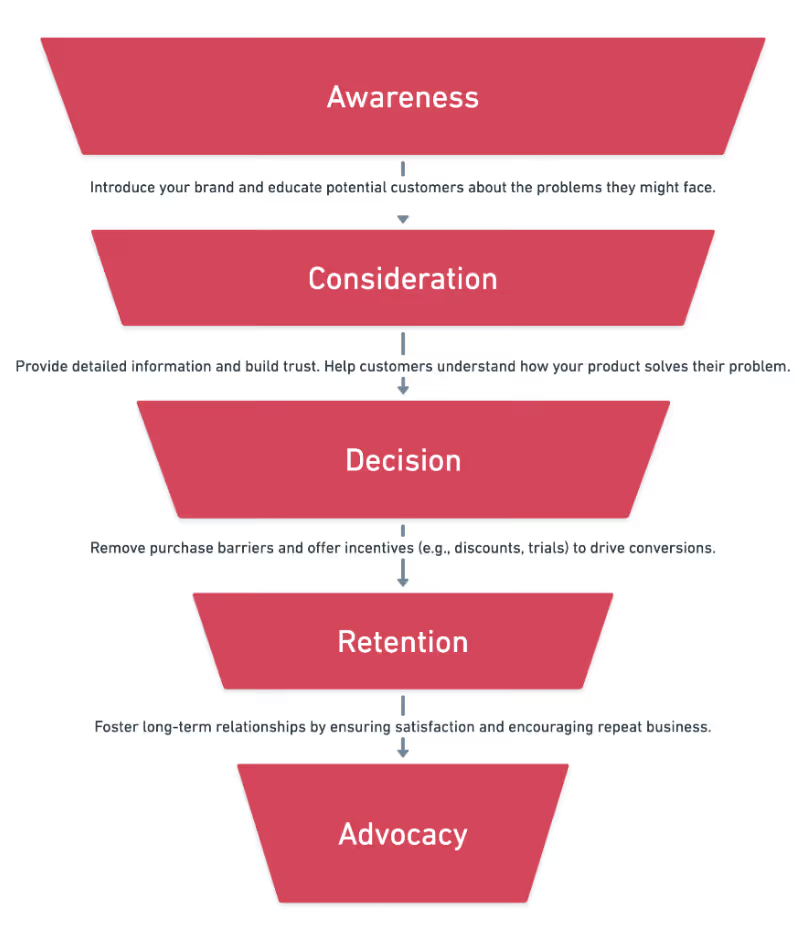
- The customer journey consists of 5 broad stages: Awareness, Consideration, Decision, Retention, and Advocacy.
- Delivering relevant material along each stage ensures that prospects feel understood and valued. This, in turn, contributes to successful journeys and provides practical insights and strategies for each stage.
- Businesses can enhance engagement and build long-term relationships by addressing customer needs and behaviors throughout the journey.
- Factors.ai connects the dots across campaigns, websites, and CRM to map the customer journey using path analysis and account timelines.
- Whether you call them customer journey stages, phases, or lifecycle steps — the framework applies to any business model.
Customer journey stages are the distinct phases a buyer moves through when interacting with a brand — from first discovering a need (Awareness), to evaluating solutions (Consideration), making a purchase (Decision), continuing to engage (Retention), and recommending the brand to others (Advocacy). Mapping these stages helps businesses optimize touchpoints, reduce friction, and drive conversions at every step.
Customer centricity is at the heart of a successful business. Delivering value to buyers at every customer journey stage drives sales conversions and retention. This, however, is easier said than done — especially in the case of B2B customer journeys.
Understanding the customer journey is crucial for modern marketing and sales strategies. With evolving customer behaviors and preferences, it's essential to adapt and refine approaches to address the complexities of how customers interact with brands.
This journey is no longer a straightforward path but a complex, often non-linear process. To effectively engage with potential customers, businesses need to grasp the intricacies of each stage, especially awareness, consideration, and decision. This blog explains these customer journey phases, offering practical insights and strategies based on current industry understanding and research.
The Evolution of Customer Journey Stages
The B2B sales cycle involves several stakeholders and touch points across campaigns, social media, organic efforts, offline events, and more. A customer journey maps out these interactions to track how and why prospects become paying customers.
Since B2B sales cycles tend to be lengthy, non-linear experiences, it can be challenging to map them accurately without the right tools and frameworks.
Learn more about customer journey mapping here: The Complete Guide To Customer Journey Mapping.
Traditionally, the customer journey was viewed as a linear process, with prospects moving through clearly defined stages: awareness, consideration, and decision. However, modern perspectives reflect a more nuanced view. Today's customers might navigate through these stages in a circular or even chaotic manner, reflecting the complexities of contemporary decision-making.
According to Gartner, only 17% of a customer journey is spent directly conversing with the vendor. The remaining 83% takes place through independent research and internal deliberation. Hence, businesses must distribute relevant value at each journey stage — even outside discovery sessions and demo calls.
Common Customer Journey Stage Models
Different frameworks use varying numbers of stages. Here's how the most popular models compare:
ModelStagesBest For3-Stage ModelAwareness → Consideration → DecisionSimple sales funnels, quick purchase cycles5-Stage ModelAwareness → Consideration → Decision → Retention → AdvocacyMost B2B and B2C businesses (recommended)7-Stage ModelAwareness → Interest → Consideration → Intent → Evaluation → Purchase → LoyaltyEnterprise B2B with complex buying committees
The 5-stage model is the most widely adopted because it balances simplicity with completeness, covering both pre-purchase and post-purchase experiences.
Understanding the Awareness Stage
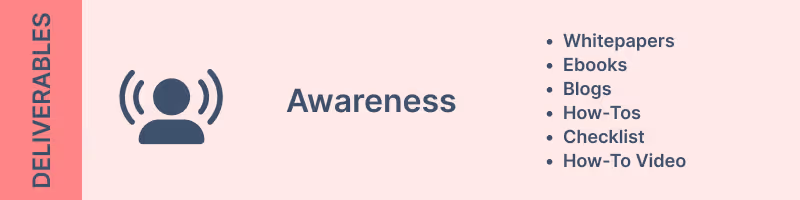
The awareness stage is where the customer journey begins. At this point, potential customers become aware of a problem or need but have not started actively seeking solutions. It's crucial to recognize that potential customers need help understanding the scope or urgency of their issue during this stage. They may be exploring general trends or innovations without a clear sense of how these relate to their specific needs.
Customers in the awareness stage primarily gather information. They might browse blogs, read articles, and engage with introductory content. Marketing efforts in this stage should focus on educational content that introduces customers to new concepts or challenges. Content such as informative blog posts, eBooks, webinars, and automated AI Phone Calls can effectively capture their interest by delivering personalized voice messages that highlight relevant industry challenges, complementing email campaigns for a cohesive multi-channel engagement strategy.
Transitioning to the Consideration Stage
As customers move from awareness to consideration, they start recognizing the need for a solution. This transition is often triggered by an internal realization, such as remembering the inefficiency of current processes or the impact of emerging trends. This is a critical phase for businesses where prospects evaluate various solutions to address their identified needs.
During the consideration phase, customers will likely seek detailed information about potential solutions. They will look for case studies, ROI calculators, and in-depth product details to compare options. Effective marketing strategies during this phase should provide comprehensive resources that assist decision-making. This includes offering detailed product descriptions, customer testimonials, and interactive tools that help prospects understand the benefits and value of different solutions.
A few questions to ask here would be:
- Is the value of my product easy to grasp?
- Can people find my business without hassle?
- How does my product compare against competitors in terms of pricing and features?
- What is my unique selling point to convince buyers to pick me over the competition?
At this stage, it's important to highlight why your product outshines the others with relevant case studies, product webinars, FAQ documentation, and more.

Navigating the Decision-Making Process
The decision stage is where customers are ready to finalize their purchase. At this point, they compare different solutions and make a final choice. However, it's important to note that the decision-making process is sometimes linear. Customers may revisit earlier stages if they encounter new information or if internal factors, such as budget constraints or organizational changes, influence their decision.
The decision stage involves evaluating competitors and making a purchase decision. Marketing efforts should be geared towards removing any final obstacles to purchase. This includes providing clear pricing information, offering competitive comparisons, and addressing any lingering objections. Strong calls to action and easy-to-navigate purchasing processes can significantly impact the final decision.
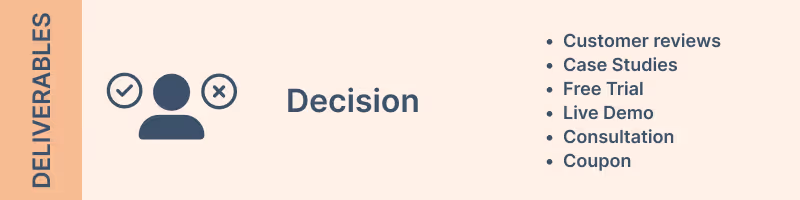
Circular and Non-Linear Customer Journeys
Modern customer journeys are often circular or iterative rather than strictly linear. Customers might revisit earlier stages as they gather more information or reassess their needs. HubSpot supports this perspective, noting that the customer journey can involve looping back to previous stages, reflecting the dynamic nature of modern decision-making.
To effectively manage this non-linear journey, businesses must be adaptable and responsive. Implementing tools for account scoring and path analysis can help identify where prospects are in their journey and adjust marketing strategies accordingly. For instance, if a prospect shows renewed interest in a particular product feature, it may indicate a return to the consideration phase.
Key Customer Journey Touchpoints at Each Stage
A customer journey touchpoint is any interaction a buyer has with your brand. Identifying touchpoints at each stage helps you optimize the experience:
- Awareness: Google search results, social media ads, blog posts, podcast mentions, industry events.
- Consideration: Product pages, comparison articles, webinars, email nurture sequences, G2/Capterra reviews.
- Decision: Pricing pages, free trial sign-ups, demo calls, proposal documents, contract negotiations.
- Retention: Onboarding emails, in-app guidance, customer support tickets, QBRs, product updates.
- Advocacy: Referral program invitations, review requests, case study interviews, community forums.
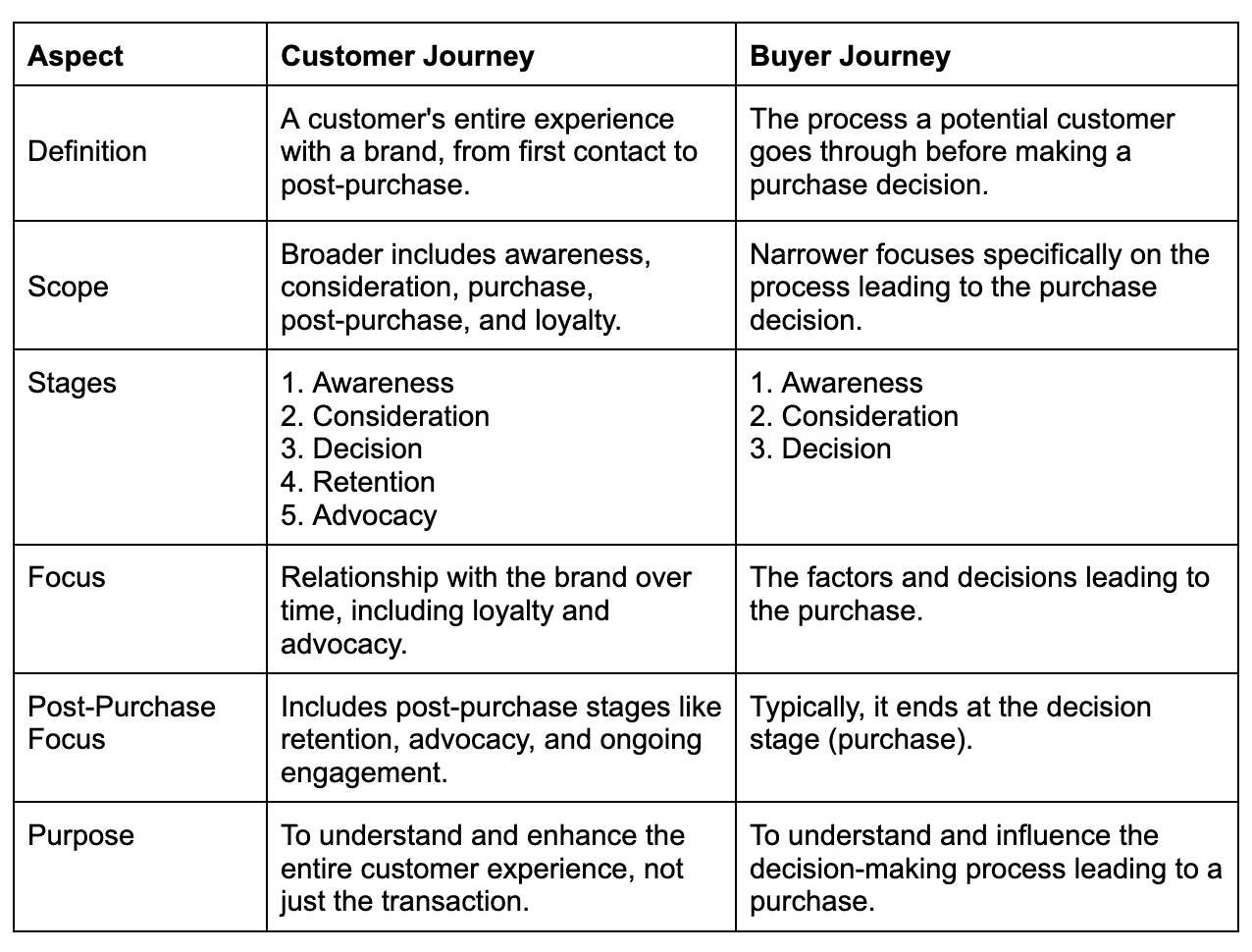
Customer Journey vs. Buyer Journey
The customer and buyer journeys are both essential concepts in marketing and sales, but they refer to slightly different processes. Here's a breakdown:
Leveraging Customer Feedback and Data
Collecting and integrating customer feedback is crucial for refining the customer journey. Feedback at various stages provides valuable insights into customer needs and preferences. By incorporating this feedback, businesses can better align their marketing strategies with customer expectations and improve overall engagement.
Implementing tools for feedback collection, such as surveys and user reviews, can help businesses understand pain points and areas for improvement. Regularly analyzing this data allows for continuous optimization of marketing efforts and enhances the overall customer experience.
Enhance Customer Experience with Personalization
Personalization plays a vital role in managing the customer journey effectively. Tailoring content and interactions based on customer behavior and preferences can significantly enhance engagement. Using data to personalize email campaigns, website content, and product recommendations can create a more relevant and engaging customer experience.
Personalization should be based on insights gained from customer interactions and feedback. Data analytics involves understanding customer behavior, preferences, and pain points. Personalized content can address specific needs and concerns, making it more likely to resonate with the target audience.
The Role of Technology in Managing the Customer Journey
Technology plays a significant role in managing and optimizing the customer journey. Customer relationship management (CRM) systems, marketing automation tools, and analytics platforms are essential for tracking and analyzing customer interactions. These tools can provide valuable insights into customer behavior, preferences, and engagement patterns.
Implementing CRM systems allows businesses to manage customer relationships more effectively by tracking interactions, managing leads, and analyzing data. Marketing automation tools can streamline communication, and nurture leads through personalized content and targeted campaigns. Analytics platforms provide insights into customer behavior, helping businesses make data-driven decisions and optimize their marketing strategies.
Integrating Omnichannel Marketing for a Seamless Journey
In today's digital age, customers interact with brands across multiple channels. Integrating an omnichannel marketing approach ensures a seamless and consistent experience throughout the customer journey. This involves unifying marketing efforts across various platforms such as social media, email, and in-store experiences.
An effective omnichannel strategy involves synchronizing marketing messages and ensuring that customer interactions are consistent regardless of the channel. This enhances the customer experience and provides a holistic view of customer behavior, enabling better decision-making and more personalized interactions.
Difference Between Customer Journey and Sales Funnels
While the customer journey and sales funnel are often used interchangeably, they represent different aspects of the purchasing process.
The sales funnel is a linear model that outlines a customer's stages, from awareness to purchase. It typically includes stages such as awareness, interest, decision, and action. The funnel model focuses on guiding customers through a sequence of steps toward a final conversion. It's a valuable tool for visualizing and managing the sales process but can oversimplify the complexity of modern customer interactions.
In contrast, the customer journey is a broader concept encompassing all customer interactions with a brand, from initial contact to post-purchase experiences. It acknowledges that customer interactions are not always linear and may involve multiple touchpoints and feedback loops. The customer journey model emphasizes the importance of understanding and optimizing the entire experience, including emotional and contextual factors, rather than just focusing on driving conversions.
The Importance of Customer Journey Mapping
Customer journey mapping is a valuable tool for visualizing the customer experience. It helps businesses understand customers' various touchpoints and interactions with the brand. By mapping out the customer journey, companies can identify potential pain points and opportunities for improvement.
Creating detailed customer journey maps is essential to gain insights into customer behavior and preferences. These maps should include all journey stages, from initial awareness to post-purchase interactions. Regularly updating and analyzing these maps allows businesses to stay attuned to evolving customer needs and optimize their marketing strategies.
Tracking Customer Journey Maps with Factors.ai
Factors.ai provides a robust platform for tracking and analyzing customer journey maps. This tool offers valuable insights into customer behavior, preferences, and interactions across various touchpoints.
With Factors.ai, you can:
- Visualize Customer Journeys
Create detailed maps illustrating how customers interact with your brand through different stages. This visualization helps identify critical touchpoints and understand the overall customer experience.
- Analyze Customer Behavior
Track customer actions, preferences, and engagement patterns. Factors.ai provides data-driven insights that inform your marketing and sales strategies, allowing you to tailor your approach based on actual customer behavior.
- Optimize Touchpoints
Use the insights gained from journey maps to optimize customer touchpoints and enhance the overall experience. Factors.ai enables you to identify pain points and improvement areas, helping you refine your strategies for better results.
- Measure Impact
Assess the impact of interactions and touchpoints on customer satisfaction and conversion rates. Factors.ai offers tools to measure the effectiveness of your efforts and make data-driven decisions to drive better outcomes.
By leveraging Factors.ai, you can better understand the customer journey and make informed decisions to enhance engagement and drive success.
Building Long-Term Customer Relationships
The end goal of managing the customer journey effectively is building long-term customer relationships. This involves facilitating a smooth journey from awareness to a decision and ensuring ongoing engagement and satisfaction post-purchase. Loyalty programs, personalized follow-ups, and excellent customer service are crucial to fostering long-term relationships.
Post-purchase engagement is crucial for maintaining customer loyalty and encouraging repeat business. This can include sending personalized thank-you emails, offering exclusive discounts, and providing excellent customer support. Companies can turn satisfied customers into brand advocates who contribute to long-term success by continuously nurturing customer relationships.
Optimize Your Customer Journey for Better Conversions
Understanding and optimizing the five stages of the customer journey - Awareness, Consideration, Decision, Retention, and Advocacy - can significantly impact customer engagement and business growth.
Here's how:
1. Awareness: Educate potential customers with valuable content that addresses their pain points and introduces your brand.
2. Consideration: Provide in-depth solution comparisons, case studies, and testimonials to help prospects evaluate their options.
3. Decision: Ensure a seamless purchasing experience with clear pricing, demos, and a frictionless checkout process.
4. Retention: Build long-term relationships with personalized engagement, exceptional customer support, and loyalty programs.
5. Advocacy: Turn satisfied customers into brand advocates by encouraging reviews, referrals, and community engagement.
By refining each stage, businesses can enhance customer experiences, increase conversions, and drive sustainable growth.
Best Practices and Content Examples for Each Customer Journey Stage
Here are actionable best practices and content types that work at each stage of the customer journey:
Awareness Stage Best Practices
- Create educational blog posts that address common pain points and industry trends.
- Invest in SEO and social media to increase organic visibility.
- Content types: Blog articles, infographics, short videos, social media posts, podcasts.
Consideration Stage Best Practices
- Provide detailed product comparisons and use-case breakdowns.
- Share customer testimonials and case studies that show measurable results.
- Content types: Whitepapers, webinars, comparison guides, ROI calculators, product demos.
Decision Stage Best Practices
- Remove purchase friction with clear pricing, free trials, and transparent terms.
- Address final objections through FAQs, live chat, and sales enablement content.
- Content types: Pricing pages, free trial offers, case studies, product tours.
Retention Stage Best Practices
- Onboard new customers proactively with guided tutorials and dedicated support.
- Use personalized follow-ups and check-ins to maintain engagement.
- Content types: Onboarding emails, knowledge base articles, product update announcements, NPS surveys.
Advocacy Stage Best Practices
- Launch referral programs that reward customers for bringing in new business.
- Encourage reviews and user-generated content on third-party platforms.
- Content types: Referral incentives, review request emails, community forums, co-marketing spotlights.
B2B vs B2C Customer Journey Stages: Key Differences
While both B2B and B2C journeys follow the same five stages, the dynamics differ significantly:
FactorB2B Customer JourneyB2C Customer JourneyDecision MakersMultiple stakeholders (buying committee of 6-10 people)Usually 1-2 individualsSales Cycle LengthWeeks to months (average 3-6 months)Minutes to daysPurchase MotivationROI, efficiency, business outcomesPersonal need, desire, convenienceContent NeededCase studies, ROI calculators, whitepapers, demosReviews, social proof, product videosConsideration DepthDeep research, vendor comparisons, internal deliberationQuick comparisons, impulse-drivenRetention FocusAccount management, QBRs, success plansLoyalty programs, personalized offersAdvocacy ChannelCase studies, G2/Capterra reviews, referralsSocial media sharing, word-of-mouth
According to Gartner, only 17% of a B2B customer journey is spent directly conversing with vendors — the rest happens through independent research and internal deliberation. This makes content at every stage especially critical for B2B marketers.
What Real Users Say About Customer Journey Mapping
Across SaaS communities and marketing forums, practitioners share candid insights about working with customer journey stages:
- Feedback changes over time: "The same user at the same funnel stage gives completely different feedback at day 1 vs. day 30 of their trial." This highlights why journey stages aren't static — regular reassessment is essential.
- Non-linear is the norm: Marketing teams consistently report that customers loop back between consideration and awareness, especially in B2B where multiple stakeholders enter at different times.
- Mapping is a team sport: Product managers, marketers, and customer success teams all bring different perspectives to journey mapping. The most effective maps are cross-functional.
- Don't over-complicate it: While some frameworks list 7+ stages, many practitioners find that the 5-stage model (Awareness → Advocacy) is the most practical starting point.
In a nutshell
Navigating the modern customer journey requires a comprehensive understanding of the various stages and an adaptable approach to marketing. The transition from awareness to consideration is a critical phase that demands targeted strategies to address evolving customer needs. Businesses can better engage with prospects and drive successful outcomes by focusing on educational content, detailed product information, and practical decision-making support.
Understanding that the customer journey is often non-linear and iterative allows businesses to remain flexible and responsive. By focusing on each stage and addressing your customers' unique needs and behaviors, you can achieve long-term success and foster a positive relationship with your audience.
Factors.ai can help track each stage, from awareness to advocacy. To see Factors.ai in action, book a personalized demo here!
FAQs on 5 Stages Of Customer Journey
1. What is a customer journey, and why is it important for businesses?
The customer journey is the complete experience a customer has with a brand, from the first interaction to post-purchase. It is important because it helps businesses understand customer behaviors and needs at each stage, allowing for better engagement, sales conversions, and long-term relationships.
2. How can businesses track and improve the customer journey?
Businesses can track the customer journey using tools like Factors.ai, which provides insights into customer behavior, engagement patterns, and pain points. By analyzing this data, businesses can optimize touchpoints, improve customer experience, and enhance overall marketing strategies.
3. What are the 5 stages of a customer journey?
The 5 stages of a customer journey are:
- Awareness: The customer recognizes a problem or need.
- Consideration: The customer explores potential solutions.
- Decision: The customer chooses a solution and makes a purchase.
- Retention: The business focuses on keeping the customer satisfied and engaged.
- Advocacy: Satisfied customers recommend the brand to others.
4. What are the 7 steps to map the customer journey?
The 7 steps to map the customer journey are:
- Define your goals — Clarify what you want to achieve (reduce churn, increase conversions, etc.).
- Create buyer personas — Build detailed profiles of your ideal customers.
- Identify all touchpoints — List every interaction point across channels.
- Map the current journey — Document how customers currently move through each stage.
- Identify pain points and gaps — Find where customers drop off or get frustrated.
- Design the ideal journey — Create an optimized path from awareness to advocacy.
- Measure and iterate — Track KPIs and continuously refine the map based on data.
Tools like Factors.ai can help automate steps 3-5 by tracking customer interactions across campaigns, websites, and CRM systems.
5. What are the 5 stages of the customer lifecycle?
The 5 stages of the customer lifecycle are Reach, Acquisition, Conversion, Retention, and Loyalty. While similar to customer journey stages, the lifecycle focuses more on the business perspective — how companies attract, convert, and retain customers over time. The customer journey, by contrast, maps the buyer's experience and emotions at each stage. Both frameworks complement each other: the lifecycle helps businesses plan strategy, while the journey map helps optimize the customer experience.
6. How do you measure success at each customer journey stage?
Key metrics for each stage include:
- Awareness: Website traffic, social impressions, branded search volume, share of voice.
- Consideration: Time on page, content downloads, email open rates, webinar attendance.
- Decision: Conversion rate, demo-to-close ratio, average deal size, sales cycle length.
- Retention: Churn rate, Net Promoter Score (NPS), customer satisfaction (CSAT), product adoption rate.
- Advocacy: Referral rate, review count, customer lifetime value (CLV), social mentions.
.avif)
Streamline LinkedIn Ads Management: Campaign Automation
Streamline ads management and efficiency with Factors' AdPilot, specifically Campaign Automation.
Managing LinkedIn campaigns manually can be daunting and inefficient. Traditional methods include loading audiences, approving budgets, and designing campaigns, which take time and effort. Our audit of multiple ads showed a need for better-balanced ad distribution, with marketers having limited control over this process. This lack of control can result in poorly optimized campaigns and less-than-ideal outcomes on LinkedIn.
Our new LinkedIn AdPilot's ‘Campaign Automation’ helps marketers regain some of this much-needed control. It streamlines LinkedIn ads management, ensuring precision, efficiency, and ROI. Factors’ automated, intent-based campaign management enhances LinkedIn ad performance by 20-30%.
The Challenge
Issues with Manual Campaign Management
Manually managing LinkedIn campaigns has several challenges. It consumes valuable time and organizational resources inefficiently.
Marketers spend hours uploading audiences, setting budgets, and designing campaigns, only to face challenges in optimally distributing ad impressions. This results in wasted budgets, as impressions may be concentrated on a few accounts or directed toward those not yet interested or prepared to convert.
These inefficiencies limit campaign potential, causing marketers to miss opportunities to engage high-intent prospects. Consequently, this leads to missed conversion opportunities and diminished overall performance.
Introducing LinkedIn Campaign Automation
Overview of AdPilot and Campaign Automation
Factors' AdPilot introduces Campaign Automation to tackle manual campaign management inefficiencies. It automates ad impression distribution based on intent, ensuring ads reach relevant audiences without a few companies monopolizing impressions.
This feature offers key benefits, including enhanced efficiency, precision targeting, and better budget allocation.
Campaign Automation is set to change the way LinkedIn ads are managed. It directs ad impressions to high-potential prospects actively seeking solutions. This reduces wasted impressions and ensures that every ad dollar is spent effectively.
Use-cases
Optimized Ad Impression Distribution
Campaign Automation directs ad impressions to high-intent, in-market buyers, minimizing wasted impressions. It enables precise targeting of prospects actively seeking solutions and optimizes ad budgets for maximum ROI by focusing spending on high-potential leads.

to high-intent and in-market buyers.

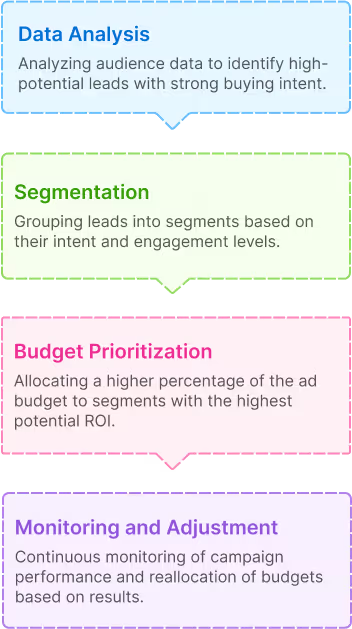
Frequency Capping Control
Our audit of over 100+ LinkedIn ad accounts found that the top 10% of companies in your target audience will likely take up 80% of the impressions. However, with the Campaign Automation feature’s intent-based ad distribution, our customers have seen lower CPMs, higher CPRs, and a lower cost per lead.
Sales and Marketing Alignment
This capability directs ad budgets towards high-intent accounts, increasing the sales team's success rate. As companies engage with sales, they automatically receive more impressions on LinkedIn, enhancing conversion potential. This capability ensures campaigns are optimized in tandem with sales efforts rather than operating in isolation.
Time and Resource Efficiency
Automating campaign management liberates marketers' time and helps them prioritize strategic tasks over manual adjustments. Campaign Automation handles routine tasks such as audience targeting and budget adjustments. It lets teams focus on crafting compelling content and refining overall strategy. This streamlined workflow boosts productivity and improves campaign effectiveness.
In a nutshell
Campaign Automation overcomes the challenges of manual ad management. It ensures optimized targeting, efficient budget allocation, and enhanced productivity. The use cases demonstrate the impact of this feature on LinkedIn ad campaigns
Ready to elevate your LinkedIn campaigns? Leverage Campaign Automation to ensure optimal performance and ROI. Contact us today to learn more about AdPilot and how our Campaign Automation feature can revolutionize your LinkedIn ad management.

Supermetrics: Features, Alternatives & more
Explore Supermetrics and its features, discover alternatives, and make an informed decision. Streamline your data analytics and reporting with this blog.

In recent blog posts, we’ve talked about marketing analytics, why they are important for your business, and which marketing analytics tools you should be tracking depending on certain business goals. But gaining data insights is only the second step in the process.
Before you derive insights from your firm’s multiple sources of data from different vendors, be it through reports or visualizations, bridging the gap between data collection and clean data insights is essential.
Here’s an example - you’re a marketing and advertising firm that receives a ton of data from multiple vendors and clients, all of which send their data using different methods of data collection and sorting. Standardizing all these reports and graphs can be an exhausting task, taking up precious time and resources.
Don’t you wish you had a tool that could help you integrate multiple data sources into a single platform that you could then use for cutting-edge insights?
Enter: Supermetrics.
While this tool works quite differently from standard analytics tools such as Google Analytics, it’s been widely used and recommended by B2B firms and their marketing teams - simply because it simplifies the process of having to manually transfer data from multiple sheets and files into a single actionable platform for better analysis.
{{INLINE_CTA_A}}
Supermetrics Features
Supermetrics, if defined simply, is a data-automation tool that allows you to pull data from various sources (such as social media platforms, Google Adwords, and Google Analytics) and feed it into a platform that can help with data organization and insights, such as MS Excel, Google Data Studio, etc.).
The reason why Supermetrics has proven to be a popular and seamless platform is to bridge the gaps between data and database/analytics software. Let’s now take a look at some of the features Supermetrics is best known for -
1. Eliminate the need for manual copy-and-paste
When we talk about B2B company data, we’re not talking about a couple of Excel sheets, but an enormous amount of data from multiple platforms that the brand uses. Ideally, a B2B brand establishes its presence on various platforms such as Linkedin, Instagram, Google Ads, and Twitter Campaigns, to name a few.
Above all, it can be extremely tricky to ensure that all of the data pulled from these platforms is regularly updated, to avoid any snags or data errors while feeding it for data insights or performance reports. Supermetrics helps with exactly that. Once you set up your Supermetrics account, it automatically starts gathering data and pasting it into any tool you opt for analytics, such as Excel or Google Data Studio.
Be it weekly or yearly reports, Supermetrics makes sure you spend a lot less time on the grunt work, and utilize that time to better study and understand the data the tool has pulled, resulting in better, actionable insights.
Pull data from hundreds of sites and platforms
One of the biggest advantages of Supermetrics is that it can pull data from multiple sources in a matter of seconds, and create reports that otherwise would have taken days to prepare. Here are a few of the sites and platforms that Supermetrics can set up to pull data from daily
- Facebook Ads
- Google Ads
- Criteo
- Taboola.
- Linkedin Ad Campaigns
- Twitter Ad Campaigns
- Hubspot
And on the other side of the process, here are the platforms that Supermetrics feeds your data into so that you can immediately create reports, sort, filter, and study reports from the data that you no longer have to manually grab and drop from the channels mentioned above.
- MS Excel
- Snowflake
- Google Sheets
- Google Data Studio
- API
- BigQuery
3. Marketing Data Visualization
Once Supermetrics has pulled data from one platform, it feeds it into another. However, while doing so, it creates visualizations that can be customized according to the brand’s needs.
For example, if you feed data from your Google AdWords campaign into an Excel spreadsheet, Supermetrics will automatically convert your campaign performance data into line charts, bar graphs, and or plotted graphs, according to your needs. In the event of updated data, the platform immediately updates its visualizations, instead of you having to manually update your database every time there’s an update or change.
Apart from these features, Supermetrics is commonly used to track PPC campaign data across various platforms and create automated reports that can be fed into brand new presentation software such as Microsoft PowerPoint, eliminating quite a lot of manual effort.
Limitations with Supermetrics
Just as any other analytics or data-grabbing software, Supermetrics comes with its pros and cons. Before making a choice, it is important to know all of these pros and cons, so that you can align your brand needs with the features of the software, and make an informed decision.
1. No clean-ups for marketing data errors
We talked about how Supermetrics can pull data from hundreds of platforms in one click, and regularly update the database platform you’ve chosen for insights. But if you have to ensure that all your data is clean and filtered through regularly for errors, you might just have to do that manually.
Supermetrics as a platform does not help weed out any data errors. All it does is pull data from one platform, paste it onto another, and create visualizations for the data received. Platforms like ChannelMix help set up rules and conditions for data grabbing, so that all of your data passes through a certain filter, ensuring a slim chance of data errors in your final reports.
2. Unintuitive marketing analytics software
While Supermetrics as a tool is extremely useful, learning how to navigate through the platform and use its features according to your brand needs can be a bit tricky.
Lots of user reviews state how steep the learning curve is for Supermetrics, and that learning how to integrate Supermetrics with multiple sites can be quite time-consuming and difficult.
3. Lack of scalability
An important distinction one must make is that while Supermetrics is an excellent data-grabber, it does not provide any services for long-term data storage, unlike data warehouses. In the event that your brand wants to scale up, or derive long-term insights from past data, it may be time to consider another tool.
The reason behind this limitation is that Supermetrics is simply concerned with pulling and feeding data from one platform to another. It does not focus on long-term data storage that multiple teams in your organization can focus on.
It might be easy in the short term to set up a data warehouse with Supermetrics, but since the warehouse is not part of the product itself, you’ll spend a lot more time, money, and effort trying to maintain and update the warehouse from time to time.
4. Supermetrics pricing
A make-or-break factor for many organizations, the cost is one of the features where Supermetrics falls short when compared to other data-grabbing tools. To ensure you pay for the service you need, and don’t end up paying more than your budget allocates, make sure to check out the pricing page on Supermetrics’s website, compare their pricing with other tools, and book a free trial of the tool so that you know exactly what you’re paying for if you choose to opt for Supermetrics in the future.
{{INLINE_CTA_A}}
How Does Factors Help with B2B marketing analytics and revenue attribution?
1. Data-Grabbing and Insights across the customer journey
While Supermetrics is a data-grabbing tool, a robust marketing effort needs more than just data-grabbing. While Supermetrics is a connector, simply relying on such a software tool does not provide a comprehensive viewpoint that you can use to optimize your efforts. Factors, apart from pulling data from multiple sites and platforms, helps analyze and optimize efforts with KPI reporting, customer journey funnels, and revenue attribution, to name a few.. helps with connecting the data you’ve pulled and shows you just how much value and traffic each of your channels is bringing in.
While data-grabbing is an excellent way to understand the trends in channel performance, Factors help understand why a source/platform performed as well as it did, and how you can use those insights to build a better marketing strategy.
2. Customizable Attribution Modeling
Just as every business has its own goals and needs, keeping a close eye on the channels and platforms that can help you get there is essential. While pulling in data from multiple sources, it can be difficult and time-consuming to figure out which source is bringing in the most profitable audience, and which source(s) need more work.
With Factors’ customizable attribution model, you can select to track and study your sales pipeline the way you want to, according to your goals. To read more about attribution and why you need to use it in your B2B marketing strategy, visit our Blog section!
3. Cost Effectiveness
The Factors pricing model is built for all types and sizes of teams so that you pay only for the services you need, based on your team size. Cost-effectiveness is a make-or-break factor for many brands, and not choosing the right tool for the right price does more harm than good in the long term.
4. User-friendly interface
One of the biggest advantages Factors holds over Supermetrics is how easy it is to use, even if you’re just starting in the world of analytics and data insights. Our interface is created keeping the customer in mind and can be picked up quite easily.
While Supermetrics simplifies data integration, alternatives offer more advanced features for comprehensive data management.
1. Key Alternatives: Look for platforms that provide automatic data normalization and analytics-ready structures.
2. Enhanced Features: Seek solutions that offer transformation capabilities, not just integration.
3. Strategic Benefits: Platforms that scale with your tech stack ensure seamless growth and data insights.
Choosing the right tool goes beyond integration, opt for solutions that enhance data usability and support long-term scalability.
Wrapping Up
There are hundreds of analytics and data-grabbing tools that you might opt for for your B2B brand. However, understanding what your brand needs are, your ideal budget, the time allotted to learning the software, and the quality of insights gained with the help of your chosen software are all factors you should keep in mind while opting for a tool.
{{INLINE_CTA_A}}

SEO Content Strategy: From Rankings to Revenue
Discover proven strategies, structures, and examples for SEO content that drives traffic, intent, and pipeline growth, with a B2B focus.

TL;DR: Building SEO Content That Drives Pipeline
- Intent beats keywords. Create content that matches where buyers are in their journey, not just what has high search volume.
- Use proven structure. Hook with a problem, add context, deliver value, guide to next steps. Make it scannable.
- Build content clusters. Create pillar posts around core ICP problems with supporting deep-dives. Interlink strategically.
- AI assists, humans create. Use AI for research and structure, but keep insights and originality human. Google spots generic content.
- Measure pipeline, not traffic. Track which content drives MQLs, SQLs, and opportunities. Attribution reveals what actually generates revenue.
- Update old winners. Historical optimization beats creating new mediocre content. Refresh your best-performing posts regularly.
- Learn from the best. HubSpot educates constantly. Semrush certifies expertise. Slack meets audiences everywhere with repurposed content.
The Shift from Keywords to Intent
Just when everyone thought they’d mastered SEO with perfect keyword research, flawless meta descriptions, and internal links organized like subway maps… rankings tanked. And instead of adapting, most people doubled down. It’s like Ross yelling “PIVOT!” while everyone pretends not to hear.

“SEO driven content” somehow became code for “stuff as many target keywords as we can!” Teams obsessed over keyword density and meta tags, forgetting one small detail: actual humans have to read this.
Most teams chase volume. “This keyword gets 10,000 searches a month!” Great. But how many of those 10,000 people would ever buy from you? Or are they just window shoppers doomscrolling their time away between meetings?
Here’s the uncomfortable truth, organic traffic alone doesn’t cut it anymore. You need the right kind of traffic. The kind that turns into a robust pipeline. The kind that eventually signs contracts.
Why Great Content Wins SEO
SEO without great content is like a storefront with no products. You might get people to show up, but they'll leave empty-handed.
Today search engines reward originality, depth, and relevance. Google's algorithms, thanks to BERT, MUM and SGE, have gotten scary good at understanding what people actually want, not just what they type into the search bar. That means your content needs to do more than hit keyword targets. It needs to solve problems, provide genuine insights, and align perfectly with user intent.
Say someone searches for “marketing automation platforms.” Who are they, really?
A junior marketer who just heard the term for the first time? A marketing director comparing tools? A VP ready to book demos?
Same search. Totally different intent. Completely different content needed.
Think about your own search queries. When you Google “best project management tool,” you’re not looking for a history lesson. You probably want to understand the best possible tools out there, their features, pricing, pros, and cons.
Growth-focused teams already know that SEO-led content marketing isn't just a traffic play anymore. It's a revenue play. The right content doesn't just bring visitors, it brings qualified accounts into the pipeline.
So, stop asking, “What keyword should I target?” Start asking, “What is this person actually trying to understand/know, and how can I help them do it better than others?”
That’s how you win. With a better understanding of your target audience’s intent.
⚡Quick Read: How To Build Your Ideal Customer Profile In 15 Steps (2025)
What Actually Makes SEO Content Work
High-performing content follows a pattern. Not because marketers love formulas (though we do), but because this matches how real humans read online.
Let’s break this SEO version of the Quadratic formula down:
- The Hook + Pain Point Opening
Start by calling out a problem your reader actually has. Skip the "in this post, we'll explore..." nonsense. Get specific about what hurts. - The Context
Answer the "why now?" question. What shifted? Why does this matter today and not six months ago? This keeps people reading instead of bouncing to TikTok. - The Value
Time to deliver. Give people insights, frameworks, examples, real data (use external links). Show them how things work, not just what to do. This is where you earn your keep. - Next Steps
Point people somewhere useful. Another resource, a tool, or just a conversation. Don't leave them hanging like a bad Tinder date.
What Separates Good Content from Great
Internal Linking Strategy
Content clusters around core topics build topical authority. Create multiple pieces that connect around a central theme. You're showing search engines you own this topic. Think of a pillar post on "B2B content marketing strategy" linking to pieces on distribution channels, measurement frameworks, and content formats. It’s like trying to spot Ursa Major on a cloudy night, technically part of the job, but not exactly edge-of-your-seat stuff.
Scannable Formatting
Subheadings every 200-300 words. Short paragraphs. Bullet points for lists (but regular sentences for explanations, please). Most people skim first. Earn their attention, then they'll read deeply.
Finally, On-page SEO ties all these elements together by structuring and linking your content for maximum visibility and user engagement.
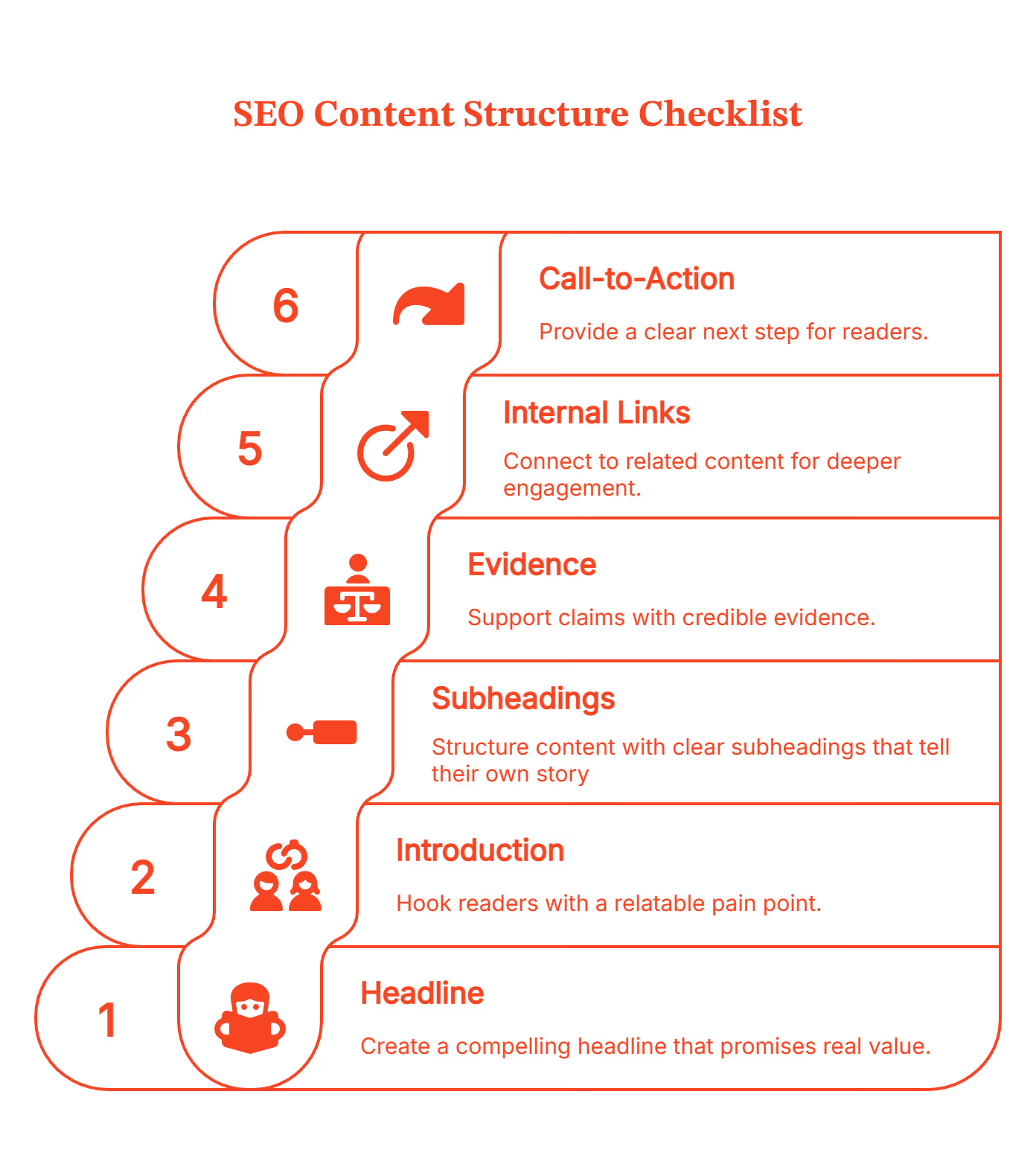
➕Also Read: Step-by-Step Guide to SaaS Content Marketing
Real-World SEO Content Examples (and What They Teach Us)
Right, let's look at some brands that actually get content AND seo right. Here’s what’s actually working out there.
- HubSpot: Practice What You Preach
The Setup:
HubSpot literally invented the term "inbound marketing." So if their content wasn’t killer, that'd be awkward, wouldn't it? They couldn't exactly sell inbound marketing software while doing outbound spam. They had to walk the walk.
What They Did:
Started with a simple realization: their customers couldn't use inbound marketing effectively if they didn't understand the fundamentals. So they created a blog. Then another blog. Then separated blogs by niche: marketing, sales, service, website design. Each with its own audience persona.
But here's the clever bit, instead of just creating more content, they implemented "historical optimization" constantly updating old content to keep it relevant and ranking. Have a look here:
Source: Hubspot
They also built HubSpot Academy with free certifications. The courses teach you marketing concepts, then you practice with HubSpot tools. Smart, right? You learn for free, experience the product firsthand, and if it works... well, converting to paid suddenly makes sense.
Why It Works:
They're not pushing products. They're building credibility. Their content educates first, sells second (or third, or not at all). By consistently creating valuable and authoritative content, they earn quality backlinks from other reputable sites, further boosting their authority and search engine rankings. When you become the trusted guide, people come to you when they're ready to buy.
The Lesson:
Stop selling. Start guiding and establishing your topical authority. And please update your old winners, they're sitting there collecting dust when they could be collecting conversions.
- Semrush: Be the Resource, Not Just the Tool
The Setup:
Semrush is an SEO tool. So is Ahrefs. And Moz. And about 100 others. In a crowded market, how do you stand out?
What They Did:
They realized not everyone visiting their site is an SEO analyst with years of experience. Some are marketers who barely understand what a meta description is. Instead of assuming expertise, Semrush created an entire education ecosystem.
Free courses on technical SEO, keyword research, content strategy, with certificates you can actually put on your LinkedIn. And here's the genius move: the courses teach a bunch of these topics using demos of Semrush. You learn real skills, while subconsciously familiarizing yourself with the tool.
They also partnered with industry heavyweights like Brian Dean and Greg Gifford as course instructors. Borrowed authority used right.
Why It Works:
They're a one-stop shop. Learn SEO and get the tools to implement it. They've positioned themselves as thought leaders, not just software vendors. When you teach someone a skill, they associate that competence with your brand.
Plus, those certifications? Free resume boosters. People share them on social media, which is basically free marketing.
The Lesson:
Turn your expertise into credentials people actually want. And if you can borrow authority from industry leaders to teach your courses? Even better. You're not just selling software. You're building certified practitioners who already trust your platform.

- Slack: Be Everywhere Your Audience Is
The Setup:
Slack exploded during COVID when everyone suddenly needed remote communication tools. But they didn't just ride the pandemic wave, they built a content strategy that works across every channel.
What They Did:
Cross-platform everything. Blog posts, podcasts, live events, on-demand webinars, and an extremely active social presence. Each piece of content complements the others. Blog posts become Twitter threads. Video tutorials get repurposed as Instagram clips. Podcasts distill complex topics for people who prefer audio.
They live by the motto: ‘Go where your audience goes, even if it's not a common channel.’
Why It Works:
They're platform-agnostic. Your target audience isn't just on LinkedIn or just reading blogs. They're everywhere, consuming different formats depending on context. Slack meets them wherever they are.
And everything connects. A podcast episode references a blog post. A social post drives traffic to a tutorial. It's a content ecosystem executed via a great content management system
The Lesson:
Don't put all your eggs in one basket. Repurpose relentlessly. And stop overthinking which channels are "professional enough" for B2B. If your audience is there, you should be too.
Notice the pattern in all the strategies? None of these are about keyword stuffing or winning algorithms. They're about being genuinely helpful in ways their competitors aren't. They provide valuable content, engage, repurpose, and show up consistently.
HubSpot educates. Semrush certifies. Slack meets you everywhere.
That's what winning seo driven content looks like in 2025. Not tricks. Not hacks. Just relentless commitment to being useful to your target audience.
Scaling SEO Content with AI, Analytics, and Data
AI is changing how teams scale SEO content but let's be clear: it's here to support human creativity, not replace it.
Think of AI as the Sheldon of your content team. A genius with data, pattern-spotting, and structure, but completely hopeless at reading the room. That's why it needs a Leonard: someone who can take all that precision and turn it into content that actually connects. Together, they're unstoppable, as long as you know who should lead the conversation.

The AI Advantage (and Its Limits)
AI tools can turbocharge your workflow. Use them for:
- Topic Ideation: Spot trending searches with tools like Clearscope, MarketMuse, SurferSEO, etc.
- Cluster Mapping: Group related themes automatically, so your strategy doesn't look like a conspiracy wall.
- Optimization: Get real-time readability and keyword suggestions.
Google's getting better at identifying AI-generated content that lacks genuine expertise or originality. Your content needs to pass what I call the "unique value test." If your competitor could write something similar with AI, you haven't created real value.
The Data-Driven Edge
The real competitive edge comes from how well you use your existing data and insights.
Here's how you can use analytics to be the brains behind your SEO operation:
Search Trends: Google Trends and Google Search Console to monitor website performance, track SEO rankings and reveal what your target audience actively wants. No more guessing.
CRM Insights: Your sales calls are gold. Real buyer questions, objections, and comparisons. Turn them into content.
But here's where most teams stop short. They track traffic and rankings, then wonder why leadership questions their budget. Organic traffic looks nice in reports. Rankings feel like progress. But if those visitors never become customers, what's the point?
Measuring What Actually Matters
Traditional SEO metrics track rankings, organic search traffic, backlinks. Great. But did revenue grow? Did you close deals?
Modern seo led content marketing connects it to business outcomes. Track which pieces drive qualified accounts, influence deal velocity, and correlate with conversions.
Consider two blog posts:
- Post A: 15,000 visits, #2 ranking, 200 signups → Zero opportunities
- Post B: 800 visits, #8 ranking, 12 opportunities → $380K closed revenue
Traditional metrics pick Post A. Impact metrics reveal Post B drives actual growth.
Stop optimizing for rankings. Optimize for revenue.
Scaling isn't about publishing more. It's about creating better content that stays true to your voice. Use AI for speed, but let humans bring in the creativity, and data bring in the clarity on what's actually working.
How Can Factors Help You?
So you've done the work. Built the clusters. Mapped the intent. Created content value-driven content. Brilliant. Now answer this: which piece drove the deal that closed last week? Can't say? That's the problem. And it's why most content teams spend more time defending their budget than doing their actual job.
Traditional SEO metrics are basically vanity metrics in disguise. "We got 50,000 pageviews this month!" Amazing. Did any of them become customers? "Our blog ranks #1 for this keyword!" Fantastic. Does that keyword bring people who can actually afford your product?
This is where Factors fundamentally changes the conversation.
From Traffic to Pipeline: The Real Metrics
Factors doesn't just tell you which content ranks or how many visits you got. It connects content performance directly to pipeline metrics. You can see which blog posts were visited by accounts that became MQLs, which progressed to SQL, and which created actual opportunities.
Imagine seeing: "This blog post drove 10,000 visits but zero opportunities" versus "This one drove 800 visits and generated 12 opportunities worth $450K in pipeline."
Suddenly your content prioritization becomes crystal clear.
Track Which Content Actually Wins Accounts
Factors tracks content engagement at the account level. You can see which specific assets attract your ideal customer profile accounts and map those interactions directly to pipeline and revenue.
No more guessing which topics resonate with buyers. You'll know exactly which content pieces show up in winning deal journeys versus lost opportunities.
Understanding Your Full Buyer Journey
Factors maps the complete path from anonymous visitor to closed deal. You can see:
- Which accounts visited which content and when
- How buyers move between stages (MQL → SQL → Opportunity → Closed-Won)
- Conversion rates and velocity at each stage
- Where accounts are dropping off and why
- The full sequence of touchpoints that influenced the deal
Cross-Channel Attribution That Actually Works
Here's where most attribution tools fail: they only track one channel at a time. Factors consolidates everything - website visits, ad engagement, sales calls, meetings - into a single dashboard
You can see the complete picture: the account that clicked on your LinkedIn ad, visited three blog posts, downloaded a whitepaper, then requested a demo. Not just fragmented data points, but the actual story of how they discovered and evaluated you.
💡Also read: Understanding Multi-Touch Attribution Models
Beyond First or Last Touch
Traditional attribution models - first touch, last touch - weren't built for complex B2B buyer journeys. Factors gives you complete visibility on every touchpoint that influenced the deal, not just the first or last one.
You'll finally be able to answer questions like: "Which marketing channels contribute most to our highest-value deals?" or "Do accounts that engage with our educational content close faster than those who don't?"
Built for B2B Buying Cycles
Unlike consumer-focused analytics tools, Factors is designed specifically for long, non-linear B2B sales cycles. It tracks at the account level (not just individual users), integrates with your CRM and sales tools, and understands that enterprise deals involve multiple stakeholders across months of evaluation.
To give you the gist
SEO optimized content in 2025 isn't about winning the rankings game. It's about winning the revenue game.
The shift from SEO and keyword optimization to intent-driven strategy isn't optional anymore. You can rank #1 for a hundred keywords and still contribute nothing to your bottom line. Or you can create focused, SEO driven content that brings fewer visitors but generates actual pipeline.
Build content clusters around real ICP problems. Track what drives deals through proper attribution. And update your old content instead of letting it collect digital dust.
The brands winning at SEO led content marketing right now aren't doing anything revolutionary. They're just being consistently useful while everyone else chases vanity metrics.
FAQs for SEO Content Strategy
Q: What's the difference between SEO content and content marketing?
A: SEO content targets search visibility, optimized for keywords and rankings. Content marketing is the broader strategy of creating valuable content across all channels. Best approach? Combine them. Create SEO driven content that ranks in search AND serves your target audience's needs. They're complementary, not separate.
Q: What's the difference between SEO and Search Engine Marketing (SEM)?
A: SEO focuses on organic search rankings through content and optimization. SEM includes both organic SEO and paid search advertising (like Google Ads). Think of it this way: SEO is the long game that compounds over time, while paid search gives immediate visibility. Smart B2B teams use both, paid ads validate topics and drive quick wins, while SEO builds sustainable pipeline without ongoing ad spend.
Q: Has there been a shift in search engine ranking?
A: Absolutely. Google's algorithms (BERT, MUM, SGE) now prioritize search intent over keyword matching. Rankings depend on content depth, user experience, and genuine expertise—not keyword density. The shift moved from "what target keywords can I rank for?" to "what problems can I solve better than competitors?" Quality and intent alignment win over optimization tricks.
Q: What is the ideal structure for a content piece?
A: Hook with a specific pain point, provide context on why it matters now, deliver actionable value (insights, frameworks, examples), and guide to next steps. Use subheadings every 200-300 words, short paragraphs, and scannable formatting. Internal links to related content build topical authority. Make it easy to skim but rewarding to read deeply.
Q: Should I focus on SEO and keyword optimization or user experience first?
A: Both. Write for humans, solve problems clearly. Then optimize: add target keywords naturally, use clear headings, include internal links, make it scannable. Modern seo and keyword optimization means helping search engines understand great content, not tricking them. Google rewards content that genuinely serves users.
Q: How do SEO and social media work together?
A: SEO builds discoverability, social media builds engagement. Repurpose top blog posts into LinkedIn carousels or Twitter threads. Use social signals to identify resonating topics, then create comprehensive blog content around them. Social activity drives brand searches and traffic, which indirectly boosts SEO performance. The integration of SEO and social media amplifies both channels.
Q: How can I scale SEO with AI, analytics, and data?
A: Use AI for topic ideation, keyword clustering, and content outlines. but keep the insights human. Combine three data sources: Search Console (what brings qualified traffic), CRM insights (real buyer questions), and engagement metrics (what resonates). Track which SEO topic categories drive pipeline, not just traffic. Scale based on revenue outcomes, not publishing volume.
Q: How can Factors help you with SEO led content marketing?
A: Factors connects content performance to pipeline metrics. See which blog posts drive MQLs, SQLs, and opportunities, not just pageviews. Track the full buyer journey from content visit to closed deal. Identify which SEO-led content marketing topics attract high-fit accounts versus random traffic. Stop defending budgets with traffic charts; prove value with pipeline reports.

10 Signs Your Sales Process Needs AI Automation Today
Is your sales team overwhelmed or missing leads? Discover 10 signs it’s time to automate your sales process with AI—boost efficiency, conversions, and ROI fast.

TL;DR
- Automation unlocks time: AI eliminates repetitive tasks, freeing reps to focus on high-value sales activities.
- Lead quality improves: Real-time lead scoring and segmentation help target the right prospects faster.
- Communication stays sharp: Automated follow-ups and multilingual support prevent drop-offs and boost engagement.
- Performance becomes visible: With AI-driven analytics, you can track ROI, spot bottlenecks, and scale with confidence.
Sales leaders often see promising leads slip away or watch their teams get stuck with low-value tasks. When your sales process has inefficiencies, conversion rates fall, customer satisfaction drops, and team morale suffers. These problems don't just slow growth; they cost you revenue and market share.
If your sales reps spend more time on data entry than selling, or if follow-ups are missed due to scattered information, you're not alone. The good news? AI sales platforms can now automate routine tasks, provide useful insights, and ensure every lead gets attention at the right time. In this guide, you'll learn the ten clear signs that your sales process needs AI automation and how fixing them can improve your results.
10 Signs Your Sales Process Needs AI Automation
Here are the 10 signs your sales process needs AI automation:
1. Low Conversion Rates and Missed Opportunities
If your sales team faces low conversion rates, manual processes might be the issue. Missed follow-ups, inconsistent outreach, and errors can cause good leads to slip away. When sales reps handle too many tasks, they might overlook top prospects or send messages that don't connect. This not only lowers your close rate but also harms your brand over time.
AI sales platforms can automate follow-ups, personalize communication, and ensure no lead is missed. By analyzing data in real time, AI identifies which prospects are most likely to convert and prompts your team to act at the right moment.
Automated workflows also remove repetitive tasks, allowing your sales reps to focus on building relationships and closing deals. If your pipeline is full but your win rate is low, consider AI automation to capture more opportunities and drive steady growth.
For more insights on improving conversion rates, check out our Funnel Conversion Optimization page.
2. Excessive Time Spent on Repetitive Tasks
When your sales team spends hours on manual data entry, scheduling meetings, or sending routine follow-up emails, it drains productivity and morale. These repetitive tasks take up valuable time and increase the risk of mistakes, leading to missed appointments or incorrect information in your CRM. Over time, this inefficiency can slow down your sales cycle and limit your team’s ability to focus on important activities like building relationships and closing deals.
AI sales platforms automate these time-consuming tasks. They sync data across systems, schedule calls, and send personalized follow-ups. Automation handles each step quickly and accurately. With AI automation, your sales reps gain hours each week, allowing them to focus on strategic conversations and nurture key accounts. If your team is bogged down by repetitive work, it’s a clear sign your sales process needs AI automation to boost efficiency and free up your team for selling.
3. Inconsistent Customer Communication
When your sales team sends mixed messages or misses follow-ups, it can damage trust and hurt your chances of closing deals. This often happens when team members don't have a unified approach or when manual processes cause delays. Prospects might get mixed messages, wait too long for replies, or be forgotten.
AI sales platforms help by automating follow-ups. They ensure each lead gets timely, relevant, and clear communication. Automated workflows send emails, reminders, and updates based on where each prospect is in the sales funnel. This improves the customer experience and helps your team appear professional and reliable. If prospects lose interest or complain about unclear messages, it's a sign your sales process needs AI automation. Consistent, automated outreach keeps leads interested and moves them through your pipeline, increasing your conversion rates.
4. Difficulty Segmenting and Prioritizing Leads
If your sales team finds it hard to spot which leads will likely convert, you're not alone. Guesswork or outdated spreadsheets often guide manual segmentation, wasting time and missing chances. Without clear lead prioritization, your team might spend the same effort on cold leads as on hot prospects, lowering efficiency and sales results.
An AI sales platform can change this process. AI analyzes lead behavior, demographics, and engagement in real time. It automatically segments your database and scores leads based on their likelihood to buy. This lets your team focus on high-priority prospects and tailor outreach for each segment. As a result, you'll see better conversion rates and a more predictable pipeline.
If you still rely on manual lists or intuition to prioritize leads, it's a sign your sales process needs AI automation. With smarter segmentation, your team can work more strategically and close more deals with less effort. Explore our Account Intelligence for more details.
5. Poor Tracking of Sales ROI and Performance
Many sales teams find it hard to measure the real impact of their activities. They often use scattered spreadsheets, manual data entry, or outdated tools, which makes it tough to see what works and what doesn’t. This lack of clarity can waste resources, miss revenue targets, and make it hard to justify spending.
AI sales platforms fix this by automatically gathering and analyzing sales data from every touchpoint. Real-time dashboards and detailed reports give you clear insights into conversion rates, pipeline health, and campaign success. Automated tracking removes human error and keeps data consistent, so you can make decisions based on facts.
If your team spends too much time on reports or can't link sales activities to results, AI automation can change your process. You’ll spot bottlenecks, improve strategies, and prove ROI with confidence, freeing up time for more valuable work. For more on tracking performance, check out our Marketing ROI From PPC page.
For further insights, read this guide on AI-powered sales intelligence.
6. High Manual Labor and Operational Costs
If your sales team spends too much time on data entry, follow-ups, or admin tasks, you face high costs and low productivity. Manual work slows your team and raises the risk of errors and burnout. These issues can cut into your profits and make it hard to grow.
AI sales tools handle tasks like data capture, lead nurturing, and scheduling. This lets your team focus on building relationships and closing deals. Automation lowers the need for more hires, cuts training costs, and keeps your sales process consistent. If you face high labor costs or slow workflows, AI automation offers immediate savings and long-term efficiency, helping your team achieve more with less.
7. Lack of 24/7 Multilingual Support
If your sales process only works during business hours or struggles to serve non-English speakers, you’re missing valuable opportunities. Buyers today expect quick responses, no matter their time zone or language. When leads wait for answers or can’t communicate in their preferred language, they often lose interest and move to competitors.
AI sales platforms can address this by providing support 24/7 and handling conversations in multiple languages. Modern AI tools, like those from. This keeps your sales funnel open, capturing leads and nurturing prospects even when your team is off the clock.
With AI-driven multilingual and 24/7 support, you can expand your reach, boost customer satisfaction, and ensure no lead slips through the cracks due to timing or language barriers. AI automation is essential for global growth and a seamless buyer experience.
8. Inefficient Call Routing and Lead Assignment
If your sales team struggles to decide who should handle each lead or call, you face a common problem that slows response times and frustrates both staff and prospects. Manual lead assignment leads to confusion, missed follow-ups, and uneven workloads. This often leads to lost sales and a poor customer experience.
AI sales platforms fix this by analyzing incoming leads and calls in real time. They automatically route them to the right sales rep based on availability, expertise, and workload. Advanced AI can even detect caller intent, ensuring high-priority leads get quick attention.
By automating call routing and lead assignment, you ensure every inquiry is handled quickly and by the right person. This improves your team’s efficiency and increases your chances of turning leads into loyal customers.
9. Limited Scalability and Growth Constraints
When your sales process relies on manual tasks, scaling up to handle more leads or customers is tough. As your business grows, your team may struggle to meet rising demand. This often leads to slower responses, missed chances, and unhappy customers.
AI sales platforms solve these issues by automating tasks, lead nurturing, and follow-ups. Unlike manual processes that require more staff, AI can handle a surge in leads immediately, without compromising quality or consistency. For example, AI can manage many conversations at once, allowing your business to grow without adding more people or costs.
By using AI automation, you can support growth efficiently and keep high service standards, even during busy times. This ensures your sales process stays quick, responsive, and ready to seize new opportunities, giving you an edge in a competitive market.
10. Inadequate Data Analysis and Reporting
If your sales process uses scattered spreadsheets or manual data entry, you might miss valuable insights. Without centralized, real-time data analysis, it's tough to know which sales tactics work, where leads drop off, or how your team performs. This lack of visibility leads to guesswork, making it hard to improve your sales strategy or predict revenue accurately.
AI sales platforms change raw sales data into useful insights. They automatically collect, organize, and analyze every customer interaction, showing patterns, conversion issues, and top channels. With advanced reporting, you can track KPIs, measure ROI, and make informed decisions quickly. AI also predicts customer behavior, helping you prioritize leads and adjust your approach.
By automating data analysis and reporting, you remove errors and save hours of manual work. This allows your sales team to focus on building relationships and closing deals, rather than struggling with spreadsheets. In the end, you gain a clear, data-driven path to sales growth.
Security and Compliance Risks in AI Sales
Handling sensitive customer data is a core part of sales operations, but relying on manual tools like spreadsheets, emails, or outdated CRMs creates serious vulnerabilities. These methods increase the risk of data breaches, unauthorized access, and non-compliance with privacy regulations such as GDPR, HIPAA, or CCPA. This leads to costly fines, reputational damage, and loss of customer trust.
AI sales platforms significantly reduce these risks by offering robust, built-in security features. Key safeguards include:
- End-to-end encryption to protect data in transit and at rest.
- Role-based access controls (RBAC) are used to restrict sensitive information.
- Automated compliance workflows to ensure data is handled appropriately.
- Real-time threat detection and alerts for proactive protection.
- Audit trails and logging for simplified reporting and regulatory audits
With automation managing data securely and consistently, the chances of human error drop sharply. These platforms not only help you meet evolving legal requirements but also demonstrate your commitment to data protection, which builds trust and confidence with customers and stakeholders alike.
When Sales Inefficiency Signals It’s Time for AI
In sales, delays and manual errors can quietly undermine growth. This guide outlines ten unmistakable signs that your sales process is outdated and in urgent need of AI automation. From low conversion rates and inconsistent communication to high operational costs and poor data visibility, each issue points to a broader problem: your team is spending more time managing tasks than closing deals.
AI tools step in to resolve these challenges by streamlining workflows, prioritizing leads, automating follow-ups, and delivering actionable data in real time. The result? Fewer missed opportunities, better customer engagement, and faster decisions. If your CRM is a mess, reports are manual, and support is offline after hours, you’re already falling behind. By implementing AI-driven automation, you free your team to focus on selling while ensuring every lead gets timely, personalized attention. Whether your business struggles with scalability, ROI tracking, or lead segmentation, this guide shows how automation can shift the balance and reinvigorate your revenue engine, without increasing headcount.
Try the Factors AI sales platform for free. Discover how automation can increase your conversion rates and lower costs. Sign up for a free trial and notice improvements in just weeks.

SEO ROI Forecast: An SEO Playbook That Convinces Leadership, Survives Google Updates and AI chaos
AI Overviews changed SEO forecasting. Learn how to model traffic, AI visibility, and pipeline with a two-layer SEO ROI forecast that leadership trusts.

TL;DR
- SEO forecasting now has two layers: traditional performance and AI-driven visibility. You need both.
- Traffic ≠ impact anymore. AI Overviews change clicks, so rankings alone don’t tell the whole story.
- Good forecasts are built on fundamentals: fresh data, realistic capacity, and scenario ranges, not guesses.
- The goal isn’t prediction. It’s planning for uncertainty and tying SEO to pipeline and revenue.
Imagine you walk into your quarterly planning meeting feeling optimistic. Leadership asks, “So… what will SEO deliver next quarter?” Suddenly, everyone is staring at you like you’re THE one person who knows exactly what Google will do next. (If only.)
You pull up a spreadsheet. You explain the numbers. And someone still asks, “But what about AI Overviews? And LLM search? Isn’t everything changing?”
(A fair question, but also, when does Google not change something?)
If you’ve lived through that moment before, you’re definitely not alone. And here’s a little secret, the most confident SEO managers already know:
Forecasting SEO isn’t about predicting the future. It’s about building a believable story backed by math.
And when that story shows real pipeline and revenue?
Your SEO strategy suddenly becomes the hero of the marketing team.
Let’s break down how to build an SEO ROI forecast that’s fun to present, easy to defend, and shockingly useful for planning.
Why SEO forecasting even matters (Yes, even now..)
Here’s the truth: SEO is helpful for a company because it reduces Customer Acquisition Cost, or CAC, compounds over time, and generates the kind of inbound demand that makes paid search look… well, expensive. (I’ll try not to look too pleased about that.)
But your founders don’t care about ‘rankings’ or ‘domain authority.’ They care about:
- MQLs
- Pipeline
- Revenue
- Efficiency
- Predictability
Your SEO potential forecast is the bridge between ‘here’s what we hope’ and ‘here’s what we’re planning for.’ When done well, it becomes less of a forecast and more of a business case.
(Also, when your forecast is credible, you get fewer surprise ‘urgent’ Slack messages at 9 PM. Small victories…)
Related read: B2B SEO checklist to know what steps to take before starting your SEO planning, keyword research, and strategy development.
The part most SEO forecasts now miss: SEO has two layers
Here’s where SEO changed in the last two years, and where many forecasts quietly fall apart.
SEO no longer operates as a single system. Today, every credible SEO forecast has two parallel layers:
1. The traditional performance layer
This is the familiar one:
- Rankings
- Traffic
- Conversions
- Pipeline
- Revenue
2. The AI visibility layer
This is newer, messier, and harder to measure:
- AI Overviews and zero-click answers
- LLM summaries and citations
- Brand mentions on LLM searches
- Influence that shows up before a user ever lands on your site
This layer assists conversions rather than owning them.
The mistake we all make here is forecasting only the traditional performance layer and ignoring the AI visibility layer, and not both.
So, let’s start with the foundation first.
What a traditional SEO forecast still needs to include
If you want your SEO forecast template to actually hold up in a meeting, it needs a few essentials:
1. Recent baseline metrics
Use your last 3 to 4 months of data, and not all of last year’s. Why? Because SEO changes fast, and old numbers lie. (Lovingly.)
2. Realistic capacity inputs
Be honest about what your team can deliver:
- How many pieces of content can you actually publish each month?
- How many technical fixes can dev genuinely handle?
This keeps your forecast grounded in reality rather than wishful thinking.
3) Real CTR and conversion data
- Skip the outdated ‘position #1 gets 30% CTR’ myths.
- Use your Google Search Console data instead; it reflects how your real audience behaves today.
4) Three scenario ranges
Make three easy versions:
- Low (Conservative): What you can hit even on a bad month
- Middle (Expected): What do you think will actually happen
- High (Ambitious): What’s possible if everything goes right
Why do this?
Because giving leadership one number is a trap. Instead, give them a range. This helps everyone stay calm when things shift, and reminds them that things always shift in SEO.
5) Clear assumptions
Write down every key assumption affecting your forecast, like:
- “We’ll publish 4 articles/month.”
- “We’ll get 6 dev hours per sprint.”
- “CTR stays stable.”
These notes save you later, especially when someone asks, “Why did this change?” and you actually have an answer.
Related read: Top free website traffic analysis tools for 2026.
How AI, AIO, GEO, AEO, and LLMs are reshaping SEO ROI forecasts
(AKA: “Everything changed and here’s how to stay sane.”)
AI isn't “disrupting search.” It's rebuilding a whole new search economy. Everything is evolving, right from traffic flows to visibility layers and the fundamental definition of ranking.
Here’s what’s actually shifting.
1) Zero-click growth & AI answer layers = fewer clicks
Generative AI layers such as AIO (AI Overviews), SGE (Search Generative Experience), and AI mode increasingly provide users with full answers in the SERP.
This means:
- Users get answers without clicking
- CTR drops the hardest on informational and research queries
- AI doesn't consistently cite the same sites that rank organically
- Forecasts based on “rank × volume × CTR” are increasingly wrong
If organic traffic used to be your golden goose, AI just built a fence around the nest.
2) AI search channels are growing, but referrals are still tiny
AI platforms do generate referrals, but they’re just small right now.
Your forecast should include:
- A small-but-growing ‘AI referrals’ line
- A qualitative measure of AI visibility (citations, mentions)
We’re in the ‘teenage years’ of AI search, so it's moody, unpredictable, and still figuring itself out.
3) New optimization targets: AEO, GEO, and LLM SEO
Classic SEO = ‘How do I rank on Google?’
Modern SEO = ‘How do I become the answer everywhere?’
The answer to the latter is:
- AEO: Answer Engine Optimization
- GEO: Generative Engine Optimization
- LLM SEO: Creating content LLMs rely on, cite, or summarize
This means
- You’re no longer forecasting just ‘traffic.’
- You’re forecasting visibility, citations, and brand lift, even when they don’t produce immediate clicks.
(Welcome to the multiverse of search.)
4) Regulatory and platform risks increase volatility
Google is being scrutinized for:
- Using publisher content without compensation
- Potential ‘zero-click monopolization’.
- How AI answers are sourced
This means your forecast must assume:
- Periodic feature rollouts
- Traffic instability
- Possible policy changes around citations
The 7-step playbook for a complete SEO forecast
Even with AI reshaping search, the mechanics of forecasting still rely on fundamentals. This is the traditional SEO, AKA the non-AI layer, and it’s where your numbers earn trust.
1) Start with a clean baseline
Pull the last 3 to 6 months of performance from GSC and GA4. Export impressions, clicks, positions, and conversions.
Why not 12 months?
Because the last few months reflect the current SERP environment and your present traffic behavior (seasonality matters, but recency matters more when SERPs are changing fast).
Practical tip: Build a sheet with ‘current monthly organic clicks’, ‘conversion rate by page type’, and ‘average LTV of an organic customer’.
2) Segment keywords by intent and SERP features
Not all keywords behave the same.
Create buckets: high-intent commercial, informational (AI-overview prone), branded, and long-tail. Apply different CTR assumptions per bucket. Informational terms will often see different click behavior when AI answers or zero-click features appear.
Practical tip: Tag queries in your GSC export and calculate CTR by bucket. This is where a decent traffic estimator helps.
3) Choose your forecasting method (or mix them)
Pick the approach that fits your data and team:
- Keyword-based: useful when you have clear target rankings.
- Traffic trend modeling: good when historical growth trends are stable.
- Back-planning from business goals: best when leadership gives a target (e.g., ‘we need 500 MQLs’).
(You can and should combine them.)
4) Be explicit about capacity and timelines
Forecasting SEO isn’t magic; it’s resourcing. Document how many articles you can publish monthly, the dev hours you can spend on technical fixes, and link-building efforts. Then map those to expected traffic lifts and timelines: most content sees meaningful movement in 3 to 6 months; technical fixes can show impact in 1 to 2 months.
Practical tip: Use an SEO forecast template with inputs for ‘articles/month’, ‘avg visits per article’, and ‘dev hours’.
5) Build three scenarios (conservative / expected / ambitious)
Because uncertainty is real.
Show a cone of probability: A narrow range near-term, wider out 6 to 12 months. Attach assumptions to each scenario for what’s required (headcount, budget) to achieve ambitious vs. conservative outcomes.
Practical tip: For each scenario, calculate leads and pipeline.
Then compute SEO ROI: (pipeline value × close rate × contribution margin) / SEO investment.
6) Add an ‘AI visibility’ and brand lift line item
LLMs and answer engines are new channels of visibility that don’t always mean direct clicks. Track LLM citations, featured-answer impressions, and branded search lift. Assign a conservative conversion proxy (e.g., treat 10–30% of AI-driven awareness as future site sessions or uplift to branded queries) until you have better data.
Practical tip: Create an ‘AI visibility to traffic’ multiplier in your model. Start conservative, iterate with data.
7) Document assumptions, cadence, and adjustment triggers
List every assumption (CTR by position, conversion rates, content velocity). Set thresholds that trigger reforecasting (e.g., >15% MoM traffic variance). Schedule monthly check-ins to recalibrate.
Practical tip: Save assumptions in a single tab of your SEO forecast template so you can show leadership what changed when numbers deviate.
And before anyone asks, yes, we’ve heard this take too:
That you don’t need GEO, LLMO, or a shiny new acronym for every AI update; ‘good SEO is still good SEO.’
We actually agree.
But here’s the nuance:
Doing normal SEO now means understanding where your content shows up, not just where it ranks. Same fundamentals but on new surfaces.
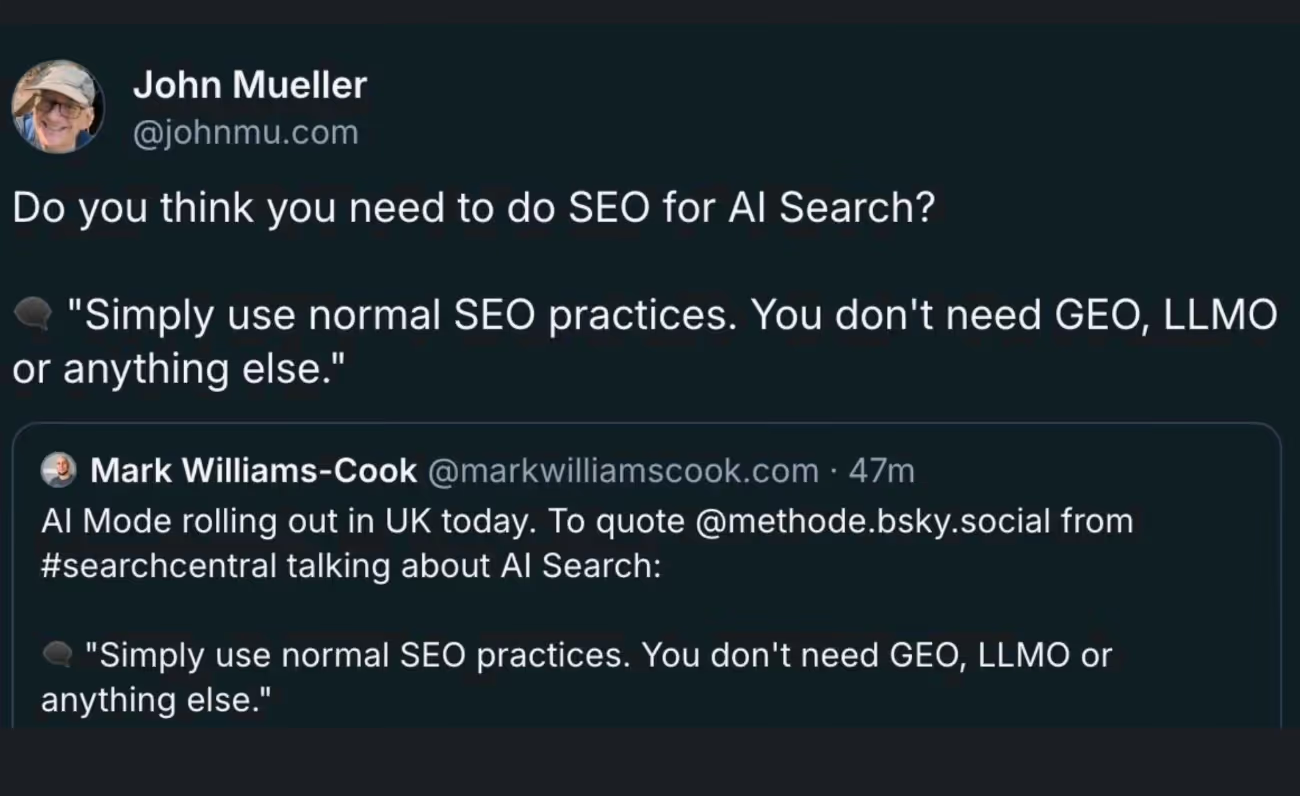
Tools that can be used for SEO ROI forecasting
You don’t need a Frankenstein stack to forecast SEO ROI. You just need tools that answer three questions clearly:
- What’s happening?
- What’s most likely to happen?
- What’s the business impact?
Here’s a practical, non-overkill setup.
1. Google Search Console
This is your source of truth for:
- Impressions
- Clicks
- Real CTRs by query and page
- Early signs of AI Overviews impact
If your forecast ignores GSC data, it’s already shaky.
2. Google Analytics (GA4)
Use GA4 to map:
- Organic sessions → conversions
- Conversion rate by page type
- Assisted conversions and paths
This is where SEO stops being ‘traffic’ and starts being revenue-adjacent.
Optional: If you want this automated
Instead of stitching data together manually, you can use Factors.ai to see traffic and page-level conversion data and performance. You also get to see how buyers actually move from first visit to demo booking across LinkedIn ads, Google ads, and other touchpoints (Yes, the non-linear customer journey using multi-touch attribution.)
3. Keyword & traffic estimation tools
Tools like Ahrefs, Semrush, and the like, help with:
- Search volume (directionally)
- Keyword clustering
- Competitive SEO benchmarking
PS: Treat these as estimators, not promises. They’re inputs, not answers.
4. Spreadsheets (still undefeated)
Your actual SEO ROI forecast will almost always live in a spreadsheet.
Why?
- You can model scenarios
- You can show assumptions
- You can explain why the numbers changed
A clean SEO forecast template with inputs, assumptions, and outputs beats any black-box dashboard.
5. AI visibility tracking (emerging, imperfect, necessary)
This part is still evolving, but you should start tracking:
- LLM citations and mentions
- Featured answer appearances
- Branded search lift over time
Even if the data is directional, leadership will appreciate that you’re measuring what’s changing and not ignoring it. Some of the AI SEO tools help you with this.
Common pitfalls that break SEO ROI forecasts
Most SEO forecasts don’t fail because SEO ‘didn’t work.’ They fail because of avoidable planning mistakes.
Here are the big ones:
1. Treating SEO as a single-channel system
- SEO is no longer just ‘you rank, people click, and they convert’
- Ignoring AI visibility, zero-click behavior, and assisted demand creates blind spots that leadership will notice.
2. Using old CTR assumptions
- Those industry CTR charts from five years ago? Well, they don’t survive AI Overviews.
- If you’re not using your own GSC data, your forecast is already outdated.
3. Forecasting ambition instead of reality
- Publishing ‘10 articles per month’ in a forecast when your team has never shipped more than four is how you end up overpromising and under-delivering.
- Capacity realism matters more than optimism.
4. Giving leadership one number
- SEO outcomes come in ranges, not guarantees.
- Single-point forecasts create unnecessary tension when things shift (and they always do).
5. Forgetting to document assumptions
If assumptions aren’t written down, every variance turns into a debate.
If assumptions are written down, variance turns into a conversation.
Big difference.
Summing it up: How to make SEO forecasting work in the ‘AI era’
SEO forecasting hasn’t become impossible; it’s just become more layered.
Today, a credible SEO ROI forecast does three things well:
1. Models the traditional performance layer
This is the familiar, measurable part of SEO.
It forecasts traffic, conversions, pipeline, and ROI using your real historical data and actual team capacity. No inflated CTRs, no best-case assumptions. Just a clear view of what SEO can realistically deliver as a revenue channel.
2. Accounts for the AI visibility layer
SEO impact now goes beyond clicks.
This layer captures zero-click exposure, LLM citations, and brand presence that influence buyers before they ever visit your website. Even when traffic doesn’t show up immediately, SEO is still shaping demand and improving downstream conversion quality.
3. Communicates uncertainty clearly
Modern SEO isn’t predictable to the decimal.
Instead of promises, the forecast uses scenarios, documented assumptions, and ranges. This sets realistic expectations, builds trust with leadership, and gives you a framework to adapt when the search landscape shifts.
And yesss.. good SEO is still good SEO.
But ‘good SEO’ now means planning for where your content appears, not just where it ranks. Same fundamentals but on newer surfaces.
And with the right forecast? Still completely manageable.
FAQs on SEO ROI forecasting
1) What is SEO forecasting, and why does it matter?
SEO forecasting is the practice of using historical performance and current trends to estimate future organic visibility, traffic, conversions, and business value. It helps marketers set realistic goals, plan resource allocation, and justify SEO investment, especially now that search behavior and SERP features are changing rapidly.
2) How do AI Overviews and generative search impact SEO forecasts?
Generative AI features like AI Overviews and answer boxes increasingly deliver answers without clicks, reducing traditional CTR. Because of this zero-click behavior, forecasts based only on rankings and expected clicks can overstate impact. Modern forecasting must include an AI visibility layer to estimate influence even when users don’t click.
3) What data do I need to build an accurate SEO ROI forecast?
A credible forecast uses:
- Recent organic performance (clicks, impressions, CTR)
- Conversion rates by channel or page
- Search intent and keyword segmentation
- Capacity assumptions (content output, dev support)
- Scenario ranges (conservative, expected, ambitious)
These inputs turn SEO planning into a business case rather than a guess.
4) How can I account for uncertainty in SEO forecasting?
SEO forecasting isn’t about absolute predictions; it’s about preparing for a range of outcomes. Use scenario ranges, regularly update assumptions (e.g., CTR, algorithm changes), and include triggers that signal when you should reforecast. This communicates confidence with realistic caveats, not blind certainty.
5) Are traditional forecasting methods still useful in 2025?
Yes, traditional forecasting using historical trends, keyword models, and CTR estimates is still valuable. But it must be augmented with AI-aware signals (like visibility in generative responses,AI Overviews, and LLM citations) because these increasingly shape user behavior and influence demand without a click. Combining both gives a fuller picture.

7 Signs Your B2B Marketing Strategy Needs a Complete Solution Overhaul
Learn the key indicators that your B2B marketing solutions need updating, from stalled revenue to misaligned teams. Get actionable insights to revamp your strategy.
TL;DR
- Revenue stalls and conversion rates drop when tactics no longer resonate.
- Lack of clear ROI and poor sales-marketing alignment signal a need for an overhaul.
- Outdated branding and rigid strategies fail to engage today’s buyers.
- Competitors’ superior visibility and engagement highlight strategic gaps.
Has your revenue growth stalled? Are your sales teams working together hard but seeing fewer results? Are competitors catching up despite weaker products? These challenges are common for B2B companies relying on outdated marketing methods. Frustration mounts as marketing fails to generate quality leads, sales cycles lengthen, and your brand fades in a crowded market.
The solution? Recognize when your approach is faltering and transition to modern B2B marketing. By identifying the signs early, you can adjust your strategy, support your teams, and regain your competitive edge. This guide outlines the seven key indicators that your B2B marketing strategy needs a fresh, data-driven update.
If several of these signs resonate, it’s time to consider a comprehensive overhaul with modern B2B marketing solutions that align teams, clarify ROI, and drive sustainable growth.
7 Signs Your B2B Marketing Strategy Needs a Clear Solution
Sign 1: Plateaued Revenue and Stalled Growth
When revenue growth halts, it's a clear sign that your B2B marketing strategy needs reevaluation. Stagnant growth suggests that your current approach has reached its limits. To reignite growth, consider a comprehensive strategy overhaul that leverages data-driven insights and innovative marketing solutions, such as Funnel Conversion Optimization.
Sign 2: Declining Lead Quality and Conversion Rates
If your sales team spends more time on leads but closes fewer deals, it indicates that your B2B marketing isn't reaching the right audience. Poor lead quality means your campaigns attract browsers rather than buyers, wasting resources and frustrating your teams. Even if website traffic remains steady, a drop in conversion rates suggests a disconnect in messaging or a cumbersome process. To address this, refine your targeting, enhance your messaging, and ensure your strategy attracts and converts your ideal B2B customers. Tools like Intent Capture can help identify high-intent leads.
Sign 3: Unclear ROI and Ineffective Attribution
Struggling to measure marketing ROI or attribute results to specific campaigns is a red flag. Without clear metrics, it's challenging to justify marketing spend or understand which efforts drive success. Implementing robust analytics tools can provide the insights needed to optimize your strategy and demonstrate tangible results. Consider using content attribution to gain deeper insights into your marketing efforts.
Sign 4: Misalignment Between Marketing and Sales Teams
A significant indicator that your B2B marketing strategy needs adjustment is misalignment between marketing and sales teams. When these teams don't share goals or data, valuable leads can be lost. Marketing might generate leads that sales deem unqualified, leading to frustration and missed revenue targets.
For B2B companies, seamless teamwork is crucial. Marketing should deliver leads that align with sales' ideal customer profile, and sales should provide feedback on the quality of these leads. Frequent disagreements, unclear processes, or mixed messages to prospects signal the need to realign your strategy. Foster collaboration with shared goals and regular communication to unlock the full potential of your B2B marketing. Tools that have workflow Automations can streamline this process.
Sign 5: Outdated Brand Presence and Messaging
An outdated brand presence is a clear sign that your B2B marketing needs a refresh. Today's buyers research and compare options before engaging with sales. If your website, social media, and content appear outdated or inconsistent, prospects may question your relevance or expertise. Outdated messaging can miss the current needs of your audience, allowing more agile competitors to gain an edge. Regularly evaluate your brand and messaging to ensure they reflect your company's current value and position.
Sign 6: Inability to Adapt to Market or Buyer Changes
Markets and buyer behaviors evolve rapidly, especially in B2B industries. If your marketing strategy can't keep pace with new trends or shifts in buyer roles, you risk falling behind. For instance, if your campaigns target outdated personas or overlook new channels where buyers now spend time, you lose valuable opportunities. A rigid approach can also waste your budget on ineffective tactics. The best B2B marketing solutions are flexible, using data to detect changes early and adjust messaging, channels, and offers. If your team reacts slowly to market feedback or fails to engage new buyer types, it's a clear sign your strategy needs a complete overhaul to stay relevant and competitive. By tapping into the insights available through our Account Intelligence solution, you can pivot faster and engage the right accounts at the right time
Sign 7: Competitors Outperforming Your Marketing Efforts
If competitors consistently outperform you in brand visibility, lead generation, or customer engagement, it's time to rethink your B2B marketing. When rivals with similar products gain more market share, their strategy likely aligns better with current buyer needs. You might notice their content engaging more people, their messaging resonating well, or their use of new channels you haven't explored. Ignoring this can lead to lost revenue and a weakened brand.
Regularly benchmark your performance against competitors. If your results fall short despite similar resources, it's time to revamp your approach to regain your edge and ensure your marketing supports real business growth. Consider leveraging Marketing ROI tools to measure your effectiveness.
Actionable Insights to Revamp Your B2B Marketing Strategy
If your current B2B marketing results are lagging in low conversion rates, misaligned teams, or unclear ROI, it may be time for a full strategic reset. Here are proven, actionable steps to breathe new life into your strategy and drive performance:
1. Reassess Your Ideal Customer Profile (ICP)
Markets evolve, and so do your buyers. Re-evaluate your ICP by analyzing your best-performing accounts and identifying updated firmographic, technographic, and behavioral traits. Tools like Factors.ai can help enrich this data and uncover new segments worth targeting.
2. Conduct a Funnel-Wide Audit
Map out your buyer journey from first touch to closed deal and identify drop-off points. Utilize attribution platforms like Dreamdata or Factors to identify which stages or campaigns are underperforming. Then align content and campaigns to fill those conversion gaps.
3. Realign Sales and Marketing Around Shared Revenue Goals
Break down silos by implementing RevOps principles. Ensure both teams agree on definitions (e.g., MQLs vs. SQLs), share dashboards, and co-own pipeline targets. This alignment improves lead quality and shortens sales cycles.
4. Rebuild Content Strategy for Buyer Intent
Stop producing content for volume. Focus instead on intent-based content tailored to each stage of the buyer journey. Use SEO tools like Ahrefs or Semrush to identify what your target audience is actually searching for, and align assets like whitepapers, case studies, and product demos accordingly.
5. Shift to Account-Based Everything (ABX)
ABM isn’t just for enterprise. If you're selling high-value products, adopt an ABX approach, combining sales, marketing, and customer success to deliver coordinated, personalized outreach. Factors helps you with this process.
6. Upgrade Your Tech Stack for Scalability and Integration
Outdated or isolated tools slow your progress. Rebuild your stack with API-first platforms that integrate seamlessly, e.g., a headless CMS, a unified CRM, and analytics tools that support multi-touch attribution. Automate repetitive tasks to let teams focus on high-value work.
7. Create an Agile Testing Framework
Embed experimentation into your strategy. Use A/B testing and multivariate testing on messaging, CTAs, landing pages, and even sales sequences. Make data-backed decisions fast, and continually optimize based on real performance, not gut feel.
8. Invest in Training and Internal Enablement
Even the best tools and strategies fail without skilled users. Conduct regular training on systems, data literacy, and modern B2B tactics. Empower your team to act on insights, iterate campaigns, and drive continuous improvement.
When you apply these insights, you're not just patching up problems but laying the groundwork for scalable, measurable growth. A strategic overhaul doesn't need to be overwhelming; it just needs to be focused, data-driven, and aligned with real buyer behavior.
Final Thoughts: Adapting Your B2B Marketing for Better Results
Traditional B2B tactics often fail to sustain momentum, manifesting as stalled revenue and prolonged sales cycles. Declining lead quality and conversion rates frequently reflect misaligned targeting and messaging. Additionally, opaque measurement frameworks hinder accountability, making it challenging to justify budgets or attribute outcomes. When marketing and sales teams operate in isolation, prime prospects slip through gaps, intensifying friction and delaying deals.
A dated brand presence that misses the mark with today’s decision makers and inflexible strategies that lag behind buyer shifts further exacerbate performance issues. Moreover, competitors capturing superior visibility and engagement expose strategic deficiencies. To reverse these trends, companies must reevaluate their ideal customer profiles, conduct full-funnel audits, and synchronize sales and marketing around unified goals. Adopting an account-based outreach model, upgrading to an integrated technology stack, establishing iterative testing protocols, and investing in targeted team training empower businesses to reclaim relevance and achieve predictable growth.

7 Warning Signs Your B2B Marketing Strategy Needs a Better Funnel Structure
Learn how to identify and fix common B2B marketing funnel issues. Improve conversion rates, customer retention, and ROI with proven solutions.

TL;DR
- Low conversion rates at any stage indicate leaks or friction in your funnel, slowing growth and wasting resources.
- High customer loss and poor retention often mean you lack post-purchase engagement or have value gaps.
- Inconsistent brand messaging confuses prospects and erodes trust, making it hard to move leads forward.
- Poor quality traffic and unqualified leads suggest your top-of-funnel activities aren’t reaching the right audience.
- Relying too much on one traffic source risks your funnel if that source dries up.
- Misalignment between marketing and sales teams leads to missed opportunities and a disjointed buyer experience.
- Lack of data-driven decisions and funnel metrics means you’re unable to optimize or prove ROI.
Imagine your sales team working hard, but deals stall, leads vanish, and your marketing spend falls short. You're putting in the effort, but the results don't show it. Many B2B companies face this issue when they lack a clear marketing funnel. Without it, prospects slip away, messages get mixed, and your team can't find the problem. The key is to build a funnel that fits the complex B2B buying process. With the right structure, you can guide prospects from first contact to loyal customers, ensuring each stage is set for success.
Let's explore the signs that your strategy might need this vital foundation.
Role of a Funnel Structure in B2B Marketing
A clear funnel structure is essential to effective B2B marketing. B2B buyers take a longer path than B2C buyers, involving more people, facing higher costs, and enduring longer sales cycles. You need a clear process to guide prospects from awareness to decision. Without a structured funnel, you can lose track of where leads drop off or which tactics work.
A proper funnel helps you map each stage: awareness, consideration, decision, and retention, so that you can deliver the right message at the right time. It also aligns your marketing and sales teams, ensuring everyone works toward the same goals. A strong funnel structure turns scattered efforts into a cohesive strategy that boosts conversions and maximizes ROI.
7 Signs Your B2B Marketing Strategy Needs a Proper Funnel Structure
Here are the seven signs that you need a better funnel structure:
Sign 1: Low Conversion Rates Across Funnel Stages
If your B2B marketing funnel has low conversion rates, your strategy might need better structure. When prospects engage with your content but don't move from awareness to consideration, or from consideration to decision, it's time to look closer.
Healthy conversion rates should rise as leads move through the funnel: 1-3% at awareness, 3-5% at interest, and up to 10-15% at action. If your rates are below these numbers, your messaging, targeting, or nurturing tactics might be off.
Without a structured funnel, it's hard to see where leads drop off, making it tough to improve your B2B marketing for better results. Explore how subtle tweaks can lift your sales by visiting our Funnel Conversion Optimization insights.
Sign 2: High Customer Attrition and Poor Retention
High customer attrition and poor retention rates are clear indicators that your B2B marketing strategy lacks a robust funnel structure. When customers leave after their initial purchase, it often indicates a lack of post-purchase engagement or a perceived gap in value.
A well-structured funnel doesn't end at the sale; it includes strategies for nurturing existing customers, encouraging repeat business, and building long-term loyalty. By focusing on customer retention, you can increase lifetime value and reduce the cost of acquiring new customers. Explore how our Account Intelligence feature can help you analyze customer behavior and improve retention.
Sign 3: Inconsistent or Fragmented Brand Messaging
Inconsistent or fragmented brand messaging confuses prospects and erodes trust, making it difficult to move leads forward in the funnel. When your messaging is not aligned across all channels and stages of the funnel, it creates a disjointed experience for potential customers.
A strong funnel ensures that your brand message is consistent and cohesive, reinforcing your value proposition at every touchpoint. This consistency builds trust and helps guide prospects smoothly from awareness to decision.
Sign 4: Poor Quality Traffic and Unqualified Leads
If your B2B marketing efforts bring many visitors but few conversions, you might be attracting poor-quality traffic. High bounce rates, short visits, and leads that don’t fit your ideal customer profile are signs of this issue.
When your funnel lacks structure, your campaigns might target broad or irrelevant audiences, leading to wasted ad spend and low returns. Unqualified leads fill your sales pipeline, making your team spend time on prospects who will never buy.
To fix this, review your targeting criteria, refine your messaging, and use analytics to find which channels and content attract high-value prospects. A well-structured funnel helps you attract and nurture leads that truly fit your business. Explore refined sequenced outreach approaches in Cold Outbound for GTM Efforts to accelerate pipeline growth.
Sign 5: Over-Reliance on a Single Traffic Source
Relying too much on one traffic source, like paid ads, organic search, or one social platform, puts your B2B marketing strategy at risk. If that channel changes its algorithm, raises costs, or restricts your account, your lead flow can drop fast. This lack of variety shows your funnel is not complete.
A strong B2B marketing funnel should bring in and nurture leads from many sources, like SEO, content marketing, email, partnerships, and events. Using just one source often leads to unstable performance and makes it hard to grow. Also, single-source traffic can mislead you about what really drives conversions.
To build strength and steady growth, make sure your funnel captures, nurtures, and converts leads from many channels, not just one. Apply buyer-intent signals to expand your reach with tips from our Intent-Based Outreach resource.
Sign 6: Lack of Alignment Between Marketing and Sales Teams
When marketing and sales teams work separately, your B2B marketing strategy may lack a proper funnel. Marketing might generate leads that sales see as low quality, while sales might not give feedback on what works. This gap can lead to missed chances, mixed messages, and wasted resources.
For example, if marketing focuses on early-stage activities but doesn’t nurture leads enough, sales teams get prospects who aren’t ready to buy. On the other hand, if sales doesn’t share customer feedback, marketing can’t improve its approach.
A structured funnel promotes regular communication, shared goals, and a clear definition of qualified leads. This sales and marketing alignment ensures every funnel stage works together to guide prospects toward conversion and lasting partnerships. To ensure this and to maintain cross-functional momentum, leverage our Workflow Automations.
Sign 7: Absence of Data-Driven Decision Making and Funnel Metrics
A strong B2B funnel relies on clear data at every stage. If your team uses gut feelings or random reports instead of consistent metrics, you miss growth opportunities. Without tracking conversion rates, lead quality, and engagement, you can't find bottlenecks or improve campaigns. This often leads to wasted money, poor strategies, and missed revenue goals.
Modern B2B marketing tools should offer real-time dashboards and analytics to show how prospects move from awareness to purchase. Regularly reviewing these metrics helps you adjust tactics, allocate budget wisely, and show marketing’s value to stakeholders. If you don’t know where leads drop off or which content drives action, your funnel needs a data-driven update to stay competitive and deliver results.
How to Rebuild and Optimize Your B2B Funnel Structure
Here are the steps to rebuild and optimize your B2B funnel structure:
1. Map the Complete Buyer Journey:
Chart each buyer journey stage from initial awareness to post-purchase engagement. Identify where prospects drop off or lose interest.
2. Spot Funnel Gaps and Bottlenecks:
Analyze which funnel stages lack engagement or have low conversion rates. These are your opportunities for improvement.
3. Segment Your Audience Strategically:
Group prospects by firmographics (industry, size, location) and buying roles (decision-maker, influencer, user) for personalized targeting.
4. Align Sales and Marketing Teams:
Define what qualifies as a lead and standardize the lead handoff process to ensure consistent follow-through.
5. Leverage B2B Analytics Tools:
Use platforms like Factors.ai or HubSpot to track funnel performance, monitor drop-offs, and measure key conversion metrics.
6. Test and Optimize Content:
Experiment with new formats (e.g., video, webinars, interactive tools) and platforms (LinkedIn, email, retargeting ads) to boost engagement.
7. Create a Continuous Feedback Loop:
Encourage regular communication between sales, marketing, and customer success teams to refine strategies and improve results over time.
With a clear, data-driven approach, your funnel will attract better leads and build strong customer relationships.
Upgrade Your Funnel Strategy to Drive Better Results
A well-structured funnel is key to successful B2B marketing. Without it, you may face low conversions, high customer turnover, mixed messages, and wasted resources on poor leads. Issues like poor marketing and sales alignment, relying too much on one channel, or lacking useful data can slow your company's growth. Spot these warning signs early to fix your funnel, align your teams, and create a smooth buyer journey.
Effective B2B marketing strategies are not straight paths but flexible and customer-focused, adapting to real buyer actions and needs. Use the right tools, encourage teamwork, and let data guide your choices. This will lead to steady growth and establish your brand as a trusted market leader.

SEO vs Paid Search: A Marketer’s Marketing Dilemma Answered
SEO vs paid search sounds like a debate. It isn’t. Here’s a clear breakdown of speed, cost, attribution, and how to use each channel at the right time.
TL;DR
- SEO and paid search are not competitors. They solve different problems, on different timelines, even though they show up on the same search results page.
- Paid search delivers speed and clarity. It captures existing demand, works immediately, and is easy to measure, but only while you keep spending.
- SEO builds long-term leverage. It takes time, influences buyers early, compounds over time, and often looks weaker in last-click reports despite real impact.
- The best teams sequence both. Use paid search to move fast and learn what converts, then use SEO to turn those insights into sustainable growth.
As an SEO professional, here is a situation that lives in my head rent-free.
You open your dashboard.
Paid search is driving leads (nice, very nice).
SEO traffic is… slowly inching up (less nice).
Then someone asks that question. You know that one. “So… should we invest more in SEO or paid search?”
Everyone turns to you. You nod thoughtfully, as if this question is not going to haunt you during quarterly planning.
And this is where most conversations go sideways. Because here’s the truth: SEO vs paid search is not a fair fight. They’re not trying to do the same job. They just happen to live on the same Google results page.
Let’s untangle this properly and see how it actually works.
What is Search Engine Optimization (SEO) (aka the channel that refuses to be rushed)
Search engine optimization, or the acronym SEO, is how you earn visibility on Google without paying for every click. You do this by:
- Creating content people actually search for (not just what you want to say)
- Making sure your site is technically sound (no duct tapes or broken links)
- Building authority over time, so Google goes, “Okay, fine, these folks know their stuff.”
Here’s the important part people forget: SEO takes time to start, but once it works, it keeps working.
You don’t see results immediately. In the beginning, it feels quiet. Sometimes too quiet.
But over time:
- Pages start ranking
- Traffic comes in regularly
- Then suddenly, you’re getting leads from a blog you wrote months ago and forgot about.
You’re not “turning SEO on.” You’re building something that continues to drive traffic over time.
Slow start but long payoff, that’s SEO.
Paid search: The overachiever who gets results now
Paid search has a very different energy. You:
- Pick keywords
- Set a budget
- Start getting clicks almost immediately
No waiting. No suspense. No “let’s see what happens in three months.”
It’s fast. It’s measurable. And yes, it can get a little addictive.
Paid search is what you reach for when:
- You need results this month
- Leadership wants numbers, fast
- You’re launching something new and can’t wait for SEO to warm up
But here’s the simple truth people often ignore: Paid search only works while you’re paying. Pause the budget, and the traffic pauses with it.
That doesn’t make it bad. It just means it’s built for speed, not permanence.
How SEO actually works
SEO isn’t magic. It’s three things working together:
- Content – Are you answering real questions people search for?
- Technical health – Can Google even understand your site?
- Authority – Do other sites trust you enough to link to you?
And one thing people always forget: SEO runs on Google’s timeline, not yours.
When you publish a page, Google doesn’t instantly reward you with traffic. First, it does a little homework. It:
- Finds your page
- Tries to understand what it’s about
- Decides where it might fit among millions of other pages
Now, at this stage, Google is basically asking, “Is this page useful, and who is it useful for?”
If the answer isn’t clear yet, nothing dramatic happens. Your page just… sits there. (Very humbling, I know.) Which is why:
- New pages don’t rank instantly
- Results feel invisible at first
- Patience becomes a strategy (unfortunately)
Over time, Google watches what users do:
- Do people click your results?
- Do they stay or bounce?
- Do other sites reference or link to it?
Each of these is a small signal. One signal doesn’t move the needle. Many signals, consistently, do.
As that confidence builds, your page starts showing up more often, in more places, for more searches. Not because you asked nicely. But because the data says you deserve it.
Slow, yes.
Predictable, also yes.
And once you understand that, SEO stops feeling mysterious and starts feeling manageable.
How paid search (PPC) actually works (also not magic)
Paid search looks simple at first.
Pick keywords. Add budget. Get clicks.
Easy… until you zoom in.
Behind every single click, Google is quietly evaluating a few things:
- Your bid – How much you’re willing to pay
- Your relevance – How closely your ad matches what someone searched
- Your quality score – How useful Google thinks your ad and landing page are
- Your signals – What Google learns from who converts and who doesn’t
Here’s where things get interesting:
- If your targeting is off, you don’t just get bad clicks. You pay more for them.
- If your conversions are weak, Google learns the wrong lesson.
- If your tracking is messy, Google guesses. And guessing gets expensive.
We know that paid search moves fast, but it has very little patience. It rewards teams who are clear about:
- Who they want
- What action matters
- What a “good” conversion actually looks like
And it quietly punishes everyone else. But once you understand how it thinks, it becomes very predictable.
Fast, yes. Easy? Only if you’ve done the homework.
Let’s talk money (the slightly awkward part)
This is usually where everyone clears their throat and says, “Well… it depends.”
With SEO, you usually pay for:
- Content
- Tools
- People
- Time
You spend upfront, then wait for results. That’s why SEO can feel expensive early on. You’re investing before you see much return.
With paid search, you pay for:
- Every click
- Every test
- Every campaign you run
Traffic starts quickly, but the moment you stop spending, results stop too.
So the difference isn’t really about cheap vs expensive. It’s about when you pay:
- SEO costs more at the start and pays off over time
- Paid search costs less upfront but adds up continuously
Basically, one expects patience and the other expects a credit card. Neither one is actually cheaper. They just hurt (and work) in very different ways.
Once you look at it that way, the tradeoff becomes much easier to explain.
Where SEO and paid search fit in the funnel (aka who does what)
Think of the funnel like buyer’s mood swings.
Paid search works best when buyers already know what they want. They’re typing things like:
- Best X software
- X pricing
- X alternatives
They’ve done the thinking.
They’re comparing options.
They’re basically saying, “I’m ready. Don’t mess this up.”
That’s paid search territory.
SEO shows up much earlier in the story. This is when people are Googling things like:
- How do I solve this problem?
- Is this even the right approach?
- What does everyone else do?
Questions are vague. Intent is forming. Nobody is ready to talk to sales yet (and they definitely don’t want a demo).
That’s where SEO belongs.
So, my point is…
Paid search catches people when they’re ready to decide
SEO meets them while they’re still figuring things out
Paid search captures demand. SEO warms it up quietly, long before anyone is ready to buy.
Different moments. Same journey.
Why SEO always looks worse in reports (and isn’t actually worse)
Paid search is very straightforward to explain in a report.
Someone clicks an ad.
They fill a form.
Revenue shows up.
Everyone nods. Charts look clean. Life is good.
SEO is messier.
Someone reads a blog.
They leave.
They come back a week later.
Then maybe they check pricing.
They later fill a form by clicking on your ad.
Then they talk to sales.
Then they convert.
Then no one remembers how they first found you.
So when you look at last-click attribution reports, SEO looks… underwhelming (and feels like you’re right in the middle of the Bermuda Triangle).
Not because it didn’t help. But because it showed up early, did its job quietly, and didn’t stick around to take credit.
SEO doesn’t close the deal in one move. It warms people up, gives them context, and nudges them forward long before conversion happens.
Which is great for buyers. And mildly frustrating for dashboards.
Classic SEO behavior.
SEO vs Paid Search: Mistakes almost everyone makes
If you have done at least one of these, you are completely normal.
- Expecting SEO to behave like ads
- Giving up on SEO because nothing happened immediately
- Throwing more budget at paid search without fixing targeting
- Treating SEO and paid search like rival teams instead of coworkers
None of these comes from a bad strategy.
They usually come from pressure. Deadlines. And someone asking, “Why is this not working yet?”
So decisions get rushed. Shortcuts get tempting. Context gets ignored.
At this point, know that this is not incompetence (it’s stress).
And once you see that clearly, these mistakes become easier to avoid next time.
What the community actually thinks (and why it matters)
Spend a few minutes reading Reddit threads on SEO vs paid search, and a pattern shows up pretty quickly. People say things like:
- “Paid search works… until it suddenly gets very expensive.”
- “SEO was painfully slow, but it saved us later.”
- “Turning SEO off was a mistake.”
- “Ads are great, as long as you know exactly what you are doing.”
Reddit is not polished. There are no frameworks, slides, or jargon. But it is honest. And here is the part worth paying attention to. Most people are not arguing about which channel is better. They are talking about what happens when teams over-rely on one and ignore the other.
The takeaway is simple:
- Teams that rely only on paid search feel exposed (and broke) when budgets tighten
- Teams that ignore paid search struggle to move fast when it matters
- Teams regret not doing SEO in the early stages of growth.
In other words, the community has already learned the lesson the hard way.
Balance wins. Short-term speed plus long-term stability beats picking sides.
So… SEO vs Paid search: Which one should you choose?
Here’s the answer most people don’t love, because it is not flashy.
You do not choose.
You sequence.
- Use paid search when you need to move fast. It helps you test, learn, and capture demand that already exists.
- Use SEO to build something that keeps working over time, even when budgets or priorities shift.
Let both channels talk to each other. Let paid search show you what converts. Let SEO turn those learnings into long-term traffic and demand.
The best teams do not debate SEO versus paid search. They design a system where each channel does what it is actually good at.
Final thought before your next planning meeting
SEO builds leverage, and paid search buys speed.
One helps you survive the quarter. The other stops you from starting from scratch every quarter.
If this question keeps coming up in your team, that’s a good sign.
It means you’re not just trying to win this month. You’re trying to still be winning a year from now.
And that is when both channels start to make a lot more sense (in their own way).
FAQs on SEO vs Paid Search
Q1. Is SEO better than paid search in the long run?
SEO wins long-term, but only if you are willing to wait. On Reddit, you will often see comments like “SEO saved us once ads got too expensive.” The catch is that SEO takes time to build. If you need results immediately, paid search usually performs better early on.
The practical answer is not either or. Use paid search for speed and SEO for durability.
Q2. Can I rely only on paid search and skip SEO completely?
You can. Many teams do. They just rarely enjoy it forever.
Communities like Reddit are full of stories where teams relied heavily on ads, then struggled when costs increased or budgets tightened. Paid search works, but it keeps charging you rent. SEO gives you a fallback. Without it, you are fully dependent on ongoing spend.
Q3. Why does SEO feel slow compared to paid search?
Because Google does not trust new pages instantly. Paid search shows results as soon as you launch a campaign. SEO needs time to understand your content, test it against competitors, and see how users respond. It is also normal.
Q4. Should startups focus on SEO or paid search first?
Start with paid search if you need quick feedback and leads. Start SEO as early as possible, even if it is small. Paid search helps you learn what converts. SEO helps you avoid rebuilding demand from scratch later.
Teams that delay SEO often say they wish they had started sooner.
Q5. Why does SEO look weak in attribution reports?
SEO often influences buyers early. People read a blog, leave, come back later, then convert through another channel. In last click reports, SEO does not get credit. SEO “works quietly” and gets undervalued because of how attribution is set up, not because it is ineffective.

10 Signs Your ICP Marketing Is Targeting the Wrong B2B Customers
Learn how to identify and fix B2B targeting mistakes with ICP marketing. Discover key indicators of misaligned marketing and actionable solutions.
TL;DR
- Misaligned marketing in B2B leads to wasted resources and stunted growth.
- High bounce rates, low engagement, extended sales cycles, and high churn are indicators of targeting the wrong audience.
- Defining your Ideal Customer Profile (ICP) and Anti-ICP is crucial for effective targeting.
- ICP marketing focuses on accounts that align with your solution, enhancing conversion rates and customer loyalty.
- Identifying your Anti-ICP helps avoid investing in accounts likely to churn or require excessive support.
- Effective targeting combines firmographics and behavioral data, not just basic demographics.
- Regularly updating your ICP ensures alignment with market dynamics and customer needs.
- Collaboration across marketing, sales, and customer success is vital for accurate ICP development.
- Data-driven segmentation identifies high-value prospects and accounts to avoid, optimizing outreach efforts.
- Focusing on your true ICP drives sustainable growth, reduces churn, and maximizes campaign impact.
Are you investing time and money in B2B marketing without seeing results? Long sales cycles and high customer turnover might indicate that your marketing is targeting the wrong audience. This misalignment drains resources, frustrates your team, and hampers growth. It's not just about wasted ad spend; every hour spent on a poor-fit account is an hour lost on a potential advocate.
The repercussions are clear: extended onboarding, increased support tickets, and unpredictable revenue. Many B2B companies face these challenges due to an overly broad or outdated Ideal Customer Profile. They also often overlook the importance of identifying who not to target with their Anti-ICP. Refining your ICP marketing ensures every campaign, message, and call targets accounts that truly fit your offering.
This blog explores ten signs that indicate your marketing is off track and how a clear ICP (and Anti-ICP) can enhance your B2B strategy
The True Cost of Targeting the Wrong Customers
Targeting the wrong customers in B2B can undermine your entire strategy. Here’s how it does:
1. Unnecessary Expenditure on Poor-Fit Accounts: Investing in prospects that do not align with your Ideal Customer Profile (ICP) often leads to financial losses with little to no return.
2. Extended Sales Cycles and Increased Churn Rates: Misaligned targeting results in prolonged decision-making processes affecting your B2B sales cycle and reduced customer retention.
3. Elevated Onboarding and Support Costs: Customers outside your ICP typically require more intensive support, increasing operational costs and reducing overall efficiency.
4. Potential Brand and Reputation Risk: Negative experiences from poor-fit customers can lead to unfavorable reviews, impacting brand credibility and future acquisition efforts.
5. Misaligned Sales and Marketing Efforts: Focusing on the wrong leads disrupts coordination between teams and diverts attention from high-potential opportunities.
6. Inhibited Product-Market Fit and Innovation: Feedback from unsuitable customers can misguide product strategy, hindering your ability to serve your true target market effectively.
7. Decreased Team Efficiency and Morale: Continual effort on accounts that fail to deliver value can lead to frustration and reduced team motivation.
Defining and adhering to your ICP ensures your resources focus on customers who drive real growth for your business.
10 Signs Your Marketing Is Targeting the Wrong Customers
Recognizing when your B2B marketing is off-target is essential for growth. Here are ten signs your campaigns may be attracting the wrong audience:
1. Your Audience Is Too Broad or Too Narrow
A broad audience dilutes your messaging, making it hard to resonate with anyone. Conversely, overly narrow segmentation restricts your reach and potential pipeline. Inconsistent or unclear targeting signals indicate that building your Ideal Customer Profile (ICP) needs refinement.
2. High Bounce and Unsubscribe Rates
A bounce rate above 55% or email unsubscribe rates over 2% can be red flags. These metrics suggest that visitors or recipients don’t find your content relevant. This disconnect often points to misaligned messaging or a mismatch between your value proposition and your audience’s needs, a classic symptom of weak ICP alignment.
3. Low Engagement and Poor Sales Conversion
If your emails have poor open rates, social content gains little traction, or your site fails to convert (below 3–5%), you're likely targeting people who don’t see your solution as valuable. Engagement metrics reveal how well your message speaks to your audience’s pain points or if it’s falling flat.
4. Long Sales Cycles and Low Lead-to-Customer Conversion Rates
When your sales pipeline is bloated but conversions remain low, your marketing may be attracting leads that aren’t truly sales-ready, or never will be. Lengthy decision timelines and low closing ratios indicate that your messaging reaches the wrong buyers or organizations outside your ICP.
5. High Customer Churn and Revenue Fluctuations
Acquiring customers who churn quickly or contribute little to long-term revenue is costly. If your client retention is low and monthly recurring revenue fluctuates, it may be due to bringing on customers who were never the right fit. These short-term wins can damage long-term growth.
6. Onboarding Takes Too Long
If new customers frequently struggle to get started or require excessive support to see value, they may not be ideal fits for your product or service. Overly complex onboarding usually indicates that expectations weren’t aligned during the sales and marketing process, or that the customer’s needs don’t match your offering.
7. Negative Reviews and Critical Feedback
Recurring complaints or poor ratings, particularly from customers who shouldn’t have been sold to in the first place, can harm your brand and deter future ideal clients. Negative feedback often stems from a misalignment between your solution’s capabilities and the buyer’s expectations.
8. Effort vs. Return Is Out of Balance
If your team is putting in significant effort, creating content, running ads, and launching campaigns, but sees minimal return, it's time to reevaluate your targeting. Wasted effort on low-fit leads leads to burnout and budget strain. An accurate ICP helps ensure marketing energy is spent where it can generate meaningful results.
9. Missed Innovation Opportunities
The wrong customers won’t help evolve your product. If you’re getting little helpful feedback or unclear direction from your base, you may be listening to voices outside your core market. The right customers push you forward, the wrong ones hold you back with irrelevant requests.
10. Misaligned Use Cases and Value Delivery
If customers use your product in ways you didn’t intend or fail to realize its full value, your marketing is likely sending the wrong message. This misalignment hinders adoption and satisfaction and suggests your campaigns attract people who misunderstand your core value.
How ICP Marketing Fixes B2B Targeting Mistakes?
At the core of effective B2B growth is clarity on who you’re trying to reach. Ideal Customer Profiles (ICPs) help define the types of companies that are the best fit for your product or service, those that will convert, deliver long-term value, and stay loyal. Without a defined ICP, marketing efforts become scattershot, leading to wasted resources and poor pipeline quality. Read our ICP marketing guide to know more about the full framework, real B2B examples, and ICP scoring template.
1. Target Accounts that Convert
An ICP eliminates guesswork; it ensures your team is pursuing accounts with the right size, industry, budget, and needs. This targeting precision reduces sales friction, shortens sales cycles, and improves close rates.
2. Include Firmographic and Roles
A well-crafted ICP includes firmographic data such as company size, revenue, location, industry, and tech stack. It also considers key roles within the buying committee: the decision-makers, influencers, and users. This ensures your campaigns resonate with actual stakeholders, not just company names on a list.
3. Protect Strategy with Anti-ICP Profiles
An often-overlooked piece of targeting is the Anti-ICP, which is the definition of accounts you actively avoid. These might be companies with low budgets, high support needs, poor retention history, or misaligned use cases. Anti-ICPs help you avoid burning your budget on prospects who are unlikely to succeed or stay.
4. Segment Better
ICPs enable smarter account segmentation. Rather than blasting generic messages, you can tailor your outreach to segmented clusters based on shared traits. Campaigns become more relevant, engagement rates improve, and your funnel strengthens from the top down.
5. Use Real Data
Strong ICPs are backed by data, not opinions. Build them using CRM analytics, sales win/loss analysis, customer success feedback, and market research. Then test and refine using real campaign performance. This keeps your targeting grounded in reality, not outdated assumptions.
6. Keep it Updated
Markets change, customers evolve, and product offerings grow. That’s why ICPs are not one-and-done documents. Regularly revisit and update your ICP based on churn patterns, sales feedback, onboarding challenges, and evolving customer needs. A dynamic ICP keeps your marketing aligned with current conditions and growth priorities.
7. Align Sales and Marketing
A clear ICP becomes a unifying tool for go-to-market teams. It helps marketing attract the right leads, enables sales to prioritize top-fit accounts, and guides customer success in delivering maximum value. This alignment reduces handoff friction, improves customer experiences, and drives lifetime value.
8. Fix Targeting Mistakes
If your B2B marketing is suffering from long sales cycles, high churn, or poor engagement, your ICP likely needs work. By sharpening your ideal and anti-ideal profiles and grounding them in data, you avoid costly misfires and focus your efforts where they matter most.
In short, a well-defined ICP is key to fixing targeting mistakes and driving sustainable B2B growth.
Related read: SaaS buyer personas in B2B marketing
Practical Steps to Realign Your B2B Marketing Approach
1. Review Your Worst-Fit Customers
If your marketing isn't working well, take action. Review your worst-fit customers who left quickly, needed too much help, or brought low value. Talk with your sales and customer success teams to find patterns in these accounts. Focus on company size, industry, location, and where needs didn't match.
2. Define Your ICP and Anti-ICP
Next, define your Ideal Customer Profile (ICP) and Anti-ICP. Your ICP describes your best customers, while your Anti-ICP shows who to avoid. Contact potential accounts to learn about their needs and challenges, not to sell. This helps check your assumptions and improve your profiles.
3. Leverage Tools for Better Targeting
Use tools to analyze buyer intent and engagement, such as Factor’s Intent Capture and website visitor identification, to ensure your campaigns target the right audience. Update your ICP and Anti-ICP regularly as your market changes, using feedback from sales and marketing.
4. Refine Your Messaging
Ensure that your messaging speaks directly to the pain points, needs, and goals of your ICP. Craft personalized messaging that resonates with key decision-makers within your target accounts.
5. Align Your Teams
Encourage teamwork across departments. Align marketing, sales, and customer success with your ICP strategy for consistency from first contact to renewal.
By following these steps, you'll reduce wasted spending, improve lead quality, and support steady B2B growth, turning marketing into a real revenue driver.
Stop Guessing Your ICP. Let Your Data Define It With Factors.ai
One of the most common ICP targeting mistakes is building your profile from assumptions rather than evidence. Teams rely on gut feel, outdated persona documents, or a handful of won deals to define who they should be going after. The result is wasted spend, misaligned campaigns, and a pipeline full of accounts that never close.
Factors.ai corrects this by anchoring your ICP in real behavioral data. By identifying up to 75% of the accounts visiting your website and layering in intent signals from G2, LinkedIn, and Google Ads, you can see who is actually engaging with your solution, not just who you think should be.
Factors' AI agents surface patterns across your highest-engagement accounts, including firmographic similarities, shared intent signals, and common buying journeys, so your ICP is built from evidence rather than educated guesswork.
And unlike a static persona document that gets revisited once a year, Factors keeps your ICP current. As your pipeline evolves and new accounts engage, your understanding of the ideal customer sharpens automatically.
Related read: ABM personas in B2B Marketing
Wrapping Up
Targeting the wrong customers in B2B marketing can waste resources, extend sales cycles, and harm your brand. Signs like high bounce rates, low engagement, long onboarding, and inconsistent revenue show a mismatch with your Ideal Customer Profile (ICP).
Define and refine your ICP and Anti-ICP to attract the right customers and avoid those who may churn. Use firmographics, buyer intent data, and work with other teams to keep your marketing relevant as markets change.
Remember, ICP marketing is ongoing. Regularly review your customer base, get feedback from sales and customer success, and adjust your targeting as your business and market evolve. This approach saves time and money and leads to sustainable growth.
The key to B2B marketing success is clarity, knowing who you serve best and who you don’t. With a clear ICP, your marketing drives better leads, higher conversions, and strong customer relationships. Stay focused, stay flexible, and let your ICP guide your decisions.

The Practical Guide to SEO Benchmarking
Learn all about SEO benchmarking, including how to do measure performance, track key metrics, analyze competitors, and build reports that secure ROI.

TL;DR:
- Know if your SEO is actually working. Compare your metrics to past performance, competitors, or industry standards.
- Stop guessing which metrics matter. Track search visibility, keyword rankings, organic search traffic, conversions, content quality, and technical health.
- Follow a proven 7-step process. Define scope, pick KPIs, gather data, add competitors, normalize, analyze gaps, and set targets.
- Turn data into action. Identify what's holding you back and where to double down.
- Report strategically. Weekly on issues, monthly on progress, quarterly on strategy.
- Avoid vanity metrics. Focus on benchmarks that drive real business growth.
Search engine optimization is a long game. Like… training-for-a-marathon long. You don’t wake up one morning magically ranking #1 (if only). But as your SEO efforts mature, you start collecting all kinds of shiny numbers, rankings, clicks, traffic charts that go up, down, and sometimes sideways.
But the BIG question is: Are those numbers actually good?
That’s where SEO benchmarking steps in (the reality check you actually need). It helps you compare your performance against something meaningful, your past results, your competitors’ wins, or the wider industry’s average pulse.
In this blog, we’re breaking down how to set benchmarks that matter (not just vanity metrics), which numbers to track without losing your sanity, and how to turn all that data into actions that genuinely move the needle.
What is SEO Benchmarking?
Think of benchmark SEO as setting reference points for measuring your search performance. Let's say your site had 10,000 organic sessions last month. That's your benchmark. Now, your goal might be to hit 15,000 sessions next quarter.
The benchmark becomes your baseline expectation that you need to exceed, not a target you must achieve.
But benchmarking SEO performance only works when you're comparing your numbers to something specific. That could be your past performance, what your competitors are doing, or industry averages. Without these reference points, you're just collecting numbers without any real context.
Benchmarks vs KPIs vs Metrics in SEO
You'll often hear these three terms used interchangeably, but they actually play different roles in how you measure and strategize your SEO efforts. Let me break down what each one means.
These three elements work together to create your measurement framework.
Key metrics give you the raw numbers, benchmarks provide the context for those numbers, and KPIs point you in the right direction. When all three are working together, you've got a solid foundation.
Without them, you're either drowning in meaningless data or setting goals without knowing if they're even realistic
Why Does SEO Benchmarking Matter?
Without benchmarks, you see numbers go up or down, but can't really tell if you're winning or losing. Good benchmarking helps you turn raw data into insights that help drive improvements.
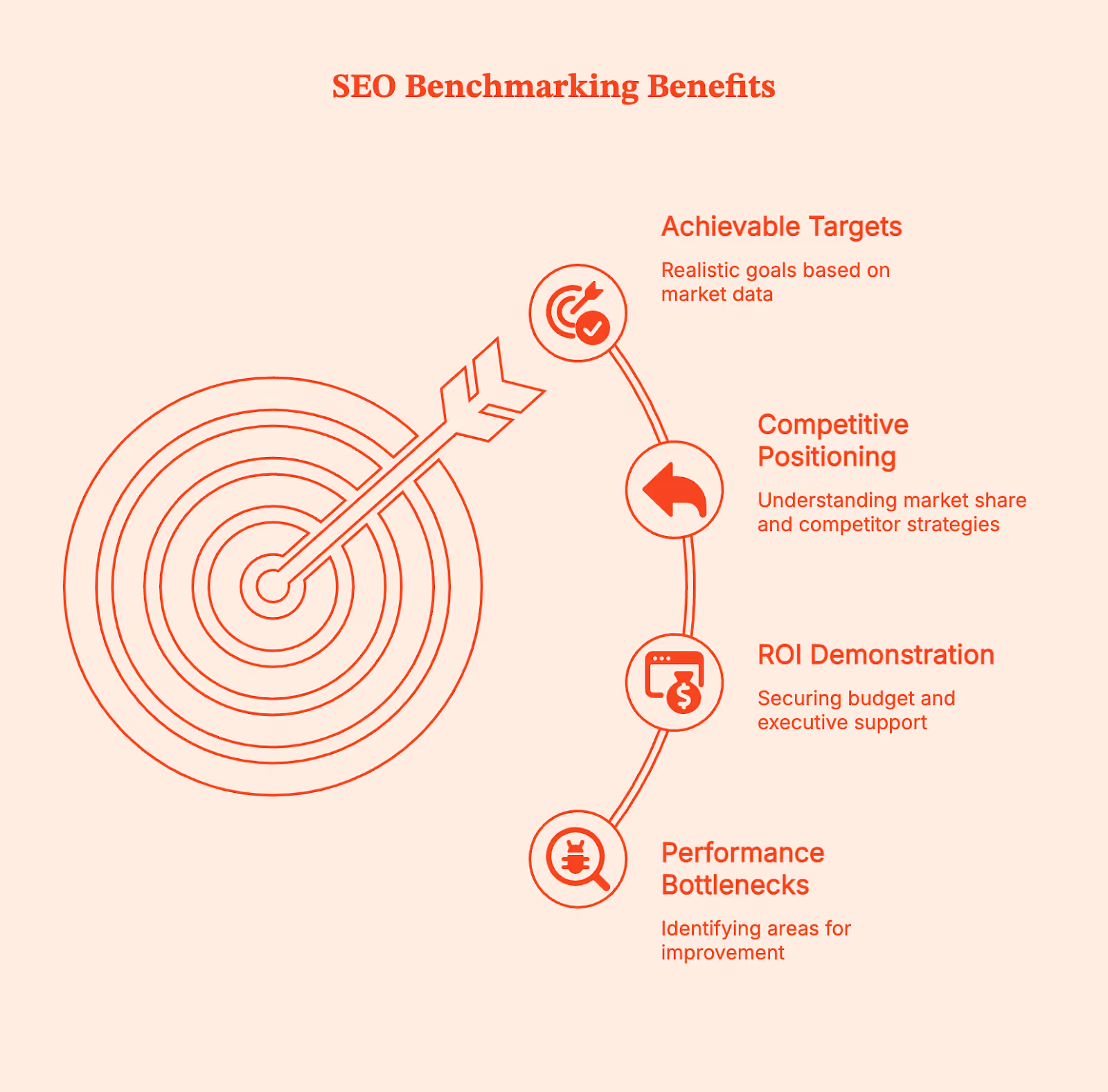
So what can effective benchmarking actually reveal? Let me walk you through it:
- Identifying Performance Bottlenecks
Benchmarking shows you exactly where your SEO strategy is falling apart.
Maybe your blog posts rank well and bring in traffic, but your product pages are stuck on page two. That tells you exactly where to focus your content optimization efforts.
On the flip side, you may be getting tons of clicks from search engine results pages, but if your conversions are lagging behind industry standards, the real problem isn't visibility but your landing page experience, how clear your offer is, or whether you're targeting the right people.
When you benchmark different content types, funnel stages, and user segments against each other, these patterns become crystal clear. Instead of spreading your resources thin across everything, benchmarking pinpoints the specific bottlenecks that, once you fix them, will give you the biggest wins.
- Demonstrating ROI and Securing Buy-In
Benchmarking gives you the proof you need to secure budget, headcount, and executive support. Without hard numbers, search engine optimization SEO stays stuck in the "nice to have" category.
Maybe you've been running SEO campaigns for six months, organic search traffic is climbing, but when budget season rolls around, leadership asks, "What's the actual return?"
If all you can say is "keyword rankings improved" or "we're getting more traffic," you're competing for resources with channels that show clear revenue impact.
But when you can walk into that meeting and say, "Our organic traffic jumped 42% quarter over quarter, our top 3 rankings doubled from 15 to 30 keywords, and our organic conversion rate climbed from 2.1% to 3.4%," you're speaking the language of business results.
That's measurable growth tied directly to the bottom line.
This is where benchmarking turns SEO into a strategic priority because it demonstrates ROI in terms that leadership actually cares about.
- Understanding Competitive Positioning
SEO performance doesn't exist in a vacuum. Let's say your organic traffic grew 10% but your competitors grew 40% during the same period. In reality, you're actually losing market share. Industry benchmarks show you whether you're keeping pace, pulling ahead, or falling behind.
On top of that, competitor analysis reveals what's actually possible when you have similar resources. It helps you pinpoint the specific areas where competitors are outperforming you, whether that's content depth, technical performance, backlink acquisition, or SERP feature ownership.
This context becomes absolutely critical when you're setting realistic expectations and figuring out which initiatives will close the most important gaps.
- Setting Achievable, Data-Driven Targets
Goal setting without benchmarks is guesswork.
You might target 100,000 monthly visits just because it sounds like a nice round number, even though competitors with similar resources and market position are only getting 50,000.
Benchmarking grounds your targets in what's actually realistic.
For example, if competitors in your space with comparable domain authority and content volume are hitting 3.5% CTR, that becomes a meaningful target instead of just some abstract aspiration. Goals driven by benchmarks are way more likely to earn stakeholder buy-in because they're rooted in demonstrated market performance rather than wishful thinking.
Now, all these benefits only work if you're tracking the right metrics and comparing them against meaningful reference points.
Now, all these benefits only work if you're tracking the right metrics and comparing them against meaningful reference points.
Essential SEO Metrics to Benchmark: What to Track for Maximum Impact
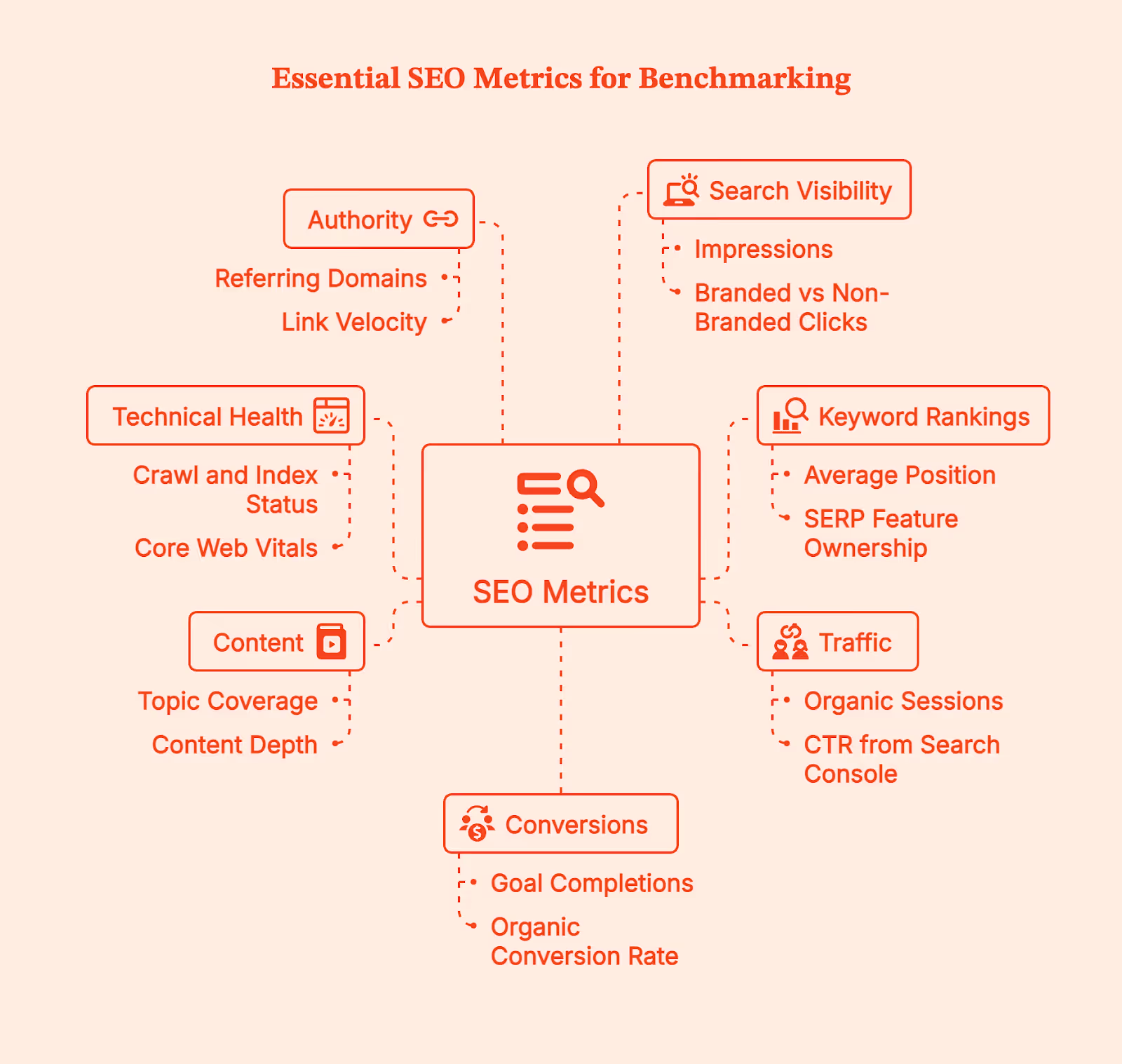
You can track endless data, but these are a few important metrics you must start with before adding anything else to your list.
- Search Visibility: Impressions (how often you appear in results), branded keywords vs non-branded clicks (are people finding you or searching for you?), total ranking keywords, and share of voice (your percentage of available clicks).
- Keyword Rankings: Average position for priority keywords, percentage in top 3 and top 10 (position 1 gets 28% of clicks, position 10 gets under 2%), and SERP feature ownership (snippets, People Also Ask boxes).
- Traffic: Organic sessions, CTR from Search Console (varies by industry: healthcare averages 3.3%, legal 6.6%), and average engagement time.
- Conversions: Goal completions, organic conversion rate, lead quality (MQL/SQL rates), and revenue attribution.
- Content: Topic coverage vs competitors, content depth compared to top results, and freshness.
- Technical Health: Crawl and index status, Core Web Vitals (LCP, FID, CLS), site speed, broken links, and internal linking.
- Authority: Referring domains (backlinks remain a top factor), link velocity, and domain authority scores.
Here's the thing, though: tracking these metrics for your own site is just the starting point. Your website performance only really makes sense when you stack it up against competitor performance.
How to Conduct Competitive SEO Benchmarking?
Your business competitors aren't always your search competitors.
For instance, an analytics platform might compete with sales enablement tools for keywords like 'revenue performance dashboard' or 'pipeline visibility,' even though they solve completely different problems.
So, how do you find your real search competitors? Search your target keywords and take note of who consistently appears in the top 10. If they rank for 60% of your tracked keywords, they're a direct competitor.
Once you've identified your competitors, you'll want to run some gap analyses:
- Keyword gap: What are they ranking for that you're not?
- Content gap: What topics have they covered in depth that you've barely touched?
- Backlink gap: Where are they getting links that you're not?
- SERP feature gap: Are they owning snippets for keywords where you rank but don't have features?
After that, you'll want to measure the delta. If a competitor gets 50,000 monthly visits and you get 20,000, that's a 2.5x gap. You can break this down by category to figure out where to focus your efforts.
Beyond just understanding these gaps, you'll also need to run a systematic benchmark that captures all this data.
How to Run a Complete SEO Benchmark: A 7-Step Process for Measuring Performance
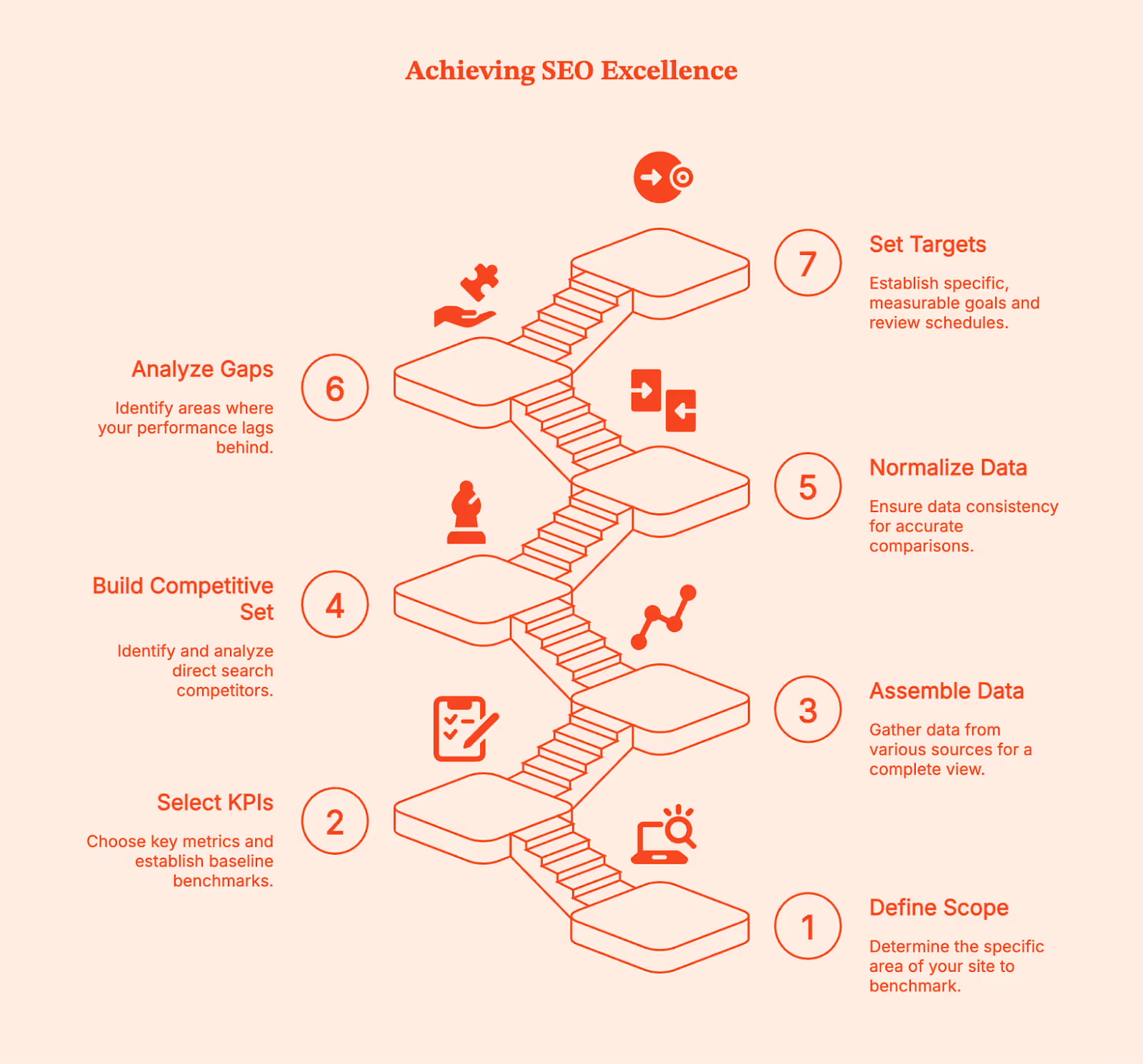
To run an effective SEO benchmark, you need a structured approach. Here are seven steps that'll help you establish meaningful baselines, spot opportunities, and set achievable targets.
Step 1: Define Your Benchmark Scope
First things first: what exactly are you benchmarking? Think about whether you're measuring your entire site, a specific product category, a content hub, or a particular funnel.
Your scope should align directly with your business goals. If you're launching a new SaaS platform for lawyers, benchmark that category specifically. If you're trying to build thought leadership, focus on your blog or resource center.
Trying to benchmark everything at once dilutes your focus and makes it harder to identify actionable patterns. If the objective is to increase demo requests, you'll prioritize conversion metrics and commercial intent keywords rather than top-of-funnel traffic.
Step 2: Select KPIs and Establish Baseline Benchmarks
You'll want to select 10-15 SEO key performance indicators that directly align with your defined goals. It's easy to get swayed and track all possible metrics, but focusing only on the ones that absolutely matter will give you the clearest insights.
Each KPI needs a precisely documented baseline. If your goal is to increase conversions by 25%, you need to know your exact starting point: current conversion count, conversion rate, and the time period measured.
Consistent measurement windows (e.g., 30 days, 90 days) help ensure accuracy, and documenting any seasonal factors that might affect your baseline is equally important. This baseline becomes your primary reference point for measuring SEO progress.
Step 3: Assemble Your Data Sources
Effective benchmarking requires pulling data from multiple sources to get a complete picture.
At minimum, you'll need:
- Google Search Console for impressions, clicks, CTR, and average position
- Google Analytics for traffic patterns, user behavior, and conversion tracking
- A rank tracker for historical ranking data and competitor visibility
- A crawl tool like Screaming Frog or Sitebulb for technical SEO metrics
- And a backlink index, such as Ahrefs or Semrush, for backlink profile analysis
Setting up regular data exports or API connections means you can track search engine rankings over time without manual data gathering eating up your schedule.
Step 4: Build Your Competitive Set
You'll then need to identify 3-5 direct search competitors. They don't necessarily need to be business competitors, but the sites that consistently rank for your target keywords.
Keyword overlap serves as your primary filter: if a site ranks for 40% or more of your priority keywords, they're a direct search competitor.
They should also target similar audiences and have comparable resources (similar domain authority, content volume, team size). It's best to avoid comparing yourself to industry giants with 10x your resources and instead focus on competitors you can realistically overtake with strategic execution.
Step 5: Normalize Your Data for Fair Comparison
Data consistency is critical for accurate benchmarking. Use identical date ranges for all comparisons. For instance, compare January to January, not January to December, to account for seasonality.
If you're comparing mobile performance, make sure all data sources are filtered to mobile devices.
If you operate in specific markets, geographic regions need to align as well. When comparing to competitors, using the same seo tools and settings is essential. Inconsistent data normalization leads to false conclusions and misguided strategy decisions.
Step 6: Analyze Gaps and Prioritize Opportunities
Once your data is normalized, you can identify the biggest gaps between your SEO performance and your benchmarks (both historical and competitive).
Patterns will start to emerge: Are you losing ground in specific content categories? Do competitors dominate certain SERP features?
Technical performance might be holding you back.
The ICE framework helps you prioritize fixes: Impact (how much will this move the needle?), Confidence (how sure are you it will work?), and Ease (how quickly can you implement it?).
Quick wins include fixing technical errors that block high-value pages, updating thin content on keywords where you rank on page 2, and adding internal links to orphaned content that's not getting crawled effectively.
Step 7: Set Specific Targets and Schedule Reviews
Set concrete, measurable targets with clear owners and a deadline.
For instance, "Increase non-branded sessions from product pages by 30% by Q3, owner: Sarah" is far more actionable than "improve traffic."
Additionally, break large goals into monthly milestones, allowing you to course-correct quickly if you're falling behind.
Schedule your next review based on your site's velocity: monthly reviews work for most sites, quarterly reviews suit slow-moving industries or smaller sites, and weekly reviews are appropriate for high-velocity businesses like news sites or large e-commerce platforms with frequent inventory changes.
How to Structure an Effective SEO Keyword Benchmark Report
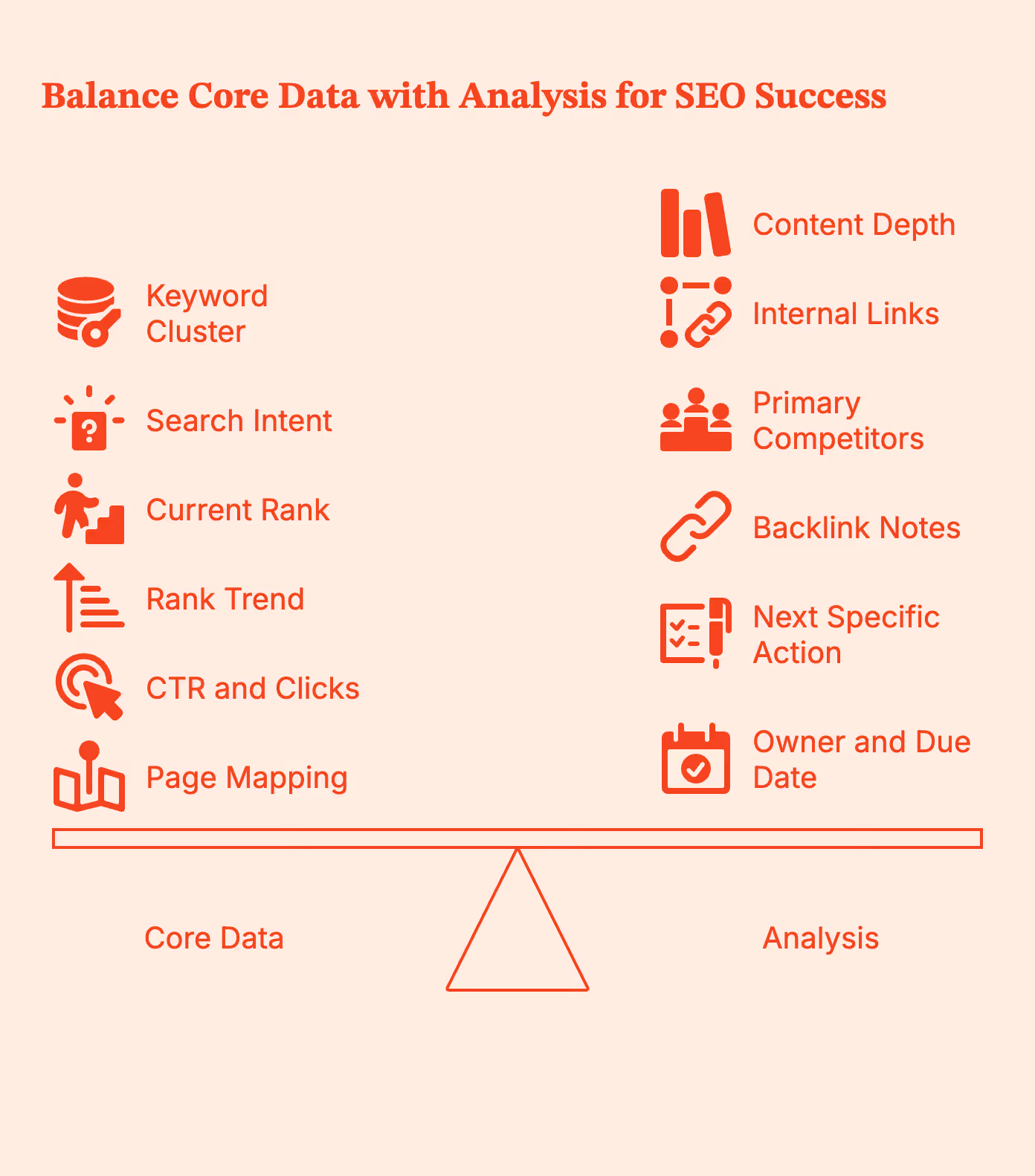
Structure your report with these columns:
- Core data: Keyword cluster (group related terms), search intent (informational/commercial/transactional), current rank, rank trend, CTR, clicks, and page mapping (which page targets this given keyword).
- Analysis: Content depth vs competitors (thin/adequate/comprehensive), internal links pointing to page, primary competitors in positions 1-3, and backlink notes.
- Action: Next specific action ("rewrite intro", not "optimize"), owner, and due date.
Then, set up views for regional, device type, brand vs non-brand, and intent type.
Create three sections:
- Top Movers: Biggest ranking changes (up/down) in 30 days
- Quick Wins: Keywords in positions 4-10 where small improvements drive more traffic
- Blocked by Tech: High-value keywords where technical issues prevent better performance
The structure matters, but so does timing. Different stakeholders need different reporting frequencies.
How Often Should You Review SEO Benchmarks and Set Performance Targets?
- Weekly: Track critical changes only: major ranking shifts, technical errors, traffic anomalies. Flag what needs immediate attention.
- Monthly: Compare benchmarks to targets. Review traffic/conversion trends, ranking progress, new SEO content performance, and technical health. Did you hit goals? Where are you ahead or behind?
- Quarterly: Full benchmark reset. Compared to the previous quarter and year-over-year. Reassess competitive set. Answer bigger questions: Are content pillars working? Should we shift the budget? Do we need different keywords?
Essential SEO Benchmarking Tools and Ready-to-Use Templates
- All-in-one platforms: Ahrefs, Semrush, or Moz handle seo keyword research, position tracking, backlink monitoring, and competitive research. Ahrefs excels at backlink data, Semrush has strong PPC integration, and Moz focuses on simplicity.
- Site crawlers: Screaming Frog or Sitebulb find technical issues. Run monthly crawls to benchmark health.
- Best keyword research tools: Google Keyword Planner for search volume and keyword ideas, Ahrefs Keywords Explorer for related keywords and search queries, and Semrush Keyword Magic Tool for building a comprehensive keyword list with niche keywords.
- Essentials: Google Analytics for analytics tracking and Google Search Console (impressions, clicks, CTR, position). Non-negotiable for website owners and SEO professionals.
- Dashboards: Google Data Studio, Tableau, or Databox visualize benchmarks and automate client reporting.
- Third-party tools: Consider specialized tools like Google Business Profile for local businesses and other SEO tools for link building and on page SEO analysis.
- Template structure: Include sheets for an overview dashboard, keyword performance by cluster, competitive comparison grid, technical health checklist (including meta descriptions, meta title, and page SEO), content gap analysis, and monthly snapshots.
Beyond internal tracking, your benchmark data has another valuable use: thought leadership.
How to Turn Your SEO Benchmark Data into Thought Leadership Content
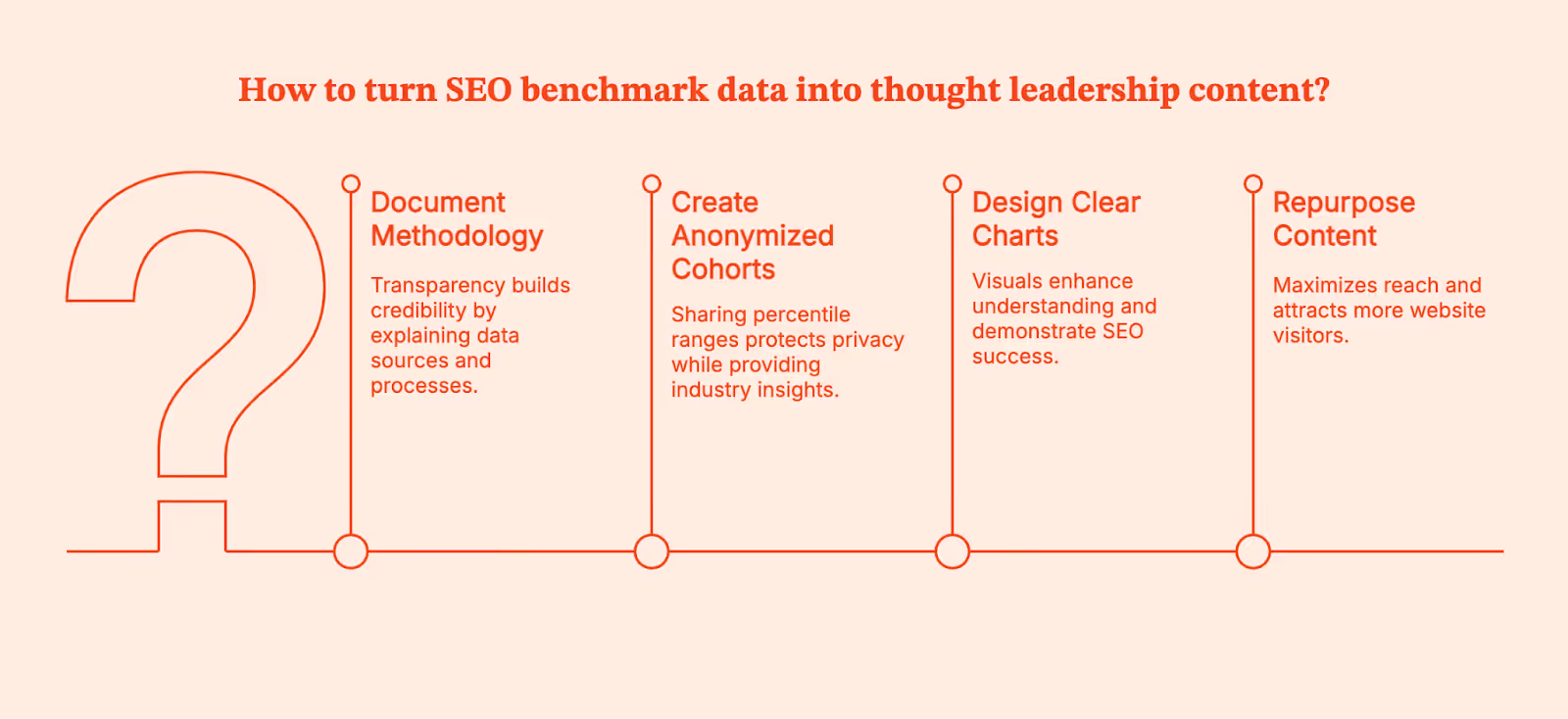
The steps you take to successfully benchmark SEO data can be used to create content for people struggling with the same. Here's how you can easily create thought leadership content:
- Document methodology: Explain date ranges, tools, and sample size. Transparency builds credibility when discussing your content strategy.
- Create anonymized cohorts: Group by industry, company size, or traffic level. Share percentile ranges, not specific numbers: "Median healthcare CTR was 3.2%, 75th percentile at 4.1%."
- Design clear charts: One insight per chart. Show benchmark ranges, year-over-year trends, and performance distribution to demonstrate SEO success.
- Repurpose everywhere: Break into 5-10 blog posts, create social graphics with stats, pitch publications with exclusive findings, build sales materials, and update annually to attract more website visitors.
This content drives organic search traffic, builds authority, and gives your sales team data for conversations. It also helps you compare organic results against Google Ads campaigns to understand your full search presence.
In a Nutshell…
I’m hoping that by now you agree that SEO benchmarking is all about making that data work for you.
By comparing performance to meaningful baselines, competitors, and market standards, you move from aimless reporting to focused, strategic action. When you set the right scope, choose metrics that align with business outcomes, and analyze consistently over time, benchmarking becomes the signal.
This guide gave you a step-by-step process to track what truly matters, spot opportunities where others overlook them, and report in a way that resonates with decision-makers. Whether you’re tracking performance monthly or reviewing quarterly trends, benchmarking helps you sharpen focus, improve ROI visibility, and stay one step ahead of your search competition.
Bottom line: good SEO is about knowing what’s working, what’s not, and what’s next.
FAQs for SEO Benchmarking
Q. What does an SEO report mean?
A. A summary of performance vs goals and benchmarks, with insights and next steps. Not a data dump. Good reports answer three questions: Where are we? How does that compare? What do we do next?
Q. How often should I benchmark?
A. Track weekly for issues, review monthly against benchmarks, and realign quarterly for strategy. Adjust based on site scale and volatility.
Q. What are good benchmarks for CTR and conversions?
A. CTR varies by industry: healthcare, 3.3%, legal, 6.6%. Compare these to Google Ads benchmarks for a full picture. E-commerce conversion averages 2.5-3%, B2B leads 2-5%. Your baseline matters more than industry averages. Focus on improving your own performance and track keyword rankings consistently.
Q. Which tools are best for competitive benchmarking?
A. Combine Semrush or Ahrefs (keywords, content, backlinks), Screaming Frog (technical), and Google Search Console + Google Analytics (your own data). All-in-one platforms handle most needs for tracking keyword performance.
Q. How do I create a compelling keyword report for leadership?
A. Lead with goals and changes. Start with a one-page summary showing status vs goals, three wins, three risks, and top actions for 90 days. Use visuals and color coding: green for on-target clusters, yellow for at-risk, red for problems. Show the 30 highest-value keywords, not all 500. End with clear budget or approval requests tied directly to benchmark gaps.

10 Best Sales Intelligence Tools for B2B Pipeline (2026)
Sales intelligence tools optimize GTM workflows. Compare the top 10 platforms like Factors.ai and Apollo to track buyer intent and find accurate contact data.
TL;DR
- Sales intelligence tools enable smarter GTM execution by identifying in-market accounts and relevant buyer contacts across web activity, CRM, and third-party data.
- Top solutions include Factors.ai, Clearbit, Apollo, and LinkedIn Sales Navigator, each with unique strengths in data accuracy, automation, enrichment, and outreach.
- Choosing the right tool depends entirely on your immediate bottleneck—use account-level solutions (like Factors.ai) to deanonymize web traffic, and contact-level databases (like Apollo) to harvest direct emails and mobile dials.
- Key evaluation criteria include data coverage, integration flexibility, pricing structure, ease of use, and customer support responsiveness.
- Real-time engagement tracking and automation features help accelerate buyer journeys, personalize touchpoints, and measure true pipeline impact.
What is Sales Intelligence Software?
Sales intelligence software is a category of GTM data platforms that enables marketing and sales teams to discover high-intent target accounts, enrich business profiles, harvest accurate buyer contact details, and report pipeline performance metrics.
Sales intelligence tools provide marketing and sales teams with relevant data to refine outreach and targeting workflows and performance. Leveraging sales intelligence tools help drive pipeline by discovering high-intent target accounts (with reverse IP-lookup account identification), surfacing relevant contact data (phone numbers, mail IDs, etc), enriching account profiles (firmographics and technographics), and/or reporting GTM metrics and KPIs. In short, sales intelligence tools provide insights to support better marketing and sales efforts.
Needless to say, sales intelligence relies crucially on accurate, up-to-date data to be of any value. Workflow automations, integrations, UI, customer support, and pricing plans are other factors you should consider when evaluating a sales intelligence tool.
While there’s no shortage of sales intelligence solutions out there, it can be challenging to pick one that aligns with your requirements and budget. The following article reviews the top 8 sales intelligence tools for your consideration.
Sales Intelligence - Account Level
Depending on the nature of your business, your total addressable market may be very, very large. Especially for SMEs with limited resources, it wouldn’t make sense to go after each and every account in your TAM. Instead, it's important to identify and prioritize those ICP accounts that showcase the most buying intent with your brand.
Account intelligence tools use reverse IP-lookup to do just that: identify and qualify anonymous, high-intent companies that are already engaging with your brand but are yet to convert. Account intelligence tools deanonymize traffic to reveal account names, firmographics, technographics and more.
With account intelligence tools, you may target warm accounts as opposed to cold, brand-unaware ones. This, unsurprisingly, results in more conversions than ever before. Here are 4 robust account intelligence platforms for your consideration:
1. Factors.AI

Factors is an AI-fuelled ABM and account intelligence solution built upon strong analytics and attribution foundations for B2B teams. Factors provides a wide range of features including account identification, account scoring, workflow automations, multi-touch attribution and more.
Features
- Account identification - discover anonymous accounts interacting with your brand
- Account enrichment - enrich accounts with firmographics and technographics
- Analytics & attribution - KPI reporting, funnels, path analysis, multi-touch attribution and more
- Journeys & scoring - Bird’s eye view of customer journeys and account scoring based on cross-channel engagement
- Workflow automations - Configure real-time alerts, trigger-based emails, CRM updates and more based on intent signals
Benefits
- Data-accuracy - Factors works with industry-leading data partners including 6sense and Clearbit to deliver accurate account identification match rates of up to 64%. This includes firmographics and technographics such as geos, industry, revenue range, employee headcount, etc.
- Holistic scoring - Deep-rooted collaborations with LinkedIn and G2 in addition to website engagement ensures that accounts are scored holistically across the most common channels
- Robust analytics - Given that Factors is built upon strong analytics and attribution foundations, it provides unmatched granularity in terms of reporting and reporting techniques — so you can make data driven decisions, effortlessly
Limitations
- Contact-level data: At the moment, Factors does not provide contact-level data such as email IDs or phone numbers. Instead, users will have to integrate this data from a contact database provider like Apollo or ZoomInfo.
- Native integrations: At the moment, Factors provides native integrations with the most popular B2B ad platforms, CRMs, MAPs, CDPs, and more. That being said, it misses out on integrations with lesser used platforms like Zoho. Note that data may still be pushed from Factors to nearly any other tool in the webhooks (Zapier, Make.com, etc).
Pricing
Factors pricing is based on the number of accounts identified (or volume of monthly website traffic). Factors does offer a free trial and a free plan. Learn more about Factors pricing here: www.factors.ai/pricing
2. Clearbit

Clearbit is an industry-leading sales and marketing intelligence platform that helps teams gain deeper insights into their customers, enhancing marketing efforts and sales strategies. Through a suite of APIs, Clearbit integrates with existing systems, providing real-time identification and enrichment data.
Features
- Reveal - Clearbit identifies anonymous website visitors using IP-lookup. Given that every tool on this list does this, data accuracy and pricing are two important considerations when differentiating between alternatives.
- Enrichment - Clearbit also provides firmographics from over 250 data sources. This includes technologies, headcount, revenue, location, contact information, and more.
- Capture - like Leadfeeder Contacts, identifies best-fit contacts from companies visiting your website to reach out to with retargeting campaigns or outbound efforts
Benefits
- Intuitive UI - Clearbit is a well-established platform with an intuitive, accessible user interface making it easy to plug and play for most teams.
- Strong integrations - Clearbit provides deeper, two-way integrations with CRMs, Internals comms, and other everyday GTM platforms as compared to other tools on this list.
- Contact database - In addition to account level data, Clearbit also provides a contact database to streamline the outreach process by recommending relevant people to get in touch with.

Limitations
- Pricing - While Clearbit boasts an impressive database, it’s definitely a more premium product. Pricing starts at around $12,000 annually for its more basic plans. This might be inaccessible for early-stage SME teams.
Pricing
Clearbit does not openly reveal its pricing but estimates place it starting at about $12,000-$20,000 a year. Learn more about Clearbit pricing by connecting with their sales team.
3. Leadsquared
LeadSquared CRM is a sales and marketing automation platform to boost sales productivity and revenue outcomes. Salespeople can sell a lot faster and smarter by using LeadSquared's customizable workflows, reminder systems, and lead scoring features. The tool also provides complete visibility into the prospects activities and preferences in a single view, for a more personalized selling experience.
Features
- Automated Lead Management: Capture, distribute, and track leads at every stage of the sales funnel.
- Reports and Analytics: In-depth reports for managers to analyze sales performance, forecast sales, and manage the team's targets.
- Segmented User Lists: Assign customers to lists based on various parameters such as demographics, preferences, etc. Businesses can set up trigger-based communication for every list to personalize communication.
- Mobile CRM: Track field sales activities and interactions as your sales reps get through the day. The Mobile CRM also allows them to upload documents and lead data from their phone.
- Built-in-dialer: Set up one-click calls to prospects, manage call logs, recordings, and notes by integrating with IVR solutions.
Benefits
- Completely customizable: LeadSquared is a good fit for businesses of all sizes, no matter how complicated their workflows are. The product and workflows can be customized to solve specific business challenges.
- Integrations: All your data can be centralized on the CRM because it can be easily integrated with most of the popular tools.
- Security: LeadSquared is compliant with all the laws and regulations related to data security. So, businesses never have to worry about the data they add on the platform.

Limitations
Initial training: Users who are new to using a CRM might require training while setting up complex automation and reporting.
Pricing
LeadSquared offers three plans based on the features businesses may require. Here are the specifications of these plans:
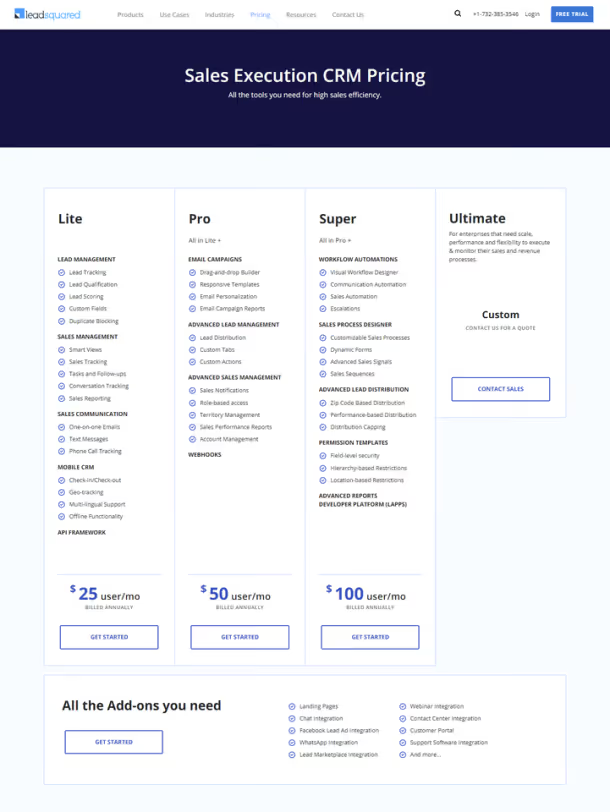
4. Leadfeeder/Dealfront
Leadfeeder [Now Dealfront] is another popular account intelligence solution that’s been around for quite some time. It has recently rebranded itself as Dealfront — a Europe-centric GTM intelligence platform. This has resulted in several former customers looking for Leadfeeder Alternatives. That being said, it’s still a comprehensive solution depending on your use-case.
Features
- Account identification - As with other tools on this account intelligence list, Leadfeeder identifies the names of the companies visiting your website.
- Leadfeeder Contacts - As with Clearbit, Leadfeeder also provides contact-level data based on the accounts visiting your website
Benefits
- Europe-centric data - If you’re looking for Europe-focused sales intelligence, Leadfeeder may be the best choice for you, given that it especially specializes in European geographies.
Limitations
- Shacky integrations - While Leadfeeder provides a wide range of integrations, users often find discrepancies and inaccuracies in terms of data synchronization.
- Poor customer success - Several users complain about Leadfeeder’s poor customer success, claiming it to be pushy and unhelpful.
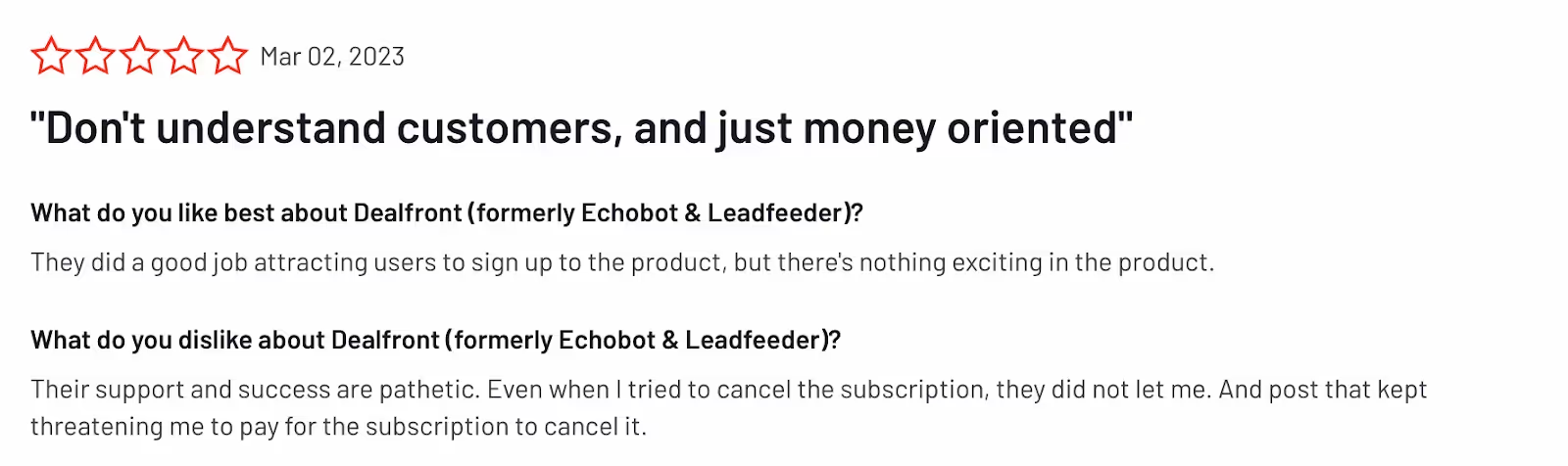
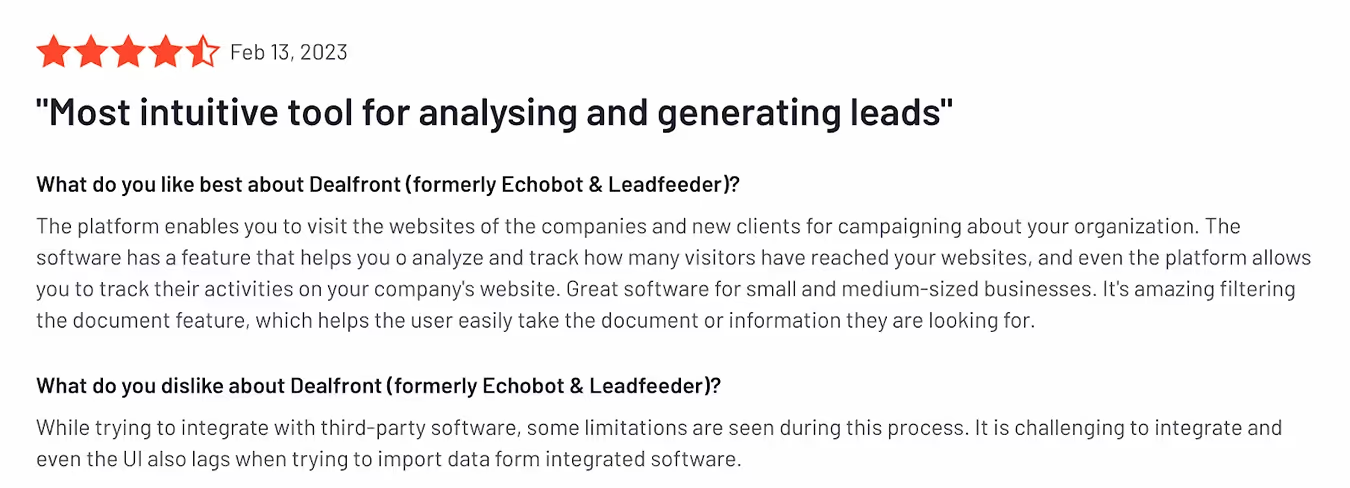
Pricing
As with most other tools on this list, Leadfeeder pricing is based on the volume of data consumed. Leadfeeder does offer a free plan. Leadfeeder pricing starts at about $150.
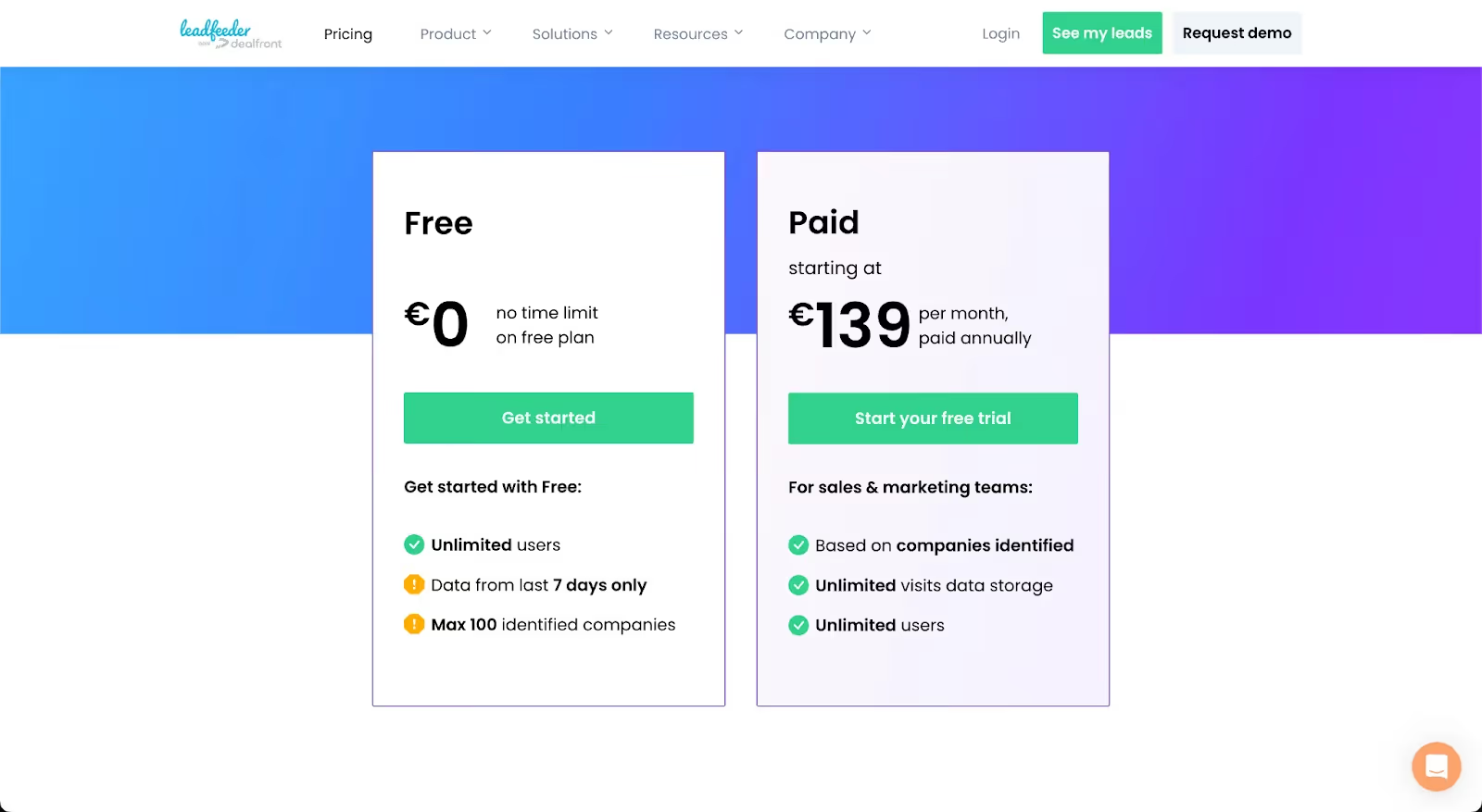
5. Albacross

Finally, we arrive at Albacross. Albacross is another leading sales intelligence tool. The Sweden-based platform works with 10,000+ companies to provide data enrichment, sales alerts and intent signals.
Features
- Account Identification: Albacross identifies anonymous accounts, firmographic information and visitor intent. Albacross features one of the largest proprietary first-party databases in the world.
- Personalization: Albacross natively integrates with popular personalization tools such as Optimizely and VWO to customize website content based on who’s visiting the site.
- Display ads: Albacross can also launch and monitor display ads within the platform itself. The software partners with several publicists such as The New York Times and Daily Mail to distribute account-level targeted ads.
Benefits
- Experimenting: Albacross offers the unique benefit to experiment and run A/B tests in conjunction with visitor identification and intent data.
- Customer success: Several reviews rave about Albacross’s stellar customer success management. Given that Albacross is considered to be an involved, enterprise-level tool, it’s essential to have this level of support to get the most value out of the product.

Limitations
- Rigid firmographics and filters - Albacross lacks agility when it comes to filters and breakdowns. Reviews reveal that, unlike other tools on this list, Albacross is currently unable to filter identified companies based on firmographics such as name or size. As a result, users seem to find sorting and reporting somewhat challenging.
- Buggy integrations: Multiple reviews claim that Albacross’s integrations, especially with CRMs like Salesforce, could do with some work. Given that visitor identification is primarily used to support ABM, this can be a major drawback to B2B teams.
- Limited documentation and resources make users overly reliant on customer success teams

Sales Intelligence - Contact Level
Identifying in-market accounts is a fantastic start to optimizing GTM performance. But once you have a set of target accounts, you also need to know who to reach out to within those accounts for the best chance of conversions. You need phone numbers, email IDs, and LinkedIn profiles to get in touch with the relevant stakeholders and move forward with outreach and targeting.
This next set of sales intelligence tools helps with just that: Identifying relevant contacts and their contact information from your target accounts using enormous contact databases.
6. Apollo
Apollo is a sales intelligence and engagement platform. It is an end-to-end sales solution platform with over 265 million contacts. It provides access to rich buyer data, analytical insights and automated and personalized workflows for outreach.
Features
- Enrich: Apollo helps search and enrich lead data leveraging their extensive B2B database.
- Prospect: Using over 65 data attributes, Apollo helps you build lists and filter leads with precision
- Engage: automated sequencing across channels like LinkedIn, SMS, email, etc with AI-powered hyper personalisation.
Benefits
- Powerful Search Tool: The search capabilities are robust, allowing you to fine-tune our searches for targeted sales prospecting.
- Great Support: The customer support team has been responsive and helpful whenever we've had questions or needed assistance.
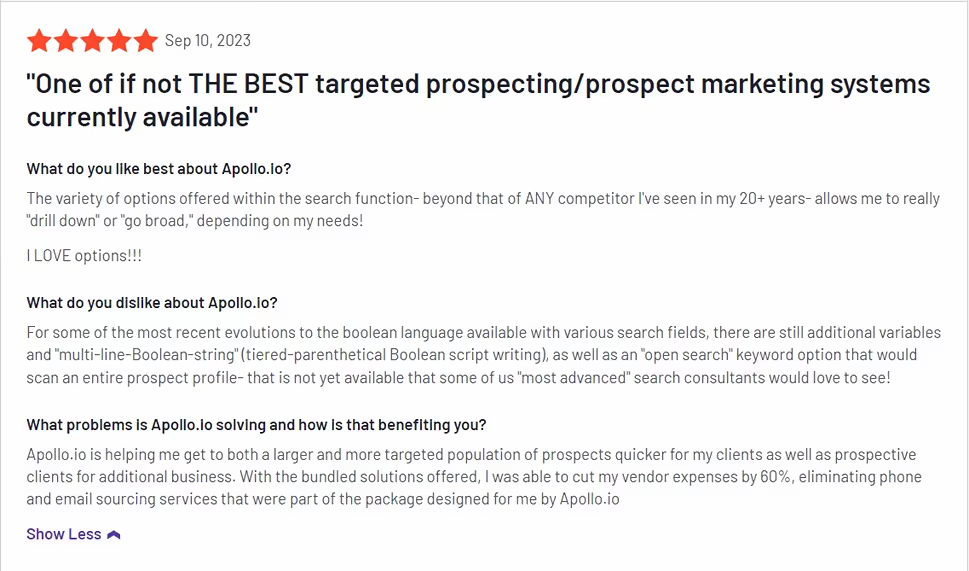
Limitations
Surface-level LinkedIn Integration: No cross-platform automation available with LinkedIn
Steep learning curve: The numerous customizations and variables can be overwhelming for beginners
Pricing
Apollo.io has user based pricing model with a basic plan that starts at $49 dollars/user per month:
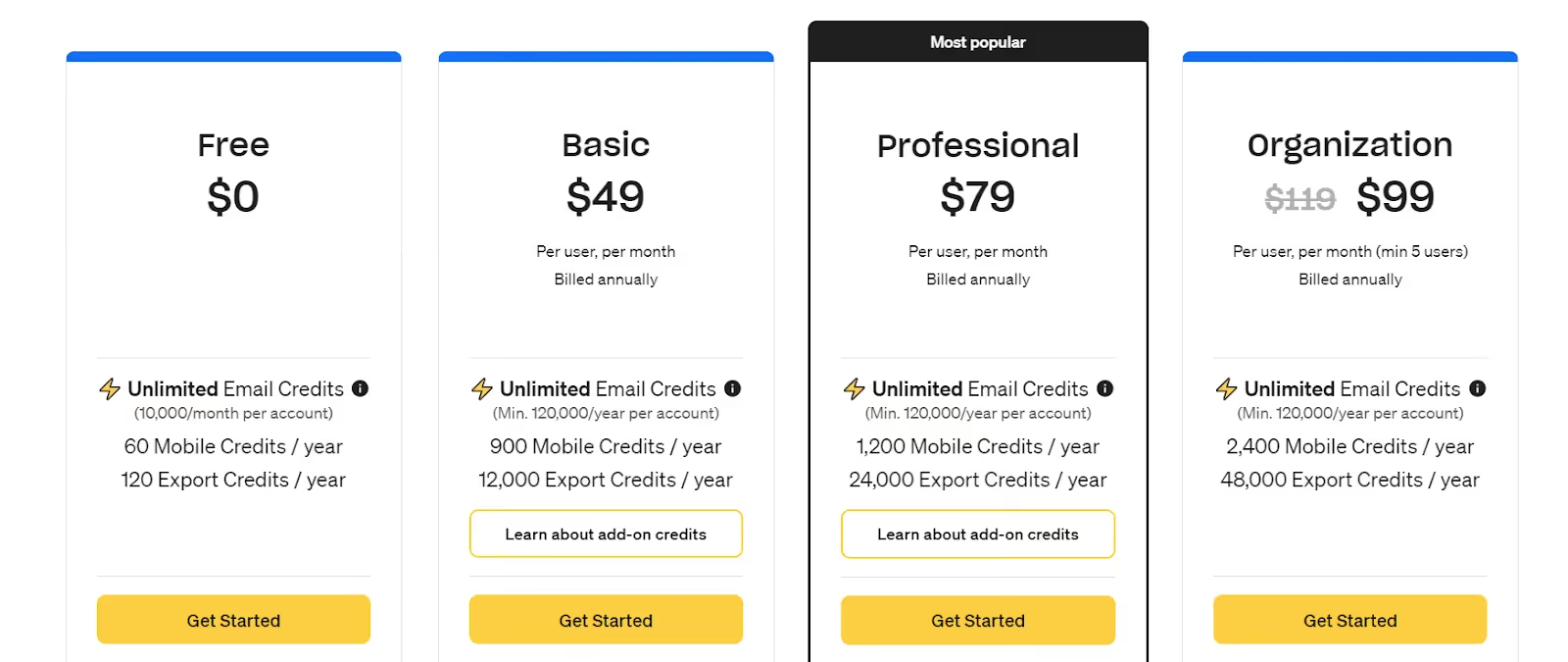
7. Slintel
Slintel is an advanced sales intelligence software that provides valuable technographic data and helps enhance leads by offering precise details about prospects, including email addresses and contact information.
Features
- Buyer enrichment: rich database which provides additional information about their leads and prospects, such as company size, location, and industry
- Buyer intent tracking: Slintel has a valuable indicator to signify a lead’s readiness to purchase.
- People Profiles: Slintel’s database also provides detailed information about the individuals within a company, including their job titles, responsibilities, and contact information.
Benefits
- Technographic filtering: Slintel features unique filters based on understanding the technologies that their leads and prospects are using.
- API suite: Slintel’s API offers range of integrations that help connect with your teams’ current operating system, workflow, and technological infrastructure
Limitations
No mobile credits: Slintel has overlooked an important outbound channel by not providing mobile credits in any of their plans.
Pricing
Slintel has tiered pricing and prices for each plan vary based on the number of leads and users, as well as the duration of the subscription.
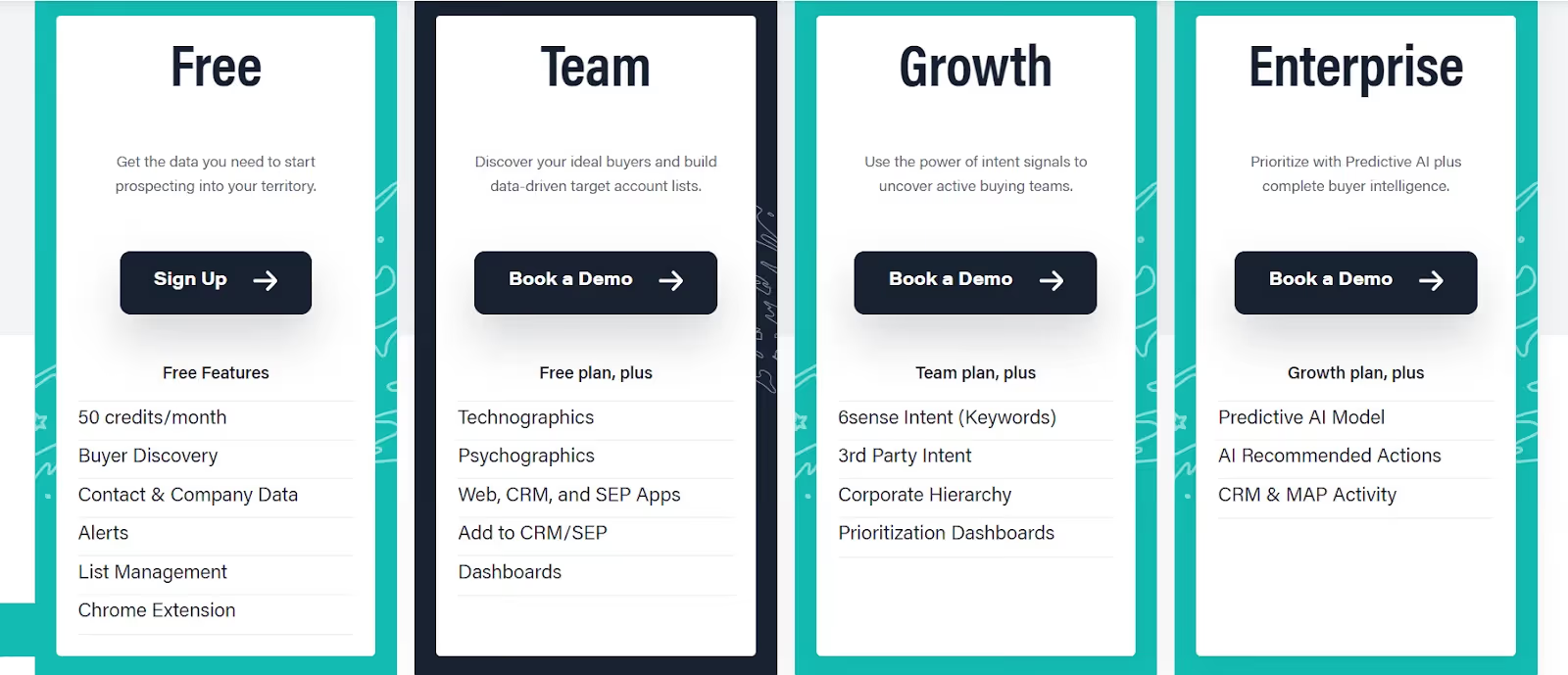
8. LinkedIn Sales Navigator
LinkedIn Sales Navigator is a popular sales intelligence that enables professionals to expand their network, find potential customers, and engage in effective lead generation. It offers advanced search capabilities, personalized insights, and seamless integration with other sales tools for enhanced prospecting and relationship building.
Features
- Search Feature: The Sales Navigator advanced search function gives reps the power to more narrowly target their ideal leads and discover relevant connections.
- Automated Lead Generation: The Lead Recommendations feature suggests relevant leads based on your sales preferences, search history, profile views, and past saved leads.
- Real-time updates: Sales Navigstor provides real-time updates on their leads and accounts, including job changes, company updates, and news mentions.
- Customized Lists: Users can create and save customized lead and account lists for targeted outreach.
Benefits
- Lead Tracking and Notes: Users can save leads and accounts, add notes, and track interactions, helping them stay organized and keep a record of their sales activities.
- InMail Credits: users get a certain number of InMail credits with a sales navigator subscription, which allow them to send direct messages to LinkedIn members even if they are not connected.
Limitations
- Cost: LinkedIn Sales Navigator is a premium service and can be relatively expensive, especially for individual users or small businesses. The cost may be a barrier for some users.
- Learning Curve: The platform has a steeper learning curve and it may take time to fully understand and utilize all its features effectively.
- Limited InMail Credits: While Sales Navigator provides limited InMail credits. If users exhaust their credits, they may need to purchase additional ones, which is costly.
Pricing
LinkedIn Sales Navigator offers three pricing tiers: Core, Advanced, and Advanced Plus:

9. Lusha
Lusha is a lead generation and data enrichment tool that aims to help companies generate qualified leads and maximize conversions. It helps manage business leads, company contacts, and B2B databases fo better sales prospecting.
Features
- Team: Lusha lets you add team members and create different groups within the application to facilitate collaboration.
- Technology Filter: Lusha's Technographic filters that give businesses the ability to target companies based on the technology stack they are using.
- Salesforce Data Enrichment: Lusha's Salesforce Data Enrichment feature automatically enriches Salesforce records with accurate contact and company data.
- Intent: Lusha allows you to filkter prospects based on their behavioral signals
Benefits
- High Accuracy: Lusha claims the highest accuracy rate in the entire industry, claiming 81% accurate emails and phone numbers to their users for cold outreach.
- User-friendly interface: The platform interface is intuitive and easy to navigate for beginners.
- Chrome extension: Lusha’s chrome extension is a value add that makes it easy to get the contact information from the browser directly.
- Responsive customer support: The customer support team is extremely responsive and friendly, helping improve the user experience.
Limitations
Data Security: there are reports of outrage from customers that accuse Lusha of selling their personal information to third parties.
Pricing
Much like most softwares on this list, Lusha has a usage based pricing model with 4 plans- free, pro, premium and scale:
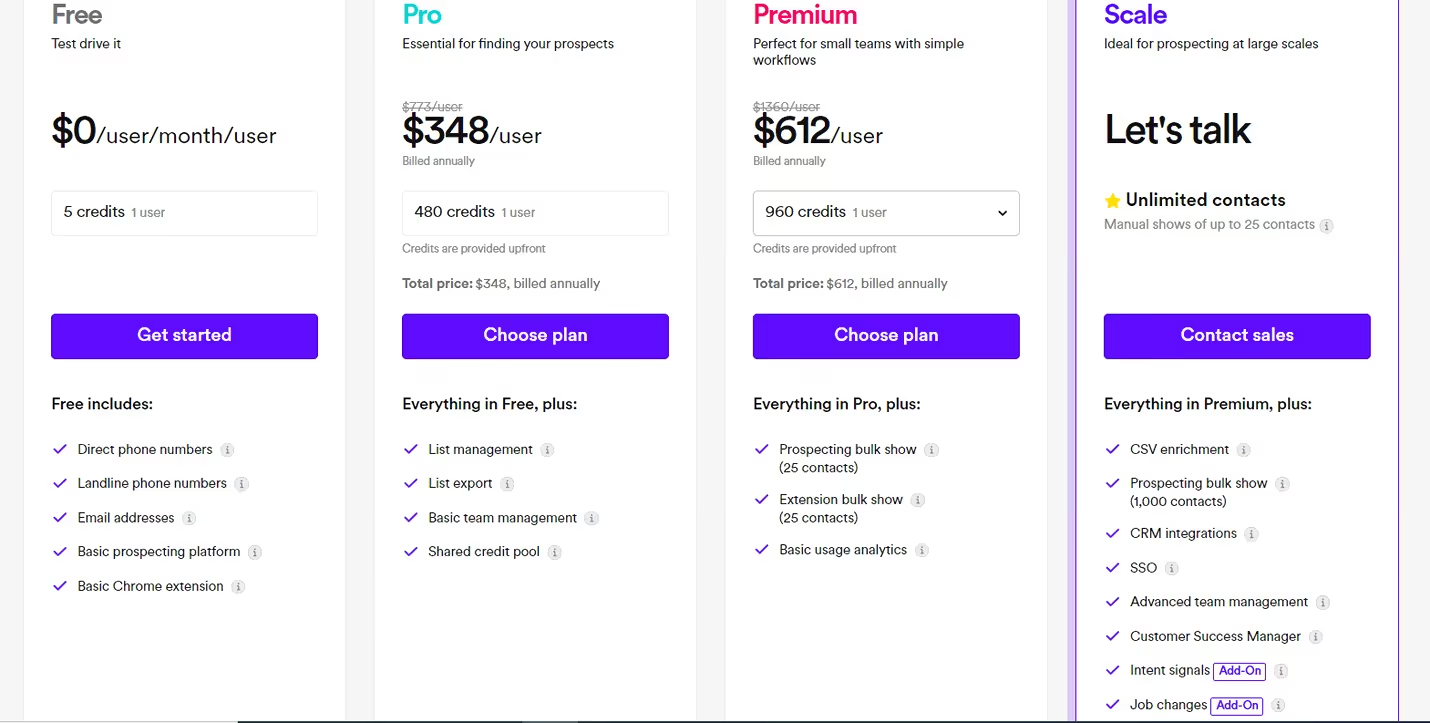
10. SDRx
SDRx is an AI SDR that builds targeted lists, conducts account research, and crafts personalized emails with follow-ups tailored to the prospect's journey. SDRx works like a 24/7 sales assistant, managing your outreach activities so you can dedicate your time to meaningful prospect interactions.

Features:
- List Building: Identifies and generates precise account and prospect lists matching Ideal Customer Profiles (ICPs).
- Comprehensive Account Research: Collects actionable insights from internal and external data sources.
- Personalized Email Creation: Leverages 25 proven email frameworks to maximize response rates.
- Multi-Channel Outreach: Automatically customizes follow-up frequency and messaging based on the prospect's buying stage.
- 24/7/365 Continuous Operation: Eliminates ramp time and burnout associated with traditional sales development.
Benefits:
SDRx's claims to combine deep account research, end-to-end email deliverability, and the use of 25 copywriting frameworks to conduct multi-channel outreach.
Pricing:
Pricing details are available upon request.
Key Considerations When Choosing Sales Intelligence Software
Picking the right sales intelligence software in 2025 isn’t just about ticking off a list of features—it’s about finding the perfect fit for your business. So, what should you be looking for?
First up, data quality and coverage. You want a platform that delivers verified, up-to-date info across your target markets. Make sure the data gets refreshed regularly and covers all the geographical areas where you’re active.
Next, think about integration capabilities. Your new tool should play nicely with your current tech setup, especially your CRM. A seamless connection means your team won’t have to juggle different platforms, keeping everything running smoothly.
When considering pricing and ROI, don’t just focus on the price tag. Look at user limits, data credits, and any extra features you might need as you grow. Consider the potential return on investment by factoring in improved conversion rates and time saved.
User experience? It’s more crucial than ever. Your team should be able to navigate the software easily without needing a ton of training. Look for clean interfaces and dashboards you can customize to fit your workflow.
And don’t forget to check out the customer support quality. The top tools come with thorough onboarding, responsive support teams, and educational resources to help you get the most out of your investment. Regular check-ins and dedicated success managers can be game-changers, especially for larger rollouts.
In the end, choosing the right sales intelligence software is all about finding a solution that feels like it was made just for you and your business.
The Best Sales Intelligence Tools to Drive High-Intent B2B Pipeline
Choosing the right sales intelligence tool is essential for modern B2B teams aiming to work smarter, not just harder. With today’s buyers conducting research independently across platforms, identifying and engaging the right accounts at the right time can be the difference between pipeline acceleration and wasted outreach.
As we saw, sales intelligence tools enhance marketing and sales efforts by providing data-driven insights for better targeting and outreach.
- Key Capabilities: Reverse IP-lookup, contact data enrichment, firmographics, technographics, and GTM analytics.
- Selection Criteria: Data coverage, integration flexibility, pricing, UX, and customer support.
- Top Solutions: Factors.ai, Clearbit, Apollo, and LinkedIn Sales Navigator—each excelling in data accuracy, automation, and outreach.
The above definitive guide compares 10 leading sales intelligence platforms—across both account-level and contact-level categories. Tools like Factors.ai, Clearbit, Apollo, and Slintel offer features like reverse IP lookup, firmographic enrichment, contact data access, real-time alerts, and automation that allow teams to focus their efforts on high-conversion opportunities.
From budget-conscious startups to enterprise-grade go-to-market teams, each platform serves a different need. You’ll also find breakdowns of strengths, limitations, and pricing transparency to help evaluate fit based on data quality, integrations, user experience, and ROI.
Whether you're optimizing ABM workflows, enhancing outbound targeting, or aligning sales and marketing around shared signals, this review helps you choose a platform that delivers results.
Top Sales Intelligence Tools for Smarter Outreach
Sales intelligence tools enhance marketing and sales efforts by providing data-driven insights for better targeting and outreach.
1. Key Capabilities: Reverse IP-lookup, contact data enrichment, firmographics, technographics, and GTM analytics.
2. Selection Criteria: Data coverage, integration flexibility, pricing, UX, and customer support.
3. Top Solutions: Factors.ai, Clearbit, Apollo, and LinkedIn Sales Navigator—each excelling in data accuracy, automation, and outreach.
Choosing the right tool ensures precise targeting, improved lead quality, and higher conversion rates.

Convert High-Intent Accounts With Salesforce & Webhooks
This guide explores how to identify and convert high-intent accounts with the combined powers of Factors visitor identification and Salesforce webhooks.
Target the right accounts, at the right time with intent-based outreach
B2B sales teams invest significant time and resources into reaching out to prospects who are yet to show any intention of buying. However, this cold outreach almost always yields disappointing results. Even the most comprehensive benchmarks indicate that the average response to cold-calls is only 2%.
And honestly, It’s not difficult to see why.
While it’s easy enough to find lists of companies and leads that fit your ideal client profile, it’s extremely challenging to convince prospects to consider your solution when they’re not yet ready to buy.
So what’s the alternative to reaching out to the right accounts at the wrong time?
Reaching out to the right accounts at the right time of course! Or more specifically, it’s intent-based outreach based on the pot of gold that is the anonymous, sales-ready companies already visiting your website.

The following guide explores how to identify and convert high-intent accounts with the combined powers of Factors’ accounts identification and Salesforce webhooks. We first discuss how this integration works, before delving into a handful of use-cases.
How It Works: Pushing website data back into Salesforce
Factors taps into industry-leading IP-lookup technology to identify up to 64% of anonymous companies visiting your website — without the need for form submissions. This includes company names as well as firmographics such as geography, industry, employee headcount, revenue range and more.
In addition, Factors auto-tracks website activity and engagement at an accounts level with advanced analytics. This includes page views, button clicks, scroll-depth, account timelines, funnels and more.

With this information, users can filter the total set of anonymous traffic down to ICP accounts that have expressed buying intent:
- ICP criteria: Filter down traffic based on firmographics such as industry, headcount and revenue-range to identify accounts that fit your ideal client profile.
- Intent criteria: Filter down traffic based on intent signals such as high-intent page views such as pricing, time-spent on page, and percentage scroll-depth to identify sales-ready buyers.
In short, access a list of high-intent ICP accounts that are already visiting your website but are yet to submit a form or sign-up.
Now, with webhooks and Zapier, it’s easier than ever to automatically push all this account data from Factors into any other tool your team uses. This includes ad platforms, marketing automation platforms, and, in this case, Salesforce CRM.
How will this help? Rather than going after cold leads with negligible chances of conversion, sales reps can view, segment, and target sales-ready accounts inside Salesforce. As we’ll see in the next section, this dramatically simplifies and improves targeted sales outreach.
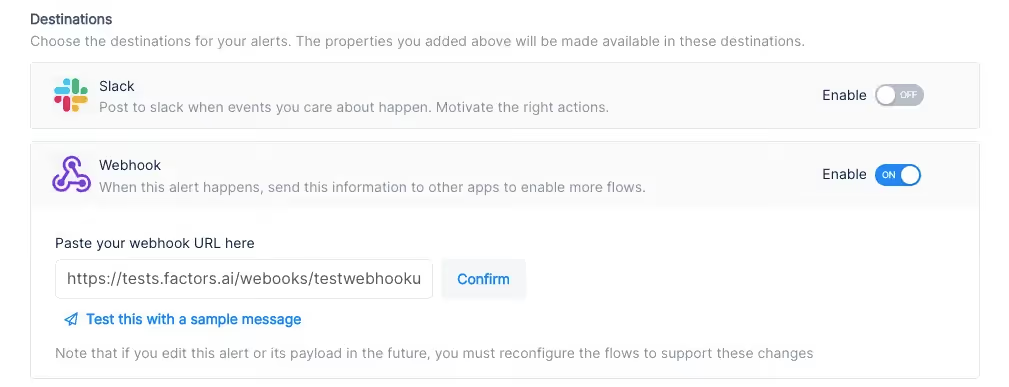
Implementing Webhooks on Factors is easy as pie. See how here.
Use-cases: Making the most of your website traffic
1. Identify new business opportunities
Factors surfaces anonymous, high-intent companies visiting your website. As previously discussed, this data can be filtered down to high-fit, high-intent accounts.
Using webhooks, this data can be pushed from Factors into Salesforce. In other words, you can automatically create accounts inside Salesforce for companies that match your ICP and intent criteria.
For example, webhooks can be configured to create a new account when a visitor from a US-based software company with at least 250 employees is live on your website.
Here are a few more examples of what you can see inside your CRM with Factors:
- Accounts that visit a landing page through a search ad but fail to submit a form
- Software companies with at least 500 employees visiting high-intent pages like pricing
- US-based companies that have read through at least half a product comparison blog
Rather than relying on the 5% of website traffic that submits a form, teams can identify and target a deep new pool of potential pipeline — all within Salesforce. What’s more? Alerts can be relayed to sales reps in real-time through Slack or MS teams so they can immediately reach out to live prospects.
2. Stay on top of existing target accounts
In addition to recording new accounts visiting your website, Factors can be used to monitor and update data for target accounts that already exist within Salesforce.
For example, say an account clicks on a search ad, submits a demo form, but never schedules time on your calendar. While the account's data is available in Salesforce, it can be tedious to track and update their actions post the demo form submission.
To solve for this, Factors can automatically update CRM properties based on trigger criteria when leads return to your website. Let’s say that the same account is back reading a product alternatives blog or visiting the pricing page after a couple of weeks. This event can be updated within Salesforce, including their last active time.
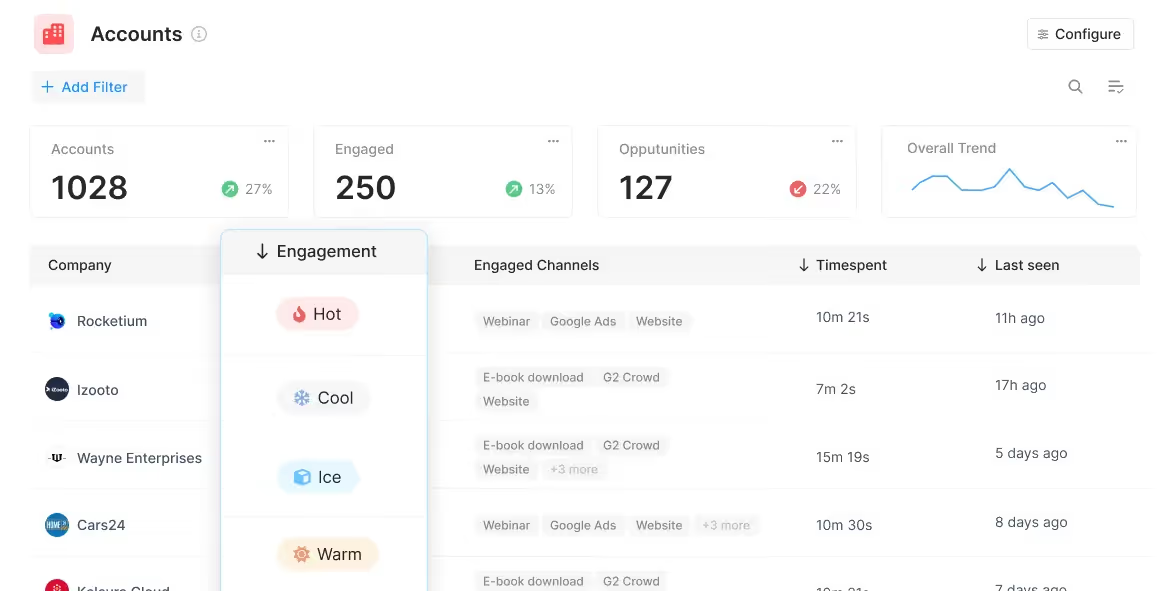
Sales reps can be notified with real-time when high-intent events take place so as to be able to immediately reach out to leads and improve the odds of conversion.
3. Accelerate deals with behavioral data
Certain marketing material may or may not be relevant depending on the audience in question. For example, an enterprise-level account may be especially interested in security compliance related content. An early-stage start-up, on the other hand, may find content around cost-effective pricing more appealing.
Factors can track how various types of companies are interacting with your website to understand what visitors care about most. This data can be pushed back into Salesforce so sales reps can easily assess a prospect’s interactions, priorities and pain-points before jumping into a sales call.
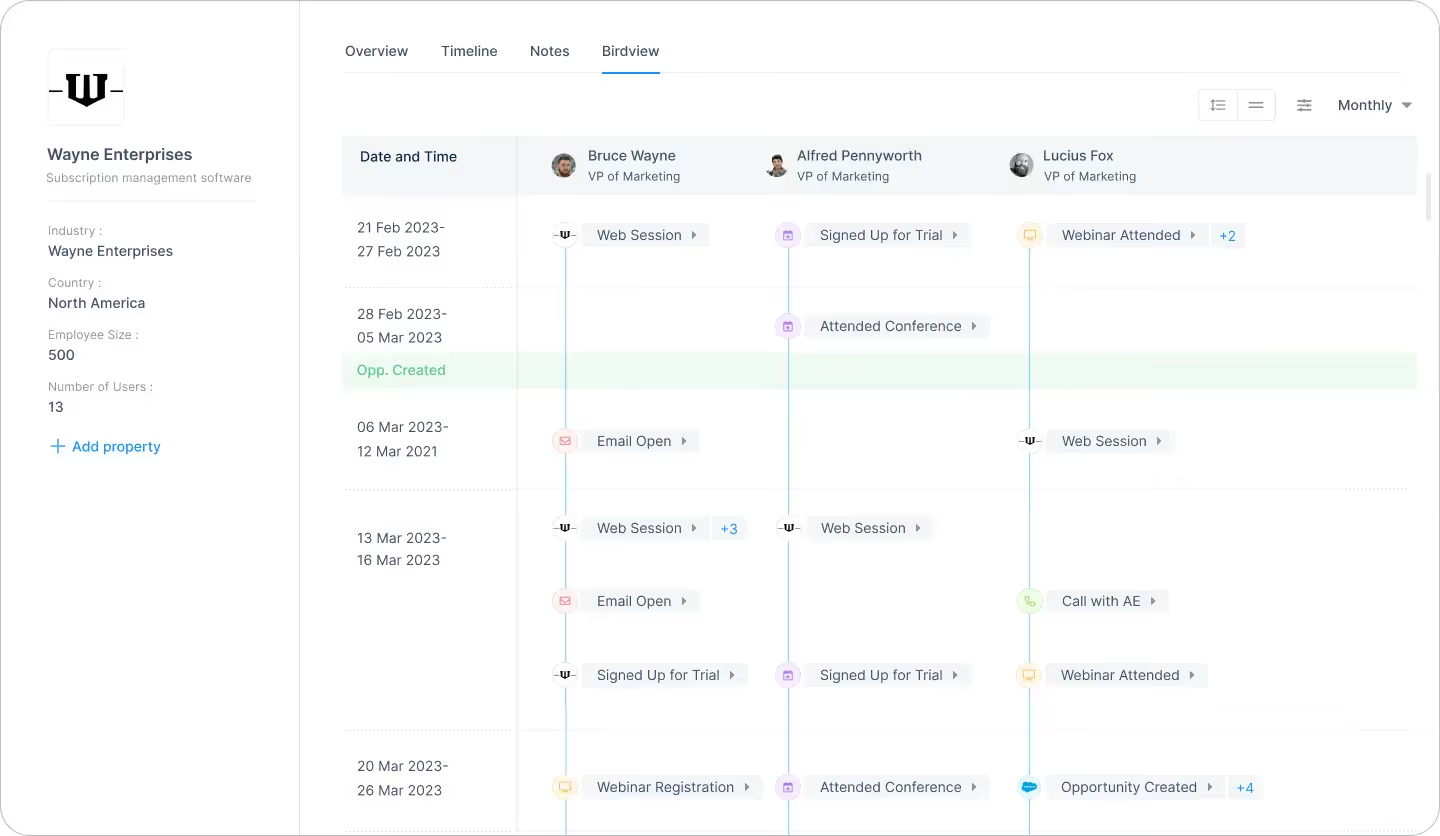
For one, sales reps can accelerate deals by personalizing the customer experience. For another, marketing teams can gauge what resonates best with the target audience and fine-tune content efforts accordingly.
4. Rekindle lost opportunities
Use Factors to track how accounts that have dropped off the funnel or former customers are returning to engage with your website. For instance, maybe an account that churned a couple of quarters ago is back interacting with a page that highlights a new feature release.
This may be an intent-signal that the lead is reconsidering your product. It might be a good idea for sales reps to reach out and share some relevant information on what’s new. Of course, this doesn’t necessarily guarantee a conversion. But it’s far more effective than reaching out to an ice cold lead.
This guide has covered a handful of ways in which pushing account data back into Salesforce can be helpful. Ultimately, the goal is to align visitor data with relevant stakeholders and technologies in order to:
- Drive intent-based sales outreach
- Refine ABM efforts and spends
- Optimize retargeting campaigns
There are countless other use-cases with account identification working in conjunction with CRMs, MAPs, and more. With webhooks, Factors can push valuable account data to nearly any platform on the planet. How you make the most of that data is really up to you — the possibilities are endless.

30 Proven Sales Tactics To Drive More Deals In 2026
A sales tactic is a closing strategy used to convert leads. Discover 30 proven sales methodologies, from benefits-oriented pitches to AI workflows.
TL;DR
- Modern B2B buyers don't care about your product's technical specifications; they care about its economic and operational value. Shift from feature lists to value-oriented storytelling.
- Lower the barrier to entry by using low-commitment offers, micro-courses, or the Foot-in-the-Door technique to secure a small, positive micro-commitment before pitching your core contract.
- Deploy AI tools, conversational chatbots, and intelligent email sequencing to handle routine lead administration so your human reps can focus on high-impact consulting.
- Leverage transparent pricing grids, peer-to-peer user-generated content (UGC), and personalized video clips to eliminate purchase anxiety from day one.
We all agree with the American author, Jeffrey Gitomer when says, “Quality performance starts with a great attitude”. But is that enough when it comes to sales? Unfortunately, not! But guess what, we get it — the sales journey can often feel like a rollercoaster ride, with peaks of triumphs and some valleys of challenges. But we’ve got you this toolkit with 30 sales tactics that will equip you to build better relationships with potential clients and arm you to turn challenging sales pitches into stepping stones for your success.
So, without much ado, let’s get started.
Here are 30 sales tactics to drive more deals in 2026
1. Benefits-Oriented Sales Pitches
Focus on emphasizing the benefits or value your product or service brings to the table rather than solely highlighting its features during sales pitches. By highlighting how your solution addresses specific pain points and improves outcomes, you can resonate more deeply with customer’s use-cases and pain-points.
Why will this technique work?
Prospects are ultimately interested in how a product or service can solve their problems and improve their situation. By prioritizing benefits over features, salespeople can effectively communicate the value proposition and relevance of their offering to the prospect's needs.
Rather than inundating prospects with technical specifications, paint a vivid picture of how your solution streamlines processes and boosts efficiency. For instance, illustrate how your software eliminates repetitive tasks, saving time and resources, thus making the work lives of your clients easier and more productive.
2. Offer Freemiums or Complimentary Trials and Demos
Provide prospects with the opportunity to experience your product through free trials or demos.
Why will this technique work?
Providing freemium or trial versions allows prospects to experience your product firsthand. By allowing hands-on exploration, salespersons can showcase the product's value and functionality, making it more enticing for prospects to convert.
A software company could offer a 14-day free trial, allowing potential clients to explore features before committing. Offer free trials or demos to give potential clients a hands-on experience with your product. For Example:, a software company could provide a 14-day free trial, allowing prospects to explore features and experience the value firsthand before committing.

3. Leveraging Email Automation and CRM Tools for Efficiency
Leverage email automation tools and Customer Relationship Management (CRM) software to streamline prospecting and lead nurturing processes. By automating repetitive tasks and centralizing customer data, sales teams can work more efficiently and effectively to manage their interactions with prospects.
Why will this technique work?
Automation reduces manual workload, allowing sales teams to focus more on building relationships and closing deals. Integration with CRM systems ensures that all interactions with prospects are tracked and managed systematically, leading to improved organization and follow-up
Factors.ai is an account intelligence solution that identifies and activates high-intent accounts engaging with your brand with workflow automations across LinkedIn, CRM, Slack/Teams, and your favorite mail sequencing tools. Learn more over a quick demo
4. Creating Urgency with Limited-time Offers
Employ limited-time offers to create a sense of urgency and prompt prospects to make a decision sooner rather than later. Whether it's a discount, bonus feature, or extended trial period, limited-time offers can push prospects towards a purchasing decision.
Why will this technique work?
Limited-time offers trigger the fear of missing out (FOMO) in prospects, compelling them to act quickly to take advantage of the offer before it expires. By introducing urgency, salespeople can expedite the decision-making process and increase conversion rates.
A limited time seasonal offer, for example, encourages customers to follow through with the purchase decisions, even in periods of relatively low engagement such as the holidays.
5. Establishing Authority through Thought Leadership
Position yourself or your company as an authority in the industry by sharing valuable insights, expertise, and knowledge through thought leadership content. This could include blog posts, whitepapers, webinars, or speaking engagements at industry events.
Why will this technique work?
Prospects are more likely to trust and engage with salespeople who demonstrate a deep understanding of their industry and offer valuable insights. By establishing authority through thought leadership, salespeople can build credibility and trust, making it easier to convert prospects into customers. Publish a series of blog posts or articles addressing common challenges or trends in your industry, providing actionable advice and solutions. Share these resources with prospects to showcase your expertise and differentiate yourself from
6. Developing Interactive Content for Engagement and Data Collection
Create interactive content, such as quizzes, assessments, or webinars, to engage prospects and gather valuable data. Interactive content not only captures attention but also provides insights into prospects' preferences and behavior.
Why will this technique work?
Interactive content is more engaging and memorable than traditional forms of content, making it an effective tool for capturing and retaining prospects' attention. Additionally, the data collected from interactive content can be used to personalize future interactions and tailor your offerings to meet prospects' needs.
Develop an interactive quiz related to your industry or target audience's interests. Not only does this capture leads' attention, but it also provides valuable data on their preferences and pain points. This doesn’t always have to be boring sales enablement. For example, here’s a fun interactive spin off of Wordle by Descope, an authentication platform:

7. Utilizing Referral Programs
Implement referral programs to leverage the trust existing clients have within their network. By incentivizing clients to refer to new business, you can tap into their credibility and expand your customer base through word-of-mouth marketing.
Why will this technique work?
Referral programs capitalize on the existing relationships and trust that clients have with their network. People are more likely to trust recommendations from friends or colleagues, making referral programs an effective way to acquire new customers.
Offer incentives, such as discounts or rewards, to clients who refer new business to you. By turning satisfied clients into advocates, you create a win-win situation where both parties benefit. HubSpot, for examples, runs a robust referral program by encouraging authors to monetise their existing content

8. Implementing Cross-Sell and Upsell Strategies
Identify opportunities to cross-sell or upsell to existing clients to maximize profitability and deepen your relationship with them. By offering additional products or services that complement their existing purchases, you can increase the lifetime value of each client.
Why will this technique work?
Existing clients are already familiar with your brand and have demonstrated trust by making a purchase. By presenting relevant cross-sell or upsell opportunities, you can leverage this trust and provide additional value to your clients while boosting your revenue. A SaaS provider could offer advanced features or premium packages to current users, enhancing their overall experience and addressing additional needs they may have. Identify complementary products or services that align with your clients' existing purchases and present them as value-added propositions.
9. Nurturing Cold Leads with Informative Content
Nurture cold leads with informative content to keep your brand top-of-mind and gradually warm them up to your offerings. By providing valuable insights and resources, you can build credibility, establish trust, and increase the likelihood of conversion.
Why will this technique work?
Cold leads may not be ready to make a purchasing decision immediately, but by consistently providing them with valuable content, you can keep them engaged and build a relationship over time. This increases the chances of converting them into warm leads and eventually customers. Send regular newsletters containing industry insights, success stories, and relevant content to your cold leads.
10. Gamify Sales Incentives
Enhance motivation and a competitive spirit within your sales team by introducing gamification elements into your sales incentives. By incorporating game-like features, such as challenges, rewards, and leaderboards, you can make the sales process more engaging and enjoyable for your team members.
Why Will This Technique Work?
Gamification taps into intrinsic human desires for achievement, recognition, and competition. By infusing the sales process with elements of fun and competition, you can boost morale, increase productivity, and foster a sense of camaraderie among team members. Additionally, gamification provides clear goals and feedback mechanisms, helping salespeople track their progress and stay motivated to perform at their best.
For example, Implement a sales leaderboard that dynamically tracks individual and team achievements in real-time. Recognize top performers with rewards, incentives, or badges to incentivize healthy competition and encourage continuous improvement. Additionally, incorporate interactive challenges or quizzes into sales training sessions to make learning more engaging and memorable for your team members. By leveraging gamification, you can create a positive and motivating sales culture that drives results and promotes collaboration.
11. Harness the Power of AI and Workflow Automations
When it comes to modern sales, AI and workflow automations stand as stalwart allies, streamlining processes and supercharging productivity. From intelligent lead scoring to automated follow-ups, leverage AI tools to identify high-value prospects, predict their needs, and deliver personalized interactions at scale.
Why will this technique work?
AI and workflow automations enhance sales efficiency by automating repetitive tasks, allowing sales teams to focus on high-value activities. The predictive capabilities of AI help identify promising leads, increasing the likelihood of successful conversions. Warmly is a great example of an AI-fuelled sales orchestration platform.

12. Master the Art of Negative Reverse Selling
Flip the script on traditional selling techniques with negative reverse selling. Instead of pushing the benefits of your product, uncover pain points and challenges your prospects are facing. By addressing their concerns head-on, you position yourself as a problem solver, fostering trust and paving the way for a smoother sales journey.
Why will this technique work?
Negative reverse selling works by addressing customer concerns upfront, building trust through transparency. By acknowledging challenges and proposing solutions, salespersons position themselves as problem solvers rather than mere product pushers. Instead of promoting product features, a salesperson starts a conversation by acknowledging common pain points faced by prospects. This honesty creates a connection, and the subsequent discussion revolves around solutions tailored to the prospect's needs.
13. Retarget Website Visitors Strategically
Don't let valuable website visitors slip through the cracks. Implement strategic retargeting campaigns to re-engage potential leads. Use personalized content and incentives to reignite interest and guide them back into your sales funnel, increasing the likelihood of conversion.
Why will this technique work?
Strategic retargeting keeps your brand top of mind, re-engaging visitors who showed initial interest. By delivering personalized content based on their previous interactions, you stay relevant and increase the chances of conversion. For example, a prospect visits your website, explores specific product pages, but leaves without making a purchase. Through strategic retargeting ads on various platforms, they encounter tailored content, such as a limited-time discount, prompting them to revisit and complete the purchase.

14. Craft Personalized Warm Outreach Based on Historical Engagement
Harness the wealth of data at your disposal to craft warm outreach messages tailored to your prospect's historical engagement. Reference specific interactions, highlight relevant content, and demonstrate a genuine understanding of their needs. Personalization is the key to making a lasting impression.
Why will this technique work?
Personalized outreach builds on the prospect's history, creating a connection and showing genuine interest. By referencing past interactions and aligning messages with their preferences, salespersons establish rapport and trust. A prospect who frequently engages with your email newsletters receives a personalized outreach email. It mentions their interest in specific topics, proposes relevant solutions, and invites them for a one-on-one discussion, acknowledging their valuable contribution to your community.
15. Amplify Impact with Customer Testimonials
Let your satisfied customers be your strongest advocates. Integrate compelling customer testimonials into your sales strategy. Showcase real-world success stories to build credibility, instill confidence, and provide tangible proof of the value your product delivers.
Why will this technique work?
Customer testimonials provide authentic proof of your product's value. Prospects are more likely to trust the experiences of their peers, making testimonials a powerful tool for building credibility and influencing purchasing decisions.
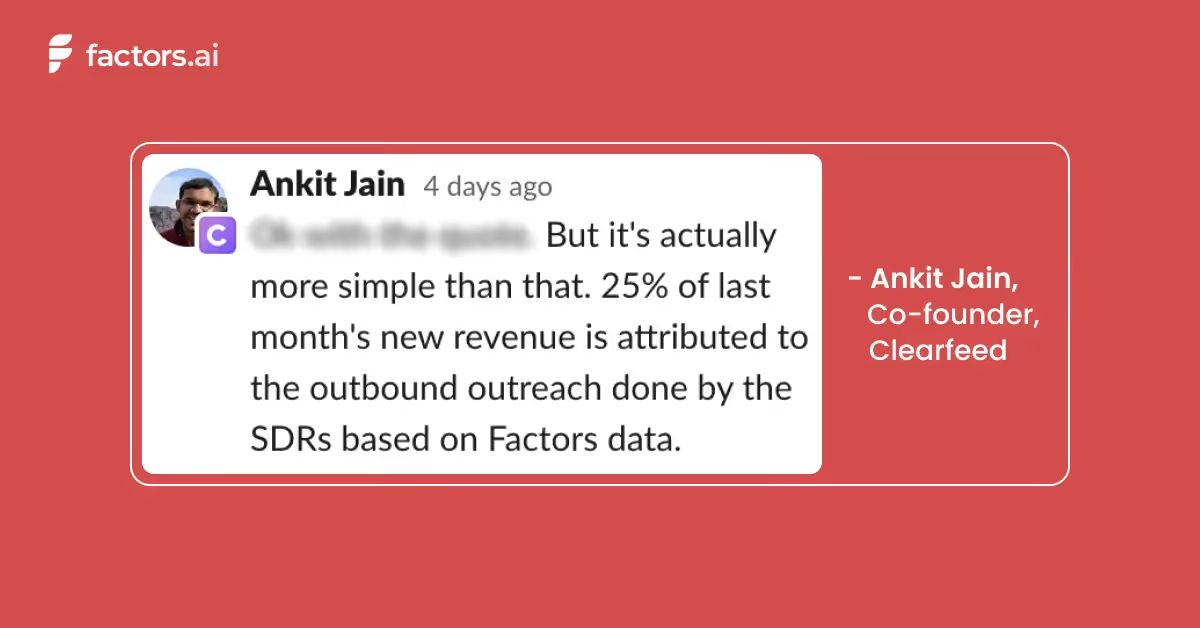
16. Score Account Engagement for Prioritized Action
Implement a robust account engagement scoring system to prioritize sales-ready accounts. Analyze interactions across channels, from website visits to email engagement, assigning scores based on their behavior. Focus your efforts on high-scoring accounts, optimizing your sales outreach for maximum impact.
Why will this technique work?
Account engagement scoring allows sales teams to focus on leads showing the most interest. By quantifying engagement across various touchpoints, salespersons can prioritize their efforts, concentrating on accounts with higher conversion potential. Implement an engagement scoring system where prospect interactions with your content, events, ads, emails, and more contribute to an overall engagement score. Sales then targets accounts with the highest scores, ensuring a more personalized approach.
17. Implement the Challenger Sale Methodology
This methodology involves challenging prospects' existing beliefs and introducing new perspectives to drive sales. This approach emphasizes proactive engagement and assertive questioning to lead prospects towards a better understanding of their needs and potential solutions.
Why will this technique work?
The challenger sale methodology is effective because it encourages salespersons to disrupt the status quo and engage prospects in meaningful conversations. By challenging their assumptions and offering fresh insights, sales teams can differentiate themselves from competitors and position themselves as trusted advisors who understand the prospect's challenges and can offer innovative solutions. Provide comprehensive training to your sales team on the principles of the challenger sale methodology. Encourage them to initiate conversations that challenge prospects' current approaches and provoke thought-provoking discussions. By guiding prospects towards a deeper understanding of their pain points and potential solutions, your sales team can effectively drive sales and build long-lasting relationships with clients.
18. Employ the Foot-in-the-Door Technique
Initiate relationships with the foot-in-the-door technique. Start with a small, easy-to-commit request or offer, securing a positive response. Once the prospect has taken that initial step, it becomes easier to present larger requests or propositions, gradually building commitment and trust.
Why will this technique work?
The Foot-in-the-Door technique starts with a small request, creating a sense of commitment. Once a prospect agrees to a small ask, they are more likely to comply with larger requests, gradually building a positive relationship. For example, initiate contact with a prospect by offering a free resource (Guides, playbooks, templates, etc) or inviting them to a low-commitment event. Once they've engaged positively, follow up with more significant requests, such as a product trial or in-depth consultation.

19. Provide Supporting Literature: E-books, Reviews, Comparison Pages
Support your pitch with literature that educates, informs, and persuades. E-books, reviews, and detailed comparison pages offer prospects valuable insights, helping them make informed decisions. Position these resources strategically in your sales funnel to guide prospects through their buyer's journey.
Why will this technique work?
Comprehensive supporting literature educates prospects, addresses queries, and builds confidence. E-books, reviews, and detailed comparison pages offer valuable information, aiding prospects in their decision-making process. Develop sales enablement assets that delves into industry challenges, providing actionable insights and showcasing how your product addresses specific pain points. Share this resource with prospects, positioning your brand as a knowledgeable partner invested in their success.

20. Utilize Micro-Influencers for Niche Impact
Explore the realm of micro-influencers who hold sway within niche communities. Partner with influencers relevant to your industry to amplify your brand message. Their authentic reach can significantly impact your target audience, fostering trust and driving conversions.
Why will this technique work?
Social proof from influencers enhances your brand's credibility. Partnering with industry influencers allows you to tap into their audience and leverage their endorsement to bolster your product's reputation. Collaborate with an influencer relevant to your industry and product niche. Have them share their positive experience with your product through social media, webinars, or other platforms, amplifying your reach and credibility.
21. Incorporating Social Proof through User-Generated Content
Enhance the authenticity of your sales pitch by integrating user-generated content (UGC). Encourage satisfied customers to share their experiences through testimonials, reviews, or user-generated media. By showcasing real feedback from actual users, you add credibility to your offerings and resonate with prospects seeking authentic validation.
Why will this technique work?
Social proof is a powerful psychological phenomenon where people look to others for guidance in uncertain situations. By displaying UGC, you provide tangible evidence of your product or service's value, reassuring prospects and building trust in your brand.
Feature awards and recognitions on your website or marketing materials, highlighting specific benefits or outcomes. Share user-generated photos or videos showcasing your product in action on social media platforms. By leveraging the voices of satisfied customers, you create a compelling narrative that influences prospects' perceptions and purchase decisions.
22. Implementing Intelligent Email Sequences
Maximize the effectiveness of your email outreach efforts by deploying intelligent email sequences. Craft customized sequences that dynamically adjust based on prospect interactions and behaviors. Whether it's the initial engagement or follow-up communication, smart email sequences ensure that your messages are relevant and timely, ultimately boosting response rates and engagement.
Why will this technique work?
Personalization and relevance are key drivers of email engagement and conversion. By tailoring your email sequences to align with the prospect's journey and preferences, you increase the likelihood of capturing their attention and eliciting a response. Intelligent email sequencing allows you to deliver the right message to the right person at the right time, optimizing your communication strategy for maximum impact.
You could create email sequences that automatically adapt based on prospect actions, such as opening an email, clicking a link, or downloading a resource. Incorporate personalized content and dynamic variables to ensure that each message resonates with the recipient's interests and needs. By delivering timely and relevant communication throughout the prospect's journey, you can nurture relationships and move them closer to conversion.
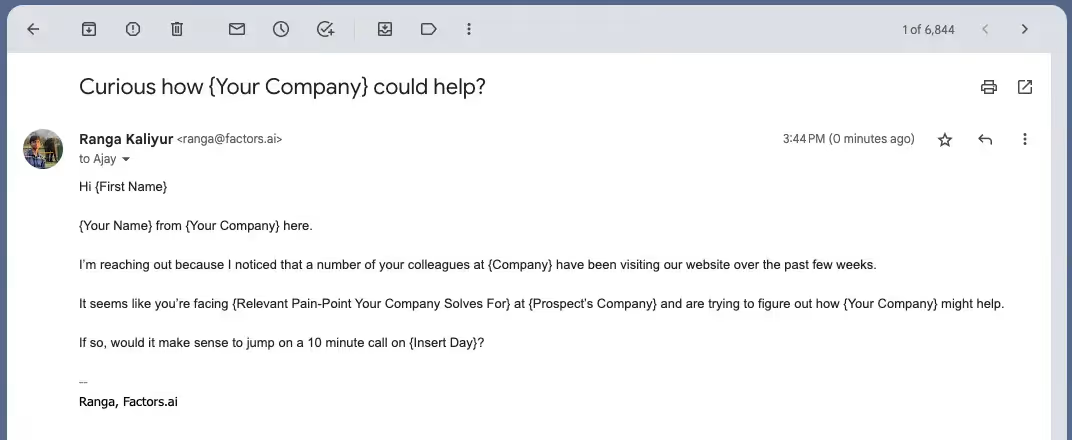
23. Building Trust with Transparent Pricing Models
Establish trust with prospects from the outset by adopting transparent pricing models. Clearly communicate pricing structures, making it easy for prospects to understand the value they receive in exchange for their investment. Transparent pricing fosters trust, reduces uncertainty, and streamlines the decision-making process.
Why will this technique work?
Transparent pricing eliminates ambiguity and instills confidence in prospects by demonstrating honesty and integrity. When prospects have a clear understanding of the costs involved, they are more likely to perceive your offering as fair and trustworthy, leading to increased conversions and customer satisfaction.
Display pricing information prominently on your website, providing detailed breakdowns of features and corresponding costs. Offer transparent explanations for any additional fees or charges, ensuring that prospects have all the information they need to make an informed decision. By being upfront about pricing, you build credibility and differentiate your brand from competitors who may employ hidden costs or opaque pricing structures.
24. Optimizing Landing Pages for Conversion Excellence
Maximize the effectiveness of your landing pages by optimizing them for conversion excellence. Ensure a seamless user experience, compelling visuals, and persuasive copy that guides visitors towards taking the desired action. A well-crafted landing page not only captures attention but also enhances credibility and encourages conversions.
Why will this technique work?
Landing pages serve as critical touchpoints in the buyer's journey, where prospects decide whether to engage further with your offering. By optimizing landing pages for conversion, you create a positive first impression, build trust, and facilitate the decision-making process, ultimately driving more conversions.
Design landing pages with clear and concise messaging that communicates the value proposition effectively. Use visually appealing elements, such as high-quality images and compelling calls-to-action, to guide visitors towards the desired action, whether it's making a purchase, signing up for a trial, or downloading a resource.
25. Adopt Conversational Marketing with Chatbots
Integrate chatbots into your website for conversational marketing. Chatbots provide instant responses, qualify leads, and guide prospects through the initial stages of their journey. Conversational marketing with chatbots ensures that no opportunity slips through the cracks.
Why will this technique work?
Chatbots provide immediate responses, catering to the growing demand for instant engagement. By offering real-time interactions, salespersons can capture leads' attention and guide them through initial queries.
26. Enhancing Engagement with Live Chat
Drive customer engagement by integrating live chat functionality on your website for real-time interactions. Live chat allows you to promptly address queries, offer instant support, and guide prospects through their decision-making process. By providing immediate assistance, live chat adds a personal touch to your online presence and enhances the overall customer experience.
Why will this technique work?
In today's fast-paced digital landscape, consumers expect instant responses and personalized interactions. Live chat enables you to meet these expectations by offering real-time assistance, which can significantly improve customer satisfaction, reduce bounce rates, and increase conversion rates.
Embed a live chat widget on key pages of your website, such as product pages or pricing pages, to proactively engage with visitors. Train your live chat agents to provide helpful and informative responses, address concerns promptly, and guide prospects towards the next steps in their journey. By leveraging live chat effectively, you can foster meaningful connections with prospects and nurture them towards conversion.
27. Delivering Personalized Video Messages
Differentiate your outreach efforts by crafting hyper-personalized video messages tailored to individual prospect needs and pain points. Video adds a human touch to your communication, allowing you to convey sincerity, empathy, and authenticity. By addressing prospects directly and addressing their specific concerns, you can make your outreach more memorable and impactful.
Why will this technique work?
Video has become a preferred medium for consuming content due to its engaging and emotive nature. By leveraging personalized video messages, you can capture and retain prospects' attention more effectively than traditional text-based communication. Additionally, personalized video messages demonstrate a genuine interest in the prospect's needs, which can help build trust and rapport.
Record personalized video messages addressing prospects by name and referencing specific information or challenges they've shared. Use visuals, body language, and tone of voice to convey empathy and understanding. Whether it's a personalized introduction, a product demonstration, or a follow-up message, incorporating video into your outreach can significantly enhance its impact and effectiveness.
28. Transactions with Blockchain Integration
Integrate blockchain technology to enhance the security, transparency, and efficiency of transactions. In industries where trust and integrity are paramount, blockchain provides a decentralized and immutable ledger that ensures the integrity of data and transactions. By leveraging blockchain technology, you can instill confidence in your prospects and facilitate smoother and more trustworthy transactions.
Why will this technique work?
Blockchain offers several benefits, including enhanced security, transparency, and traceability, which are highly valued in industries such as finance, healthcare, and supply chain management. By incorporating blockchain into your transactions, you can mitigate risks associated with fraud, tampering, and data manipulation, thereby building trust and credibility with your prospects.
For example, implement blockchain-based solutions such as smart contracts or distributed ledger technology (DLT) to automate and secure transactions. Showcase the benefits of blockchain integration, such as improved transparency, reduced costs, and increased efficiency, to prospects. By demonstrating your commitment to integrity and security, you can differentiate your offering and attract prospects who prioritize trust and reliability.
29. Develop Micro-Courses for Educational Engagement
Position your brand as an educational resource by developing micro-courses. Offer bite-sized educational content that addresses specific industry challenges or provides valuable insights. Micro-courses establish your brand as a knowledge leader, attracting prospects seeking expertise
Why will this technique work?
Micro-courses cater to the need for concise yet valuable content. By hosting short, focused webinars, salespersons can deliver impactful insights, address specific pain points, and showcase the expertise of the brand. For example, host a series of micro-courses or webinars, each addressing a specific challenge faced by your target audience. Keep the sessions brief but impactful, providing actionable insights and positioning your brand as a valuable resource in the industry.
30. Implementing Exit-Intent Pop-ups for Lasting Impressions
Utilize exit-intent pop-ups to capture the attention of departing website visitors and provide them with compelling offers, discounts, or content to encourage them to reconsider their decision to leave. Exit-intent pop-ups offer a last-minute opportunity to engage potential leads and drive conversions.
Why will this technique work?
Exit-intent pop-ups leverage the principle of reciprocity, where visitors feel inclined to reciprocate when offered something of value. By presenting visitors with enticing offers or valuable content just before they leave, you create a sense of urgency and incentivize them to stay and explore further, ultimately increasing the likelihood of conversion.

B2B sales success warrants a strategic combination of innovation, empathy, and resilience. By continuously refining your tactics, embracing new tech, and prioritizing the needs of your customers, you can position yourself and your organization for sustained growth and prosperity.
Successful sales go beyond pitches, they’re built on connection.
1. Core Tactics: Listen actively, solve real pain points, and tailor your pitch.
2. Relationship Building: Earn trust through honest, consistent communication.
3. Strategic Benefits: Align with the buyer’s journey, adapt in real-time, and close with confidence.
When you lead with empathy and insight, closing becomes a natural next step, not a hard sell.
The Strategic Sales Execution Matrix
To help your leadership team figure out which playbooks to run first, here is an operational roadmap structured by sales complexity:
.avif)
What Is a Sales Territory? Types, Planning & Management Guide (2026)
A sales territory is a defined market segment assigned to a salesperson or team. Learn the 7 types of sales territories, how to create a territory plan, best practices, and tools to optimize coverage and revenue.
TL;DR
- Sales territories involve dividing markets into manageable segments to enhance efficiency and specialization.
- As digital sales evolve, traditional geographic boundaries are giving way to parameters like industry, product, and customer type.
- Well-defined territories boost customer satisfaction, optimize sales team performance, and drive organizational growth.
- Common types of sales territory include geographic, industry-based, customer-based, product-focused, and channel-specific approaches.
- Effective planning involves setting clear objectives, analyzing data, segmenting markets, assigning teams, and monitoring results.
A sales territory is a defined market segment. It is based on geography, industry, customer type, or product line — assigned to a specific salesperson or sales team to manage and grow. Sales territories divide your target market into smaller, manageable segments so reps can specialize, reduce overlap, and focus their efforts for maximum efficiency.
Historically, geography defined sales territories because sales were conducted in person. However, as digital sales gain prominence, territories are increasingly defined by factors like industry vertical, company size, product line, and customer lifecycle stage. Understanding and effectively managing sales territories is crucial to driving organizational growth and achieving sales goals.
This guide covers everything you need to know about sales territories: what they are, the 7 main types, how to create a territory plan, best practices, tools, KPIs, and common challenges — with real-world examples and community insights.
What is a Sales Territory?
A sales territory is a defined market segment for which a salesperson or a sales team is responsible. In simple terms, territories divide your target market into smaller segments that reps can better manage. For example, back in the day, one person would be assigned to the top half of the west coast of the USA while another would be manning the bottom half.
The territories you define can be based on various parameters like location, company size, industry, product line, channel partners, etc. This can also be useful when working on account-based marketing campaigns.
For example:
● A software company selling to SMBs across the US can split the country into Northeast, Midwest, South, and West sales territories. Reps based in each territory will handle that area.
● An enterprise software company may divide its market by industry verticals. One rep handles all education/non-profit accounts; another handles healthcare accounts, and so on.
The primary goal is to create manageable sections that allow sales teams to focus their efforts and resources effectively. These territories can be defined by geography, industry, customer type, product type, or a combination of these factors.
That said, geography doesn't matter as much in digital sales as it used to. If you are selling a service performed by people like a circus or even heavy machinery, geography will play a role since you might wish to go and pitch your product. The same applies to an expensive product or service. However, geography won't matter much if a software or course can be sold, bought, used, and serviced anywhere.
We'll explore different types of sales territories later in this guide.
Benefits of Sales Territory Management
Implementing sales territories provides immense strategic value for SaaS organizations. Well-defined territories lead to optimal sales coverage, increased efficiency, and higher productivity.
Let's understand why sales territories are essential for everyone involved in the transaction:
1. Customer Perspective
From the customer's perspective, sales territories ensure they receive in-person service from sales representatives knowledgeable about specific, specialized products. Customers benefit from having a dedicated point of contact who understands their unique needs and can provide tailored solutions. Studies show that personalized service in sales territories can improve customer satisfaction by up to 20%.
2. Company Perspective
From the company's perspective, sales territories help build competence within specific product categories or markets, leading to better predictability and coverage. This structured approach allows companies to allocate resources efficiently, track performance accurately, and adapt to market changes swiftly. Sales capacity planning involves predicting future hiring needs and balancing recruitment, ramp-up times, and churn. Effective territory planning can enhance overall sales team efficiency by 40%.
3. Salesperson Perspective
Clearly defined territories mean less overlap and conflict for salespeople, leading to higher motivation and productivity. Sales territories also provide a clear framework for sales compensation and career development. A well-designed sales territory plan can boost salesperson productivity by up to 25%.
Additional considerations in sales territory planning
- Frequency of Territory Updates
Regular updates to sales territories are essential to reflect changes in the market and business priorities. Market conditions, customer needs, and competitive landscapes can evolve, necessitating adjustments to sales territories. For example, if a company expands into new geographic regions or introduces new products, it may need to reallocate resources and adjust territories accordingly.
Finding the right balance between stability and flexibility is crucial. Frequent changes can disrupt sales activities and impact performance, while infrequent updates may lead to missed opportunities and inefficiencies. According to Spotio, updating territories quarterly can help maintain alignment with market dynamics and maximize sales effectiveness.
- Impact on Compensation Structures
The design of sales territories can significantly impact sales compensation structures. Transparent and fair compensation plans motivate sales teams and align their efforts with company goals. Changes to territories can affect how sales representatives are compensated, potentially leading to adjustments in commission structures, bonuses, and performance metrics.
Ensuring that compensation plans remain competitive and attractive, even as territories evolve, is essential. Companies should regularly review and adjust compensation structures to reflect territory changes and maintain alignment with overall business objectives. Data from Xactly indicates that aligning compensation with territory performance can lead to a 15% increase in sales results.
- Trade-offs in Territory Planning
Every approach to sales territory planning involves trade-offs. Static territories offer stability but may lack flexibility, while dynamic territories provide adaptability but can be complex to manage. Companies must evaluate their specific needs, market conditions, and business objectives to determine the best approach for their sales teams.
Trade-offs include balancing the need for specialized expertise with the desire for a more flexible and responsive sales strategy. Companies should consider each approach's potential benefits and drawbacks and make informed decisions based on their unique circumstances.
Types of Sales Territories for SaaS Companies
Sales territories for SaaS companies can be defined in multiple ways depending on the nature of your business, products, and buyers.
Let's explore the most common SaaS sales territory structures with real-world examples:
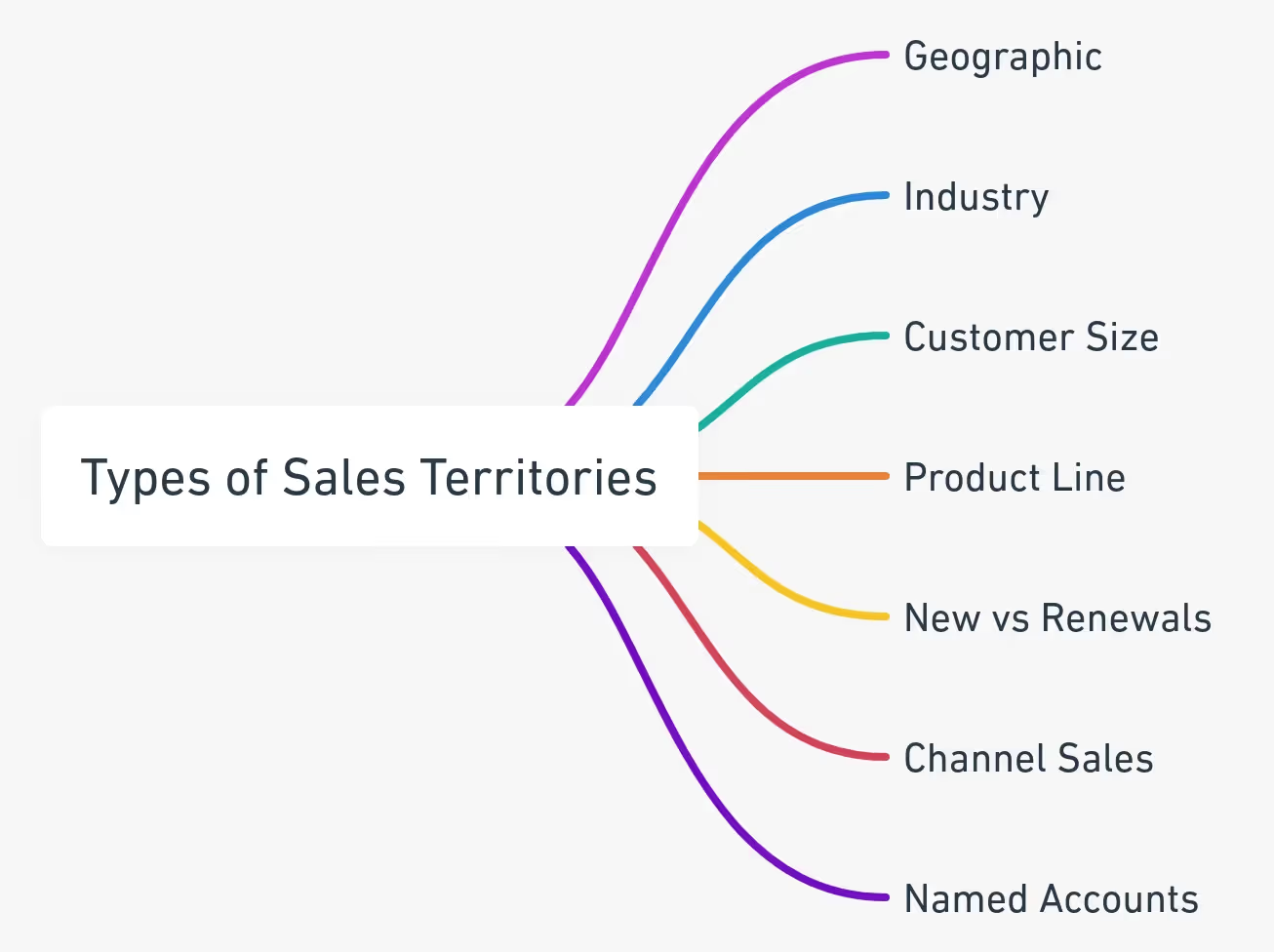
1. Geographical Territories
Geographical territories have been a traditional approach where sales regions are defined based on physical locations. This method is still relevant for physical and high-value digital products requiring face-to-face interaction. For instance, a company selling agricultural equipment may divide its territories based on states or regions, ensuring sales representatives can visit farms and build strong relationships with farmers. Similarly, pharmaceutical companies often define territories based on healthcare regions, allowing sales reps to develop in-depth knowledge of local healthcare providers and regulations. A study by HubSpot shows that geographical territories can help reduce travel costs by 20%.
Geographical territories also offer several advantages. They simplify logistics, reduce travel costs, and provide a more focused approach to local marketing efforts. However, they can also present challenges, such as unequal distribution of potential customers or varying market potential across regions. Companies must regularly analyze market data and adjust territories to address these issues.One notable example is Amazon Web Services (AWS), which might sell to various sectors with differing needs. By defining sales territories based on industry, AWS can provide specialized services and solutions tailored to each sector's unique requirements.
2. Industry-Based Territories
Industry-based territories focus on sectors such as government, airlines, and telecom. This approach requires a deep understanding of industry-specific use cases and relationships. Sales teams become experts in the needs and challenges of their assigned industries, enabling them to offer highly relevant solutions.
For example, a technology company might have dedicated sales teams for the healthcare, finance, and education sectors, each with tailored messaging and product offerings. Spotio highlights that industry-based territories can lead to a 25% increase in conversion rates due to specialized knowledge.Industry-based territories allow for a more targeted approach to sales. Sales representatives can speak the language of their industry, understand regulatory requirements, and build strong relationships with key stakeholders. This expertise can lead to higher conversion rates and increased customer loyalty. However, significant investment in training and development is required to ensure that sales teams are well-versed in industry-specific knowledge.
3. Customer Type Territories
Defining territories based on customer types involves segmenting the market by customer size, purchase behavior, or lifecycle stage. This method allows sales teams to tailor their strategies to the unique requirements of different customer segments, whether small businesses, large enterprises, or key accounts. For instance, a software company might assign sales teams to small, mid-sized, and large enterprises, each with distinct needs and buying processes. Small businesses require more straightforward solutions and cost-effective pricing, while large enterprises may need customized solutions and dedicated support.Customer-type territories enable sales teams to specialize in addressing each segment's unique challenges and opportunities. This specialization can improve the relevance of sales pitches, enhance customer satisfaction, and drive better results. However, it also requires careful segmentation and may lead to a more complex management structure.
4. Product Type Territories
Product-type territories assign sales teams to specific product lines or services. This approach is efficient for companies with diverse product portfolios. Sales teams can develop deep expertise in their assigned products, providing better support and driving higher sales. For example, a company that sells various types of industrial machinery might have separate sales teams for each product line, such as forklifts, cranes, and conveyor systems.
Product-type territories allow for a focused approach to product management and sales. Sales representatives can become experts in their assigned products, better understand customer needs, and offer more specialized solutions. However, this approach may require additional resources and coordination to ensure that sales efforts are aligned with overall business goals and that customers receive comprehensive support across product lines.
5. New Business vs Renewals Territories
An account can also be divided between new business reps focused on landing net new customers and renewal reps who manage ongoing subscription revenue.
New business requires more outbound prospecting while renewals need customer success skills. Separate territories prevent mixed focus.
6. Channel Sales Territories
If part of your sales goes through reseller partners, you can have dedicated partner account managers aligned to them.
For example, having an APAC channel partners territory manager who handles all partnerships in that region and works to grow revenue.
7. Named Accounts Territories
Larger SaaS firms often assign strategic accounts like Fortune 500 companies to specific reps who can customize solutions for them.
These named account territories get all the sales and marketing resources required to land massive deals.
As you can see, SaaS sales leaders have many options to define territories based on their unique situation and customer landscape.
How to Create an Effective Sales Territory Plan
Creating an optimal sales territory plan is crucial yet complex. There are many factors to consider and steps involved.
Let's go through a comprehensive, step-by-step process for designing a sales territory plan that drives growth:
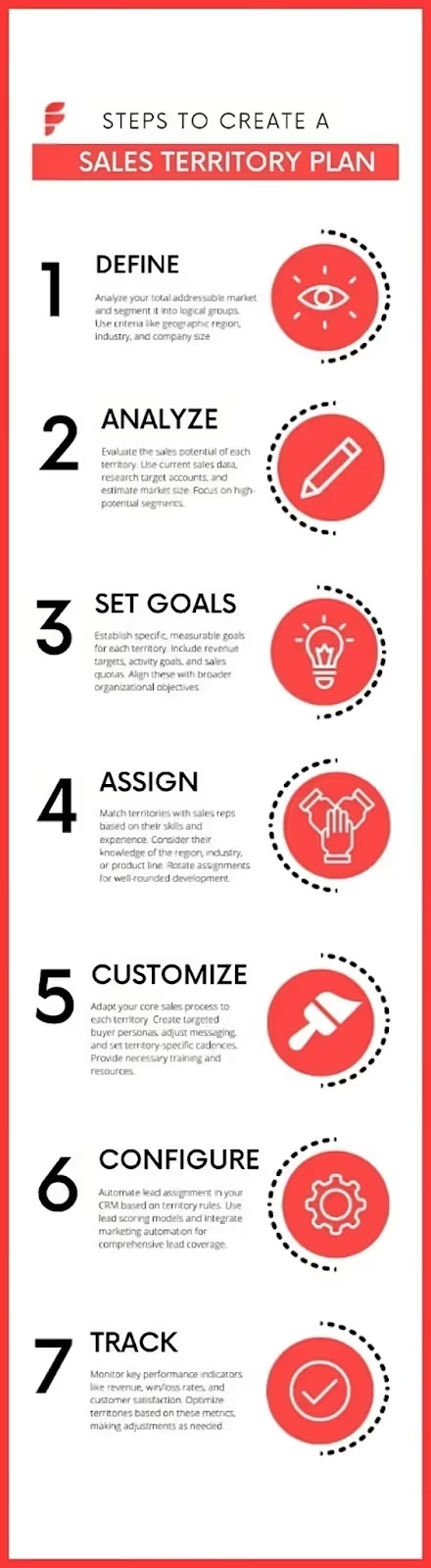
Step 1: Define Your Objectives
Start by clearly defining the objectives of your sales territory plan. Are you looking to increase market coverage, improve customer satisfaction, or boost sales in a particular segment? Understanding your goals will guide the entire process.
Step 2: Analyze Market Data
Conduct a thorough analysis of your market data. This includes identifying potential customers, understanding market trends, and assessing the competition. Use data analytics tools to segment your market based on relevant criteria such as geography, industry, or customer type.
Step 3: Segment Your Market
Based on your market analysis, segment your market into manageable sections. Ensure each segment is large enough to justify dedicated resources but small enough to allow personalized attention. This segmentation will form the basis of your sales territories.
Step 4: Assign Sales Teams
Assign your sales teams to the defined territories. Consider factors such as team expertise, experience, and workload. Ensure each team has the necessary resources and training to succeed in their assigned territories.
Step 5: Set Goals and Metrics
Establish clear goals and metrics for each territory. These should align with your overall business objectives and provide a basis for performance evaluation. Regularly review and adjust these goals to reflect changes in the market and business priorities.
Step 6: Implement and Monitor
Implement your sales territory plan and continuously monitor its performance. Use CRM systems and other sales tools to track progress, identify issues, and make data-driven adjustments. Regular feedback from sales teams is crucial to refine and optimize your territories.
Remember to make iterative changes when it comes to sales territories to allow your sales reps time to adjust. You do not want to make knee-jerk changes that disrupt the working processes your sales teams follow.
Key KPIs to Measure Sales Territory Performance
Tracking the right KPIs ensures your territory plan is driving results. Here are the most important metrics to monitor:
1. Revenue per Territory
Measure the total revenue generated within each territory over a given period. This helps identify high-performing and underperforming territories so you can reallocate resources accordingly.
2. Quota Attainment Rate
Track the percentage of reps meeting or exceeding their sales quotas. Low attainment across a territory may signal that the territory is too large, under-resourced, or poorly defined.
3. Pipeline Coverage Ratio
Calculate the ratio of pipeline value to quota for each territory. A healthy pipeline coverage ratio (typically 3x to 4x) indicates enough opportunities in the funnel to hit targets.
4. Win Rate by Territory
Analyze the percentage of deals closed versus deals pursued in each territory. Variations in win rates can reveal differences in market fit, rep effectiveness, or competitive pressure.
5. Average Deal Size
Monitor the average contract value across territories. Significant differences may suggest that certain territories have access to larger accounts or that reps need support with upselling.
6. Sales Cycle Length
Track how long it takes to close deals in each territory. Longer cycles may indicate complex buying processes, insufficient rep support, or misaligned territory assignments.
7. Customer Acquisition Cost (CAC)
Measure the cost of acquiring a new customer in each territory. High CAC in certain territories may point to inefficiencies that need to be addressed through better targeting or resource allocation.
8. Account Penetration Rate
Evaluate what percentage of total addressable accounts in a territory are actively being worked. Low penetration rates suggest untapped potential and an opportunity to expand coverage.
Common Challenges in Sales Territory Management
Even well-designed territory plans face obstacles. Being aware of these challenges helps you proactively address them:
1. Unbalanced Territories
One of the most common issues is uneven distribution of accounts or revenue potential across territories. Some reps end up with too many high-value accounts while others struggle with low-potential segments. Regularly review territory data and redistribute accounts to maintain balance.
2. Rep Turnover and Ramp-Up Time
When a rep leaves, the territory can go dark for weeks or months during the hiring and onboarding process. Build documentation, establish account handoff processes, and cross-train team members to minimize disruption.
3. Data Quality Issues
Territory planning is only as good as the data behind it. Incomplete, outdated, or inaccurate CRM data leads to poor territory assignments and missed opportunities. Invest in data hygiene processes and tools that keep your account data clean and current.
4. Overlapping Territories
When territory boundaries are unclear, multiple reps may pursue the same accounts, leading to internal conflicts and a poor customer experience. Define clear rules of engagement and use CRM-based territory mapping to eliminate ambiguity.
5. Resistance to Change
Sales reps often resist territory realignments, especially when they lose accounts they have nurtured. Communicate changes transparently, involve reps in the planning process, and ensure compensation plans account for transitions.
6. Scaling Territories with Growth
As your company grows, territories that once worked may become too large or too small. Build a scalable framework from the start — one that allows you to split, merge, or redefine territories without major disruption as the business evolves.
Static vs. Dynamic Sales Territories
- Static Sales Territories
Static territories consist of a fixed set of accounts for a specified period. This approach provides stability and allows sales teams to build long-term customer relationships. However, it may need to be more responsive to market changes and evolving customer needs.
- Dynamic Sales Territories
Dynamic territories adjust based on market changes, customer intent, and sales performance. This approach is more flexible and can respond quickly to new opportunities or challenges. Companies like 6sense are known for their dynamic sales territories, constantly using advanced analytics to optimize territory assignments.
Detailed Real-world Examples and Case Studies
- AWS's Industry-Based Territories
Amazon Web Services (AWS) is a prime example of a company that uses industry-based sales territories. AWS segments its sales teams based on various industries, including healthcare, finance, and government. This approach allows AWS to tailor its solutions and sales strategies to each sector's needs and regulatory requirements.
By focusing on industry-specific sales territories, AWS can leverage its expertise and build strong relationships with key stakeholders in each sector. This specialization enhances AWS's ability to address complex industry challenges and drive successful customer outcomes.
- Salesforce's Dynamic Approach
Salesforce employs a dynamic approach to sales territory planning, using advanced analytics to optimize territory assignments. The company monitors market conditions, customer intent, and sales performance to adjust its territories in real-time.
Salesforce's dynamic approach allows it to respond quickly to market changes and seize new opportunities. By leveraging data and analytics, Salesforce can ensure that its sales teams are always focused on the most promising prospects and regions.
- 6sense's Use of Advanced Analytics
6sense is known for its innovative use of advanced analytics in sales territory planning. The company uses data-driven insights to define and adjust sales territories, enabling its teams to focus on high-potential opportunities and optimize their efforts.
6sense's approach highlights the importance of leveraging data and analytics to drive effective sales territory planning. Using advanced tools and techniques, 6sense can continuously refine its territories and achieve better results.
How Factors Helps Optimize Territories
Factors is an AI-powered Account intelligence & analytics platform that can help maximize the potential of sales territories:
1. Enriches Anonymous Traffic
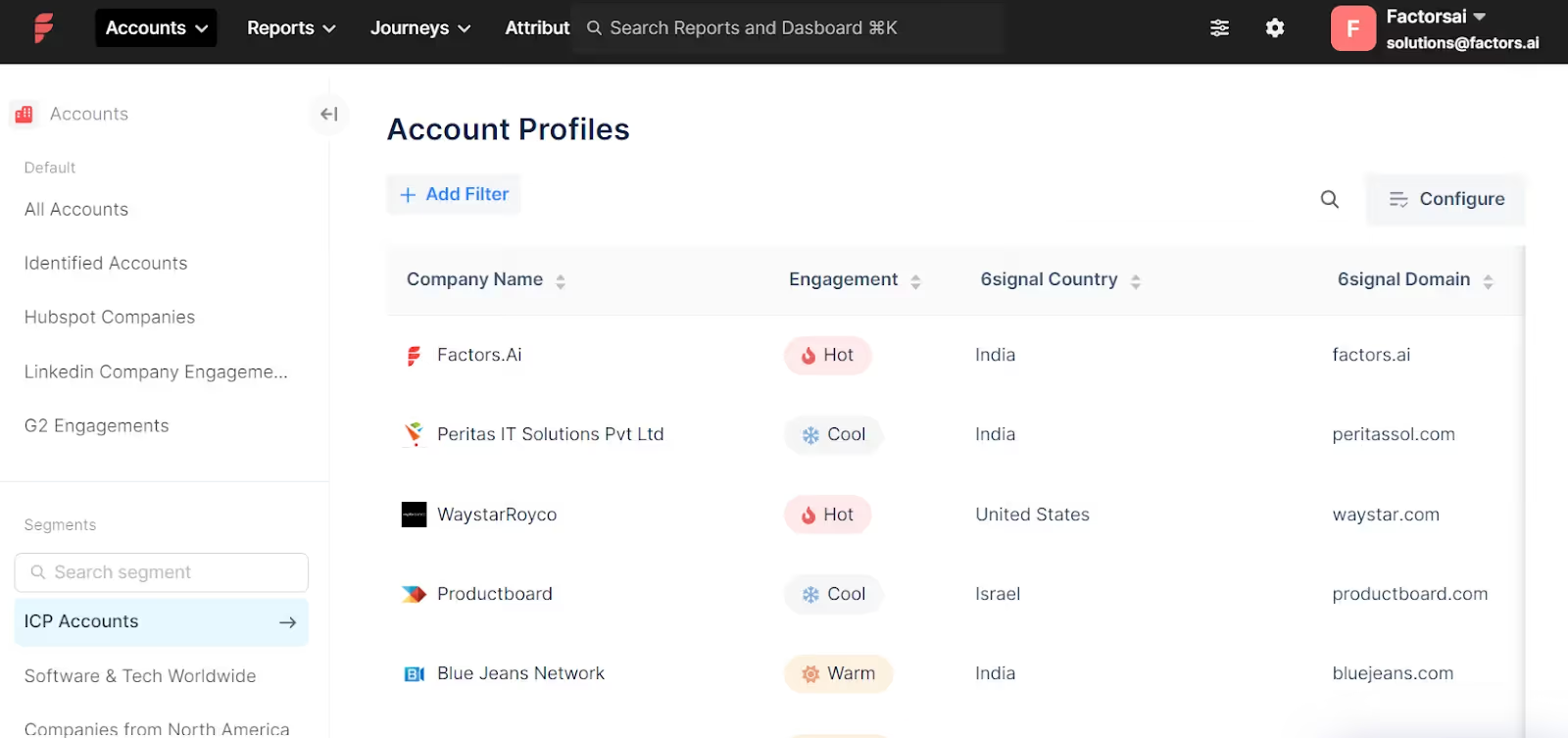
Factors enriches anonymous website visitors and ad impressions with company data—revealing the company name, industry, location, and other attributes you can use to map accounts to matching sales territories.
2. Automatically Assigns Accounts to Territories
Once Factors discovers the right data, like the location, industry, account size, etc, it automatically assigns the accounts to the right reps based on the territory definitions in your CRM. You no longer have to manually assign a rep every time there's a new lead in the system.
3. Alerts Reps About Territory Accounts
Factors helps you automatically alert users when there are new accounts identified. You can set up Factors to automatically message users on Slack informing them about the new account.
The best part is, Factors continuously monitors your website and other connect platforms for new leads. Your reps are alerted as soon as a new lead hits Factors (in real-time) so they can act upon the leads while they're hot.
4. Provides 360-Degree Territory Account View
Factors unifies cross-channel account data to provide a 360-degree view of territory accounts—including web activity, ad impressions, intent data, CRM interactions etc.
5. Enables Data-Driven Territory Optimization
It analyzes territory performance across metrics like engagement, pipeline velocity, and more. This allows data-driven planning and optimization of territories.
With Factors, you can leverage previously untapped anonymous interactions to drive more territory leads. Continuous optimization of territories also becomes easier based on hard data vs guesswork.
Tips to Effectively Manage Sales Territories
Here are some tips to manage Sales Territories effectively:
1. Divide Your Territory Logically
Understand your current customers, potential customers, competitor activity, and account locations. Organize your territory using a logical approach, such as geography, industry, or product, to match your business strategy.
Create a structure that allows your sales team to focus on high-value opportunities and use their time effectively. Prioritize maximizing time with qualified customers to drive better results.
2. Develop a Call Rotation Plan
Regular contact builds strong customer relationships. Create a call rotation plan that specifies how often and through which method to engage each account. Review your accounts quarterly or semi-annually to determine whether they need in-person visits, phone calls, emails, or marketing outreach, and set a suitable frequency.
For instance, schedule quarterly follow-ups for dormant accounts, while high-value accounts may need monthly visits and consistent calls. To save time, focus on high-priority accounts and group meetings geographically. Use CRM tools to automate reminders and maintain consistency in your follow-ups.
3. Leverage Relationships to Cross-Sell and Upsell
Leverage existing relationships to create more opportunities within the same organization. A strong connection in one department can open doors to others. It can lead to long-term growth and cost-effective results. Create joint case studies. These efforts can lead to significant payoffs and stronger client partnerships.
Best Tools for Sales Territory Management
The right tools make territory planning and management significantly more efficient. Here are the top categories and tools to consider:
1. CRM Platforms
Your CRM is the foundation of territory management. Platforms like Salesforce, HubSpot, and Microsoft Dynamics 365 allow you to define territories, assign accounts to reps, and track performance. Most CRMs support territory hierarchies and rules-based account routing.
2. Territory Mapping Software
Dedicated mapping tools like Maptive, Badger Maps, and eSpatial provide visual territory maps that help you balance workloads, identify coverage gaps, and optimize geographic assignments. These tools are especially useful for field sales teams.
3. Revenue Intelligence Platforms
Tools like Gong, Clari, and 6sense provide data-driven insights into territory performance, pipeline health, and buyer intent. They help sales leaders make informed decisions about territory adjustments and resource allocation.
4. Sales Engagement Platforms
Platforms like Outreach and Salesloft help reps execute territory strategies through automated sequences, task management, and multi-channel outreach. They ensure consistent engagement across all accounts in a territory.
5. Account Intelligence Tools
Factors enriches anonymous website traffic with firmographic data, automatically assigns accounts to the right territories, and provides a unified view of account activity across channels. It is purpose-built to optimize territory coverage and identify hidden revenue opportunities.
6. Data Enrichment Tools
Tools like ZoomInfo, Clearbit, and Apollo keep your account data accurate and up to date — which is critical for proper territory segmentation and assignment. Clean data ensures reps are working the right accounts in the right territories.
What Sales Reps Say About Territory Management
To understand how territory management works in practice, it helps to hear directly from the people on the front lines. Here is what sales professionals commonly share about their experiences:
On Territory Balance
Many reps report that unbalanced territories are their biggest frustration. When one rep has a territory packed with enterprise accounts while another is stuck with low-potential segments, it creates resentment and turnover. Reps consistently emphasize that fair distribution of opportunity — not just accounts — is what matters most.
On Involvement in Planning
Sales reps who are involved in the territory planning process report higher satisfaction and better performance. They bring ground-level insights about account relationships, competitive dynamics, and market nuances that data alone cannot capture. Top-performing teams typically include rep feedback before finalizing territory assignments.
On Frequent Realignments
Reps widely agree that too-frequent territory changes are disruptive. Building relationships takes time, and constant reshuffling undermines trust with prospects and customers. The consensus among experienced reps is that territories should be reviewed quarterly but only realigned annually unless there is a compelling business reason.
On Technology and Tools
Sales professionals appreciate tools that reduce manual work — especially automated lead routing, real-time alerts for new accounts, and dashboards that show territory health at a glance. However, they also caution against over-relying on tools without combining them with human judgment and relationship-building skills.
On Communication from Leadership
Transparency around why territory changes are made is critical. Reps who understand the rationale behind decisions — even unfavorable ones — are far more likely to stay motivated and bought in. The best sales leaders share data, explain trade-offs, and give reps a voice in the process.
Key Takeaways
- Sales territories optimize market coverage, sales efficiency, and account management for your team. Ways to define territories include geographic, industry, size, products, or channels.
- Steps for creating a territory plan include choosing territory types, mapping target accounts, estimating potential, setting goals, assigning territories, configuring lead routing, and tracking performance.
- When assigning territories, take rep strengths into account, involve reps in planning, make data-driven decisions, and limit frequent realignments.
- Specialized software provides visibility into sales territories and makes territory management efficient.
- Factors enriches anonymous traffic to assign accounts to territories. It also unifies data across channels for continuous optimization.
- Well-planned sales territories ensure your reps have reasonable workloads and can nurture the right accounts. Combined with the right technology, sales territories provide immense leverage to scale revenue growth.
Smart Territory Planning Increases Sales Performance
Sales territories help reps focus on high-value accounts, leading to higher win rates and revenue growth. Traditionally, businesses assigned territories based on geography, but digital sales now prioritize factors like business models, product offerings, and customer needs. Involving reps in planning ensures alignment with their strengths, improving performance and engagement.
Well-structured territories increase customer satisfaction, streamline sales processes, and maximize resource allocation. Automating inbound lead routing in CRM systems to the right sales representatives maximizes efficiency. Continuously track and optimize territories based on hard data.
Factors plays a critical role here. It enriches anonymous website traffic to identify and assign accounts to matching sales territories and automatically connects the dots across customer touchpoints to uncover revenue opportunities hidden within your data.
Regular updates, clear objectives, and continuous optimization keep sales teams agile and productive. By leveraging technology and real-time data, businesses can fine-tune their territories, reduce inefficiencies, and maximize sales performance. A well-planned territory strategy drives revenue and strengthens customer relationships and long-term business growth.
So if you're struggling with sub-optimal territory planning, take control of your revenue engine. Book a customized Factors demo today to see how it can help optimize your sales territories.
FAQs on Sales Territory
1. What is the meaning of a sales territory?
A sales territory is a defined market segment assigned to a salesperson or team based on factors like location, industry, or customer type to improve focus and efficiency.
2. What are different sales territories?
Sales territories can be:
- Geographical: Based on physical locations.
- Industry-Based: Focused on specific industries.
- Customer Type: Segmented by customer size or behavior.
- Product Type: Assigned by product lines.
- New Business vs. Renewals: Differentiating new customer acquisition and renewals.
- Channel Sales: Focused on reseller partners.
- Named Accounts: Assigned to strategic, high-value clients.
3. How do you create a sales territory plan?
Creating a sales territory plan involves six key steps: (1) Define your objectives — determine whether you want to increase coverage, improve satisfaction, or boost segment sales. (2) Analyze market data using analytics tools. (3) Segment your market into manageable sections. (4) Assign sales teams based on expertise and workload. (5) Set clear goals and metrics aligned with business objectives. (6) Implement the plan and continuously monitor performance using CRM systems and sales tools.
4. How do you effectively manage a sales territory?
Effective sales territory management requires dividing your territory logically based on geography, industry, or product; developing a call rotation plan to maintain regular contact with accounts; leveraging existing relationships to cross-sell and upsell; using CRM tools to automate reminders and track engagement; and regularly reviewing territory performance data to make adjustments. Prioritize high-value accounts and involve your reps in planning decisions.
5. What tools are used for sales territory management?
Common tools for sales territory management include CRM platforms (Salesforce, HubSpot, Microsoft Dynamics 365), territory mapping software (Maptive, Badger Maps, eSpatial), revenue intelligence platforms (Gong, Clari, 6sense), sales engagement platforms (Outreach, Salesloft), account intelligence tools like Factors, and data enrichment tools (ZoomInfo, Clearbit, Apollo).
6. What are the biggest challenges in sales territory management?
The biggest challenges include unbalanced territories with uneven revenue potential, rep turnover and ramp-up time, data quality issues in CRM systems, overlapping territories causing internal conflicts, resistance to change from sales reps during realignments, and scaling territories as the company grows. Addressing these challenges requires clean data, clear rules of engagement, transparent communication, and a scalable territory framework.

Sales workflow guide: Let buyers tell you when they are ready
Buyers now control the research process. Build sales workflows that detect buying signals in real-time and reach out when timing actually matters.

- Sales workflows adapt to buyer behavior in real-time. Trigger actions based on intent signals, timing, and account activity, rather than static stages or form fills.
- AI workflows prioritize accounts showing real purchase intent. Score leads using pricing visits and engagement depth so reps focus on buyers ready to buy.
- Signal-based selling times outreach to buyer readiness. Engage when behavioral signals confirm interest, such as when accounts visit pricing pages, download content, or return multiple times.
- Autonomous agents act on insights instantly. Predictive AI identifies opportunities, while agentic AI adjusts pipelines and follow-ups in real time without manual intervention.
To err is human. Certainly, but automating thy sales workflow without understanding? That’s simply beyond the pale.
It’s a risky move, considering buyers move faster than workflows ever did. Gen Z buyers complete nearly 70% of the buying journey independently before ever talking to sales. By the time a flawed workflow reacts, routing a lead, triggering outreach, and updating stages, the moment has already passed.
Yes, automation is a life-saver and reps have their plates full. There’s no denying that. But automation done wrong is worse than no automation at all. Because now, instead of a human making mistakes, you've got a machine making those same mistakes. Faster than you can fix them.
Look, a standard sales workflow works just fine today, but it was never built for scalability. It was built piece by piece over time, shaped by individual CRM choices and informal hand-offs. As a result, execution now depends on memory, interruptions, and Slack messages that start with “Quick question…”
Without predictive sales AI, these fragmented, human-dependent workflows can’t be redesigned. They can only be pushed harder, accelerating inefficiency rather than eliminating it.
In this (not-so-ultimate) guide, I’ll walk you through how modern sales workflows actually work, and how to automate them without turning chaos into speed or feeling compelled to comment ‘straight shrimp’ under every blueprint post.
What is a B2B sales workflow anyway?
A sales workflow is a repeatable sequence of tasks that guides prospects from initial contact to close. It answers these questions: Who should you contact? When? What should you prioritize? What should you ignore?
Most teams confuse sales processes with sales workflows. A sales process is static, and stages like lead, opportunity, and closed-won that don't change based on buyer behavior. The latter is dynamic. It adapts based on intent signals, timing, and account activity.
How traditional sales workflows worked vs AI sales workflows now
For years, sales workflows pushed more leads in and more activity out, turning reps into hamster-wheel operators. AI-driven workflows change that by handling the grunt work in the background, prioritizing accounts, updating follow-ups, and adjusting next steps, so reps can focus on real conversations. The workflow shifts from chaotic to intentional, and it looks something like this:
How to build your sales workflow across the core stages
A sales workflow works only when inputs, logic, timing, and execution line up. Miss one, and it breaks. It’s like coffee: good beans, the right grind, the right temperature, a steady pour. Get one wrong, and the result is bitter…even if you pretend it’s fine. Here’s how to get it right across four core sales stages.
- Prospecting and account discovery
Modern sales workflows don’t start with list-building but with visibility. Companies are already finding you. They’re visiting your site, reading your blog, checking pricing, and comparing you to competitors. You just don’t see it because 98% of website traffic is anonymous. This is where AI sales tools help with tracking buyer behavior early.
Account intelligence changes that. Instead of building lists, you identify companies already showing intent. Factors.ai's account intelligence de-anonymizes your website traffic so you can see which companies are visiting, what they’re viewing, and how often they return. Now reps can lead with relevance: “I noticed you’ve been reviewing our pricing. Want to see how other logistics teams are using this?”
💡Also read: Understanding anonymous website visitor identification
- Outreach and engagement
Ever burned coffee because the water was too hot? Or brewed something so weak it tasted like disappointment?
Outreach timing works the same way. Too early and you’re annoying. Too late, and your competitor already closed. Blast the same email to 500 people, and you’re just pouring cold water on everything, hoping something extracts by accident.
What actually works is simple, personalized outreach triggered by behavior. An account that downloads your ROI calculator doesn’t want the same message as someone who’s only skimmed your homepage. One is ready for numbers. The other isn’t even sure there’s a problem yet.
In fact, with Factors.ai's GTM engineering services, you can track intent signals in real-time and trigger sequences based on what accounts actually do. For instance, when a prospect visits the pricing page, the sales team is alerted in real time and can respond with personalized outreach via email, phone, or LinkedIn. A whitepaper download creates the right moment to share a relevant ROI case study, while a form fill following repeated high-intent engagement clearly signals it’s time to move straight to a call.
- Lead qualification and prioritization
If you’ve ever tried brewing espresso with a coarse grind, you know the result. Lead qualification fails the same way. Real intent shows up across the buyer journey, not in the last click.
Multi-touch attribution shows what actually matters. Did an account attend a webinar, read two case studies, then check pricing? That’s a pattern. Factors.ai's analytics and attribution map these patterns across every marketing touchpoint and score leads based on what historically drives closed deals. Reps stop wasting cycles on leads that were never going anywhere. They focus on accounts showing real buying behavior. That’s the right grind.
- Closing and pipeline management
You can get the beans, temperature, and grind right, yet a bad pour still ruins the coffee. Deals work the same way. They stall when champions leave, budgets shift, or decision-makers disappear. Conversation intelligence shows what’s really happening, and flags drops in momentum early, so you can step in, fix the gap, and close.
Why B2B teams should switch to signal-based selling
Buyer behavior has shifted, and sales teams now have access to far richer intent signals. That said, it’s fair to add that outbound outreach is not dead, but what worked in outbound since 2018 is. As George Coudounaris, co-host of The B2B Playbook, puts it in his latest podcast, outbound lost its edge when “the playbook became process, and process became volume. And that volume drowned out the very people it was meant to reach.”
Most outbound motions still follow a tired loop: reach out, wait for a response, move on. No reply? Mark the account cold and forget it. That worked when buyers engaged early. It doesn’t reflect how B2B buying works today.
73% of B2B buyers actively avoid suppliers who send irrelevant outreach. Think of it like a store associate who walks up the moment you enter, starts pitching aggressively, and follows you aisle to aisle. You don’t buy. You leave.
Signal-based selling is the opposite. The associate notices when you stop comparing two products, read the label twice, or look around for help. That’s the signal, and that’s when they step in. Signal-based selling shifts the focus from who to contact to when to engage, using behavioral, intent, and engagement signals to time outreach when relevance is highest.
AI sales assistants work the same way. They don’t interrupt. They observe patterns, pauses, repeat visits, changes in behaviour, and only then prompt a seller to engage.
Without AI, those moments are very easy to miss. But with AI, outreach is triggered when behaviour signals readiness.
Choosing the best AI sales tools for your stack
“Most AI tools for sales are solving problems you don’t have yet.” Read that again because it explains half the chaos in AI sales today.
The fastest way to spend money on AI is buying tools that vaguely promise to “help reps sell.” When it comes to AI sales tools, less really is more. Instead, a focused AI sales stack should look and work something like this:
💡Also read: A quick guide to AI sales tools
4 absolute no-nos for sales workflow in B2B (+ fixes)
Just avoid these mistakes, and you’re sorted. Because one tiny mistake and your entire sales workflow goes from being Ser Duncan the Tall to Joeffry Baratheon (IYKYK). And, we know how Joeffrey (confidently) caused mayhem.
- Not all leads are equal.
Only a fraction of your leads are actively buying right now. The rest are researching, comparing, or are months away from a decision. Workflows that ignore this waste rep time. High-intent accounts get generic outreach. Low-intent accounts get pushed too early and disengage.
Fix it: Prioritize accounts based on real-time engagement signals. Track engagement depth, page visits, and recency. Route active accounts directly to sales representatives, while keeping the rest in automated nurture.
- Automation without intelligence is just spam at scale. Period.
Without intelligence, automation simply sends scheduled messages without regard for buyer behaviour, delivering spam efficiently (and at scale). This will leave you money on the table, given that 61% of B2B buyers already prefer a rep-free buying experience.
Fix it: Tie automation to clear intent signals, such as pricing visits or product research, and prevent sequences from running unless those signals are present.
- It’s 2026, and sales and marketing still aren’t in the same room.
It is circa 2026, and sales-marketing alignment shouldn’t be a debate. According to Forrester’s Q2 2024 report, 65% of sales and marketing teams say their leaders aren’t aligned. Sales gets leads without knowing why they matter. Marketing never learns which signals convert.
Fix it: Align on shared account signals. Surface the same data in both tools. Handoffs should explain why an account is prioritized, not just that it scored 100 points. Close the feedback loop.
- Busy reps ≠ moving deals.
200 emails sent. 100 calls logged. 50 tasks completed. Your activity on the dashboard feels flawless. But the close rate hasn’t budged in six months. The problem isn’t effort; it's tracking tasks rather than deal movement.
Activity is easy to track, so teams optimize for it. But task completion doesn’t equal deal progress. It creates the illusion of productivity while the pipeline stays stuck. Sales reps already waste 14 of their 51 weekly hours on admin work. Let’s not worsen it by rewarding busyness over results.
Fix it: Measure deal movement, not the volume of tasks. Ask whether outreach led to a meeting, whether that meeting advanced the stage, and whether momentum built or stalled. Optimize workflows around what has historically closed deals.
The future of sales: Predictive sales AI and autonomous agents
Predictive sales AI provided teams with early indicators of risk and opportunity. It could flag risky deals, score accounts, and surface buyer intent before things went sideways. Useful, but insight alone doesn’t close deals. If no one acts fast enough, the opportunity still slips far, far away.
That’s where autonomous agents marvellously assemble. They go beyond conventional reporting by acting on what is happening in that moment.
And this isn't some distant future scenario. IBM says 83% of executives expect AI agents to be autonomously executing actions by 2026. Another 85% think their teams will be leaning on real-time AI recommendations to make decisions. Meanwhile, 52% of C-suite leaders are already seeing measurable wins from AI-powered workflows. That’s a lot of figures (to process), but it’s the reality.
AI has moved from suggesting to acting. That matters because B2B buyers now move faster than manual workflows. Autonomous agents close the gap by adjusting pipelines and outreach in real-time. Predictive AI sees the signal, but agentic AI takes the shot.
Last but not least
Buyers are dropping signals everywhere. A visit to your website, a like on your social channels, a frenzy demo. Are you listening, though? Catch the signals and convert them into revenue with factors.ai. Book a demo and let’s show you how.
Frequently asked questions for sales workflows
Q. Are AI sales assistants actually useful or just hype?
They are useful when they take work off a rep’s plate. Logging, research, call summaries, and follow-ups are where they shine. They fail when teams expect them to replace judgment, timing, or relationship building.
Q. How can I identify high-intent leads before they fill out a form?
You have to stop waiting for form fills. Intent platforms show which target accounts are actively researching your site, pricing, and case studies. That signal lets reps engage earlier, with context, instead of guessing.
Q. What are the best AI sales tools for B2B prospecting right now?
There is no single “best” tool. The most effective teams combine clean data, reliable intent signals, and a single execution layer. When each tool has a clear job, reps trust the output and actually use it.
Q. Will AI sales tools eventually replace BDRs or SDRs?
No. AI replaces manual prospecting, not human selling. Buyers still want thoughtful conversations. In practice, AI makes a small team feel much larger by automating research, sequencing, and follow-up work.
Q. How does predictive sales AI improve forecasting accuracy?
It reduces blind spots. Predictive AI looks at deal movement, engagement, and velocity to flag risk early. Forecast calls shift from opinions to evidence, and leaders catch problems before quarter-end surprises.

We don’t just write about demand gen. We deliver it.
Our AI Agents help you uncover high-intent accounts, run campaigns that actually convert, and keep your GTM motion in sync.
1000+ GTM teams have already scaled their pipeline with Factors.
*Includes built-in peace of mind. And fewer late-night funnel audits.

.svg)