
Good Reads
Fix pipeline pains. Solve GTM puzzles. Read strategic brain dump.
Written for marketers who want real solutions to a leaking pipeline (and their dark circles).
Want to read more from us?
.avif)

I’m looking for…
10 Best Cognism Alternatives And Competitors
Is Cognism pricing too high, and are yearly contracts not cutting it? Here are 10 Cognism alternatives worth evaluating, including Factors.ai, Apollo, ZoomInfo, and more.
.avif)
TL;DR
- Cognism customers report paying around $15,000 to $30,000 a year, with opaque, quote-only pricing and annual contracts with no monthly option.
- Its biggest strength is EMEA data quality and GDPR compliance. Outside Europe, Cognism’s alternatives consistently outperform it.
- Factors.ai is the top Cognism alternative for B2B teams that need account intelligence, ad activation, and full-funnel attribution beyond contact data.
- The right Cognism alternative depends on whether you need contact data, intent signals, outreach automation, or a full GTM platform.
Imagine this… You're mid-evaluation. Someone on your team found Cognism, loved the EMEA data quality, then opened the pricing page and found... nothing. No numbers or tiers… just a "book a demo" button.
Welcome to the Cognism experience. (This also reminds me of the Jet2 Holiday meme for some reason, this one…)

To be fair, Cognism is a genuinely good platform if your ICP is parked in the UK, DACH, or the Nordics. The Diamond Data phone-verified numbers are real, the GDPR compliance is solid, and the connect rates in Europe are hard to beat.
For teams outside EMEA, or teams that need more than a contact database, that math is very hard to justify.
So if you're evaluating Cognism competitors, you're probably asking one of three questions: Is there something with better US/APAC coverage? Is there something more affordable? Is there something that does more than just contact data?
This list answers all three.
Why are teams looking for Cognism alternatives?
Before getting into the list, it's worth naming what actually drives teams to search for Cognism competitors in the first place. It's rarely about Cognism being bad.
The top complaints across 1,318 G2 reviews break down as follows: 99 mentions of "Inaccurate Data," 62 of "Incorrect Numbers," 58 of "Outdated Contacts," 57 of "Incorrect Information," and 55 of "Missing Information." That's a significant volume of negative signal for a platform that leads with data quality.
Beyond data issues, the other recurring pain points are:
- No built-in outreach. Cognism is a data-only platform. You still need Outreach, Salesloft, or Apollo to actually send anything, which adds cost and complexity.
If you are looking for a workflow to convert website visitors, read this blog on warm outbound using website visitors - Rigid contracts. Annual prepayment, auto-renewal clauses, and limited credit flexibility frustrate smaller teams and agencies.
- US and APAC gaps. Cognism's EMEA coverage is its moat. For teams selling into North America or Asia-Pacific, the data quality drops noticeably.
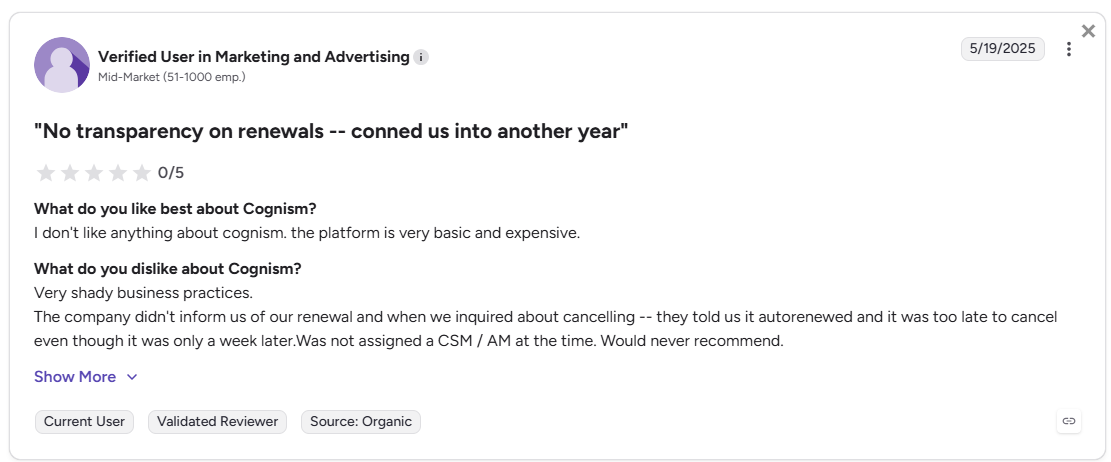
- Opaque pricing. Cognism doesn't publish its prices. For a B2B sales intelligence platform, that single fact tells you a lot about who the product is built for, and who it isn't. And you don’t have to believe it because I’m telling you, because here are some G2 reviews.
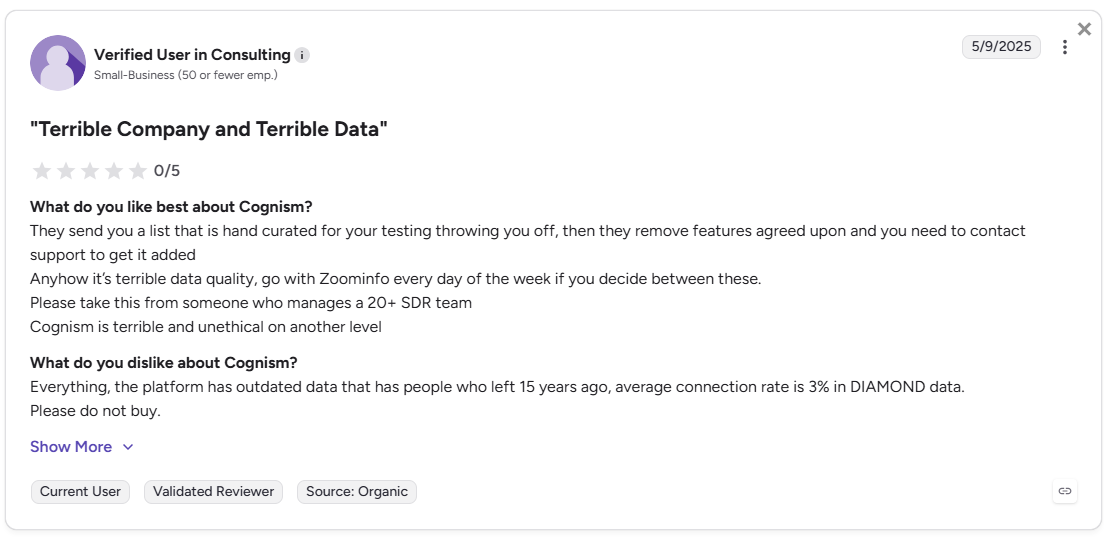
With that framing in mind, here are the 10 best Cognism alternatives.
The 10 best Cognism alternatives in 2026
1. Factors.ai: Best for B2B teams that need more than contact data
If Cognism is a database with a compliance layer, Factors.ai is an ABM platform with a database beneath it. The distinction matters enormously at the bottom of the funnel.
Factors.ai identifies more than 75% of companies visiting your website and tracks how those accounts move across pages, channels, and campaigns. What’s more, Factors.ai also offers person-level ID via RB2B for US-based B2B visitors; it surfaces name, title, work email, LinkedIn URL, and firmographics directly.
This gives marketing and sales teams a reliable account-level view of buyer activity, even when visitors never fill out forms.
Factors.ai goes WELL beyond identifying who is on your site. It tells you what they did, which campaigns touched them, and how to activate that signal across LinkedIn and Google Ads.
What makes Factors.ai different from Cognism
| Capability | Factors.ai | Cognism |
|---|---|---|
| Account-level and person-level visitor identification | 75%+ coverage via waterfall enrichment Also offers up to 40% person-level identification (via RB2B for US traffic); pulls name, title, LinkedIn URL, and work email | Not available |
| Contact database | Integrates with Apollo, ZoomInfo via API | Core product (440M+ contacts, phone-verified) |
| Intent signal sources | Website, CRM, G2, LinkedIn, Google Ads, Bombora | Bombora intent add-on only |
| Ad activation | LinkedIn AdPilot + Google AdPilot (native) | Not available |
| Multi-touch attribution | Full-funnel, MQL → Closed Won | Not available |
| Built-in outreach sequences | No (integrates with outreach tools) | Cognism Engage (basic native sequencer) |
| CRM integration | Bi-directional, HubSpot/Salesforce/Marketo | HubSpot/Salesforce/Outreach/Salesloft |
| Pricing transparency | Tiered plans, published | Quote-only, no public pricing |
| Free plan | Yes (200 companies/month) | No |
Key capabilities
- Account 360. Every account gets a unified view combining website visits, CRM stages, ad interactions, and product usage. No spreadsheet juggling.
- LinkedIn AdPilot + Google AdPilot. Native ad activation based on live buying signals. Audiences update automatically. Impressions are capped at the account level so you're not over-serving cold accounts.
- Scout AI agents. Automate account research, email drafting, campaign optimization, and list maintenance. Not a chatbot, an actual workflow layer.
- Multi-touch attribution. Tracks every touchpoint from first anonymous visit to closed deal across all your channels, not just LinkedIn clicks.
What G2 users say
"Factors.AI solves this problem by helping us identify website visitors and their level of engagement. When the data is synced with our CRM, we can see additional signals and intent metrics, which allows us to prioritize high-potential leads."
- G2 review, verified user
"The platform's unsampled analytics and attribution capabilities give us granularity we couldn't get anywhere else. We can finally prove which campaigns actually move pipeline."
- G2 review, verified user
Pricing
- Free plan: 200 companies/month, 3 seats, visitor tracking + Slack integration
- Basic: 3,000 companies/month, LinkedIn intent signals, HubSpot/Salesforce integration
- Growth (most popular): 8,000 companies/month, ABM analytics, account scoring, G2 intent, dedicated CSM
- Enterprise: Unlimited companies, 25 seats, LinkedIn AdPilot, Google AdPilot, predictive scoring, white-glove onboarding
Best for: B2B SaaS, enterprises and mid-market teams that run LinkedIn and Google Ads, need account-level intelligence, and want attribution that connects to revenue (not just top-of-funnel data).
2. Apollo.io: Best for startups and budget-conscious teams
Apollo is the answer to the question: "What if I could get a contact database AND outreach sequences in one tool, without spending $22K/year?"
Apollo.io is a strong choice for startups that want prospecting, sequencing, and outreach in one platform. Its database covers 275M+ contacts, and the sequencing tools let SDRs run multichannel outreach without a separate Outreach or Salesloft subscription.
Also, read: Best sales prospecting tools for B2B teams
What to know before buying
- Data accuracy sits around 80–85%, lower than Cognism's Diamond Data for phone numbers
- Email bounce rates can run higher than enterprise alternatives
- The free plan (100 credits/month) lets you test data quality before committing
- Paid plans start at ~$49/user/month for the Basic tier
Best for: Early-stage teams, solo SDRs, and companies that want prospecting + outreach in one affordable package, especially for US-focused outbound.
3. ZoomInfo: Best for enterprise teams with deep US coverage needs
ZoomInfo is where you go when Apollo's data accuracy isn't good enough, and Cognism's EMEA-first focus isn't the right fit. ZoomInfo starts at $14,995 per year, but the actual total cost for enterprise teams with full feature access runs significantly higher.
Also, read ZoomInfo pricing in 2026
What justifies the price? The US contact database is the deepest in the market. Org charts, technographic data, intent signals (proprietary), and conversation intelligence through Chorus.ai are all available in one platform.
If you are currently using ZoomInfo and are looking to switch, you might also want to read the ZoomInfo alternatives blog.
Cognism vs ZoomInfo, in plain terms
- ZoomInfo wins on US data depth, org chart coverage, and proprietary intent signals
- Cognism wins on EMEA data quality, GDPR compliance, and verified mobile numbers in Europe
- Many enterprise teams end up using both, which tells you something (duh)
Best for: Large sales orgs with primarily North American pipelines who need deep company intelligence, org charts, and integrated conversation intelligence.
4. Lusha: Best for small teams that need quick, affordable contact data
Lusha positions itself as the accessible middle ground: better than a basic email finder, more affordable than ZoomInfo or Cognism. Lusha starts at $36 per month per user with a credit-based model and a clean LinkedIn Chrome extension that SDRs tend to love.
The platform covers 280M+ B2B contacts, including direct dials and validated email addresses. The AI-powered prospecting layer helps prioritize outreach, and the LinkedIn integration is genuinely smooth.
Related read: Lusha alternatives and competitors
Where it falls short
- Credit limits on lower tiers run out faster than expected for high-volume teams
- Intent data isn't as deep as Cognism's Bombora integration
- Company-level intelligence is thinner compared to ZoomInfo or 6sense
Best for: Small sales teams and SDRs who need fast, affordable contact enrichment with a clean LinkedIn workflow, without committing to enterprise contracts.
5. LeadIQ: Best for LinkedIn-native prospecting workflows
LeadIQ is built for the SDR who lives in LinkedIn Sales Navigator. The platform captures prospect data directly from LinkedIn, pushes it into CRM and sequencing tools, and tracks "job changes" triggers so reps know when to re-engage warm contacts.
LeadIQ offers free and paid plans based on user count and monthly credits, with tiered pricing that scales with usage. LeadIQ is easier to use and more focused on data capture than Apollo, but Apollo offers more automation.
The job change tracking feature is underrated. When a champion moves to a new company, LeadIQ flags it so you can reach them before a competitor does.
Where it falls short
- Data volume is lower than ZoomInfo or Cognism
- Limited intent signal depth beyond LinkedIn activity
- Not built for non-LinkedIn prospecting workflows
Best for: SDR teams running LinkedIn-heavy outbound who want frictionless data capture and CRM sync without a complex platform.
6. SalesIntel: Best for teams that need human-verified US contact data
SalesIntel takes a different approach to data quality: human researchers verify contacts rather than relying solely on algorithmic validation. The ResearchOnDemand feature lets teams request verification for specific contacts within hours.
SalesIntel is a great alternative to Apollo.io for teams that value human-verified contact data. It blends automation and manual verification to maintain data quality, making it ideal for teams who rely heavily on accurate phone numbers and job titles.
The platform also includes technographic data, intent signals, and buying committee identification, making it a more complete ABM tool than a pure contact database.
Best for: Mid-market US sales teams that run high-volume cold calling and need verified phone numbers with better accuracy than Apollo can deliver.
7. UpLead: Best for transparent, credit-based contact enrichment
UpLead makes one strong promise: 95% data accuracy, with credits refunded for any email that bounces. That kind of guarantee is genuinely rare in this category and earns serious trust from smaller teams burned by bad data elsewhere.
The platform is credit-based, with transparent monthly/annual plans, no platform fees added on top, and a free trial with real data access before you buy. For teams that want to validate quality before committing, that process is faaaar cleaner than what Cognism offers.
What it doesn't do
- No built-in outreach sequencing
- No deep intent data or ABM features
- Database size is smaller than ZoomInfo or Apollo
Best for: SMBs and lean teams that want clean, verified contact data at a transparent price without the complexity of enterprise platforms.
8. Seamless.AI: Best for high-volume list building with real-time verification
Seamless.AI's positioning is simple: real-time data verification means you're pulling contact information that's being checked as you pull it, not data that was verified six months ago and may have changed.
The platform is built for SDR teams that need to move fast. The Chrome extension works across LinkedIn, company websites, and other directories, and the contact volume is generous on paid tiers.
The trade-off
- Real-time verification is a genuine differentiator for freshness
- Data accuracy reviews are mixed, with some users reporting more bounce rates than expected
- Lacks the GDPR compliance infrastructure that makes Cognism valuable for European teams
Best for: High-volume prospecting teams in North America who prioritize quantity and recency over deep enrichment or compliance features.
9. Clearbit (now Breeze Intelligence by HubSpot): Best for HubSpot-native teams
Clearbit was acquired by HubSpot in 2024 and rebranded as Breeze Intelligence. If your CRM is HubSpot, this integration is now the tightest available: real-time enrichment of form fills, company identification, and contact data all flowing natively into your HubSpot records.
The data model is firmographic and technographic first. Intent signals are limited compared to dedicated intent platforms, but the enrichment quality for the HubSpot ecosystem is strong.
Related read: Clearbit alternatives for 2026
Best for: HubSpot-first teams that want frictionless enrichment without managing a separate data vendor or integration layer.
10. Clay: Best for building highly personalized, AI-enriched outbound lists
Clay is not a traditional contact database. It's a data orchestration platform that pulls from 75+ data sources (including Cognism, Apollo, LinkedIn, and more) and uses AI to enrich and personalize outreach at scale.
The typical use case: build a highly targeted list using firmographic and technographic filters, auto-enrich each company with recent news, funding data, and technographics, then generate personalized first lines for cold emails, all in one workflow.
Why it's on this list
Teams switching from Cognism often discover they were paying for data they could access through Clay at a fraction of the cost, with more sources and better personalization workflows attached.
Where it's different
- Not a plug-and-play prospecting tool. Requires setup and a learning curve.
- Data access requires credits per row per enrichment column
- Best paired with a sequencing tool for outreach execution
Best for: Ops-savvy teams and agencies that want maximum data flexibility, AI-powered personalization, and the ability to build custom enrichment workflows without being locked into one data provider.
If you are actively looking for more tools that have similar capabilities to Clay, you might also want to read Clay alternatives for GTM teams
How to choose the right Cognism alternative for your team?
No listicle makes this decision for you. Here's a simple decision tree.
| If your primary need is… | Go with… |
|---|---|
| Full GTM platform with ad activation + attribution | Factors.ai |
| Affordable all-in-one prospecting + outreach | Apollo.io |
| Deep US enterprise data + conversation intelligence | ZoomInfo |
| Fast LinkedIn-native contact capture | LeadIQ or Lusha |
| Human-verified US phone numbers | SalesIntel |
| Transparent credits, strong accuracy guarantee | UpLead |
| HubSpot-native enrichment | Clearbit / Breeze Intelligence |
| AI-enriched outbound list building | Clay |
| High-volume real-time verification | Seamless.AI |
| Staying with Cognism for EMEA-heavy outbound | Cognism |
Look… most teams are NOT choosing one tool; they're choosing a primary platform and pairing it with something for the gaps. Factors.ai + Apollo, ZoomInfo + Cognism for EMEA, Clay + any sequencer- these combinations are common for a reason.
What matters is knowing which capability you need most, before you start talking to sales reps who will happily convince you their platform does everything.
FAQs for Cognism alternatives
Q1. What are the main reasons teams switch from Cognism?
The three most common drivers are geographic coverage gaps (weak outside EMEA), opaque pricing and rigid annual contracts, and the lack of built-in outreach sequencing. Teams selling into North America or APAC often find competitors offer better contact accuracy at a lower price. Teams that need outreach automation alongside contact data tend to move to Apollo or a combined Factors.ai + outreach stack.
Q2. How much does Cognism actually cost in 2026?
Cognism doesn't publish pricing. Based on third-party procurement data, the platform fee runs $15,000–$25,000/year before per-seat costs of $1,500–$2,500 per user annually. A 5-person team on the Grow plan typically runs ~$22,500/year. Elevate (Diamond Data tier) for the same team runs ~$37,500+. Onboarding, intent topic add-ons, and annual renewal increases push the real first-year cost higher.
Q3. Is Factors.ai a direct Cognism competitor?
Not exactly, and that distinction matters. Cognism is a contact database with compliance features. Factors.ai is an account intelligence and GTM platform that identifies companies visiting your website, activates those accounts through LinkedIn and Google Ads, and attributes revenue across channels. If you need phone numbers for cold calling, Factors.ai isn't the replacement. If you need to know which accounts are in-market, how to reach them through paid channels, and which campaigns are actually driving pipeline, Factors.ai does things Cognism can't.
Q4. Does Apollo.io have better data than Cognism?
For Europe: no. Cognism's EMEA coverage and Diamond Data phone verification are genuinely superior. For North America and global SMB coverage: Apollo is more affordable and comparable in accuracy for most use cases, though Cognism's verify rate on mobile numbers is higher. Apollo's data accuracy sits around 80–85%, and Cognism's Diamond Data verification is closer to 98% for verified numbers (though that verified set is smaller than Apollo's total database).
Q5. What's the best Cognism alternative for small teams or startups?
Apollo.io is the most practical choice at the lower end of the market: it combines contact data and outreach sequencing in one tool, offers a free plan, and paid tiers start at ~$49/user/month. UpLead is the better pick if outreach automation isn't needed and data accuracy is the priority, with transparent credit-based pricing and a 95% accuracy guarantee.
Q6. Can Clay replace Cognism?
Clay can access Cognism's data as one of its 75+ source integrations, so technically yes… you can pull Cognism contacts through Clay. But Clay is a workflow tool, not a standalone database. Teams that switch from Cognism to Clay typically do so because they want to combine multiple data sources, not because Clay's own data is superior. Expect a learning curve and budget for credits per enrichment.
Q7. What if I need GDPR-compliant data but Cognism's pricing is too high?
Factors.ai's GDPR-compliant tracking covers company-level identification without storing personal data. Kaspr is another alternative for European teams at a lower price point, particularly for LinkedIn-based prospecting. Dealfront (formerly Echobot + Leadfeeder) is specifically built for GDPR-compliant European coverage. For teams that primarily need website visitor identification from European accounts,
Q8. Does Factors.ai require a contact database to be useful?
Factors.ai identifies accounts at the company level. Most teams pair it with Apollo, ZoomInfo, or Lusha for contact enrichment. The combination is powerful: Factors.ai tells you which companies are in-market and engaging; your contact database tells you who to call there. Separately, each covers half the picture. Together, they replace the guesswork.
AI Marketing Software: The Best Platforms for Modern B2B Marketing Teams
Compare the best AI marketing software for B2B teams in 2026. Learn which tools drive pipeline, automate workflows, and improve attribution.
TL;DR
- Most AI marketing software conversations focus on feature counts and content generation speed, but the teams winning in 2026 aren't the ones with the most tools, they're the ones who actually know what's working and why.
- Attribution and pipeline visibility are now *more* valuable than content generators, not because content doesn't matter, but because measurement is the bottleneck most teams refuse to admit they have.
- Comparing Jasper to Factors.ai is like comparing Canva to Salesforce. They solve fundamentally different problems, and the best ai marketing software depends entirely on the job you're hiring it to do.
- AI amplifies existing systems. Good data and clean processes get more efficient, but broken systems just break faster (and more expensively).
- The next wave isn't "more AI tools." It's fewer tools that unify data, context, decisions, and actions, so marketers stop stitching together twenty disconnected dashboards every morning.
I was on a call last week with a marketing leader who'd just finished a vendor demo. She turned to me and said, "They used the word *AI* forty-three times in forty-five minutes, and I still don't know what the product actually does." I laughed, because I've been on that exact call before… And I know you’ve been through this too. Multiple times. The pitch always sounds the same: revolutionary AI, game-changing automation, intelligent everything. And then you ask, "Can this tell me which campaigns are actually driving pipeline?" and then suddenly the WiFi signal is weak.

That moment captures what's happening across the AI marketing software *landscape* right now. The category has exploded in size (sometimes unnecessarily), and nearly every marketing tool has slapped an "AI-powered" badge on its homepage. But for B2B teams trying to run smarter campaigns, measure revenue impact, and stop wasting budget, the sheer volume of options has made buying decisions harder, not easier. This is the guide I wish someone had handed me two years ago.
For the hundredth time, what is AI marketing software, really?
The term "AI marketing software" gets used SOO loosely that it's practically meaningless without context. At its simplest, it refers to any marketing tool that uses machine learning, natural language processing, or predictive analytics to automate, optimize, or personalize marketing activities. But that definition covers everything from a chatbot widget to a full-blown revenue intelligence platform, so we need to be more specific.
There's a BIG difference between four levels of AI in marketing today.
- First, you've got AI *features*, which are things like predictive subject lines or smart send-time optimization bolted onto an existing platform.
- Then there are AI *copilots*, like HubSpot's Breeze Copilot, which sit alongside you and help draft content, summarize records, or surface insights on demand.
- Next come AI *agents*, autonomous systems that can plan, execute, and optimize tasks without constant human input.
- And finally, there are AI-native platforms, which were built from the ground up with AI as the core architecture, not a feature layer added after the fact.
Most of what vendors call "AI" today falls into the first two categories. Adding a chatbot inside a dashboard doesn't suddenly make a platform AI-native (wow, never thought I'd say that). The real evolution has moved from basic marketing automation through CRM automation and predictive analytics into what some are calling agentic marketing systems, where software doesn't just follow rules but makes contextual decisions. The question marketers should ask before anything else is this… “does this software actually help me make *better* decisions, or does it just generate more output?”
Why do most AI marketing software conversations miss the point entirely?
Open any listicle comparing the best AI marketing software, and you'll see the same evaluation criteria recycled across articles. Number of AI features. Content generation capabilities. Number of integrations. Maybe a prompt library or two will be needed. These factors mattered in 2023. But now, they're table stakes.
The deeper problem is that most buying frameworks still evaluate tools in isolation, as if the software itself is the strategy.
But ‘modern AI marketing’ software should AT LEAST help with five things that rarely appear on comparison checklists:
- understanding demand signals
- identifying high-value accounts
- prioritizing opportunities by revenue potential
- automating execution across channels
- measuring actual revenue impact.
When you evaluate tools through that lens, the 'AI market' looks very different.
After working across SaaS companies for nearly half a decade, one recurring pattern keeps showing up. Marketing teams fail because they have fragmented data, broken attribution, and different versions of reality. Sales thinks the webinar drove the deal. Marketing thinks it was the LinkedIn ad. Finance looks at a spreadsheet and trusts neither (typical finance, I know).
Now, adding another AI tool on top of a messy stack often creates more confusion and chaos. The question then becomes this: "do I have the foundation for any AI tool to actually work?"
What are the different categories of AI marketing software
One of the biggest mistakes marketers make when shopping for AI marketing software is comparing tools that solve *fundamentally* different problems. Before we get into specific recommendations, it helps to understand the landscape.
- AI content creation software
Tools like Jasper, Writer, Claude, and ChatGPT live here. Their primary job is to accelerate content production: blogs, ad copy, emails, landing pages, social posts. These tools have gotten remarkably capable at generating first drafts and repurposing existing content across formats. They're the best AI software for content marketing when your bottleneck is volume.
- AI marketing automation platforms
This is where HubSpot AI, Marketo, and Salesforce Marketing Cloud (now rebranded as Agentforce Marketing) sit. These platforms handle lead nurturing, workflow automation, and campaign orchestration. They're the backbone of the best ai software for marketing automation, managing the operational side of how campaigns get built and delivered.
- AI attribution and analytics platforms
Factors.ai, HockeyStack, Dreamdata, and Cometly focus on a different problem altogether: connecting marketing touchpoints to actual revenue. They handle multi-touch attribution, pipeline visibility, and buyer journey analysis. For B2B teams with long sales cycles and multiple stakeholders, this category answers the question that keeps CMOs up at night: "where is pipeline actually coming from?"
- AI-powered ABM platforms
Factors.ai, Demandbase, and 6sense specialize in account-based marketing. They help teams identify target accounts, track intent signals, score accounts against your ICP, and prioritize which companies deserve attention right now. These platforms sit at the intersection of ai marketing software for lead generation and strategic sales alignment.
- AI agents and autonomous marketing systems
This is the newest category, and it's evolving fast. Tools like Scout, Agentforce, and Tofu AI can run autonomous workflows, conduct research, support decision-making, and optimize campaigns with minimal human input. In 2026, marketing teams are increasingly deploying agents that handle targeting, messaging, timing, and budget allocation in real time.
Comparing Jasper against Factors.ai is like comparing Canva against Salesforce. They solve completely different problems. You wouldn't evaluate a design tool and a CRM using the same rubric, and you shouldn't do it with AI marketing software either.
The best AI marketing software platforms
"Best" is a loaded word in any software comparison. The best AI marketing software 2026 depends entirely on the job you're hiring it to do. I'm organizing these recommendations by use case rather than vendor popularity, because that's how buying decisions actually work in practice.
Best AI marketing software for attribution and pipeline intelligence
- Factors.ai stands out here
The platform handles multi-touch attribution, visitor identification, company intelligence, AI-powered account insights, and pipeline measurement. It tracks how accounts move across channels (organic search, paid ads, LinkedIn, email, G2, direct traffic) and attributes pipeline and revenue to each touchpoint. The LinkedIn analytics are particularly detailed, showing which campaigns influenced which accounts at the impression level.
For B2B teams spending meaningful budget on LinkedIn and Google Ads, this visibility is difficult to get from native platform analytics alone. The platform also offers account scoring that uses real engagement signals (website behavior, content consumption, ad interactions, and third-party intent) to produce a live, ranked list of accounts showing the most buying activity.
As budgets get scrutinized harder, attribution platforms are becoming *more* valuable than content generators. Most marketers don't have a content problem. They have a measurement problem, and they know it. Attribution debates sometimes resemble group projects where everyone claims credit for the final result.
Best AI software for marketing automation
- HubSpot has invested heavily in AI capabilities under its Breeze AI umbrella.
Breeze Copilot helps write content and research contacts. Breeze Agents handle content creation, social media, prospecting, and customer service autonomously. The platform now includes AI-powered workflow building from plain language, predictive lead scoring, and an AEO (Answer Engine Optimization) tool that tracks how your brand surfaces in AI-powered search engines.
- Marketo remains a strong choice for teams with complex nurture programs, especially those already in the Adobe ecosystem.
Its lead scoring and campaign orchestration are mature and well-documented.
- Salesforce Marketing Cloud (now Agentforce Marketing) represents the enterprise end of this spectrum.
It brings agentic automation, generative content, and decisioning capabilities into marketing operations, all grounded in CRM data through Data Cloud. The recent Spring '26 release added campaign brief generation within Agentforce conversations and business unit support for enterprise-scale deployments.
Best AI marketing software for ABM
Combines account identification, intent signals, and dynamic audiences at a price point that's accessible to mid-market teams. It scores accounts based on engagement across your website, content, ads, and third-party sources, then alerts your team in Slack or via email when high-intent accounts surface.
- 6sense
The prediction engine of the ABM category. Its core strength is identifying accounts that are actively researching a purchase *before* they raise their hand, using AI-driven buying stage models. It's the strongest choice for sales-led organizations that need a daily "who to call" feed.
- Demandbase
Approaches ABM from an advertising-first angle. Its native DSP is genuinely differentiated for B2B ad targeting, with daily audience syncing and tight feedback loops between ad engagement and account scoring. Both 6sense and Demandbase carry enterprise price tags (typically $50K to $200K+ annually), so they make the most sense for organizations with dedicated ABM teams and mature go-to-market operations.
Best AI software for content marketing
- Jasper and Writer
Purpose-built for marketing content at scale. They handle blog drafts, ad variations, email copy, and landing page text with configurable brand voice settings. Writer, in particular, has carved out a niche with enterprise teams that need governance and style consistency.
- Claude and ChatGPT
General-purpose AI models that marketing teams have adopted as creative workhorses. They're versatile and powerful for brainstorming, outlining, editing, and repurposing content across formats.
PS: I think you should know this… AI can help scale content production, but it can't manufacture expertise. The companies winning with AI content aren't producing *more* content. They're producing more *informed* content, pieces grounded in original data, customer conversations, and genuine subject-matter depth. No attribution model answers every question perfectly, and anyone who tells you otherwise is probably selling one.
Best AI marketing software for lead generation
- Factors.ai
Handles the intelligence layer of lead generation: identifying companies visiting your website (even those who never fill out a form), scoring them against your ICP, and surfacing intent signals across channels. It's AI marketing software for lead generation that focuses on quality over raw volume.
- ZoomInfo and Apollo
Provide the contact data layer, verified emails, phone numbers, firmographic and technographic intelligence for outbound prospecting. Clay sits in the workflow automation space, stitching together enrichment from multiple data sources into personalized outreach sequences.
Best AI marketing software for enterprise teams
Enterprise teams need a different set of capabilities: governance, security, workflow orchestration, and large-scale implementation support.
Offers enterprise plans with AI-driven scoring, advanced analytics, and CRM integration for larger deployments.
- Salesforce (through Agentforce Marketing)
Offers the deepest enterprise infrastructure, with business unit partitioning, Data Cloud integration, and a Trust Layer that governs all AI data handling.
- Adobe
Brings its marketing suite capabilities to enterprise content and experience management.
- Demandbase
Remains the best AI marketing software for enterprise ABM teams running significant paid media budgets alongside account-based strategies.
AI marketing software comparison table
This AI marketing software comparison highlights a key point: no single platform does everything well. The leading AI marketing software providers each anchor in a specific use case and expand outward. The real tradeoff isn't features vs. features. It's whether the platform solves *your* specific bottleneck or just adds another dashboard to check every morning.
How do you choose the right AI marketing software?
Choosing the best AI software for marketing requires more than reading G2 reviews and booking demos. Here's a framework that actually works.
Step 1: Identify your bottleneck
Are you struggling with content production, attribution, lead generation, pipeline visibility, or account-based targeting? The answer determines which category of tool deserves your budget. Most teams try to solve three problems simultaneously with one purchase and end up solving none.
Step 2: Audit your existing stack
What tools do you already have? Where does data live, and where does reporting break down? If you're running GA4, a CRM, separate ad platforms, and maybe an intent data feed, you've already got fragmented data. Understanding what exists is the only way to figure out what's missing.
Step 3: Evaluate your AI readiness
Is your CRM data clean? Do you have reliable tracking in place? Is intent data available and actionable? These aren't hypothetical questions. AI tools can only work with the data they're given.
Here's one uncomfortable truth that I keep coming back to: AI amplifies existing systems. Good systems become more efficient. Broken systems become broken *faster*. If your CRM is a mess, buying an AI-driven marketing platform won't fix it. You'll just see your problems rendered in higher definition (duh).
Building an AI-first marketing stack
The modern B2B marketing stack is evolving from a collection of dashboards into a layered system. Here's how I think about the architecture.
- Foundation layer
Your CRM (HubSpot, Salesforce), product data, and core analytics. Everything else depends on this being clean and connected. If your foundation is unreliable, every layer above it produces unreliable outputs.
- Intelligence layer
This is where Factors.ai lives, along with intent signals and attribution platforms. The intelligence layer answers questions like "which accounts are showing buying intent?" and "which campaigns are actually influencing pipeline?" It turns raw data into decisions.
- Execution layer
HubSpot, Marketo, ad platforms, email tools. The execution layer is where campaigns get built, launched, and managed. It needs clean inputs from the intelligence layer to perform well.
- Agent layer
Scout, Agentforce, and other workflow agents that can autonomously research accounts, optimize campaigns, and surface recommendations. This layer is nascent but growing faaaar faster than most teams realize.
The future stack is becoming less dashboard-heavy and more agent-driven. Instead of opening ten tools every morning, marketers will increasingly ask systems questions and receive recommendations or actions. We're not fully there yet, but the trajectory is clear.
Common mistakes companies make when buying AI marketing software
- Buying AI before fixing data quality
I've watched teams sign six-figure ABM contracts with dirty CRM data and incomplete tracking. The platform can't identify high-intent accounts if your website analytics aren't instrumented correctly. Clean data first. AI second.
- Chasing features instead of outcomes
A platform with forty AI features sounds impressive until you realize your team only uses three. The best AI software for digital marketing is the one that solves a specific problem and gets adopted by your team, not the one with the longest feature list.
- Creating tool sprawl
Every new tool adds integration complexity, maintenance overhead, and context-switching. Before adding another platform to your stack, ask whether an existing tool can be better configured to handle the job. Tool sprawl is the silent budget killer in B2B marketing.
- Ignoring attribution
If you can't measure what's working, you can't improve it. Teams that skip attribution end up making budget decisions based on gut feel and internal politics. That might work for a quarter or two, but it catches up eventually.
- Expecting AI to replace strategy
The biggest misconception in marketing right now is that AI eliminates strategic thinking. In reality, strategy becomes *even more valuable* because execution is becoming commoditized. When everyone can produce content at scale, the competitive advantage shifts to who has the clearest understanding of their market, customers, and positioning.
AI marketing software for different B2B growth stages
- Early-stage startups
Keep it simple. HubSpot's free and starter tiers, ChatGPT for content ideation and drafting, and basic analytics (GA4 plus whatever your CRM provides) are enough. You don't need an enterprise ABM platform when your target account list fits in a spreadsheet. Spend your budget on understanding your ICP, not on software.
- Scaling SaaS companies
This is where Factors.ai earns its place. As pipeline grows, attribution becomes essential for knowing which channels deserve more investment. Advanced attribution, account identification, and ABM capabilities start paying for themselves when you're spending meaningful budget on LinkedIn, Google Ads, and content programs.
- Mid-market organizations
At this stage, multi-channel orchestration and intent data become critical. You're likely running several campaigns simultaneously across channels, and the buyer journey involves multiple stakeholders over weeks or months. An ai-driven marketing suite that unifies data across these touchpoints stops your team from operating on different versions of reality.
- Enterprise teams
Governance, AI agents, cross-channel measurement, and scalable workflows define the enterprise stack. Platforms like Salesforce Agentforce, Factors.ai at the enterprise tier, and Demandbase handle the complexity of global teams, multiple business units, and regulatory requirements. The best ai marketing software for enterprises 2025 and 2026 prioritizes security, auditability, and operational control alongside AI capabilities.
The best AI software is often the one that matches your operational maturity, not the most expensive platform on the market.
The future of AI marketing software
Several themes are converging that will reshape the ai marketing software landscape over the next few years.
- AI agents become operating systems
Salesforce's Connections 2026 event centered entirely on "becoming an Agentic Enterprise," and HubSpot's Breeze Agents are already handling prospecting and content autonomously. The shift from "AI in the stack" to "agents running the stack" is underway.
- Marketing workflows become autonomous
Instead of manually configuring nurture sequences and campaign logic, marketers will define goals and guardrails while agents handle execution, testing, and optimization. Salesforce's State of Marketing report found that 19.20% of marketers are already using AI agents to automate marketing initiatives end to end, and that number is climbing fast.
- Attribution becomes real-time
Multi-touch attribution has historically been a backwards-looking exercise. Platforms like Factors.ai are moving toward real-time account activity detection and predictive conversion scoring, which means teams can act on signals while buying intent is still active.
- Marketing tech stacks consolidate
The next wave is fewer tools that do more. The winners will likely be platforms that unify data, context, decisions, and actions rather than forcing marketers to stitch together twenty disconnected products. The patchwork approach loses to integration in 2026, and that trend will only accelerate.
AI software doesn't fix broken marketing
The AI marketing software market is sooo crowded right now. Every platform claims to automate growth, drive pipeline, and revolutionize your GTM motion. Very few help marketers answer the questions that actually matter: What's working? Which accounts deserve our attention? Where is the pipeline coming from? And what should we do next?
After nearly a decade in B2B SaaS marketing, the biggest shift I've seen isn't that AI is replacing marketers. It's that AI is *exposing* which marketing teams genuinely understand their customers, data, and revenue engine and which teams were quietly relying on guesswork the whole time. The software itself isn't the advantage. The advantage comes from how intelligently a team uses it, how clean their data is, and whether they've built the operational maturity to turn insights into action.
The marketers who win the next decade won't be the ones running the most AI tools. They'll be the ones who consistently make better bets with the same data everyone else has access to.
Frequently asked questions about ai marketing software
Q1. What is AI marketing software?
AI marketing software refers to tools that use machine learning, natural language processing, or predictive analytics to automate, optimize, or personalize marketing activities. This includes everything from content generation platforms like Jasper and ChatGPT to attribution and intelligence platforms like Factors.ai, marketing automation tools like HubSpot and Marketo, and ABM platforms like 6sense and Demandbase. The category is broad, which is why understanding the specific problem you're trying to solve matters more than the label on the box.
Q2. Which is the best AI marketing software in 2026?
The best AI marketing software in 2026 depends on what you're trying to accomplish. For attribution and pipeline intelligence, Factors.ai is a standout. For all-in-one marketing automation, HubSpot's Breeze AI suite offers the widest accessible feature set. For enterprise ABM with advertising, Demandbase and 6sense lead the category. For content generation at scale, Jasper and Writer are purpose-built. There's no single "best" tool, only the best tool for your specific use case and growth stage.
Q3. What is the difference between AI marketing software and marketing automation software?
Marketing automation software follows predefined rules to execute workflows: "if lead opens email, wait two days, send follow-up." AI marketing software goes further by learning from data, predicting outcomes, and adapting behavior without manual rule configuration. Modern platforms like HubSpot and Salesforce now blur the line by embedding AI capabilities directly into their automation engines. The practical difference is whether the software *follows* rules or *learns* from patterns.
Q4. How does AI marketing software improve lead generation?
AI marketing software improves lead generation by identifying which companies are showing buying intent, scoring them against your ideal customer profile, and prioritizing the highest-value opportunities for outreach. Platforms like Factors.ai identify anonymous website visitors at the account level, track engagement across multiple channels, and surface real-time alerts when target accounts are active. This shifts lead generation from "spray and pray" toward focused, signal-driven engagement.
Q5. What AI marketing software is best for B2B SaaS companies?
B2B SaaS companies with long sales cycles and multi-stakeholder buying journeys benefit most from platforms that combine attribution, account intelligence, and ABM capabilities. Factors.ai is particularly well suited because it unifies website, CRM, LinkedIn, and G2 data to map full buyer journeys. For marketing automation, HubSpot is the most popular choice among SaaS companies from startup through mid-market. Enterprise SaaS teams often layer in Salesforce or 6sense as their scale demands it.
Q6. Is AI marketing software worth the investment?
It depends on whether you have the operational foundation to use it effectively. If your CRM data is clean, your tracking is reliable, and your team has a clear strategy, AI marketing software can significantly improve efficiency, attribution accuracy, and pipeline visibility. If your data is fragmented and your processes are undefined, even the most expensive platform will underperform. The investment pays off when the foundation supports it.
Q7. What should enterprises look for in AI marketing software?
Enterprise teams should prioritize governance and security (SOC 2, GDPR, CCPA compliance), scalable workflow orchestration, business unit support, robust CRM integration, and AI capabilities grounded in unified customer data. Platforms like Salesforce Agentforce Marketing, Demandbase, and Factors.ai at the enterprise tier offer these capabilities. Implementation support and dedicated customer success resources also matter significantly at enterprise scale, because a tool that takes six months to deploy and requires dedicated ops headcount needs to deliver proportional value.
Q8. How do AI marketing platforms integrate with CRM systems?
Most leading ai marketing platforms offer native integrations with Salesforce and HubSpot, including bi-directional data sync, automated field updates, and embedded insights within CRM records. Factors.ai, for example, syncs account-level engagement data directly into your CRM so sales teams can see a full account timeline before making outreach. The quality of CRM integration varies significantly between vendors though, so it's worth testing the actual data flow during evaluation rather than relying on "we integrate with everything" promises.
Q9. Can AI marketing software replace marketers?
AI isn't replacing marketers. It's changing what marketers spend their time on. Content drafting, data analysis, workflow management, and campaign optimization are all becoming faster with AI assistance. But strategic thinking, customer empathy, creative positioning, and cross-functional leadership remain deeply human skills. The marketers who thrive in 2026 are the ones who use AI to eliminate busywork and invest the recovered time into higher-value strategic work, not the ones who try to automate their way out of understanding their market.
AI marketing implementation: the complete transformation roadmap for B2B teams
Learn how to implement AI across your B2B marketing team, stack, and workflows with a practical roadmap focused on pipeline, scale, and ROI.
TL;DR
- Most AI marketing implementations fail because they're solving for tools, not for broken workflows, bad data, and missing visibility across the funnel.
- There's a meaningful difference between AI usage, AI adoption, and AI transformation, and most B2B teams are stuck at stage one while pretending to be at stage three.
- An AI marketing implementation plan that starts with business outcomes (pipeline, conversion, revenue) will outperform one that starts with "let's try ChatGPT for blog posts" every single time.
- The companies building an AI-first marketing stack aren't adding more dashboards. They're connecting fragmented signals across CRM, ads, analytics, and revenue data into a single operating model.
- Scaling content with AI without a human editorial layer doesn't create a competitive moat. It creates noise, and your audience already has *wayyy* too much of that.
- If your AI reporting dashboard ends at "hours saved," you're measuring inputs while your CFO cares about outcomes.
Last quarter, I sat in a leadership meeting where someone said, "We need to be more AI-first." I nodded along, like everyone else. Then someone asked the obvious follow-up: "What does that *actually* mean for us, specifically?" The silence was… eerily extraordinary. Ten WHOLE seconds of it. I'm not entirely sure anyone on that call knew what that sentence meant (including the person who said it).
That moment has become a recurring theme in almost every B2B marketing conversation I've had this year. Teams are buying AI tools, running pilot projects, building prompt libraries, and still struggling to answer the simplest question: *Is any of this making us better?*

This is a guide to AI marketing implementation that doesn't start with a tool recommendation or a vendor comparison. It starts where I think every AI marketing transformation roadmap should begin: with the system you already have, the outcomes you actually need, and the BIG gap between where you are and where you think you are.
Why are most AI marketing implementations failing?
After working with SaaS companies, startups, growth teams, and enterprise marketers, I’ve noticed that most companies have an operations problem disguised as an AI problem.
For the past two years, marketers have been acquiring tools faster than we were catching Pokemons (yes, we all remember the Pokémon Go phase).
The Content Marketing Institute found that 54% of B2B marketing teams take an ad hoc approach to AI, experimenting without applying it widely.
Only 19% reported that they've integrated AI into their daily processes and workflows.
The result is a stack full of copilots generating outputs but rarely improving business outcomes.
This is what I call "pilot purgatory." A team runs a promising experiment with an AI writing tool or an audience segmentation model. The results look decent. And then nothing happens. The experiment never connects to a repeatable workflow, a measurement framework, or a revenue outcome.
McKinsey's findings illustrate this gap, showing that only 21% of businesses have redesigned some workflows around AI.
Everyone else remains stuck in earlier stages of integration.
The core issue is that 90% of AI discussions focus on tools instead of systems. CMOs keep asking "Which AI tool should we buy?" when they should be asking "Which bottleneck are we removing?" AI simply scales whatever system already exists. If your handoffs, attribution, and reporting are broken, AI just helps you break them faster.
What does AI marketing implementation actually mean?
Using ChatGPT to write LinkedIn posts isn't ✨AI transformation✨. I need to say that clearly because a surprising number of teams genuinely believe it is.
There's a spectrum here, and collapsing the terms together creates confusion. Let me break it down: AI *usage* means individuals on your team are experimenting with tools on their own, often without coordination. AI *adoption* means the organization has started standardizing around specific tools and use cases. AI *implementation* means those tools are connected to workflows, data systems, and measurement. AI *transformation* means the operating model itself has changed: how decisions get made, how teams are structured, and how campaigns move from idea to execution.
Connecting customer data, campaign data, CRM data, intent signals, content workflows, and decision-making systems into a unified operating model is what real AI and marketing integration looks like. That's the difference between having AI in your stack and building an AI-first marketing organization.
The concept of AI-native marketing is gaining traction because it describes organizations where AI isn't layered on top of existing processes; it's woven into how those processes function from the beginning.
The dividing line will be between B2B marketing organizations that are AI-enhanced and those that are truly AI-native, where some teams manage individual tools while others will have autonomous systems generating pipeline around the clock."
The emerging trend of agent-based marketing pushes this even further.
AI agents have advanced from simple automation to becoming a strategic workforce capable of executing high-impact go-to-market strategies, acting as systems that can understand and respond to customer inquiries without human intervention.
AI is increasingly becoming part of buying journeys themselves, not just the marketing side of them.
Before you buy another AI tool: audit your marketing system
Most companies jump straight into AI content generation. Meanwhile, nobody can explain why opportunities are stalling in Stage 2 of the pipeline. That's backwards.
Before you evaluate a single new tool, you need to understand the system those tools would plug into. I break this into three layers, and I'd recommend scoring your team honestly against each one.
Data layer. Can you trust your CRM data? Is your attribution setup actually reflecting buyer journeys, or just the last click? Do you have intent data, and if so, does anyone use it? Are your first-party signals (website behavior, content engagement, product usage) connected to anything downstream?
Execution layer. How long does it take to launch a campaign from brief to live? Where do content workflows break down? Is ad management centralized or scattered across team members? Can you pull a revenue report without spending a full day building it?
Intelligence layer. Do you have any forecasting in place? Is audience segmentation based on real behavioral data, or on assumptions from six months ago? Can marketing and sales agree on what pipeline visibility actually looks like?
The questions to ask before any ai integration in marketing initiative are deceptively simple. Can we trust our data? Do teams work from the same source of truth? Where are the biggest time drains? If you can't answer these confidently, AI isn't going to fix that. It'll just automate the confusion.
The AI marketing maturity framework
I've built a five-stage model for thinking about where your team sits. Honest self-assessment matters more here than aspiration (because marketers *never* lie about how advanced they are).
| Stage | Description | What it looks like |
|---|---|---|
| Stage 1: AI curiosity | Individual experimentation, no governance | People using ChatGPT on their own, sharing prompts in Slack |
| Stage 2: AI assistance | Content generation, research, summaries | Standardized tools for drafting, but disconnected from workflows |
| Stage 3: AI automation | Workflow automation, lead routing, campaign ops | AI embedded in specific processes with clear triggers and outputs |
| Stage 4: AI orchestration | Cross-channel coordination, data-connected decisions | AI tools talking to each other, informing real-time decisions |
| Stage 5: AI-native marketing | AI embedded in operating model, agents supporting execution | Human teams focused on strategy while agents handle execution |
The state of AI in B2B marketing right now is messyyyy. What I mean is… adoption is high, but competence is low 🥀
Most teams I talk to are somewhere between Stage 1 and Stage 2, which is totally fine. The problem isn't being early. It's pretending you're at Stage 4 while operating at Stage 1. That misalignment leads to bad investments and frustrated teams.
If most enterprise marketing teams report confidence in their AI tools, but almost none have centralized intelligence or orchestrated execution, then AI satisfaction and AI maturity are two very different things.
Building your AI marketing implementation plan
An effective AI marketing implementation plan doesn't start with "more AI usage." It starts with business outcomes. What does the business actually need? More pipeline. Faster campaign launches. Better content velocity. Higher conversion rates. If your plan can't connect directly to one of those, it's an experiment, not a strategy.
Step 1: Define business outcomes. Be specific. "Increase marketing-sourced pipeline by 20% in two quarters" is a business outcome. "Use more AI" is a wish.
Step 2: Prioritize use cases. Rank every potential AI use case by three criteria: revenue impact, ease of implementation, and required integrations. The use cases that score high on impact and low on complexity should go first. The ones that require rebuilding your entire data infrastructure can wait.
Step 3: Build governance. This is where most teams skip ahead and pay for it later. Governance means prompt libraries that enforce brand consistency, approval systems for AI-generated content, security protocols for data flowing into third-party models, and clear ownership of who reviews what. Without it, you end up with ten people using ten different prompts to generate inconsistent outputs across every channel.
Step 4: Train teams. AI literacy isn't optional. Your team needs to understand not just how to use the tools, but how to design workflows around them and interpret the data they produce.
Organizations combining AI deployment with clearly defined KPIs and formally redesigned workflows achieve 2.7 times higher ROI than those using AI without structural changes.
Training is the structural change most teams overlook.
Designing an AI-first marketing tech stack
The future stack isn't about adding more dashboards. When I look at ai integrations for marketing tech stack decisions, the teams that get it right organize their stack around four layers, not tool categories.
Customer data layer. Your CRM, product analytics, and CDPs. This is where all account and user data lives. If this layer is fragmented, everything downstream is unreliable.
Intelligence layer. Intent platforms, attribution platforms, and revenue analytics. This layer answers the questions that matter: who's engaging, what influenced pipeline, and what should happen next. Tools like Factors.ai sit here as the connective intelligence layer.
Factors.ai is an AI-powered marketing intelligence and ABM platform that uncovers anonymous buyer intent, tracks the entire customer lifecycle, and connects marketing touchpoints directly to revenue by unifying data from websites, CRM, ad platforms, and intent sources.
- Execution layer. Content tools, email platforms, ad management, and marketing automation. These are the systems that actually *do* things. They create, send, publish, and optimize.
- Agent layer. This is the newest and fastest-growing layer. Research agents, reporting agents, and campaign optimization agents that can operate semi-autonomously once given clear objectives.
When evaluating AI integration options for marketing software, the question is whether it connects to your intelligence layer.
Factors.ai, for example, unifies account intelligence, web analytics, multi-touch attribution, and ad optimization, identifying which companies are engaging with your website and campaigns, mapping their journeys across channels, and helping teams prioritize high-intent accounts.
The AI stack for marketing that wins isn't the one with the most tools. It's the one with the cleanest signal flow.
How are B2B teams using AI across the funnel?
The most useful way to think about AI integration for marketing teams is by mapping AI capabilities to funnel stages, because the problems AI solves look very different at each stage.
- Awareness. AI excels at content ideation, SEO research, and social content generation. Teams use it to analyze competitor positioning, identify content gaps, and generate first drafts at scale. The time savings here are *real*, but this is also where quality risks are highest.
- Consideration. This is where personalization, audience segmentation, and dynamic website experiences come in. Unlike B2C, where personalization often targets a single consumer, B2B personalization must cater to an entire buying committee, and AI excels at analyzing firmographics, technographics, and individual engagement history to deliver personalized experiences for each stakeholder.
- Decision. Account prioritization, intent scoring, and opportunity intelligence are transforming how sales and marketing collaborate at the bottom of the funnel.
Tools like Factors.ai help teams prioritize the right accounts in sales outreach and ad campaigns using predictive scores based on intent, engagement, and fit.
Expansion, customer marketing, renewal prediction, and upsell signal detection. This is the stage most B2B teams forget about entirely, and it's where AI can quietly generate enormous value by identifying expansion opportunities before the customer even thinks to ask.
Scaling content marketing with AI (without creating junk)
The internet doesn't have a content shortage. It has a *relevance* shortage. That's the biggest misconception in marketing right now: that AI helps you publish more. The best marketers are using AI to think deeper, not louder.
When I talk to teams about how to scale content marketing with AI, I always start with what AI should and shouldn't own. AI should help you research faster, repurpose existing content more effectively, and personalize deeper for different audiences and buying stages. Humans should own positioning, original insights, strategic judgment, and the editorial decisions that determine whether content builds trust or erodes it.
AI-generated content can often feel generic, lacking the authentic voice and brand tone that builds trust, with 40% of marketers citing "robotic output" as a key downside. In other words, this is what they said:

Content volume alone is meaningless if every piece reads like it was written by the same interchangeable algorithm. When you scale marketing content with AI without a human editorial layer, you create noise, and the companies you're trying to reach are already drowning in it.
The framework I recommend is simple. Use AI for the first 70% of the work: research aggregation, outline generation, first drafts, metadata, and repurposing. Use humans for the remaining 30%: fact-checking, brand voice editing, strategic angle development, and final approval.
The efficiency gains come from AI handling research, first-draft generation, and metadata, while humans handle quality assurance and strategic decisions. Teams trying to skip the human review stage typically see quality degradation that erodes performance within three to six months.
Connecting AI across CRM, ads, analytics, and revenue data
Most B2B teams run HubSpot, Salesforce, LinkedIn Ads, Google Ads, GA4, and product analytics. But none of them actually talk to each other properly. This is the ‘connecting AI tools for marketing’ challenge that nobody wants to acknowledge because solving it is genuinely hard.
Data unification means stitching account-level engagement across every touchpoint into a single profile. Attribution means understanding which interactions actually influenced pipeline, not just which ones happened to be last. Conversion APIs mean sending real revenue signals back to ad platforms so they can optimize toward outcomes, not just form fills. Audience syncing means your highest-intent accounts are automatically flowing into your ad campaigns without someone manually exporting CSVs every week.
Factors.ai connects to your CRM, ad platforms, marketing automation, and third-party intent providers, de-anonymizing website traffic using IP resolution and identity graph technology, then aggregating all touchpoints into unified account profiles that show which companies are in active buying mode.
AI scoring ranks accounts by intent and conversion probability, automated alerts notify sales when high-intent targets engage, and ad audience sync ensures LinkedIn and Google campaigns automatically target the right accounts.
The future winner isn't the company with the smartest AI. It's the company where signals flow from the first website visit through to closed revenue without getting lost in a spreadsheet somewhere along the way.
The rise of AI-native marketing teams
The organizational chart is changing. Not because AI is replacing marketers (duh), but because the work itself is shifting.
B2B marketing operations roles are evolving from "managing tools" to "designing agent workflows."
Future roles that are already showing up include Marketing AI Strategist, Revenue Intelligence Manager, Prompt Architect, Automation Lead, and AI Operations Manager. The emerging "full-stack marketer" concept isn't really about one person doing everything. It's about individuals who understand how systems connect, how data flows, and how to orchestrate AI and human capabilities together.
Gartner predicts that by 2028, one in five marketing roles or functions will be held by an AI worker, and 65% of marketing teams already have designated AI roles.
The question that’s been long looming over our heads… “Will AI replace marketers?”. It won't. But marketers who understand systems, automation, and AI orchestration will outperform those who only execute tasks. That gap is going to get faaaar wider in the next two years.
AI marketing implementation challenges (and how to avoid them)
After working with dozens of teams on ai transformation for marketing companies, I've seen the same seven challenges show up again and again.
1. Bad data
If your CRM is a mess, your AI outputs will be a mess. Clean your data before you automate anything.
2. Too many disconnected tools
44% of SaaS licenses go unused. Adding more tools without integration creates more silos, not more intelligence. Consolidate before you expand.
3. No governance
Without clear prompt standards, approval workflows, and security protocols, AI outputs become unpredictable and inconsistent across the organization.
4. Team resistance
54% of marketers feel overwhelmed by the prospect of implementing AI tools into their processes. People resist what they don't understand. Training and transparency solve this faster than mandates.
5. Unclear ROI
Only about 29% of organizations say they can measure AI ROI confidently. If you can't prove value… budget disappears.
6. AI hallucinations
Overreliance on AI-generated content happens when teams use AI as a substitute for human judgment, publishing copy with minimal review. Say this with me… human review is NOT optional; it's the quality control layer (and filter) that protects your brand.
7. Leadership expecting instant results
The primary challenge isn't a technology problem, but an organizational one. Culture, governance, workflow design, and data strategy are the main constraints on realizing ROI.
A 90-day AI marketing transformation roadmap
This is the section I want you to bookmark. A practical, phase-by-phase ai marketing transformation roadmap that gives your team a real starting point.
Days 1-30: Audit
| Task | Details |
|---|---|
| System audit | Map every tool in your stack and identify integration gaps |
| Workflow audit | Document how campaigns move from idea to launch, step by step |
| Data audit | Assess CRM quality, attribution accuracy, and first-party signal coverage |
| Maturity assessment | Score your team against the five-stage maturity framework |
| Stakeholder alignment | Get leadership agreement on business outcomes AI should drive |
Days 31-60: Pilot
| Task | Details |
|---|---|
| Content workflows | Deploy AI for research, drafting, and repurposing with human review |
| Reporting automation | Connect campaign data to pipeline data for automated dashboards |
| Audience segmentation | Build intent-based segments using behavioral and firmographic data |
| Governance setup | Create prompt libraries, review processes, and security protocols |
Days 61-90: Scale
| Task | Details |
|---|---|
| Integrations | Connect CRM, ad platforms, intent sources, and analytics into unified account profiles |
| Governance rollout | Standardize AI workflows across the entire marketing team |
| Measurement framework | Define operational, marketing, and revenue KPIs tied to AI initiatives |
| Agent evaluation | Assess where AI agents can handle research, reporting, or campaign optimization |
The sequencing matters because each phase builds on the previous one. You can't scale integrations if you haven't audited your data. You can't measure AI's impact if you haven't defined the outcomes it's supposed to drive. (Wow, never thought I'd say "sequencing matters" in a marketing blog, but here we are.)
How to measure AI marketing success
If your AI reporting dashboard ends at productivity metrics, you're measuring the wrong thing. Executives don't buy AI for faster content. They buy it for faster growth.
I recommend tracking metrics across three tiers.
- Operational metrics
Time saved per campaign, campaign velocity (idea to live), and content production time. These prove efficiency, and they matter, but they're not enough on their own.
- Marketing metrics
MQL efficiency, pipeline influenced by AI-assisted campaigns, and cost per opportunity. These connect AI activity to demand generation outcomes. The most immediate ROI indicators from AI-assisted content are content velocity and cost per content unit, meaning total cost divided by outputs.
- Revenue metrics
Customer acquisition cost, win rate, and revenue generated from marketing-sourced pipeline. These are the numbers that keep your budget alive.
Organizations that align AI deployment with clearly defined performance KPIs report *significantly* better results than those adding AI without structural changes.
The companies that build measurement frameworks early won't just know whether AI is working. They'll know where it's working and where to invest next. That's a structural speed advantage most competitors won't have.
What will ‘AI-first B2B marketing’ look like by 2027?
Here's where I get to speculate, the fun and dangerous part (because marketers never lie about predictions either).
- Agent-assisted buying journeys are coming, where the buyer's AI interacts directly with the seller's AI. Autonomous campaign optimization will move from "AI recommends adjustments" to "AI makes the adjustments and tells you what it did." AI-generated audience models will replace static ICPs with dynamic, behavior-driven segments that update in real time.
- Revenue orchestration agents, AI-first marketing content examples and beyond, and real-time personalization across every touchpoint: all of this is moving from concept to production faster than most teams expect.
The companies that win won't be the ones using the most AI (you know that already, right? RIGHT?).
They'll be the ones that redesign how marketing works around it. Every process, every handoff, every decision point, every measurement loop. That's the difference between AI-enhanced marketing and an AI-first marketing organization. And for what it's worth, I don't think anyone fully knows how to do it yet. But the teams that start building the muscle now will be the ones that figure it out first.
In a nutshell
AI marketing implementation is an operating model shift that touches your data, your workflows, your team structure, and your measurement frameworks simultaneously. The teams stuck in pilot purgatory almost always share the same root cause: they started with tools instead of outcomes. If you take one thing from this piece, let it be the sequencing. Audit your system first. Fix your data layer. Define the business outcomes AI needs to drive. Then, and only then, build your implementation plan around specific use cases ranked by revenue impact.
The 90-day roadmap gives you a practical starting point, but the maturity framework gives you the honest lens to assess where you actually are. Most teams are at Stage 1 or 2. That's fine. What's not fine is staying there while pretending to be somewhere else. Start with the audit, pilot one or two high-impact workflows, connect your AI tools to real revenue data, and measure what actually matters: pipeline influenced, cost per opportunity, and win rate. The marketers who win the next decade won't be the ones who adopt the most AI tools. They'll be the ones who consistently make better decisions with the same signals everyone else has access to.
Frequently asked questions about AI marketing implementation
Q1. What is AI marketing implementation?
AI marketing implementation is the process of integrating AI tools, workflows, and decision-making systems into your marketing operations in a way that connects to measurable business outcomes. It goes beyond simply using AI for content drafts or research. True implementation means AI is embedded in your data layer, execution layer, and intelligence layer, informing how campaigns get built, how accounts get prioritized, and how performance gets measured against pipeline and revenue.
Q2. How do you create an AI marketing implementation plan?
Start with specific business outcomes, not tools. Define what you need AI to improve: pipeline, campaign velocity, conversion rates, or content throughput. Then prioritize use cases by revenue impact, ease of implementation, and required integrations. Build a governance framework covering prompt standards, review processes, and data security. Finally, train your team on both the tools and the workflows those tools connect to.
Q3. What is an AI-first marketing organization?
An AI-first marketing organization has restructured its operating model around AI capabilities rather than layering AI on top of existing manual processes. Decisions, workflows, and team structures are designed with AI as a core component from the start. Human teams focus on strategy, positioning, and creative judgment while AI handles execution, data analysis, and routine optimization tasks.
Q4. What are the biggest AI marketing implementation challenges?
The most common challenges include bad CRM data, disconnected tools that don't share signals, absence of governance frameworks, team resistance driven by lack of training, difficulty measuring ROI, AI-generated content quality issues like hallucinations, and leadership expecting transformation-level results in weeks rather than quarters.
Q5. How do you integrate AI into a marketing tech stack?
Think about your stack in layers: customer data, intelligence, execution, and agents. AI integration for marketing means ensuring that data flows between these layers, that your intelligence tools connect to your CRM and ad platforms, and that AI outputs feed back into decision-making loops rather than sitting in isolated dashboards.
Q6. How can B2B companies scale content marketing with AI?
Use AI for the research-heavy, repetitive portions of content production: topic ideation, first drafts, repurposing, metadata, and distribution optimization. Keep humans in control of positioning, original insights, editorial quality, and strategic judgment. Teams that skip the human review layer consistently see quality erosion within a few months, which undermines the efficiency gains AI was supposed to deliver.
Q7. What tools are needed for an AI-powered marketing technology stack?
An AI-powered marketing technology stack typically includes a CRM like HubSpot or Salesforce, an intelligence platform like Factors.ai for account identification and attribution, content and automation tools, ad platforms with AI optimization capabilities, and increasingly, AI agents for research, reporting, and campaign management. The specific tools matter less than whether they connect to each other and share data across the funnel.
Q8. How long does AI marketing transformation take?
A foundational 90-day sprint can get you through the audit, pilot, and initial scaling phases. But genuine transformation, where AI changes your operating model and team structure, typically takes six to twelve months of sustained effort across multiple functions.
Q9. What KPIs should marketers track after AI implementation?
Track metrics across three tiers. Operational metrics include time saved and campaign velocity. Marketing metrics include MQL efficiency, pipeline influenced, and cost per opportunity. Revenue metrics include customer acquisition cost, win rate, and total revenue generated from marketing-sourced pipeline. If you're only tracking the first tier, you're measuring inputs while your CFO needs to see outcomes.

How to use AI for marketing: the practical B2B marketer's playbook
Learn how to use AI for marketing across strategy, content, ads, attribution, ABM, and pipeline generation with a practical B2B framework.
TL;DR
- AI is most valuable in marketing when it's connected to revenue data, not used in isolation for content generation.
- Most teams get AI wrong by starting with tools instead of diagnosing what's broken in their workflows first.
- The highest-leverage AI use cases in B2B are account prioritization, attribution, and sales-marketing alignment, not first-draft copy.
- Integrating AI into marketing workflows requires governance, prompt libraries, and human review layers, not just subscriptions.
- AI agents are replacing AI assistants, and the marketers who will win are those who know exactly where to keep humans in the loop.
- Factors.ai is purpose-built for the B2B use cases where AI actually moves pipeline: account intelligence, intent signals, and attribution.
I've been through enough marketing trends to develop trust issues.
Marketing automation was supposed to fix demand generation. Predictive analytics was supposed to fix forecasting. ABM was supposed to fix the relationship between sales and marketing.
The technology usually worked. The humans remained stubbornly… human.
Now, AI feels wayyy bigger than those shifts. I think it probably is. But I'm noticing a familiar pattern. Teams are rushing to automate processes they haven't fully figured out yet.
Which is why the biggest AI wins aren’t from generating more content (shocking, isn’t it?!) They come from reducing bad decisions.
Knowing which accounts are actually worth pursuing. Identifying buying signals earlier. Separating genuine opportunities from expensive distractions.
The companies getting the most value from AI aren't necessarily creating more, but they're wasting less.
This blog is for marketers who are past the ‘let's try ChatGPT’ phase and want to build something that survives longer than the next hype cycle.
Good news: AI isn't replacing marketing; it's replacing marketing busywork
Here's what nobody says out loud in the AI marketing conversation: the parts of your job that AI is good at replacing are mostly the parts you weren't enjoying anyway (wohoo!).
The SERP analysis at 10 pm. The fourteenth variation of an ad headline. The manual account scoring spreadsheet that three people update inconsistently.
The parts AI is genuinely bad at replacing are the parts that require accumulated judgment: which market to enter next, which story will land with a specific buying committee, where to put budget when you have imperfect signal on all sides.
What this means practically is that AI is a force multiplier on your operational layer. It makes research faster, creation faster, optimization faster, and reporting faster. But the decisions those processes are meant to inform still require a human who understands the business context. A model that hasn't sat through your last board meeting, hasn't heard your customer call recordings, and doesn't know why you lost your three biggest deals last quarter cannot replace that judgment.
The marketers getting the most value from AI aren't the ones generating the most content. They're the ones who have been ruthless about separating "decisions that require human judgment" from "execution that can be systematized," and have moved the second category to AI as aggressively as possible.
What do most marketers get wrong about AI?
Let me be specific about the failure modes, because the usual framing of "AI isn't magic" is not actionable.
Mistake 1: Buying tools before diagnosing problems
The most common version of this I've seen is teams buying ChatGPT Enterprise before fixing attribution, or standing up an AI SDR platform before defining ICP clearly enough for a human SDR to qualify well. AI doesn't know what a good lead looks like if your team doesn't agree on what a good lead looks like.
If your conversion from MQL to SQL is 8% and you add AI to your lead scoring, you might get it to 12%. But if the real issue is that marketing and sales are working from different definitions of "qualified," AI just helps you surface that misalignment faster and at higher volume.
Mistake 2: Treating content as the whole use case
Content generation is the most visible AI use case because it's the easiest to demo. Ask a model to write a blog post and something coherent appears. This creates a distorted perception that AI for marketing means AI for writing.
Content is also, genuinely, one of the lower-leverage AI applications in B2B marketing. The highest-leverage applications are in intelligence, prioritization, and attribution, where AI can process signals at a scale and speed that changes what decisions you're even able to make. Writing a faster first draft of a blog post doesn't change your pipeline. Knowing which 40 accounts are showing buying behavior right now does.
Mistake 3: Expecting AI to compensate for bad data
"Garbage in, garbage out" has been a cliché since the mainframe era, and it is no less true because the system is now a large language model. If your CRM is a mess, your attribution is broken, and your first-party data is scattered across six tools that don't talk to each other, AI will help you be wrong faster and more confidently.
AI amplifies the quality of your systems. The teams winning with it are the ones who cleaned their data and connected their stack first, then added AI as an operating layer on top.
The 7-layer framework for using AI in marketing
This is the model I think about when evaluating where AI fits in a marketing organization. It's not a technology stack, it's an operating model.
Most teams are operating at layers 3 and 4 and calling it "AI-powered marketing." The real moat is in layers 1, 2, 6, and 7, where AI is touching decisions that affect pipeline and revenue, not just content volume.
How to use AI for marketing strategy?
Marketing strategy is where AI is both most powerful and most easily misused. The power comes from AI's ability to synthesize large amounts of information quickly, whether that's analyzing hundreds of customer reviews, mapping a competitive landscape, or identifying shifts in buyer search behavior. The misuse comes from treating AI-generated strategy as a substitute for the contextual judgment that comes from actually knowing your market.
The best strategy teams aren't replacing thinking with AI. They're using AI to eliminate spreadsheet archaeology so the thinking can start earlier.
- Market research and competitive analysis
AI is genuinely excellent at accelerating the research phase of strategy work. You can feed it earnings call transcripts, G2 reviews, competitive landing pages, and win/loss notes, and get back a synthesized view of where the category is moving faster than any analyst could produce manually. That synthesis is a starting point, not a conclusion. The strategic interpretation still requires someone who knows why your customers chose you over a competitor and what that actually means about positioning.
- ICP refinement using pipeline data
One of the highest-value applications of AI in strategy is feeding it your closed-won and closed-lost data and asking it to surface patterns. Which firmographic segments close fastest? Which deal sizes have the shortest sales cycles? Which personas appear most consistently in your best accounts? AI can identify these patterns across hundreds of deals in minutes. The output becomes input for sharper ICP definition, which then improves everything downstream: targeting, messaging, channel selection, and sales prioritization.
- Trend detection before it's obvious
Search behavior, forum discussions, and job posting patterns are all signals that can tell you where buyer attention is moving before it shows up in your pipeline. AI can monitor and synthesize these signals at a scale that's not manually feasible. If you're waiting for a trend to be obvious before you build content or positioning around it, you're already late.
How to use AI for content marketing
Content is where AI entered the marketing consciousness, and it's the area where the hype-to-reality gap is most visible. The promise was unlimited content at zero marginal cost. The reality is that AI-generated content that hasn't been shaped by genuine expertise and editorial judgment is almost immediately recognizable, and increasingly penalized, both by search algorithms and by readers who've gotten very good at spotting it.
The frame I'd suggest: AI is a capable first-draft machine for templated formats. It is a poor substitute for original thinking.
The content workflow that actually works
The workflow that produces high-quality AI-assisted content isn't "prompt and publish." It's:
- Research phase. Use AI to accelerate SERP analysis, identify content gaps, pull together existing thinking on a topic, and synthesize competitor content approaches. This alone saves hours.
- Brief and outline. Use AI to generate an initial structure, then edit it based on your own expertise and the specific angle you want to take. The angle almost always needs to come from a human who has an actual point of view.
- First draft. AI drafts the templated sections: definitions, explainer boxes, comparison tables, metadata. The sections that require genuine expertise, original data, or a strong POV should be written or substantially rewritten by a human.
- SME review and voice pass. This is non-negotiable. Someone with subject matter expertise needs to verify claims, add nuance, and inject the specific examples and stories that make a piece credible. If the AI draft and the final published piece look identical, you've published AI content with a human byline.
- Optimization. AI can run SEO optimization, suggest internal links, and generate metadata efficiently. This is a genuinely good use of AI in the content workflow.
Where human expertise is irreplaceable
The sections of a content piece that are most valuable for SEO and for reader trust are also the sections AI is worst at producing: original research references, counterintuitive takes on established wisdom, specific examples from customer conversations, and the kind of confident assertion that comes from actually knowing a space well. If your content strategy is built entirely on AI generation without that layer, you're competing on volume against every other team doing the same thing.
Also read: Will AI replace digital marketers?
How to use AI in paid advertising?
Paid advertising is one of the areas where AI has had the most measurable impact, largely because the feedback loops are faster and the outcome metrics are clearer than in content or brand marketing.
Where AI is already working
Most major ad platforms have built AI into their optimization layers. Smart Bidding on Google, Advantage+ on Meta, and LinkedIn's predictive audiences are all AI-driven, and for many teams, they outperform manual bidding once they have enough conversion data to learn from. This isn't "using AI for marketing," this is just using the ad platforms in 2026.
Beyond platform-native AI, the areas where AI adds value in paid advertising are audience creation, creative testing, and budget allocation.
- Audience creation. Lookalike modeling, intent-based segmentation, and predictive audience scoring all improve when AI has access to rich first-party data. The quality of the input data determines the quality of the audience.
- Creative testing. AI can generate headline and copy variations at scale, making systematic creative testing faster. The constraint is that the winning creative still tends to come from a genuine insight about the audience, not from random variation.
- Budget optimization. AI-assisted budget allocation, when connected to pipeline and revenue data rather than just platform metrics, can dramatically change how budgets get distributed. CPL optimization looks very different from pipeline-per-dollar optimization.
The metric problem
Most AI ad optimization is optimizing for platform metrics: clicks, conversions, cost-per-lead. These are not pipeline metrics. A CFO who cares about revenue attributed to paid channels is asking a fundamentally different question than a platform algorithm optimizing for cost-per-click. The value of AI in paid advertising compounds when it's connected to downstream revenue data, not just ad platform data.
How to use AI for ABM and pipeline generation
This is the chapter that most "AI for marketing" guides don't go deep enough on, and it's the one that matters most if you're in B2B.
Account-based marketing is, at its core, a signal and prioritization problem. There are thousands of companies that theoretically fit your ICP. There are maybe a few hundred showing meaningful buying signals at any given moment. There are probably thirty or forty where your timing, solution fit, and relationship position create a genuine near-term opportunity. AI's job in ABM is to collapse that funnel with signal rather than spray-and-pray.
- Identifying accounts that are actually in-market
Traditional ABM target lists are built from static firmographic criteria: industry, headcount, revenue, tech stack. These tell you which accounts could be buyers. They tell you nothing about which accounts are currently looking.
Intent data, web visit patterns, content engagement signals, and technographic change signals (new hires, tech additions, funding rounds) are all behavioral signals that indicate buying activity. AI can aggregate and score these signals across thousands of accounts continuously, surfacing the ones that are warming up before a sales team would ever notice organically.
- Prioritizing accounts using behavioral and firmographic scoring
The combination of firmographic fit (does this account match your ICP?) and behavioral signals (is this account showing buying behavior right now?) is what good AI-powered account scoring looks like. Either dimension alone produces noisy results. Together, they produce a shortlist of accounts that your sales team can engage with a realistic expectation of relevance.
- Personalizing at the account level
Once you've identified which accounts to prioritize, AI can help personalize outreach at a scale that would be impossible manually. Industry-specific pain points, relevant product use cases, references to the prospect's specific business context, these can all be dynamically assembled at the account level. The output still needs human review before it goes out, but the legwork of assembly can be significantly automated.
- Expanding beyond the single contact
One of the consistent patterns in B2B deal loss is single-threading: marketing and sales are engaged with one person in an account while the actual buying committee has five to eight people involved in the decision. AI can analyze engagement signals to surface other stakeholders showing interest, identify typical buying committee structures for your segment, and suggest outreach strategies for each persona.
Factors.ai is built specifically for this layer: account-level intent aggregation, buying signal scoring, and pipeline intelligence that connects marketing activity to the accounts that actually matter.
Also read: Account-based marketing metrics that actually matter
How to use AI in sales and marketing alignment?
The biggest operational AI opportunity in B2B isn't better emails. It's getting marketing and sales to finally work from the same data about which accounts matter and why.
The classic version of misalignment: marketing is reporting on MQLs, sales is complaining about lead quality, and nobody has a shared view of which accounts are actually progressing toward revenue. Both teams are technically doing their jobs. The problem is that the jobs aren't connected to the same goal.
AI can create a shared operational layer between marketing and sales by synthesizing engagement signals, scoring accounts, and surfacing next-best-action recommendations that both teams can work from.
- Lead qualification. AI can score leads against ICP criteria and behavioral signals in real time, creating a qualification layer that's consistent across both teams rather than dependent on individual judgment.
- Buying signal detection. When AI is aggregating signals across a prospect's web behavior, content engagement, intent data, and CRM history, it can surface buying signals that neither marketing nor sales would catch individually.
- Account summaries. AI can generate real-time account summaries for sales reps before calls: recent content engagement, website visit patterns, intent topics, and open opportunities. This closes the information gap between what marketing knows and what sales has access to.
- Opportunity intelligence. AI can flag accounts that are showing signs of going cold, identify timing patterns that predict deal progression, and surface competitive signals that should change the sales approach.
The north star here is a shared revenue intelligence layer that both teams trust enough to act on. That's both a technology question and a change management question.
How to use AI for attribution and measurement
Attribution is where the AI conversation in marketing gets interesting, and where most of the existing guides stop too early.
The standard treatment of AI in marketing analytics focuses on automated reporting and anomaly detection. These are useful. They're not the leverage point.
The real leverage is in connecting marketing activity to pipeline and revenue outcomes, at a signal resolution that manual analysis can't achieve. This is where AI fundamentally changes what you're able to know about your marketing.
The attribution models that matter in B2B
AI-driven attribution doesn't just automate the calculation of these models. It can identify which combination of touchpoints statistically predicts pipeline conversion, flag channels that look efficient on CPL but underperform on pipeline influence, and surface the content assets that appear most frequently in the journeys of accounts that close.
That last one is genuinely underused: most content teams have no idea which pieces of content show up in the paths of their best deals versus their worst fits.
Forecasting with AI
Once you have clean attribution data connected to pipeline and revenue data, AI can start doing meaningful forecasting: which accounts are likely to progress in the next 30 days, which channels are likely to hit or miss their pipeline targets, where budget reallocation would have the most impact. This is the layer that turns marketing from a cost center into a revenue function in the eyes of the business.
How to choose AI marketing tools?
The AI marketing tool landscape in 2026 is... a lot. There are AI writing tools, AI SEO tools, AI ad platforms, AI CRM enrichment tools, AI SDR tools, AI attribution tools, and an entire category of platforms that have added "AI" to their positioning because the market rewards it. Evaluating these thoughtfully requires a framework that isn't "what demo looked most impressive."
Questions to ask vendors before you buy
- What does your data model look like, and what integrations are required to get value?
- How does the system handle ambiguous or conflicting signals?
- What does the review and governance layer look like?
- Can you show me a customer in my segment who is six months into using this, and what does their ROI story look like?
- What happens to my data if I cancel?
The best AI tool isn't the one with the most impressive AI. It's the one your team is actually using six months after implementation, and can connect to a number on a revenue dashboard.
How to integrate AI into marketing workflows
Integration is where AI projects go to die. The demo worked. The tool is purchased. The workflows never actually change because the new tool doesn't fit how work gets done.
The integration patterns that work are the ones that slot AI into existing workflows with minimal friction, rather than asking teams to adopt entirely new workflows to get the AI value.
Content workflow with AI
- Research. AI pulls together SERP analysis, competitive content inventory, and existing internal assets. Output: a research brief that a writer can actually use.
- Brief. AI generates a structured outline based on the research brief. Human editor shapes the angle, adds the POV, and confirms the key argument.
- Draft. AI writes sections where templated structure is sufficient (definitions, comparison tables, metadata). Human writes or substantially edits sections requiring expertise or original argument.
- SME review. Subject matter expert validates claims and adds specificity. This step is non-negotiable.
- SEO and AEO optimization. AI runs optimization checks. Human confirms recommendations fit the overall piece.
- Publish and distribute. AI handles metadata, social variants, and distribution formatting.
ABM workflow with AI
- Intent monitoring. AI continuously scores accounts against ICP fit and behavioral signals.
- Prioritization. Weekly or real-time surfacing of accounts that have crossed engagement thresholds.
- Personalization. AI assembles account-specific outreach context. Human reviews and edits before send.
- Measurement. AI tracks account progression through the funnel and flags accounts going cold.
Ad workflow with AI
- Audience building. AI segments audiences based on intent signals and behavioral patterns.
- Creative testing. AI generates headline and copy variations. Human selects and refines based on brand judgment.
- Campaign launch. Platform AI handles bid optimization.
- Insight generation. AI surfaces which creative patterns and audience segments are driving pipeline, not just clicks.
How to operationalize AI inside a marketing team
This is where most playbooks end with a vague gesture toward "change management." Let me be more specific.
The companies winning with AI aren't necessarily using better models. They're building better operating systems around the models they have.
- Ownership and governance
The first question in any AI operationalization is: who owns this? Not tool-by-tool ownership, but a genuine accountability structure for how AI is used, reviewed, and improved across the team.
Without ownership, you get tool sprawl, inconsistent output quality, and zero institutional learning. Someone needs to own the prompt library, maintain the integration documentation, run the periodic audits of AI output quality, and be accountable for the team's AI literacy over time.
- Building a prompt library
One of the highest-leverage investments a marketing team can make is building and maintaining a prompt library: a shared, documented set of prompts for common use cases (content briefs, competitor analysis, account summaries, ad copy variations) that have been tested and refined over time.
The alternative is every team member reinventing the wheel every time they use an AI tool, which both wastes time and produces inconsistent output. A good prompt library is a genuine competitive asset.
- Training for AI literacy, not just AI tools
AI literacy in a marketing team isn't about knowing how to use specific tools. It's about understanding what AI is reliably good at, where it requires heavy human oversight, and how to evaluate the quality of AI output without blindly accepting it. These are judgment skills, not tool skills, and they develop through deliberate practice and shared norms, not just access to the tools.
- Measuring what matters
The right success metrics for AI adoption in marketing are not "how many AI tools are we using" or "how much content are we producing." They are: has AI reduced the time from insight to action? Has AI improved the quality of our account prioritization? Has AI helped us attribute marketing activity to pipeline more accurately? The measurement frame has to be tied to the business outcomes the team is accountable for.
Common AI marketing mistakes to avoid
The future of AI marketing: agents, not assistants
The current dominant use of AI in marketing is query-response: you ask, it answers. This is already genuinely useful. But it's the first phase, not the end state.
The shift that's happening now, and will accelerate significantly over the next two years, is from AI assistants to AI agents. An assistant responds to requests. An agent executes workflows autonomously, checks for exceptions, makes decisions within defined parameters, and surfaces outputs for human review rather than waiting to be asked.
In practice, this means marketing workflows that look like: a target account shows intent signals, AI automatically assembles the account brief, routes it to the right sales rep, queues personalized outreach, and flags it for pipeline tracking, without a human initiating each step. The human's job becomes defining the rules, reviewing the exceptions, and making the judgment calls that fall outside the model's parameters.
This is not a threat to marketing jobs. It's a redistribution of where human attention goes. The marketers who will thrive in this environment are the ones who understand how to design these systems, define the right guardrails, and recognize when AI is making a decision that needs human judgment. The ones who will struggle are the ones who are currently doing tasks that agents can do and haven't developed the judgment layer above those tasks.
The next generation of B2B marketers won't win because they use AI. They'll win because they've figured out exactly where humans need to stay in the loop and where the machine should just run.
How does Factors.ai fit into this?
Everything in this playbook converges on one core problem: B2B marketing has always struggled to connect activity to revenue. You know your MQL volume. You might know your pipeline influence. You rarely have clean, trustworthy data on which marketing activities drove which deals.
Factors.ai is built specifically for this problem. It aggregates account-level intent signals, tracks buying behavior across your website and campaigns, connects marketing touchpoints to pipeline and revenue, and gives both marketing and sales a shared view of which accounts are in-market and why.
If you're serious about moving AI from content generation to revenue intelligence, the place to start is getting your attribution and account intelligence layer right. That's the foundation everything else in this playbook is built on.
FAQs for how to use AI for marketing
Q1. How do beginners start using AI for marketing?
Start with a specific, bounded problem rather than trying to "use AI for marketing" in the abstract. Pick one workflow that's time-consuming and templated, like writing ad copy variations or generating content briefs, and build a repeatable AI-assisted process for that workflow. Once you have one working pattern, expand from there. The teams that struggle are the ones that try to transform everything at once.
Q2. How can small businesses use AI for marketing?
Small businesses often get more from AI than enterprise teams do, because the ROI of saving five hours a week on content and research is proportionally more significant. The highest-value AI uses for small B2B businesses are content production, ad creative testing, and basic competitive research. The more complex intelligence and attribution use cases require data volume that most small businesses don't have yet, so don't over-invest in that layer early.
Q3. What is the best way to use AI in B2B marketing?
The best use of AI in B2B marketing is at the account intelligence and attribution layer: identifying which accounts are showing buying signals, scoring them against ICP, and connecting marketing activity to pipeline and revenue. This requires clean data and integrated systems, which is why most teams default to content generation instead. But the revenue impact of getting account intelligence right dwarfs the impact of producing content faster.
Q4. How do you integrate AI into marketing workflows?
The integration patterns that work are the ones that fit AI into existing workflows rather than creating new workflows around AI. Map your current content, ABM, and campaign workflows, identify the steps that are templated and time-consuming, and add AI assistance at those specific steps. The goal is to reduce friction for the people who are already doing the work, not to redesign how work gets done from scratch.
Q5. What are the best AI marketing tools?
The right tools depend entirely on the problem you're solving. For content, tools like ChatGPT, Claude, and Jasper handle different parts of the workflow well. For ABM and account intelligence, Factors.ai, 6sense, and Bombora serve different segments. For attribution, Factors.ai, Bizible, and Triple Whale are common choices depending on your stack. Evaluate tools against your specific use case and data environment, not against a generic "best AI tools" list.
Q6. How can AI improve marketing ROI?
AI improves marketing ROI most reliably when it's connected to revenue outcomes, not just efficiency metrics. Producing content faster doesn't improve ROI if the content isn't driving pipeline. AI improves ROI when it surfaces accounts that are actually in-market (reducing wasted SDR time), identifies which channels are driving revenue not just leads (improving budget allocation), and accelerates the time from insight to action across the marketing function.
Q7. How do you use AI for content marketing?
The effective AI content workflow is: AI handles research synthesis, initial outlining, templated draft sections, and SEO optimization. Humans handle the strategic angle, original arguments, subject matter expertise, and final voice pass. If your AI-generated draft and your published piece look identical, you've skipped the steps that make the content worth reading.
Q8. How do you use AI for account-based marketing?
AI in ABM primarily serves three functions: identifying accounts showing buying behavior through intent data and engagement signals, scoring those accounts against ICP fit to surface the highest-priority targets, and personalizing outreach at the account level at a scale that isn't manually feasible. The integration requirement is that AI needs access to your first-party data, intent data, and CRM to do this well. Platforms like Factors.ai are built specifically for this use case.
Q9. How do you measure AI marketing success?
Measure AI marketing success against the business outcomes the team is accountable for, not against AI adoption metrics. Is account prioritization improving, meaning are SDRs spending time on accounts that actually convert? Is attribution getting cleaner, meaning can you connect marketing spend to pipeline with more confidence? Is the time from insight to campaign action decreasing? These are the metrics that translate AI investment into business impact.
AI marketing vs traditional marketing: What actually drives growth?
Compare AI marketing vs traditional marketing across ROI, personalization, attribution, and B2B growth. A practical guide for modern marketers.
TL;DR
- The AI vs traditional marketing debate is mostly a distraction. The real question is whether your team is making better decisions with the data and tools you already have.
- Traditional marketing still wins on brand building, emotional storytelling, and trust. AI marketing wins on speed, personalization at scale, and predictive intelligence.
- AI marketing and marketing automation are not the same thing. Conflating them leads to bad vendor choices and worse expectations.
- Most AI marketing implementations fail because they're layered on top of broken data foundations, fragmented attribution, and unclear strategy.
- The highest-performing B2B teams aren't choosing between AI and traditional. They're using AI as the operating system and human judgment as the decision layer.
- Machine learning marketing use cases that actually move pipeline include predictive lead scoring, intent-based targeting, and account prioritization, not just content generation.
- The future problem in marketing won't be lack of AI tools. It'll be lack of governance, clean data, and people who know how to use both.
Every few weeks, someone declares the death of traditional marketing… usually on LinkedIn… in a post written using traditional marketing, by a ‘thought-leader’.
The argument is always roughly the same. AI changes everything. Old playbooks are dead. The future belongs to marketers who automate, orchestrate, optimize, and whatever other verb is currently raising venture capital. Blah. blah. blah.
A few days later, someone else posts that AI is overhyped, brand is everything, fundamentals still matter, and marketing was better when people weren't prompting machines to write emails.
Both sides get plenty of engagement… neither side is particularly useful.
Because "AI vs Traditional Marketing" isn't really a debate. It's mostly a category error.
It's a bit like arguing whether calculators are better than mathematics or whether GPS is better than knowing how to drive. One is a tool. The other is the thing you're trying to get better at.
The companies seeing the best results from AI aren't replacing marketing fundamentals. They're applying them more effectively. They still need positioning. They still need messaging. They still need customer understanding. They still need someone capable of recognizing a bad idea before it gets automated at scale.
The companies struggling with AI usually have the opposite problem. They bought the tools before they understood the strategy. Which is a surprisingly expensive way to discover that automation doesn't fix confusion.
So instead of asking whether AI marketing is better than traditional marketing, the more useful question is this:
What parts of marketing benefit from AI, what parts still depend on human judgment, and where do the two work best together? That's what we'll unpack in this guide.
What do marketers get wrong about the AI vs traditional marketing debate?
The biggest mistake is assuming there are only two sides.
Most teams I've seen approach this as a resource allocation debate. Do we invest in AI tools or stick with what we know? But that framing treats marketing as a collection of tools rather than a system of decisions. And decisions, unlike tools, aren't either/or.
Here's what the debate usually misses: buyers don't experience your marketing strategy. They experience your content, your ads, your emails, your sales conversations. Whether those were produced by a human writer or a large language model, whether that targeting was AI-driven or manually segmented, is completely invisible to them. What they feel is relevance, timing, and quality. Everything else is internal.
The second thing it misses is that AI doesn't create demand. It improves decision-making inside existing demand generation systems. If your messaging is off, AI will scale bad messaging faster. If your ICP is wrong, AI will target the wrong accounts more efficiently. The technology amplifies what's already there, and that cuts in both directions.
The real divide in modern marketing is intelligence versus guesswork. Teams that run on gut feel and quarterly reporting cycles versus teams that have feedback loops, clean data, and the infrastructure to act on signals. AI is one of several tools that can move you toward the intelligence side of that spectrum. But it's not the only one, and it's not sufficient on its own.
AI marketing vs traditional marketing: a side-by-side comparison
Before getting into the nuances, here's how the two approaches actually stack up across the dimensions that matter most in B2B.
The pattern here is worth naming directly. Traditional marketing optimizes for campaigns. AI marketing optimizes for outcomes. Those aren't the same thing, and that gap is where a lot of marketing waste lives.
How does traditional marketing actually work?
Let's be honest about something: "traditional marketing" has been used as a pejorative for so long that we've stopped acknowledging what it actually does well.
In B2B, traditional marketing rarely means TV ads and billboards. It means campaign planning on a quarterly cadence, static audience segments built from CRM data and industry research, manual optimization based on performance reviews, and human-led decisions about positioning, messaging, and budget. Most enterprise marketing teams still operate this way, and the reason isn't stubbornness. It's that traditional frameworks were built for a world with less data, longer sales cycles, fewer channels, and simpler attribution paths. Within those constraints, they worked.
The problems emerged when the world changed. Channels multiplied. Buyer journeys got longer and more fragmented. Data volumes increased faster than human capacity to process them. The systems that made sense in 2010 started showing their limits, and the response from most teams was to hire more people and buy more point solutions. Which worked, until it didn't.
Traditional marketing also deserves credit for something AI genuinely struggles with: building brand. The campaigns that people remember, the ones that shift category perception, create cultural moments, or define what a company actually stands for, those come from human craft, editorial judgment, and risk-taking. You can't A/B test your way to an iconic brand. Some things require a point of view.
How does AI marketing actually work?
When people say "AI marketing," they usually mean several different things at once, which is part of why the conversation gets muddy.
There's a useful taxonomy here. AI technologies use data analysis, machine learning, and automation to predict consumer behavior, often by interpreting customer data to guide audience decisions. In marketing, that shows up as lead scoring models that predict conversion probability, algorithms that determine which ad creative to serve to which audience segment, systems that identify which accounts are showing buying intent based on behavioral signals, and forecasting models that estimate revenue from current pipeline. These are all different applications of the same underlying concept: using data patterns to improve decisions.
Generative AI is the newer layer, covering tools like large language models that can produce content, summarize data, draft variations, and increasingly take autonomous actions. It's what most people think of when they hear "AI marketing" right now, partly because it's the most visible. But it's worth noting that the most impactful AI applications in B2B marketing aren't primarily about content generation. They're about signal detection, prioritization, and prediction.
Agentic AI systems, which can plan and execute sequences of tasks with limited human input, are early-stage in most marketing contexts but moving fast. The practical frontier for most B2B teams right now is using AI to do three things: identify high-probability accounts earlier in the buying cycle, personalize outreach and content at a scale that humans can't match manually, and surface insights from revenue data that would take days of analyst work to produce manually.
The biggest advantages of AI marketing
- Personalization at scale
Traditional marketing can reasonably support a few dozen audience segments. AI marketing can support individual-level experiences. The difference isn't cosmetic. At scale, generic messaging produces generic results. The reason Amazon recommendations feel weirdly good at predicting what you want, or why Spotify Wrapped is genuinely compelling every year, is that personalization at the individual level creates a fundamentally different experience than personalization at the segment level. In practice, personalized marketing paired with data-driven campaigns can lift engagement rates by 10-15% versus traditional methods. B2B is catching up, and the teams doing it well are already seeing better engagement, shorter sales cycles, and higher pipeline quality.
- Faster optimization loops
Traditional campaign optimization runs on a quarterly or monthly cadence, which means you're often three budget cycles behind by the time a poor performer gets cut. AI-powered systems can optimize daily or even hourly, reallocating budget toward what's working before the waste compounds. This isn't just a speed advantage. It's a compounding advantage. AI-driven marketing can also cut overhead by 12.2% and increase sales productivity by 14.5% by automating repetitive tasks. Small, frequent improvements add up faster than large, infrequent ones.
- Predictive intelligence over historical reporting
The shift from "what happened last quarter" to "what is likely to happen next quarter" is one of the more underappreciated changes AI enables. Predictive lead scoring, churn forecasting, and pipeline prediction models don't eliminate uncertainty, but they shift teams from reactive to anticipatory. That changes how you allocate resources, how you brief sales, and how you think about capacity planning. Anyone who's sat in a Q4 pipeline review with a spreadsheet and vibes knows how much this matters.
- Smarter attribution across long buying cycles
B2B attribution has always been hard because buying decisions involve multiple people, multiple touchpoints, and a lot of activity that never shows up in any tracking system. AI-powered multi-touch attribution doesn't solve the dark funnel entirely, but it gets closer to the truth than last-touch models do. More accurate measurement improves marketing ROI, and targeted, measurable programs have been shown to drive revenue gains as high as 760% compared with harder-to-track traditional approaches. When attribution is more accurate, budget decisions get better. And better budget decisions are one of the highest-leverage things a marketing leader can do.
Where does traditional marketing still win?
Here's where most AI articles get lazy, so I want to be direct about this.
AI is not winning everything. And the areas where it isn't winning matter a lot, especially for B2B companies where trust, category definition, and relationships are core to the sales motion.
- Brand building
The kind of brand that creates genuine preference, not just recognition, requires emotional resonance, a coherent point of view, and a willingness to take creative risks. AI can assist with execution, but the thinking that makes a brand matter has to come from humans. The companies with the strongest brands in B2B, think Salesforce in its early days, Hubspot's inbound era, Drift when it was actually provocative, were making bold choices about what to say and who to be. That's judgment work, and traditional strategies often build long-term loyalty, especially where community familiarity and older audiences matter.
- Emotional storytelling
There's a growing body of evidence, and honestly just common sense, suggesting that "AI slop" content is eroding trust at scale. When everything sounds like it was written by the same invisible hand, readers feel it. The content that earns attention, the founder essays, the honest post-mortems, the opinionated takes that make someone screenshot and share, still relies on traditional marketing tactics that create emotional connections through human-crafted narratives.
- Category creation
If you're trying to define a new market, educate buyers on a problem they don't know they have, or shift how an industry thinks about something, AI can't do that for you. Category creation is fundamentally a narrative and positioning challenge. It requires conviction, repetition, and credibility. That's human work.
- Trust and relationship-driven sales
Enterprise deals don't close because of a well-timed AI-personalized email sequence. They close because someone trusted someone. The handshake at the end of a deal often traces back to a conversation at a conference, a referral from a mutual connection, or a follow-up that felt genuinely thoughtful. AI can support the top of that funnel, but it can't manufacture the trust that closes it. Unlike traditional methods, conventional marketing campaigns are also harder to change once published, and traditional marketing lacks precise metrics to measure ROI accurately.
AI vs traditional marketing across the B2B funnel
The smarter way to think about this is by funnel stage. Different stages have different requirements, and the balance shifts as you move toward revenue.
The pattern worth noting: the further you move down the funnel toward actual revenue, the more valuable AI signals become. At awareness, human creativity dominates. At expansion, AI prediction becomes genuinely critical. The middle stages are where the two work best together.
AI vs marketing automation: they're not the same thing
This is probably the most important clarification in this entire article, and it's the one most vendor pitches deliberately blur.
Marketing automation is rule-based. It executes workflows according to conditions you define in advance. If someone fills out a form, send this email. If a contact reaches a score of 50, notify sales. If an account visits the pricing page twice, trigger this sequence. Automation is incredibly useful for operationalizing repeatable processes, but it doesn't learn, predict, or improve on its own. You're still the brain. The system is the hands.
AI marketing learns from data and makes probabilistic decisions. It can identify which accounts are likely to convert before they fill out any form. It can predict which email subject line will get the best response for a specific contact based on their behavior history, not just a rule you set. It can surface which opportunities are at risk of going cold based on engagement patterns, without you defining what "cold" looks like.
The confusion between these two categories leads to a specific failure mode: teams that buy automation platforms expecting AI-level intelligence, get frustrated when it doesn't learn, and conclude that "AI doesn't work." What they experienced wasn't AI. It was conditional logic dressed up in modern software design.
Also read: Marketing automation vs AI: what B2B teams actually need
Machine learning marketing use cases that are delivering results today
Let me skip the theoretical here and talk about what's actually working in B2B teams right now.
- Predictive lead scoring. Models trained on historical win/loss data can rank inbound leads by conversion probability far more accurately than manually-defined scoring rules. The impact is practical: sales spends more time on leads that are likely to close and less on ones that aren't. When it's working well, this looks less like a technology project and more like a quiet improvement in sales efficiency.
- Intent-based targeting. Third-party intent data, combined with first-party behavioral signals, can surface accounts that are actively researching your category before they've raised a hand. Getting in front of a buying committee when they're in research mode versus after they've built a shortlist is a completely different conversation.
- Dynamic audience building. AI can continuously update audience segments based on behavioral data rather than static filters. An account that was "not ready" six weeks ago might look very different based on recent activity, and static segments don't catch that.
- Ad spend optimization. Algorithmic bidding and creative optimization have been available in paid channels for years, but the maturity of these models has improved substantially. Teams that lean into the algorithm rather than fighting it with manual overrides generally see better CPL outcomes.
- Conversion forecasting. Pipeline prediction models that account for deal age, engagement patterns, stakeholder coverage, and historical win rates give revenue leaders something better than a spreadsheet of guesses. The forecast doesn't become perfect, but it becomes less wrong.
- Account prioritization with Factors.ai. This is where it connects directly to what we build. Factors identifies which companies are on your site, tracks behavioral and intent signals across accounts, scores them against your ICP, and surfaces the accounts most likely to convert, before they become leads. That's the power of machine learning applied to the top of the B2B funnel: finding the signal in the noise before your competitors do.
Also read: Account intelligence: what it is and why it matters for B2B growth
The hidden problems nobody talks about in AI marketing
The enthusiasm around AI in marketing has produced a lot of content about what it can do and very little about what it gets wrong. So let me spend some time here.
- Bad data produces bad AI. This is the one that trips up the most teams. AI models are only as good as the data they're trained on, and most B2B marketing stacks have data quality problems that predate any AI implementation. Duplicate records, inconsistent tracking, missing attribution, contacts with no engagement history. All of that flows directly into your AI models and degrades their outputs. You can't fix data problems by adding AI on top of them.
- Hallucination risk in customer-facing content. Generative AI confidently produces incorrect information. That's a known behavior, not a bug being fixed next quarter. For internal drafts and ideation, this is manageable. For customer-facing content, legal documents, or anything involving specific product claims, it requires a human review layer that teams often underestimate in their implementation plans.
- Black box decision-making. When an AI system tells you to prioritize Account X, you should be able to understand why. Many AI tools in market today can't explain their reasoning in terms a marketer can act on. That makes them hard to audit, hard to trust, and hard to improve when they're wrong.
- Privacy and compliance complexity. AI systems that learn from behavioral data are operating in an increasingly complicated regulatory environment. GDPR, CCPA, and sector-specific regulations create real constraints on what data can be used, how it can be stored, and what decisions it can power. Most marketing teams aren't equipped to assess this risk independently, and most AI vendors aren't forthcoming about it.
- Tool sprawl and integration debt. The average B2B marketing stack has grown substantially in the last five years, and AI tools are being layered on top of stacks that were already struggling with integration. Every new tool is a new data silo, a new login, a new workflow, and a new source of inconsistency. The governance problem isn't coming. For most teams, it's already here.
The future problem in marketing won't be a lack of AI tools. There are already more of them than anyone can evaluate properly. The problem will be governance, data literacy, and the organizational will to slow down long enough to build the foundations that actually make AI work.
AI vs marketing agencies: replacement or evolution?
Let's address this directly because it's becoming a real conversation in agency-client relationships.
AI won't replace good agencies. But it will replace agencies that are essentially selling manual execution disguised as strategy. There's a difference, and it matters.
What agencies do well that AI can't replicate: strategic positioning, brand narrative, category thinking, creative risk-taking, stakeholder management, and the kind of contextual judgment that comes from working across dozens of companies and seeing patterns. Those capabilities have genuine value and they're deeply human.
What AI does better than traditional agency delivery models: analysis at scale, content variation, performance optimization, competitive monitoring, and the mechanical execution work that historically consumed a lot of agency hours and client budget. When an AI can do a competitive analysis in twenty minutes that used to take a junior strategist two days, that's not a threat to good agencies. It's a release valve that should free up strategists to do the work they're actually good at.
The agencies that are thriving right now are the ones who've absorbed AI into their workflows and compete on judgment, not volume. The ones struggling are the ones whose value proposition was essentially "we have people who can do the work." That's a shrinking moat.
For B2B companies evaluating agencies versus AI tools: it's usually not either/or. You probably need strategic partners for positioning and brand, AI tools for signal detection and execution, and an internal team that can connect the two. The mistake is expecting AI to replace the strategic thinking or expecting an agency to provide the data infrastructure.
The future isn't AI or traditional marketing… it's both.
The synthesis isn't complicated, but it requires honesty about what each approach is actually good at.
The highest-performing marketing teams in B2B aren't AI-first. They're judgment-first. They know which decisions require human context and which ones are better made by a model that's seen a thousand data points. That distinction, knowing what to delegate to a machine and what to own yourself, is the actual skill that matters right now.
AI becomes the operating system. Humans remain the decision-makers. That's the model, and it's a better frame than any versus debate.
How modern B2B teams are building AI-powered marketing systems
This is the part where we get practical, because frameworks are only useful if they're actionable.
1. Fix data foundations first
You can't skip this step. Clean CRM data, consistent UTM tagging, unified tracking across channels, accurate contact and account records. Every AI system you build on top of broken data will produce outputs you can't trust. This isn't glamorous work, but it's the highest-leverage thing most teams can do before touching any AI tooling.
2. Unify your revenue data
The gap between marketing data and revenue data is where a lot of companies lose the thread. Connecting campaign activity to pipeline to closed revenue requires integrations that most teams haven't fully built. This is what makes attribution credible and what allows AI models to train on outcomes that actually matter.
3. Add AI-powered insights, not just AI-powered content
The most common mistake in AI marketing adoption is treating generative AI as the primary use case, when AI marketing tools also support deeper customer analysis and more useful data-driven insights than content generation alone. Content generation is useful, but the insight layer is where the real leverage lives. These tools help interpret consumer behavior and improve campaign success through better signal detection. Tools that identify which accounts are showing purchase intent, which leads are most likely to convert, which campaigns are actually driving revenue, those have direct pipeline impact. Content generation has indirect impact at best.
4. Automate decisions, not just tasks
Once you have clean data and reliable insights, the next layer is using AI to automate repetitive tasks within campaign management: routing leads to the right sales rep based on fit and timing, triggering outreach sequences when an account hits a specific intent threshold, and reallocating budget across channels based on performance signals. For example, it can adjust audience timing and follow-ups in email campaigns as a repeatable workflow based on performance data. The goal is to get routine decisions out of human queues so that human attention goes to the decisions that actually require it.
5. Measure pipeline, not clicks
The final piece is measurement. If your marketing team is still optimizing for impressions, clicks, and MQLs without a clear line to pipeline and revenue, AI tools will optimize the wrong things faster. Set pipeline contribution as the north star metric and build backward from there. This is what forces the AI and traditional components to work together toward a shared outcome rather than optimizing separately for their own metrics.
Factors.ai is built around exactly this architecture: account identification, intent signals, ICP scoring, pipeline attribution, and predictive account prioritization. The teams using it well aren't using it to generate more activity. They're using it to make better decisions about which accounts to prioritize, where the pipeline is actually coming from, and what's likely to close.
The companies winning with AI right now aren't generating more content than everyone else. They're surfacing better signals, making faster decisions, and measuring what actually matters. That's the only version of AI marketing that compounds over time.
FAQs for AI marketing vs traditional marketing
Q1. What is the difference between AI marketing and traditional marketing?
Traditional marketing relies on human-defined segments, manual optimization, and historical reporting. AI marketing uses machine learning in digital marketing to act on customer data and real-time signals, personalize around consumer behavior, and optimize at the individual level, while traditional methods rely more on broad targeting and historical planning. The practical difference in B2B is in speed, scale, and precision. Traditional marketing plans quarterly. AI marketing learns daily.
Q2. Is AI marketing better than traditional marketing?
For specific functions, yes. Audience targeting, campaign optimization, predictive scoring, and attribution are all areas where AI demonstrably outperforms traditional approaches, while traditional marketing excels at trust-building through familiar channels and AI-driven systems improve measurable marketing effectiveness. For brand building, emotional storytelling, strategic positioning, and trust development, traditional and human-led approaches still lead. The most effective teams use AI to improve execution and decision-making while keeping humans in charge of strategy and creative direction.
Q3. Can AI replace traditional marketing teams?
No, and the teams that have tried to replace marketing judgment with AI tools have mostly ended up with more content and less strategy. What AI can replace is the manual, repetitive execution work that consumed a disproportionate share of marketing team hours. What it can't replace is the contextual judgment, creative risk-taking, and relationship-building that produce brand differentiation and pipeline quality.
Q4. What are the biggest machine learning marketing use cases in B2B?
The ones delivering measurable pipeline impact right now are predictive lead scoring, intent-based account targeting, dynamic audience building, ad spend optimization, pipeline forecasting, and account prioritization using behavioral and firmographic signals. Content generation gets the most press, but it's not where the ROI is clearest for B2B.
Q5. How is AI used in B2B marketing specifically?
In B2B, AI is primarily useful for identifying which accounts are in-market before they raise a hand, scoring and prioritizing inbound leads, personalizing outreach based on behavioral data, attributing pipeline to the right marketing activities, and forecasting revenue from current deals. It's less about content automation and more about signal intelligence and decision support across a long, complex buying cycle.
Q6. What's the difference between AI marketing and marketing automation?
Marketing automation executes workflows based on rules you define. If X happens, do Y. It doesn't learn, predict, or improve on its own. AI marketing builds models that find patterns in data, make probabilistic predictions, and improve over time without manual reconfiguration. You can have automation without AI and AI without automation, and knowing the difference prevents a lot of bad vendor decisions.
Q7. Can AI replace marketing agencies?
Good agencies with strong strategic capabilities are not at risk. Agencies whose primary value is executing deliverables at volume are under real pressure. AI handles production work faster and cheaper than a human team. What it can't do is develop a brand narrative, position a company in a crowded category, or build the kind of client relationships that produce long-term strategic partnerships.
Q8. What are the biggest risks of AI marketing?
The risks that matter most in B2B are data quality degradation flowing into AI models, hallucination in customer-facing content, compliance exposure from behavioral data use, lack of transparency in how AI systems make recommendations, and tool sprawl that creates more integration debt than business value. The governance gap is the risk most teams are underestimating right now.
Q9. How does machine learning improve campaign performance?
By replacing manual, periodic optimization with continuous learning from outcome data. A machine learning model running on ad performance can test more creative variants, optimize bidding more precisely, and reallocate budget faster than any human-managed campaign. Over time, models trained on your specific data outperform generic benchmarks because they've learned the patterns specific to your audience and offer.
Q10. Should enterprise B2B teams invest in AI marketing platforms?
Yes, but not before fixing data foundations and clarifying what outcomes they're trying to improve. AI marketing tools often have more predictable monthly costs, often around $100 to $5,000 per month, while traditional marketing methods can require very high upfront investment, including TV ad budgets that can range from about $200,000 to $7 million. AI platforms built on top of broken data produce bad outputs at scale. The right order is: clean data first, unified revenue attribution second, AI-powered insights third. Teams that skip the first two steps and start with the third spend a lot of money to get confident-sounding answers that they can't trust, and traditional marketing methods are also slower to adapt to changing market conditions.

10 best Fibbler alternatives for B2B attribution and ABM
Compare the top 10 Fibbler alternatives across features, pricing, compliance, and support to find the right fit for your GTM motion.
TL;DR
- Fibbler is a LinkedIn + Google Ads attribution tool, but it lacks SOC 2 / ISO 27001 certification (in progress as of June 2026), has no multi-source intent, and offers no native ad activation beyond LinkedIn.
- Factors.ai is the strongest full-funnel alternative, with account identification (75% coverage), person-level identification (up to 40%), multi-touch attribution, LinkedIn and Google AdPilot, and SOC 2 Type II certified.
- The right alternative depends on whether you need visibility (attribution only) or activation (intent + ads + CRM orchestration in one place).
Here is the breakdown of the top five players in the space.
You connected LinkedIn Ads. You linked your CRM. Fibbler told you which companies clicked.
And then leadership asked: "But what happened next?"
And then, you start looking like this:

That's where most teams hit a wall. Fibbler is good at one thing… showing you which companies engaged with your LinkedIn (and Google) Ads and mapping that to pipeline. BUT the moment your GTM motion grows beyond LinkedIn-only attribution, you start running out of runway.
Fibbler tracks LinkedIn ad engagement at the account level and syncs it to your CRM, and its G2 rating also comes from a narrow user base of LinkedIn-focused marketers. When an account is clicking your LinkedIn ads while visiting your website, showing intent on G2, and has hired 5 SDRs in the last 30 days, Fibbler only sees the LinkedIn part.
This Fibbler alternatives piece covers 10 Fibbler alternatives worth evaluating in 2026, including when Fibbler is actually the right call (because I’m a very fair person) and when you need something with more depth (read: Factors.ai)
Why are teams looking for Fibbler alternatives?
The most telling complaint from G2 reviewers: they're "not totally sure how to act on the insights." Fibbler tells you which companies are engaging but doesn't give you contact data for the people at those companies.
And then there's the compliance question. From Fibbler's own security page:
“We are not yet SOC 2 or ISO 27001 certified. We started the certification process in January 2026 and expect to receive both certifications within a few months."
Fibbler's SOC 2 and ISO 27001 audits are in progress (started in January 2026, conducted by auditor Sensiba) and are expected to complete around the end of summer 2026.
For smaller teams, this might not matter. For mid-market and enterprise buyers, it often does. One internal conversation at a prospect company put it plainly: the company had evaluated Fibbler and dropped them specifically because of the missing SOC 2 certification and noted that "all mid- and large-sized companies pretty much have this as a filter."
The five most common reasons teams go looking for Fibbler alternatives:
- Limited signal coverage. Only LinkedIn Ads and Google Ads (the latter as a $59/month add-on). No website intent, no G2 signals, no CRM-based scoring.
- No native ad activation. Fibbler shows you who engaged. It doesn't auto-build LinkedIn audiences or sync Google conversions back to the platform.
- Compliance gaps for enterprise procurement. SOC 2 and ISO 27001 certifications not yet in place.
- 90-day lookback limit. The 90-day lookback window limits historical analysis for teams with longer sales cycles.
- No multi-touch attribution across channels. LinkedIn is one part of B2B buying. Fibbler only sees that part.
Now, the alternatives.
The 10 best Fibbler alternatives
1. Factors.ai: Best full-funnel alternative with SOC 2 certification and a well-rounded ABM platform
If Fibbler is the tool that shows you who clicked, Factors.ai is the system that shows you what they did before, during, and after, and then activates that account intelligence across your ads.
Factors.ai identifies more than 75% of companies visiting your website and tracks how those accounts move across pages, channels, and campaigns, giving marketing and sales teams a reliable account-level view of buyer activity even when visitors never fill out forms.
What sets Factors.ai apart from Fibbler?
SOC 2 Type II certified. ISO 27001 certified
This is NOT a minor footnote for teams that run enterprise or regulated-industry GTM motions. Factors.ai passes procurement filters that Fibbler currently cannot.
Account identification at scale
- Factors.ai uses waterfall enrichment across 4 data sources to identify accounts- not just which ones clicked your ads, but which ones visited your website, engaged on G2, showed third-party intent via Bombora, or interacted with your CRM campaigns.
Individual-Level Deanonymization:
Factors.ai now integrates RB2B to deanonymize US-based B2B website visitors at the individual level. For each identified visitor, you get details such as first and last name, job title, LinkedIn profile URL, work email, company name, industry, employee count, and revenue range.
Role-Specific Use Cases:
- SDRs: Receive instant Slack notifications with LinkedIn URLs and work emails when decision-makers visit target pages.
- Marketing: Create and activate ICP-based audiences using firmographic data across ad platforms and outbound sequences.
- Customer Success: Monitor customer accounts to identify contacts visiting churn-related pages.
- RevOps: Analyze attribution reports using enriched, person-level data rather than anonymous account traffic.
Multi-source intent, not just ad engagement
This is where Fibbler is limited to LinkedIn and Google Ads signals; Factors.ai combines
- First-party intent - website behavior, CRM activity, product usage
- Second-party intent - LinkedIn Ads, paid search, G2 intent
- Third-party - Bombora company-level intent into a single account score.
This means you're prioritizing accounts based on actual buying signals, not just ad impressions.
LinkedIn AdPilot + Google AdPilot (native ad activation)
This is where Fibbler and Factors.ai diverge faaaar more than the feature comparison tables suggest.
- Automated Audience Management: Builds and refreshes LinkedIn audiences based on real-time ICP fit and funnel stage.
- Frequency Control: Manages ad impression frequency at the account level.
- Conversion Syncing: Sends enriched conversion events directly to LinkedIn via LinkedIn AdPilot and to Google via the Conversions API (CAPI).
- Revenue Attribution: Ties view-through attribution directly to revenue movement in your CRM.
Fibbler shows you what happened. Factors.ai acts on it.
Full-funnel analytics and attribution
Factors.ai provides full visibility into account acquisition and the customer journey:
- Multi-Touch Attribution: Tracks multiple touchpoints across web, ads, CRM, and product.
- Milestone Tracking: Maps the complete funnel from MQL to Closed Won.
- Custom Dashboards: Segment data by geography, persona, or specific campaign.
- Granular Segregation: Separates data at both the Contact and Account levels for clear, structured analysis.
What do Factors.ai customers say?
"Factors delivers us the best ROI in our tech stack. The wealth of data and granularity helps us do a lot when it comes to our marketing and demand initiatives."
- Verified G2 Review
With Factors' account identification, journey insights, and advanced filters, we can segment and target leads based on their behaviour and intent."
- Gayatri Ivaturi, Aviso.ai (G2 Review)
Factors.AI helps teams tackle the challenge of unknown website traffic by identifying which companies are visiting and surfacing their intent, giving clear visibility into high-potential accounts that might otherwise go unnoticed.
Pricing
Factors offers a free plan (200 companies/month, 3 seats), with paid tiers scaling from Basic (3,000 companies/month) through Growth (8,000 companies/month, dedicated CSM) to Enterprise (unlimited companies, LinkedIn and Google AdPilot, white-glove onboarding). Contact Factors for current pricing.
Best for
Enterprises and mid-market B2B SaaS teams that need account identification, multi-source intent, native ad activation, multi-touch attribution, enterprise-grade compliance in a single platform. Especially relevant if you're running LinkedIn and Google Ads, managing multiple buying signals, or scaling GTM into enterprise accounts.
Also read: Factors.ai vs Fibbler: which GTM platform aligns with your growth motion?
2. HockeyStack: Best for deep LinkedIn attribution and buyer journey modeling
HockeyStack goes deeper on buyer journey modeling, AI-assisted analysis, and LinkedIn ad attribution.
HockeyStack pulls account-based ad impressions and engagement data, includes an AI assistant to help you understand your data, offers custom workflow automation for outbound sales, native lead scoring tools and buyer journey modeling based on intent signals, and a no-code report builder to visualize data.
G2 rating: 4.6/5.
Where it differs from Fibbler: HockeyStack gives you the full journey view, not just which companies engaged with ads. You can trace an account from first anonymous visit through ad impressions, SDR touchpoints, and deal progression. The AI assistant can answer natural-language queries about your pipeline data.
Where it differs from Factors: HockeyStack doesn't let you control LinkedIn ad campaigns directly or auto-build audiences. It's an analytics and attribution layer, not an activation engine.
Pricing: Not published publicly. G2 reports plans start at $2,200/month, including funnel reporting, website visitor identification, and buyer journey modeling. Significantly higher entry point than Fibbler.
Best for: B2B SaaS teams that want deep buyer journey analytics and are willing to pay a premium for that depth. Not ideal for small or scrappy teams, or anyone who needs quick LinkedIn attribution on a lean budget.
Also, read best hockeystack alternatives
3. Dreamdata: Best for multi-channel B2B revenue attribution
Dreamdata's core pitch is the complete revenue attribution timeline, every touchpoint from first interaction to closed deal, across all channels.
Dreamdata is a B2B revenue attribution platform that maps the entire customer journey from first touch to closed-won, collecting data from your CRM, ad platforms, website, and sales tools, then stitching it into a unified timeline for every deal.
If Fibbler shows you a snapshot of who viewed your LinkedIn ad, Dreamdata shows you the entire movie. It's especially strong for teams with long, multi-stakeholder buying cycles who need to prove which channels are actually driving revenue, not just engagement.
Dreamdata integrates with CRMs like HubSpot, Pipedrive, Salesforce, and Microsoft Dynamics, provides customer journey timelines to view a lead's journey pre-purchase across multiple channels, and includes an AI engine to suggest sales trends based on attribution data. G2 rating: 4.7/5.
Pricing: Free plan available (company identification and engagement scoring). Premium features like AI signals and customer journey maps are paid.
Best for: Multi-channel B2B teams that need reliable long-cycle journey reconstruction and multi-touch attribution across every channel, not just LinkedIn.
4. 6sense: Best enterprise ABM with predictive intent
6sense is built for a different buyer than Fibbler's core audience. It's an enterprise ABM platform with AI-driven predictive scoring, third-party intent data, and a built-in advertising layer.
6sense offers third-party intent data from 40,000+ B2B websites combined with first-party signals (far broader than Fibbler's ad-engagement-only scope), predictive AI account scoring that identifies accounts in active buying cycles before they engage with ads, and a built-in advertising layer for display and LinkedIn retargeting from within the platform.
The tradeoff: 6sense is significantly more expensive than Fibbler and takes 6 to 12 weeks to implement. Teams looking for fast, affordable LinkedIn attribution will find it over-built and over-priced for that specific need. If you are currently using 6sense and are looking for alternatives, then you might be interested in reading the 6sense alternatives and competitors blog.
Pricing: Not publicly listed. Enterprise contracts.
Best for: Enterprise revenue teams (200+ employees) that want account-level buying signals across all channels, AI-predicted pipeline, and integrated ABM advertising in one platform.
Also read: Factors.ai vs 6Sense
5. Demandbase: Best for enterprise ABM with a global GTM team
Where 6sense competes on predictive AI, Demandbase competes on data depth and GTM alignment. It's a mature enterprise platform that unifies third-party intent and CRM data into account intelligence for large, multi-team GTM operations.
Demandbase combines third-party intent and CRM data into a high-fidelity intelligence layer at enterprise scale, with a proprietary B2B DSP that reaches buying committees across the entire open web and a "Decision Maker Journey" map to filter out false positives from simplistic ad-click scoring.
For mid-market teams that want some of this depth at a lower price point, Demandbase is often over-engineered. But for enterprise GTM teams where multiple departments need a shared source of account intelligence, it's one of the strongest options available.
Also, read Demandbase alternatives and competitors
Pricing: Not publicly listed.
Best for: Large enterprise GTM teams that need a unified intelligence layer across sales, marketing, and RevOps, with intent data depth that goes well beyond LinkedIn engagement.
6. ZenABM: Best for LinkedIn-specific ABM without Fibbler's complexity
ZenABM sits in a similar lane to Fibbler, LinkedIn-focused ABM with CRM integration, but with a stronger emphasis on audience management and campaign orchestration within LinkedIn's ecosystem.
It's worth noting that LinkedIn launched the Company Intelligence API in 2025, with a structurally different architecture that removes the ceiling on company-level reach. Partners with access see 287% more companies reached. How well ZenABM leverages this API versus older data-sampling approaches is worth verifying directly with their team.
Best for: Teams that want a LinkedIn-focused ABM with more audience-orchestration capabilities than Fibbler, but aren't ready to move to a full-stack ABM platform like Factors.ai.
7. Warmly: Best for real-time person-level visitor engagement
Warmly takes a different angle entirely. It's less about attribution and more about immediate engagement: identifying who's on your website right now at the person level and connecting your sales team to them in real time.
Warmly is an AI-powered revenue orchestration platform that identifies website visitors and takes action automatically. Its AI Chat can qualify visitors, answer questions, share resources, and book meetings without human involvement.
Where it differs from Fibbler: Warmly is outbound-first, sales-activation-first. It's not primarily an attribution tool; it's a real-time engagement engine. Where it falls short versus Factors: no native ad activation, limited multi-touch attribution models, and engagement-only analytics rather than full-funnel revenue attribution.
Also, read Warmly alternatives and competitors
Pricing: Annual pricing starting at $16,000/year (Nurture Agent), up to $25,000/year (Marketing Ops Agent).
Best for: SDR-heavy or sales-led B2B teams that want to act on website intent immediately, rather than analyze it post-campaign.
Also read: Factors vs Warmly: which B2B GTM platform fits your playbook?
8. Koala: Best for product-led growth teams with strong PLG signals
Koala is purpose-built for PLG companies that want to combine product usage data with website intent and third-party signals to surface the highest-converting accounts.
Koala is an intent-based sales intelligence platform designed for product-led growth teams that combines website activity, product usage data, and third-party intent signals to score and surface the accounts most likely to convert.
This makes it a Fibbler alternative only in the narrow sense, both help sales teams identify warm accounts. But Koala's use case is fundamentally different: it's for companies where product adoption is itself a buying signal, not for teams whose primary intent channel is LinkedIn Ads.
Best for. PLG SaaS companies that want to convert product-qualified accounts (PQAs) into pipeline using behavioral data from their own product.
9. Metadata.io: best for automated paid media optimization across LinkedIn and Google
Metadata focuses squarely on making paid media more efficient. It automates campaign creation, budget allocation, and audience targeting across LinkedIn, Facebook, and Google, using account-level data to reduce wasted spend and improve conversion rates.
Where it overlaps with Fibbler: both deal with LinkedIn Ads. Where it diverges: Metadata is about optimizing ad spend, not just attributing it. It's closer to Factors.ai's AdPilot functionality than to Fibbler's attribution-first model.
If your primary bottleneck is "our LinkedIn Ads aren't performing and we need smarter automation," Metadata deserves a look. If your bottleneck is "I can't prove LinkedIn Ads drove pipeline," Fibbler or Factors serve that need better.
Pricing: Not publicly listed. Contact for pricing.
Best for: Demand gen teams running significant paid media budgets across LinkedIn and Google who want autonomous campaign optimization, not just attribution.
Also, read Metadata vs Factor.ai
10. RollWorks: Best for SMB ABM with CRM-native workflows
RollWorks is an ABM platform built for smaller teams that want account targeting and ad retargeting without the complexity (or price tag) of enterprise platforms like 6sense or Demandbase.
It integrates directly with HubSpot and Salesforce, lets teams build target account lists, run display and LinkedIn retargeting, and measure account-level engagement. The analytics are basic by enterprise standards, but the setup is fast, and the onboarding is more accessible for lean GTM teams.
Also, read: Rollworks alternatives
Pricing: Not publicly listed; significantly lower than 6sense or Demandbase.
Best for: SMB and early-stage B2B teams that want ABM capabilities beyond LinkedIn-only tools, without committing to an enterprise platform budget.
How Fibbler compares to the alternatives: quick reference
Fibbler pricing vs Alternatives: what you actually pay
Fibbler's pricing starts at $89/month (Growth plan), $129/month (Unlimited), and $159/month (Agency), with a Google Ads attribution add-on at $59/month additional.
At that price, it's genuinely one of the most accessible LinkedIn attribution tools on the market. But the question isn't just what you pay; it's what you get, and what you still need to buy separately.
With Fibbler, you still need:
- A separate tool for website visitor identification
- A separate intent data provider (Bombora, G2, etc.)
- A separate ad activation layer for building and refreshing LinkedIn/Google audiences
- Contact enrichment for the accounts you identify
- A multi-touch attribution platform if you need cross-channel revenue tracking
Factors.ai's paid plans consolidate several of these into one platform. For teams already spending on three or four point tools, the math often shifts in Factors' favor when you total actual stack cost, not just per-seat pricing.
Fibbler compliance and security: what you need to know before signing a DPA
This section exists because it matters, especially for buyers at mid-market and enterprise companies who have procurement teams reviewing vendor security before contracts are signed.
Fibbler's current compliance status (as of June 2026):
- GDPR compliant. All data is hosted in the EU on Google Cloud and Fly.io. Data never leaves the EU; operations are fully contained within European data centers.
- AES-256 encryption at rest, TLS in transit.
- Third-party security audit completed by Aikido Security in February 2026.
- SOC 2 Type II and ISO 27001: not yet certified. The audit process started in January 2026 and is expected to complete around the end of summer 2026.
For EU-based smaller teams, Fibbler's GDPR posture and EU data residency may be sufficient. For companies with strict InfoSec requirements, particularly those selling to US enterprise or regulated industries, the missing SOC 2 is a real obstacle.
Factors.ai's compliance status, for comparison:
- SOC 2 Type II certified (via GCP infrastructure)
- ISO 27001 certified
- GDPR compliant, with Standard Contractual Clauses for EU-US data transfers
- AES-256 encryption at rest, TLS in transit
- Strict IAM-based access control, formal incident response policy, dedicated Data Protection Officer
If your procurement process includes a security questionnaire, Factors clears those filters. Fibbler currently does not, though that's expected to change later in 2026.
When is Fibbler the right call?
This guide isn't a hit piece. Fibbler is genuinely useful for specific situations, and recommending the wrong tool doesn't help anyone.
Choose Fibbler if:
- Your GTM motion is primarily LinkedIn-driven, and you need clean, fast attribution without infrastructure overhead
- You're a small or early-stage team that doesn't have the RevOps bandwidth to onboard a platform like Factors or 6sense
- You're EU-based, GDPR is your main compliance concern, and SOC 2 isn't a procurement requirement
- You want to prove LinkedIn ad ROI quickly to leadership without a 4-week implementation
- Your budget is under $200/month and you need a single-channel attribution tool
Choose a Factors.ai alternative if:
- Your ICP also finds you through Google, your website, G2, or content, and you need to see all of it
- You're running LinkedIn AdPilot or Google AdPilot-style automation and need audiences that refresh automatically
- Your sales team needs to know when to reach out, not just who engaged
- Enterprise procurement requires SOC 2 Type II and ISO 27001 certification
- You need multi-touch attribution that ties ad spend to actual closed revenue
The teams that outgrow Fibbler fastest are the ones whose GTM motion grew past LinkedIn, and they suddenly need to explain pipeline influence across five channels, not one.
FAQs on Fibbler alternatives
Q1. What is the main limitation of Fibbler compared to full-stack ABM platforms?
Fibbler's core limitation is signal scope. It tracks LinkedIn Ads and Google Ads engagement at the company level, but has no visibility into website intent, G2 activity, CRM behavioral signals, or third-party intent sources like Bombora. This means it can tell you an account clicked your LinkedIn ad, but can't tell you that same account has been visiting your pricing page four times a week and is already on your target account list. Full-stack platforms like Factors.ai combine all of these signals into one account view.
Q2. Is Fibbler SOC 2 certified?
Not as of June 2026. Fibbler started its SOC 2 and ISO 27001 certification process in January 2026 and expects to complete it by the end of summer 2026. Their infrastructure providers (Google Cloud, Fly.io) are SOC 2 Type II and ISO 27001 certified, and Fibbler completed a third-party security audit with Aikido Security in February 2026. If SOC 2 is a hard procurement requirement for your company today, Fibbler cannot satisfy it yet; Factors.ai can.
Q3. What is the best Fibbler alternative for mid-market B2B teams?
Factors.ai. It gives mid-market B2B teams account identification, multi-source intent signals, LinkedIn and Google AdPilot for native ad activation, multi-touch attribution, and SOC 2 compliance, without requiring an enterprise-level budget or a 3-month implementation. The free plan also lets you start without a credit card.
Q4. How does Fibbler pricing compare to alternatives?
Fibbler starts at $89/month (Growth plan), which is among the lowest entry points for LinkedIn attribution tools. HockeyStack reportedly starts at $2,200/month. Warmly starts at $16,000/year. Factors.ai has a free plan with paid tiers available for growing teams. The key question is whether you need additional tools to fill the gaps Fibbler leaves.
Q5. Can Fibbler activate LinkedIn Ads automatically?
No. Fibbler shows you which companies engaged with your LinkedIn campaigns, but it doesn't auto-build audiences, refresh them based on live signals, or send conversion data back to LinkedIn's algorithm. Factors.ai's LinkedIn AdPilot does all three, building audiences from ICP and intent data, updating them daily, and using CAPI to feed conversion outcomes back into LinkedIn for smarter optimization.
Q6. What is the best Fibbler alternative for enterprise teams?
6sense or Demandbase for enterprise GTM teams that need predictive AI and a dedicated advertising layer. Factors.ai for enterprise teams that want full-funnel attribution, native ad activation, and SOC 2 compliance at a more accessible price point than legacy enterprise ABM platforms.
Q7. Does Fibbler integrate with Salesforce and HubSpot?
Yes, natively, via a push-only sync. Fibbler pushes LinkedIn ad engagement data into HubSpot or Salesforce as custom fields. It doesn't pull data from your CRM to inform ad targeting. Factors.ai does both: it pulls CRM data to build smarter LinkedIn audiences, and pushes enriched engagement and intent data back into your CRM with bi-directional sync.
Q8. What makes Factors.ai different from Fibbler beyond LinkedIn attribution?
Three things: multi-source intent (website, G2, Bombora, CRM, ads, not just LinkedIn), native ad activation (auto-built audiences, impression control, CAPI feedback loops across LinkedIn and Google), and multi-touch attribution that connects every touchpoint to closed revenue. Fibbler handles one stage of the GTM motion: ad engagement visibility. Factors handles the entire motion.

AI marketing ROI & business impact: how B2B teams actually measure value
Learn how to measure AI marketing ROI, reduce wasted spend, improve attribution, and scale B2B marketing efficiency with AI.
TL;DR
- Measuring productivity metrics like "hours saved" or "content volume scaled" is an operational dead end.
- True B2B AI return on investment (ROI) is defined strictly by customer acquisition cost (CAC) reduction, pipeline acceleration, and closed-won revenue impact.
- Generative AI is a static tool that requires prompt engineering and manual supervision to accelerate production.
- Agentic AI is an autonomous, closed-loop infrastructure layer designed to drastically reduce decision latency, minimizing the time elapsed between a buyer intent signal and a sales action.
- High-leverage AI ROI often surfaces silently as cost avoidance; machine learning models generate immediate returns by dynamically suppressing out-of-market retargeting, eliminating duplicate ad impressions across account-based marketing (ABM) platforms, and filtering bad-fit accounts before they reach sales.
- AI acts as an operational multiplier; it cannot engineer data maturity.
- Deploying predictive scoring or intent orchestration on top of a fragmented Customer Relationship Management (CRM) platform simply scales data inaccuracies and pipeline dysfunction faster.
AI has a funny way of looking successful.
The team is moving at the speed of light. More and more content is getting published. Workflows that used to take HOUR now take minutes. Leadership is happy. The vendor is even happier.
Six months later, someone from finance asks the deeply inconvenient question: "So what did all this actually do for revenue?"
That's usually where the confidence starts to wobble.

And suddenly the room develops a strong interest in discussing productivity metrics.
That's usually where things start falling apart.
Not because AI isn't creating value. In many cases, it is. The problem is that most teams are measuring things that are easy to count rather than things that matter. Hours saved. Content produced. Prompts generated. Workflows automated.
All useful metrics… but none of them pay salaries.🙁
Somewhere along the way, marketing convinced itself that productivity and ROI were the same thing. They're not. One is a leading indicator. The other is what your CFO keeps asking about after the third renewal invoice arrives.
The companies getting real returns from AI aren't necessarily using more AI than everyone else. They're just much better at answering a simple question:
"What happened after the AI did its thing?" Did pipeline increase? Did conversion rates improve? Did CAC come down? Did revenue move?
Because if the only thing that changed was the number of LinkedIn posts being published, congratulations. You've successfully automated the production of LinkedIn posts.
That's not necessarily a business outcome.
This guide is about measuring the outcomes that actually matter, connecting AI activity to revenue, and avoiding the awkward experience of explaining to leadership why your AI strategy is generating far more dashboards than dollars.
Why AI marketing ROI is suddenly under pressure
For about two years, "we're using AI" was a complete sentence at most companies. It implied innovation, forward-thinking, and generally got executives off your back. That era is over.
The shift happened somewhere around late 2024, when CFOs started asking for something more than productivity screenshots. They wanted pipeline impact. They wanted cost-per-acquisition movement. They wanted to see AI show up in the revenue numbers, not just the output numbers. And honestly? That's fair. At this point, most major B2B marketing teams have been running AI tools for long enough that the "we're still learning" grace period has expired.
What makes this harder is that AI spend is now significant enough to show up on a budget line. When you're spending $50K a year across AI tools, writing assistants, predictive platforms, and agentic workflows, the ROI question isn't abstract anymore. There's an actual denominator.
The pressure is compounding because most AI projects were greenlit based on productivity promises, "marketers will do more with less", rather than revenue promises. So now teams are stuck trying to reverse-engineer a business case for investments that were never framed in business terms. It's like being asked to explain the calories in a dish after you've already eaten it.
The companies navigating this well have stopped trying to justify historical spend and started building forward-looking measurement systems. The ones struggling are still looking for a single number that makes the investment look good. There isn't one. There's a framework.
What does ‘AI marketing ROI’ actually mean?
Before we can measure it, we need to agree on what we're measuring. And "AI marketing ROI" is genuinely less obvious than it sounds.
At its most literal, it's the ratio of value generated to cost incurred from AI investments in marketing. But value comes in several forms that behave differently, compound differently, and require different attribution approaches.
Here's the framework I use:
| ROI type | What it measures | Example |
|---|---|---|
| Efficiency ROI | Time and cost reduction | Campaign launch time cut by 40% |
| Performance ROI | Output quality and conversion impact | ROAS improved by 25% on ABM campaigns |
| Attribution ROI | Accuracy of marketing measurement | View-through influence identified on 30% of pipeline |
| Strategic ROI | Better decisions over time | ICP refined based on AI-scored firmographic signals |
| Revenue ROI | Direct pipeline and revenue contribution | $2M pipeline influenced by AI-personalized sequences |
The mistake most teams make is measuring only efficiency ROI and calling it a day. "We saved 200 hours of content writing time." Great. What did those 200 hours generate? If you can't answer that, you haven't measured ROI, you've measured activity.
Revenue ROI is the hardest to measure cleanly because it requires attribution infrastructure. You need to be able to draw a line from an AI-influenced touchpoint to a closed deal. Most companies can't do that today. But that's the goal worth building toward, because it's the one that makes the CFO conversation easy.
The other thing worth naming: AI ROI has a time dimension. Efficiency ROI shows up fast. Revenue ROI takes longer. Strategic ROI compounds quietly over quarters and then suddenly looks like a structural advantage. A measurement framework that only looks at quarterly returns will systematically undervalue the most durable form of AI investment.
The biggest mistake companies make when measuring AI ROI
Let me be direct: the most common mistake is measuring AI like a point solution when it actually functions as a workflow layer, which is why treating AI like an organizational change effort matters more than treating it like a simple software purchase.
When you measure a point solution, you ask: "What did this tool do?" When you measure a workflow layer, you ask: "How did this change what the entire system produces?" These are completely different evaluations.
Take a company that deploys an AI writing tool. A point-solution measurement asks: "How many posts did we publish?" A workflow-layer measurement asks: "Did content-assisted pipeline increase? Did organic traffic convert at a higher rate? Did content production bottlenecks stop blocking the sales team's outreach sequences?"
The hours-saved metric is not useless. It's just incomplete. An hour saved by a junior writer means something different from an hour saved by your best strategist. AI that frees up time for high-leverage thinking has a different ROI than AI that produces more of something nobody needed more of. Under BCG's 10/20/70 rule, 70% of resources in AI marketing go toward people and processes, which makes team training and skilled talent central to ROI.
The other major failure mode is retroactive dashboard building. Teams run AI workflows for six months, realize they didn't measure anything, and then try to reconstruct impact from whatever data is available. This produces survivorship bias at best and outright fiction at worst. You end up measuring AI ROI with the same fragmented, cookie-based, last-touch attribution that never accurately measured traditional marketing ROI either. Weak change management and missing executive sponsorship often stall AI initiatives even after successful pilots, especially when implementing AI without clear ownership.
And here's the uncomfortable truth underneath all of this: AI amplifies operational maturity. If your GTM data is clean, your attribution is solid, and your funnel metrics are trustworthy, AI will make you measurably better. If none of those things are true, AI will make your dysfunction faster, louder, and more expensive. It's the marketing equivalent of adding turbo to a car with a cracked engine.
The teams that get real ROI from AI aren't necessarily the ones with the most sophisticated tools. They're the ones who built clean data foundations first.
The 5 types of ROI AI creates in marketing
- Efficiency ROI
This is the most visible and the easiest to sell internally, which is exactly why it gets over-indexed. AI genuinely compresses time on things that used to require multiple people and multiple rounds of back-and-forth.
- Campaign briefs that took three days now take an afternoon.
- Reporting summaries that required an analyst now get drafted automatically.
- Content production for templated formats (ad copy, email sequences, landing page variants) can scale 5x without proportional headcount growth.
To track performance here, quantify efficiency ROI by monetizing hours saved on repetitive tasks at each employee’s fully loaded labor cost, while factoring in whether consolidated workflows reduce ongoing maintenance overhead.
The key is being honest about what this time compression is worth. If it frees your best marketers to do more strategic work, it's high-value efficiency. If it just means more of the same mediocre output shipped faster, the ROI is marginal. For generative AI work, time-to-market can be measured by the hours saved on copy and design tasks.
- Performance ROI
This is where AI starts earning its keep in the revenue conversation. Better audience targeting, smarter bidding, more relevant personalization, these improve the underlying performance of campaigns, not just the speed of executing them.
AI-driven predictive audience models consistently outperform manually built segments on conversion rate. Intent-based scoring shifts budget toward accounts that are actually in-market rather than accounts that look right on paper. These are performance improvements that show up in ROAS, in MQL quality, in sales acceptance rates. Performance ROI should track key metrics such as Customer Acquisition Cost (CAC), Return on Ad Spend (ROAS), and conversion rates to quantify revenue lift from AI-driven execution. Engagement signals like open rates, click-through rates, and session duration also matter when evaluating AI personalization.
- Attribution ROI
Probably the most underrated category. AI improves your ability to understand what worked. View-through attribution, multi-touch influence modeling, account-level journey mapping: these capabilities let you make better budget allocation decisions, which is its own form of ROI. Attribution ROI also depends on attribution accuracy, and with predictive analytics you can assess which touchpoints actually drive sales across the entire customer journey.
If you were previously allocating 40% of budget to a channel that appeared to drive 60% of conversions (because it owned last touch), and AI-powered attribution reveals the actual influence picture is different, the ROI from that insight could exceed the ROI from all your content tools combined.
- Strategic ROI
This one compounds quietly. AI-assisted ICP refinement, predictive churn signals, account scoring models that improve over time, these create a strategic edge that's hard to attribute to a specific quarter but very visible over a year or two. Strategic ROI often comes from actionable insights and deeper insights generated by AI solutions over time.
The companies that will dominate their categories in 2027 are probably building this ROI right now without fully realizing it.
- Revenue ROI
The hardest to isolate, the most important to track. Pipeline influenced by AI-personalized outreach, deals accelerated by predictive sales alerts, expansion revenue identified by AI churn models, and retention gains reflected in customer lifetime value and broader customer lifetime revenue impact, including changes from AI retention campaigns, are the numbers that make AI spending defensible at the board level.
Measuring this properly requires connecting marketing AI activity to CRM data, which requires clean integrations, account-level thinking, and patience. Most teams aren't there yet. But it's the north star.
AI marketing ROI metrics every B2B team should track
Here's the honest answer to "what should we actually measure": it depends on where you are in your AI maturity curve. But here are the metrics that matter across the board.
| Metric | Why it matters | AI impact |
|---|---|---|
| CAC | Core efficiency indicator | AI targeting reduces spend on low-fit accounts |
| Pipeline influenced | Revenue impact | AI-orchestrated touches show up in influenced pipeline |
| ROAS | Ad efficiency | Budget optimization and predictive bidding improve returns |
| MQL to SQL conversion | Lead quality | Intent scoring lifts conversion to sales-accepted |
| Time-to-launch | Operational efficiency | AI workflow automation compresses campaign cycles |
| Content production velocity | Team productivity | GenAI tools scale output without scaling headcount |
| Win rate | Revenue quality | Better account prioritization improves close rates |
| Sales cycle length | Pipeline velocity | AI-driven signals accelerate decision timelines |
| AI-assisted pipeline % | Attribution clarity | What share of pipeline touched an AI-influenced moment |
| Content-influenced revenue | Content ROI | Pipeline that engaged with AI-assisted content pre-close |
The most important metric most teams aren't tracking yet: AI-assisted pipeline percentage. You need to know what share of your closed-won deals had an AI-influenced touchpoint in the journey. That number tells you more about actual ROI than any productivity metric.
The other thing worth building: account-level measurement rather than lead-level measurement. B2B pipeline is an account-level phenomenon. A decision at a $500K deal involves six to ten people across multiple departments, over six to eighteen months. Lead-level attribution misses most of what's actually happening. AI ROI measurement needs to operate at the account level to be credible.
How does AI change marketing efficiency across the funnel?
Efficiency in marketing gets talked about almost exclusively in terms of output volume. More content, more campaigns, more touchpoints. But the more interesting and durable efficiency gains are in friction reduction, specifically, reducing the friction between marketing activity and revenue outcomes.
- At the top of the funnel, AI's contribution is mostly about scale and relevance. AI content tools let you produce more variations, test more angles, and cover more keyword surface area. AI audience research tools let you understand what your ICP actually cares about right now rather than what you assumed six months ago when you wrote the messaging doc. Predictive trend analysis helps you lean into conversations before they peak rather than after.
- In the middle of the funnel, AI starts doing something more interesting: it helps you treat different accounts differently without building custom workflows for each one. Lead scoring based on behavioral signals, personalized journey orchestration based on industry and stage, content recommendations that surface the right case study at the right moment, these are efficiency gains that also look like performance gains, which is why MOFU is where AI investment tends to have the highest combined ROI.
- At the bottom of the funnel, the efficiency story is about decision speed. Intent prioritization tells your sales team which accounts to call today rather than which accounts look interesting in theory. Pipeline prediction gives revenue leaders a more accurate view of the quarter without requiring manual CRM hygiene. Sales alerts based on account signals reduce the time between "account showed buying intent" and "rep acted on it" from days to hours.
The throughline: real marketing efficiency means compressing the distance between insight and action. AI does that at every stage of the funnel, but the measurement approach for each stage looks different.
How to measure ROI from generative AI in content marketing?
The ROI of AI for content marketing is more complicated than it looks on the surface, and I think a lot of teams are currently overcounting it.
Here's what's real: generative AI meaningfully improves content production velocity. Brief-to-draft timelines that used to take a week can happen in a day. Scaling from 10 pieces of content per month to 40 without adding headcount is genuinely achievable. AI-assisted SEO optimization )meta descriptions, internal linking suggestions, semantic coverage analysis) compresses what used to be a two-person job into one.
Here's what people overclaim: that velocity translates directly into traffic, pipeline, and revenue. It doesn't, automatically. The internet is currently experiencing a content volume explosion driven by AI, which means the bar for content that actually ranks, gets cited, and influences decisions is higher than it was two years ago. Publishing more doesn't help if none of it is good enough to earn attention.
The metrics that actually matter for generative AI content ROI:
- Organic traffic growth on AI-assisted content vs baseline
- Content-assisted pipeline (deals that engaged with content before closing)
- Time-to-publish on content types where AI accelerates production
- AI visibility in LLM results (answer engine optimization, increasingly relevant)
- Cost per piece of content produced
That last category, AI visibility in LLM results, is genuinely new and genuinely important. As more B2B buyers use AI assistants to research vendors and solutions, getting cited in model outputs is a real distribution channel. It requires structured content, clear authority signals, and the kind of comprehensive coverage that lets an LLM confidently attribute a claim to your brand. This isn't a vanity metric. It's an emerging acquisition channel.
The content ROI equation is NOT "publish more." It's "publish better, faster, and in formats that LLMs can cite and distribute."
How to measure ROI from AI in paid media and ABM?
This is where AI ROI gets the most concrete and the most measurable, which is probably why it's also where the best-run marketing teams are concentrating their investment.
When evaluating paid-media AI, measure the direct financial return of campaigns alongside labor costs and tech spend to understand whether ai marketing tools and ai powered tools are actually improving efficiency.
Paid media is a closed loop by nature. You spend money, you get data, you optimize. AI plugs into that loop at several points: audience building, bid optimization, budget allocation, creative testing, and conversion attribution. Each of these is measurable, which means ROI claims here are actually defensible.
The AI capabilities that move paid media ROI meaningfully:
- Predictive audience modeling. AI-built lookalike and intent audiences consistently outperform manually built segments on ROAS, because they're built on behavioral signals rather than assumptions about what your ICP looks like.
- Dynamic ICP targeting. Real-time adjustments to who gets served what message based on account-level firmographic and engagement signals.
- Offline conversion syncing. Connecting CRM deal data back to ad platform algorithms so optimization is based on pipeline quality, not just form fills. This is one of the highest-leverage changes a B2B team can make.
- Budget suppression. AI-identified accounts that are unlikely to convert get suppressed, which reduces waste and improves efficiency ratios even before improving absolute results.
For ABM specifically, the ROI picture looks like this: AI-driven ABM campaigns that use account-level engagement signals to orchestrate ads, content, and sales outreach tend to see shorter sales cycles, higher deal sizes, and better conversion rates than spray-and-pray approaches. The measurement challenge is that ABM deals take longer, so ROI timelines don't fit neatly into quarterly reporting.
On LinkedIn specifically, which is still the dominant B2B paid channel, ICP-weighted optimization using engagement data beyond clicks (impression pacing, account-level time-on-content, multi-channel touchpoint mapping) is where the real efficiency gains live. Optimizing for cost-per-click on LinkedIn in 2025 is like optimizing for page views in 2019. You're measuring the wrong thing.
Agentic AI and the next phase of marketing ROI
We need to talk about agentic AI separately from generative AI because they are genuinely different things with genuinely different ROI profiles.
Generative AI is a tool. It responds to prompts. You put something in, you get something out. The ROI comes from what you do with the output. Agentic AI is a system. It monitors signals, makes decisions, takes actions, and loops back. The ROI comes from what happens without you having to be in the room.
The productivity economics of agentic AI are different in a specific way: they don't scale with headcount. A human marketing team scales its capacity by hiring. An agentic AI system scales its capacity by running more workflows in parallel without additional cost. For high-volume, signal-driven tasks, account monitoring, campaign adjustments, alert generation, intent-to-action routing, this is a fundamentally different cost structure.
The ROI of agentic AI in B2B marketing automation comes primarily from what I'd call decision latency reduction. The time between "this account showed a buying signal" and "we acted on it" is where pipeline leaks. Human-in-the-loop systems take hours or days. Agentic systems take minutes. That gap, multiplied across hundreds of accounts, compounds into meaningful pipeline velocity improvements.
The risks are real, though. Over-automation without oversight creates brand risk. Agentic systems acting on noisy signals can poison account relationships at scale. The ROI case for agentic AI includes the cost of governance, monitoring, and periodic audits, not just the efficiency gains. Teams that ignore this will have a reckoning.
The honest ROI measurement framework for agentic AI: track the decisions it made autonomously, what actions followed, and what pipeline outcomes those actions contributed to. Compared to a baseline of human-driven response time and conversion rate, that delta is your agentic ROI.
Building an AI marketing performance dashboard
An executive-ready AI performance dashboard isn't a collection of AI tool metrics. It's a view of how AI investment connects to the business outcomes leadership actually cares about.
The structure I recommend:
| Dashboard section | Metrics to include |
|---|---|
| Pipeline impact | AI-assisted pipeline %, influenced revenue, sales cycle length by AI touchpoint |
| Campaign efficiency | ROAS by AI-optimized vs baseline campaigns, time-to-launch, impression waste rate |
| Content performance | AI-assisted organic traffic, content-influenced pipeline, LLM citation frequency |
| Audience intelligence | ICP match rate, account engagement score, intent coverage % |
| Attribution visibility | Multi-touch contribution by channel, view-through influence, offline conversion match rate |
| Spend efficiency | CAC trend, budget allocation accuracy, waste suppression rate |
Two things kill this dashboard in practice. The first is disconnected data. If your ad platform, CRM, MAP, and analytics tools don't share a common account identifier, your attribution layer is fiction and your "AI ROI" numbers are at best directionally correct. The second is measuring AI tools separately rather than measuring AI impact on outcomes. A dashboard that shows "we used AI in 47 campaigns this quarter" tells you nothing. A dashboard that shows "AI-optimized campaigns drove 2.3x the pipeline of non-AI campaigns" tells you something you can act on.
The goal isn't to prove that AI is working. It's to understand where it's working, so you can do more of that and less of the stuff that looks like AI ROI but isn't.
AI marketing budget optimization strategies
Budgeting for AI in marketing is still mostly guesswork at most companies, which is a problem because AI tools have genuinely different ROI profiles depending on how mature your data infrastructure is.
A maturity-based approach to AI budget allocation:
| Stage | AI maturity | Where to invest |
|---|---|---|
| Beginner | No attribution, fragmented data | AI content tools, basic automation |
| Intermediate | Single-platform attribution, clean CRM | Predictive scoring, paid optimization |
| Advanced | Cross-channel attribution, account-level data | Agentic workflows, autonomous optimization |
The most common budgeting mistake is spending at the "advanced" level before reaching "intermediate" maturity. Buying a sophisticated intent data platform when your CRM has 40% data hygiene issues are a waste of budget and an easy way to develop institutional skepticism about AI tools that will outlast your tenure.
The allocation principle that actually works: invest first in AI that improves your ability to measure, then in AI that improves your ability to perform. Measurement AI pays for itself by making everything else more attributable. Performance AI compounds on top of measurement infrastructure. In that order, the ROI math works. In the reverse order, you get impressive dashboards that don't connect to anything real.
Predictive spend optimization is worth calling out specifically. AI systems that can adjust budget allocation in real-time based on account engagement signals, intent data, and historical conversion patterns consistently outperform manually managed budgets on pipeline per dollar spent. The catch: they require clean conversion data flowing back to the optimization layer. Which brings us back to data infrastructure being the prerequisite for everything else.
Where does AI reduce waste in marketing spend?
This is actually where some of the most compelling AI ROI lives, and it's the part of the story that's least often told. Most AI ROI conversations focus on growth, more content, better targeting, more pipeline. But AI ROI often shows up first as waste reduction, which improves efficiency ratios before improving absolute output.
The specific waste categories AI addresses well:
- Bad-fit lead pursuit. AI scoring models reduce the percentage of MQLs that are actually poor-fit accounts dressed up in conversion behavior. Fewer bad-fit leads handed to sales means less wasted sales capacity and better SDR morale.
- Ad fatigue and frequency waste. AI-managed impression pacing and audience rotation reduces the cost of overexposing the same accounts to the same message. This shows up in CPM trends and engagement rates.
- Duplicate targeting. In multi-platform ABM programs, AI can identify and suppress overlapping audiences across channels, reducing spend on the same account across multiple platforms without coordinated frequency management.
- Low-intent retargeting. Serving retargeting ads to people who visited your pricing page once in 2023 and never engaged again is an embarrassing waste that many companies are still doing. AI-based audience suppression based on engagement recency and depth eliminates this.
- Content inefficiency. Publishing content that never attracts traffic, earns links, or influences pipeline is a form of waste. AI-assisted content strategy (keyword clustering, competitive gap analysis, SERP intent mapping) reduces the percentage of content investment that returns nothing.
The framing I'd use for this internally: AI cost avoidance is real ROI. If AI prevents $200K in wasted ad spend this year, that's as real as $200K in additional pipeline, it just doesn't show up as a revenue line. Build your ROI case to include both sides of the equation.
Common reasons AI marketing ROI fails
I've talked to enough B2B marketing teams at this point to have a pattern on this. The failures cluster around a few predictable failure modes.
- Data quality problems upstream. AI models are only as good as the data they're trained on and operating against. Dirty CRM data, unattributed conversions, anonymous web traffic, and disconnected tech stacks mean AI is optimizing toward a broken signal, a major reason ai projects fail, because data silos, poor availability, and inaccurate information break both implementation and measurement. The output looks sophisticated but isn't connected to reality.
- No attribution layer. Measuring AI ROI without attribution infrastructure is guesswork. You can't connect AI-influenced activities to pipeline outcomes if you don't know which touchpoints influenced which deals.
- Measuring productivity instead of business outcomes. Counting hours saved, content pieces published, or campaigns launched is not ROI measurement. These metrics are fine as operational indicators, but they don't tell you if AI is making the business better.
- Tool sprawl without integration. Eight different AI tools that don't share data or common account identifiers create more measurement complexity than they reduce. ROI gets lost in the seams between systems.
- AI without workflow redesign. Plugging AI into existing processes that were designed for human-speed execution often produces marginal results. The real gains come from redesigning workflows around AI's capabilities, which means slower time to value upfront and a steeper learning curve.
- Lack of human oversight on AI outputs. Teams that let AI-generated content or AI-driven decisions run without review cycles tend to accumulate brand and quality debt that eventually offsets efficiency gains.
What successful teams do differently: they start with measurement infrastructure, not AI tools. They define what "working" looks like before they buy anything, because unclear goals and hidden AI costs and AI deployment costs distort expected ROI before rollout even starts. They should also set SMART goals, so AI initiatives connect directly to business goals and are easier to track. They appoint someone accountable for AI ROI, not just AI adoption. And they're honest about what the data actually shows, including when it shows nothing.
How Factors.ai helps teams measure real AI marketing impact
The measurement challenge underlying every section of this post is an attribution and data infrastructure problem. Most marketing teams don't have clean, account-level visibility into what's influencing pipeline, which means their AI ROI measurement is built on a shaky foundation regardless of how good their AI tools are.
Factors.ai is built around the specific infrastructure requirements for modern AI ROI measurement:
- Multi-touch attribution at the account level. Rather than lead-level attribution that misses the buying committee, Factors provides account-level journey mapping that shows every touchpoint, including AI-influenced ones, that contributed to pipeline.
- Pipeline measurement connected to marketing activity. The ability to see which campaigns, channels, and content pieces influenced specific deals closes the loop between AI-assisted marketing activities and revenue outcomes.
- Company-level visitor identification. Connecting anonymous web traffic to known accounts means AI optimization signals are based on real account behavior, not demographic proxies.
- ICP scoring and engagement intelligence. AI-powered scoring that surfaces accounts showing buying signals across web, ads, and content channels, the input layer for effective predictive targeting.
- LinkedIn AdPilot and paid optimization. ICP-weighted campaign optimization that connects impression and engagement data to account-level pipeline outcomes, with offline conversion syncing to close the attribution loop on B2B ad spend.
- Scout-style autonomous workflows. Revenue intelligence and account monitoring that reduce decision latency, the core ROI driver for agentic AI in B2B marketing.
Factors is the measurement and attribution infrastructure that makes AI marketing ROI measurable. And if the argument of this entire post holds, that measurement infrastructure is the prerequisite for real AI ROI, then that's not a small distinction.
Also read: B2B attribution: the complete guide for revenue teams
The future of AI marketing ROI measurement
The measurement challenge will get harder before it gets easier, for a few reasons.
- First, AI visibility in LLM outputs is becoming a real metric and almost nobody has figured out how to track it yet. As B2B buyers increasingly use AI assistants to research solutions, the brands that show up in model outputs gain a distribution advantage that doesn't register in Google Analytics. Measuring this requires new infrastructure, monitoring what LLMs say about your brand, tracking which content gets cited, and connecting LLM-sourced traffic back to pipeline.
- Second, agentic AI will blur the lines between marketing-driven and sales-driven pipeline in ways that existing attribution models aren't designed to handle. When an AI agent monitors account signals across marketing and sales touchpoints and autonomously routes a message, which team gets the attribution credit? This isn't a philosophy question. It's a measurement question that will affect budget allocation, team incentives, and how companies evaluate their AI investments.
- Third, the compounding nature of strategic AI ROI will start showing up at scale. Companies that have been building ICP models, training intent data systems, and refining audience models for two or three years will have a durable advantage that looks increasingly difficult to replicate quickly. Future measurement systems will also need to capture customer satisfaction scores from AI-enhanced interactions, since the time savings they create can lift Net Promoter Score and reduce customer churn, a true game changer for connecting experience metrics to ROI. The ROI from that compounding won't fit neatly into a quarterly report, but it will show up in win rates and market position over time.
The marketing teams that will win the next five years aren't necessarily the ones who adopted AI first. They're the ones building the measurement systems that make AI accountability possible, and the feedback loops that make AI investment smarter over time. The competitive moat in AI marketing isn't the AI itself… but the infra that tells you if it's working...
FAQs for AI marketing ROI
Q1. What is AI marketing ROI?
AI marketing ROI measures the business value generated from AI investments in marketing, revenue growth, CAC reduction, pipeline acceleration, and efficiency gains, relative to the cost of those investments. The important distinction is between productivity ROI (doing more with less) and business ROI (growing revenue and improving profitability). Most AI marketing ROI conversations focus on the former when the latter is what actually matters to leadership.
Q2. How do you measure ROI from AI in marketing?
Start with the business outcomes you care about, pipeline, CAC, ROAS, sales cycle length, and build backward to the AI activities that influence them. This requires attribution infrastructure that can connect marketing touchpoints to revenue outcomes at the account level. Without that layer, you're measuring activity, not impact. The practical sequence is: clean your data first, instrument your attribution layer second, then deploy and measure AI tools against that baseline.
Q3. What are the best AI marketing ROI metrics?
The metrics that matter most are pipeline influenced, CAC trend, ROAS by AI-optimized vs baseline campaigns, MQL-to-SQL conversion rate, sales cycle length, and content-influenced revenue. The most underused but most valuable metric is AI-assisted pipeline percentage, what share of your closed-won deals included an AI-influenced touchpoint. That single number tells you more about real AI impact than any productivity metric.
Q4. Does AI actually improve marketing ROI?
Yes, when implemented with proper data infrastructure, attribution, and workflow integration. AI alone does not guarantee ROI, in many cases, it accelerates dysfunction in organizations that have broken data, unclear attribution, or misaligned GTM processes. The teams reporting strong AI ROI have typically invested in measurement infrastructure before or alongside their AI tooling, not as an afterthought.
Q5. What is the ROI of generative AI in content marketing specifically?
Generative AI reliably improves content production velocity, reduces cost per piece, and enables faster iteration on messaging. The ROI on organic traffic and pipeline is more variable and depends heavily on content quality and strategy. Publishing more AI-assisted content doesn't help if the bar for content quality has risen (which it has). The emerging ROI lever worth tracking is AI visibility, how frequently AI assistants cite your content in responses to buyer queries.
Q6. How can AI reduce wasted marketing spend?
AI reduces waste through audience suppression (excluding low-intent and bad-fit accounts), predictive bidding that avoids overpaying for low-value placements, duplicate audience identification across channels, and content strategy optimization that reduces investment in content unlikely to perform. Waste reduction is often the first measurable AI ROI signal, appearing before conversion improvements because it requires less attribution infrastructure to track.
Q7. What is the difference between AI productivity and AI ROI?
Productivity measures output efficiency: how much more a team can produce with the same resources. ROI measures business impact: how that output affects revenue, pipeline, and profitability. AI productivity is a means to AI ROI, but the two are not the same. A team can be 3x more productive with AI and generate no additional ROI if the additional output isn't connected to revenue outcomes. Measuring productivity without measuring business impact is a common and expensive mistake.
Q8. What is agentic AI and why does it matter for marketing ROI?
Agentic AI refers to systems that can autonomously monitor signals, make decisions, and take actions without requiring human prompts for each step. For marketing ROI, the significance is decision latency reduction: agentic systems can act on buying signals in minutes rather than the hours or days a human-in-the-loop process requires. This compresses the time between intent and engagement, which improves pipeline conversion rates and sales cycle efficiency at a scale that traditional automation can't match.
Q9. Why does attribution matter so much for AI marketing ROI measurement?
Without attribution, you can't connect AI-influenced activities to pipeline and revenue outcomes. You end up measuring AI activity rather than AI impact. This makes it impossible to know which AI investments are working, which aren't, and how to allocate budget intelligently going forward. Attribution at the account level is specifically important in B2B because buying decisions involve multiple stakeholders and long timelines, lead-level attribution systematically misrepresents what's actually influencing deals.
AI marketing compliance: the practical guide to ethical AI in B2B marketing
Your practical guide to AI marketing compliance: covering governance, ethics, regulations, decisioning, and what B2B teams actually need to do.
TL;DR
- AI marketing compliance covers governance, ethics, legal requirements, and operational accountability across every AI-powered workflow in your marketing stack.
- The biggest risks are biased scoring models, hallucinated stats in content, opaque attribution, and consent gaps nobody audited.
- AI decisioning (when AI automatically makes or influences decisions like lead scoring, budget allocation, and audience targeting) is now embedded in most B2B stacks, and most teams have no governance layer for it.
- Responsible AI marketing isn't about slowing down. It's about building review systems that make speed sustainable.
- The EU AI Act, GDPR, and FTC guidance are converging. B2B teams that ignore the regulatory landscape now will be scrambling to retrofit compliance later.
- First-party data governance, explainable attribution, and human-in-the-loop workflows are becoming differentiators, not just checkboxes.
For a technology that's supposed to save us time, AI has created a surprising number of meetings. And usually… the meeting starts when something weird happens.
An AI tool invents a statistic. A lead scoring model ranks a student wayyy higher than a Fortune 500 prospect. An automated campaign targets customers you're actively trying to exclude. Somebody notices. Screens are shared, people start investigating.
Then comes the most dreaded bit… nobody really knows why it happened.
The vendor has an explanation. The marketing team has a theory. RevOps pulls a report. Someone says, "the model probably learned that from the data."
Eventually, the issue gets fixed, everyone moves on, and the same thing happens somewhere else a few weeks later.
That's the reality of AI adoption for a lot of companies right now.
The tools have moved from experimentation to infrastructure remarkably quickly. AI is writing content, scoring accounts, allocating ad budgets, identifying buying signals, and influencing decisions that directly affect pipeline and revenue. Yet in many organizations, the governance around those systems still looks suspiciously like "if nothing catches fire, we're probably okay."
That's where AI marketing compliance comes in.
Despite the name, it isn't just about regulations, legal reviews, or checking boxes for auditors. At its core, AI compliance is about accountability. It's about understanding how AI systems are being used, putting guardrails around them, and making sure someone can answer a very simple question when things go wrong:
"Why did the AI do that?"
Because sooner or later, somebody is going to ask.
What is AI marketing compliance all about?
AI marketing compliance refers to the set of policies, regulations, ethical standards, and governance practices that ensure AI is used responsibly across marketing workflows. It covers how AI-generated content is reviewed, how targeting and personalization systems handle personal data, how AI decisioning is audited, and how organizations stay accountable when AI outputs are wrong or harmful.
The terms get conflated constantly, so it's worth separating them clearly:
- AI governance is the internal framework: who owns AI decisions, what approval workflows exist, how models are monitored.
- AI ethics is the normative layer: what values guide how AI is used, especially around fairness, privacy, and transparency.
- AI compliance is the regulatory layer: what laws, guidelines, and standards apply and whether you're meeting them.
- AI safety is the technical layer: whether the systems behave reliably and don't cause unintended harm.
In practice, these four overlap constantly, and a failure in one usually creates exposure in the others.
Compliance applies across the entire marketing stack now. It's not just content, it touches audience targeting, attribution logic, lead scoring, AI agents, predictive analytics, personalization engines, and any AI decisioning that influences pipeline or revenue outcomes. Here's a quick reference for where risks live and what compliant teams actually do:
For GTM platforms specifically, governance matters because AI now touches pipeline decisions that used to live with humans. When the system prioritizes Account A over Account B based on a model you can't interrogate, that's not just a product design choice. It's an accountability question.
Why has AI compliance suddenly become a boardroom problem?
A year ago, AI compliance was largely a legal team concern with occasional IT involvement. Now it's showing up in procurement conversations, security questionnaires, enterprise vendor evaluations, and executive risk reviews. The shift happened because adoption outpaced oversight at exactly the wrong moment.
Generative AI tools became mainstream-grade in 2023. By 2024, most marketing teams had at least a handful integrated into daily workflows. AI SDRs were prospecting autonomously. Google's Performance Max and Meta's Advantage+ were making creative and audience decisions with minimal human input. AI agents were being handed tasks that used to require human judgment. As AI adoption accelerated, 56% of companies said they plan to use generative AI in their risk and compliance programs within the next 12 months. And somewhere in all of that acceleration, the question shifted from "can we use AI?" to "should we trust what AI is outputting?"
Legal teams got involved when they realized marketing was processing customer data through third-party AI models with unclear retention policies. IT got involved when security teams started receiving vendor questionnaires asking which AI tools were in use, what training data they were built on, and whether outputs were explainable and auditable. Procurement started asking these same questions of external vendors, which meant marketing organizations suddenly had to have answers too. In practice, 90% of risk and compliance teams using AI report positive impact, including compliance functions like automatically flagging policy violations in marketing content and scanning data use for privacy issues.
The EU AI Act made the regulatory case unavoidable. GDPR already had provisions around automated decision-making that many marketing teams were technically violating without knowing it. The FTC had started publishing guidance on AI-generated marketing content and deceptive automation. And enterprise buyers, particularly in regulated industries, started baking AI governance questions into vendor evaluations. That pressure is even stronger under growing regulatory scrutiny: 68% of financial services firms say implementing AI in risk and compliance functions is their top priority.
The risk that actually moved the needle with boards wasn't "AI will write something bad." It was "AI is making revenue-impacting decisions with no accountability trail." Black-box AI influencing which accounts get prioritized, which leads get scored, how budget gets allocated — those are business risks, not just PR risks.
The biggest ethical risks in AI marketing
Most AI ethics coverage reads like a philosophy lecture with no operational guidance. Here's what actually goes wrong in practice.
- Hallucinated claims in AI-generated content
AI language models generate confident-sounding text whether or not the underlying facts are real. In marketing, this shows up as invented statistics ("67% of buyers say..."), fabricated case study details, incorrect product specifications, or made-up citations. Exaggerated or unsubstantiated AI-generated claims can trigger compliance issues, especially when a performance claim cannot be substantiated. Any of these can become published content if there's no review layer. The model just doesn't know what it doesn't know, which is somehow… worse.
Teams running high-volume AI content workflows are especially exposed here. When the goal is output velocity, the review process often becomes the casualty. The FTC also targets AI-washing when marketers overstate ai capabilities in customer-facing claims.
- Biased targeting and lead scoring
Predictive models learn from historical data. If your historical data reflects biased outcomes (certain segments converting better because they were targeted more, or certain personas being historically de-prioritized), the model learns and replicates those patterns. The result is algorithmic filtering that systematically excludes or deprioritizes certain accounts or contacts, often without anyone noticing because the model's logic isn't surfaced.
This is one of the least-discussed risks in B2B AI marketing and one of the hardest to catch without deliberate auditing.
- Manipulative personalization
There's a meaningful difference between personalization that's useful and personalization that's exploitative. Using intent signals to show relevant content is useful. Identifying anxiety signals to time outreach for maximum psychological vulnerability is something else. The line isn't always obvious, but it's worth drawing deliberately. Personalization that makes prospects feel surveilled rather than understood creates the opposite of trust.
- Consent and privacy violations
hird-party data enrichment tools, intent data providers, and AI-powered identification platforms all operate in a consent gray zone that's getting tighter. GDPR's provisions on profiling and automated decision-making already apply to much of what modern ABM platforms do under tightening privacy rules, where valid consent and proper consent are central for AI-powered identification, enrichment, and tracking. CCPA, as amended by CPRA, adds opt-out mechanisms and “Do Not Sell My Info” links that should be reflected in consent status across AI-powered marketing workflows. Using scraped data, unverified enrichment sources, or tracking tools without proper disclosure creates real legal exposure, not just reputational risk.
- Deepfake and synthetic media risks
AI-generated spokesperson videos, cloned voices in ads, and synthetic testimonials are technically accessible to most marketing teams now. The line between "AI-assisted production" and "deceptive content" is thin and getting regulatory attention, and required disclaimers may apply when synthetic media appears in marketing materials. This isn't a far-future risk — it's a current one. Sponsored influencer content created with AI may need to disclose both the paid partnership and the AI use to avoid missing disclosures.
- Black-box AI decisioning
In AI-driven marketing, marketers are increasingly unable to explain why AI made a decision, and those black-box outputs increase compliance exposure when teams cannot explain them. Why was this account scored low? Why did the algorithm deprioritize this audience? Why did the creative perform differently? When there's no answer to those questions, there's no accountability, and no ability to course-correct when something goes wrong. That lack of explainability becomes especially risky as regulatory violations and enforcement actions increase around AI-generated marketing decisions.
AI decisioning in marketing: what it actually means
"AI decisioning" has become one of those terms that gets used in vendor decks without much operational clarity. In practice, it refers to AI systems automatically making or influencing marketing decisions, rather than just assisting humans in making them.
The distinction matters. AI-assisted content generation still involves a human reviewing and approving output. AI decisioning operates at a layer where the decision happens before the human sees it, or where human review is theoretically possible but practically impossible at scale.
Here's how this maps across common marketing workflows:
The best AI decisioning use cases in B2B marketing are the ones where speed and pattern recognition genuinely beat human capacity: ABM account prioritization based on real-time intent signals, predictive pipeline scoring across large account bases, customer journey orchestration across multiple channels, campaign pacing against conversion signals, and intent-driven audience segmentation at scale.
What makes AI decisioning compliant is explainability. Can you answer "why?" for any decision the system makes? In ABM specifically, explainable scoring matters enormously. If a revenue leader asks why Account X is prioritized over Account Y, "the model decided" is not a very useful answer… showing the specific signals that influenced the score (firmographic fit, intent spike, engagement depth, CRM stage) is.
That explainability gap is also where black-box AI platforms lose enterprise trust. The differentiation for governed AI systems isn't just accuracy. It's the ability to audit, challenge, and configure the logic.
Responsible AI marketing vs. "move fast and automate everything"
The companies that automated the fastest in 2023 and 2024 are now doing a lot of auditing. Turns out, AI-generated content at scale without review systems produces a lot of mediocre output mixed with occasional serious errors. AI-driven prospecting without governance produces a lot of outreach that feels robotic, impersonal, or off. AI-powered targeting without bias checks produces results that are hard to explain and sometimes hard to defend.
Speed was the pitch. Operational maturity is the problem. And that matters now: 35% of compliance professionals expect AI to drive substantial changes in their compliance processes within the next year, which is exactly why governance has to mature alongside usage.
The teams genuinely winning with AI aren't the ones who removed humans from the loop. They're the ones who redesigned the loop so humans are reviewing the right things instead of everything. The practical approach is phased implementation: start with high-impact use cases, keep human intervention in place, and refine workflows with feedback. Here's roughly how AI maturity looks across organizations:
Most B2B marketing teams are somewhere between stages two and three right now. The jump to stage three requires something most teams haven't built yet: an actual AI usage policy that tells people what tools are approved, what data can go into them, what needs human review, and who's accountable when something goes wrong.
The instinct to treat governance as a slowdown is exactly backwards. Without governance, you can't scale AI responsibly because you can't catch the errors before they compound.
AI transparency in marketing: what buyers expect now
Buyer behavior around AI is shifting in ways that aren't fully reflected in most marketing strategies yet. The "AI-generated" label still triggers skepticism in enough audiences that disclosure is becoming a practical question, not just an ethical one.
Enterprise buyers are increasingly asking: was this content AI-generated? Was personal data used to personalize this? How are these recommendations being made? These questions show up in procurement processes, in sales conversations, and in how prospects evaluate vendor trustworthiness.
The answer isn't "never use AI." It's "use it in ways you're willing to be transparent about."
Should marketers disclose AI-generated content?
The honest answer is: it depends on context, but the threshold for disclosure is lower than most teams think.
In regulated industries, healthcare, financial services, legal, disclosure around AI-generated content is increasingly a compliance requirement. Guidance from the FTC and emerging state-level regulations already require that AI-generated marketing content not be materially deceptive, which implicitly covers AI personas, synthetic testimonials, and fabricated endorsements.
For B2B enterprise SaaS, the ethical case for disclosure is strong even without a legal mandate. Buyers making significant purchasing decisions deserve to know if the thought leadership they're reading, the recommendations they're receiving, or the ROI projections they're being presented were AI-generated without substantive human expertise behind them. Content that presents AI output as expert opinion without disclosure is operating in the same neighborhood as ghostwriting, mostly fine, but context-dependent.
The practical guidance: disclose AI assistance in high-stakes content (analysis, recommendations, case studies) and in contexts where authentic expertise is part of the value proposition. You don't need to footnote every email subject line that was A/B tested with AI assistance. You do need to think carefully about AI-generated research reports, AI-written executive thought leadership, and AI-generated testimonials or reviews.
AI marketing compliance regulations in 2025 and 2026
The regulatory landscape is moving faster than most marketing teams are tracking. Here's what actually matters operationally.
EU AI Act
The EU AI Act came into effect in stages through 2024 and 2025 and represents the most comprehensive AI regulatory framework globally. For marketing, the relevant provisions are around transparency obligations for AI systems that interact with people (including chatbots and AI-generated content), prohibitions on certain manipulation techniques, and requirements for high-risk AI systems used in profiling and scoring. If you're operating in European markets or targeting EU-based buyers, this isn't optional reading.
GDPR and AI marketing
GDPR's Article 22 governs automated decision-making with legal or significant effects on individuals. In a strict reading, this applies to AI-driven lead scoring, audience exclusions, and personalization systems that influence what prospects see and when. Consent, legitimate interest documentation, the right to explanation, and data retention limits all apply to AI systems processing personal data. Most marketing teams have GDPR basics covered for their email and web tracking. Far fewer have applied those same requirements to AI enrichment, intent data, and predictive scoring.
FTC guidance on AI-generated marketing
The FTC has been explicit about AI-generated reviews, testimonials, and endorsements; synthetic content that presents as authentic is deceptive marketing. The guidance extends to AI-generated influencer content, AI-written reviews, and AI-generated comparative claims. This is particularly relevant for product marketing content and anything presented as user-generated or independently validated.
Emerging AI regulations globally
US state-level AI legislation is proliferating. Colorado, California, and several other states have passed or are advancing AI bills that include provisions affecting marketing and personalization. India, the UK, and Singapore each have active AI governance frameworks at various stages of maturity. For B2B teams with global footprints, this patchwork means compliance needs to be designed for the most restrictive applicable jurisdiction, not the most permissive.
What should marketers actually do?
- Audit which AI tools in your stack process personal data and under what legal basis
- Review consent mechanisms for AI-powered personalization and enrichment
- Document your AI decisioning workflows and the data inputs they rely on
- Implement human review requirements for AI-generated content that makes factual claims
- Establish a vendor evaluation process that includes AI governance questions
Ethical AI marketing best practices for B2B teams
This is the operational section with actual practices:
- Keep humans in approval workflows
Every AI system that produces customer-facing content, makes targeting decisions, or influences pipeline scoring should have a defined human review checkpoint. The frequency and depth of review should be proportional to risk: AI-generated social captions need lighter review than AI-written analyst-style reports.
- Build an AI usage policy
Without a written policy, every person on your team is making individual judgment calls about what data can go into AI tools, what review is required before publishing, and what vendor practices are acceptable. That's how you end up with someone pasting customer PII into a public AI model because nobody said not to. The policy doesn't need to be lengthy. It needs to be clear about approved tools, restricted data types, review requirements, and escalation paths.
- Validate AI-generated statistics and claims
Every quantitative claim that originates from an AI tool needs a source before it goes live. If the model can't provide a verifiable citation, the claim shouldn't be published. Full stop. This single practice eliminates most of the hallucination risk in content marketing.
- Avoid uploading sensitive customer data into public AI tools
ChatGPT, Claude, Gemini, and similar public AI tools have data handling terms that most enterprise security teams would not approve for customer data. Unless you're using enterprise API versions with documented data handling agreements, assume that data entered into these tools could be used in model training or retained beyond your session.
- Audit AI-generated content regularly
A sampling audit of AI-assisted content on a quarterly basis, checking for accuracy, factual claims, tone consistency, and brand alignment, catches drift before it becomes a problem. Models can be updated, prompts can degrade, and output quality can shift without anyone noticing unless someone's actually reading it with a critical eye.
- Monitor model drift and output quality
AI models change. Whether through vendor updates, changes in underlying training data, or shifts in your own usage patterns, outputs that were consistently strong can degrade. Building lightweight monitoring (even just a human reviewer sampling outputs monthly) is cheaper than discovering quality issues after they've been scaled.
- Create escalation systems for AI failures
When AI produces something wrong, harmful, or ethically questionable, your team needs to know what to do. Who gets notified? What gets reviewed? When does legal or leadership get involved? Having that protocol documented before you need it means you're not making those decisions under pressure.
Responsible AI marketing checklist:
- [ ] AI usage policy is documented and accessible to the team
- [ ] Approved AI tools list exists and is reviewed quarterly
- [ ] Personal and sensitive data handling rules are clear
- [ ] All AI-generated content with factual claims is reviewed before publishing
- [ ] Consent and data lineage is tracked for AI enrichment and scoring
- [ ] Vendor AI governance questionnaire is part of procurement process
- [ ] Model drift monitoring is in place for critical AI workflows
- [ ] Escalation process for AI failures is documented
AI content moderation for marketing campaigns
Content moderation is an underrated compliance lever for marketing teams running campaigns at scale. AI-powered moderation tools can help manage brand safety across ads, user-generated content in communities and events, social campaigns, and webinar comments without requiring a team of human moderators for every interaction.
The capabilities are genuinely useful: toxicity filtering, spam detection, misinformation flagging, and brand safety monitoring across large content volumes. For teams running active LinkedIn or social communities, or managing event platforms with live Q&A, AI moderation provides coverage that's practically impossible with humans alone.
The limitations are worth understanding clearly, though. AI moderation fails at cultural nuance, what reads as aggressive in one context is standard professional communication in another. It produces false positives that can alienate legitimate community members. It's bad at detecting sophisticated misinformation that sounds authoritative. And it has essentially no ability to handle context-dependent judgment calls.
The right framing for AI content moderation is that it reduces operational load on human reviewers by filtering high-confidence cases, not that it replaces human judgment. The edge cases, the context-dependent calls, and anything with potential legal or brand implications still need eyes on them.
First-party data, consent, and AI governance
Third-party cookies are largely gone at this point, and the infrastructure built around them is being rebuilt around first-party data. That shift creates both an opportunity and a compliance obligation.
First-party data strategies mean collecting richer behavioral, engagement, and intent data directly from your own properties. That data then feeds AI models for scoring, personalization, attribution, and targeting. The compliance question is whether the data was collected with appropriate consent, whether it's being used in ways users understood when they gave consent, and whether the AI systems processing it are operating within the scope of that consent.
Compliant AI enrichment looks like: transparent data sourcing with documented provenance, consent-aware systems that respect user preferences, audit trails that show what data was used in which decisions, and data retention policies that are actually enforced rather than just written down.
For ABM specifically, intent data governance is a live issue. Many intent data providers aggregate behavioral signals from networks of third-party sites. The consent basis for that aggregation varies enormously by provider. Knowing what you're buying, how it was collected, and what your obligations are as a downstream user is increasingly part of responsible GTM operations.
Visitor identification platforms, which identify anonymous web visitors based on firmographic and reverse-IP data, operate in a consent gray zone that's getting more scrutiny under the EU AI Act and evolving GDPR enforcement. If you're using these tools, understanding their data sourcing and being able to answer questions about it is table stakes for enterprise compliance conversations.
How AI compliance changes ABM and attribution
ABM and attribution are where AI compliance gets most consequential for B2B revenue teams, because these are the systems informing actual investment and prioritization decisions.
Multi-touch attribution models are AI-powered in most enterprise platforms now. They're assigning fractional credit across touchpoints, weighting channels, and producing the numbers that justify budget decisions. If those models are opaque, if you can't audit the logic, challenge the assumptions, or trace why a particular campaign got credit, then your budget decisions are built on an unverifiable foundation.
The same applies to account scoring. Dynamic AI-powered scoring models that update in real time based on intent signals, engagement, and firmographic fit are vastly more sophisticated than rule-based scoring. They're also vastly more opaque. When a model deprioritizes an account without being able to explain why, or when scoring logic shifts after a model update without anyone noticing, you lose the ability to trust the output or improve it.
Potential compliance risks in AI-powered ABM:
- Opaque scoring that can't be audited or challenged
- Attribution logic that can't be traced back to its inputs
- Automated audience creation that may inadvertently discriminate
- Personalization that uses data beyond the scope of original consent
- Pipeline forecasting that presents AI confidence as certainty
A compliant AI attribution framework has four properties: explainable signals (you can see what data inputs influenced each attribution decision), human oversight (someone can review and challenge the model's logic), configurable models (you can adjust weighting based on strategic priorities), and auditability (there's a record of decisions that can be reviewed after the fact).
AI marketing compliance software comparison
The vendor landscape here is genuinely fragmented, so thinking in categories is more useful than chasing specific tools.
When evaluating any AI marketing platform for compliance, the questions that actually matter are:
- Where does the training data come from, and is its sourcing documented?
- Can outputs and decisions be audited at the individual level?
- How is customer data retained and who has access to it?
- Is model behavior explainable to non-technical stakeholders?
- What happens when the model produces an error or a biased output?
- Is there a documented process for handling compliance concerns or regulatory requests?
Enterprise security certifications (SOC 2, ISO 27001, etc.) are table stakes now. The differentiating governance questions are the ones above.
Building an internal AI marketing policy
If your organization doesn't have an AI marketing policy, you have a policy by default. It's just unwritten, inconsistent, and ownedby no one.
A workable AI marketing policy doesn't need to be a legal document. It needs to be clear enough that someone new to the team can read it and know what's allowed. A practical structure:
- Approved tools: A list of AI tools that have been reviewed and approved for marketing use, with notes on what they're approved for and what data can be used with them.
- Restricted data types: An explicit list of data that cannot be entered into AI tools without special approval (e.g., customer PII, unpublished financial data, confidential contract details, health information).
- Human review requirements: Clear guidelines for which AI outputs require review before use. At minimum: all customer-facing content with factual claims, any AI-generated materials used in sales conversations, and any AI outputs that influence budget or pipeline decisions.
- Disclosure rules: When and how to disclose AI involvement in content creation, personalization, or recommendations.
- Vendor evaluation criteria: Questions to ask AI marketing vendors during procurement, and minimum standards for data governance, explainability, and security.
- Escalation workflows: What to do when AI produces something wrong, harmful, or ethically questionable, including who to notify and when to involve legal.
Questions every marketing leader should be asking their AI vendors right now:
- How do you handle data entered into your platform and what are your retention policies?
- Can you provide documentation of your training data sources?
- If a model update changes output behavior, how are customers notified?
- What audit capabilities exist for decisions made by your AI systems?
- How do you handle regulatory requests related to AI-processed personal data?
What does the future of ethical AI in marketing look like?
By 2026 and beyond, the trajectory is toward more AI capability and more regulatory constraint arriving simultaneously. AI agents handling campaign management, real-time budget optimization, personalized content generation at individual scale, autonomous prospecting and outreach, these aren't speculative. They're being deployed now by early-adopter teams and will become standard within a few years.
The counterweight is a buyer population that's grown increasingly skeptical about AI-generated content, regulatory frameworks that are getting more specific and more enforced, and enterprise procurement processes that treat AI governance as a vendor qualification criterion rather than a nice-to-have.
The teams that will navigate this best aren't the ones betting on AI replacing human judgment. They're the ones building what you might call trustworthy AI systems with accountable humans, where AI handles pattern recognition, scale, and optimization, while humans provide context, judgment, ethical oversight, and accountability for outcomes.
The most interesting development to watch is how transparency becomes a differentiation strategy. In a world where most marketing is AI-assisted, the teams willing to be clear about how their AI works, what data it uses, and what its limitations are will earn a trust premium that pure automation can't replicate.
Compliance is becoming a competitive advantage, here’s how…
The B2B marketing teams that will win aren't necessarily the ones who automated the most. They're the ones whose AI systems are explainable, whose data practices can survive a procurement questionnaire, whose attribution is defensible in a revenue review, and whose personalization feels helpful rather than unsettling.
Compliance started as a cost center framing. It's becoming a trust framing. And in enterprise B2B, trust is the thing that shortens sales cycles, survives competitive evaluations, protects consumer confidence, and builds the kind of customer relationships that don't dissolve the moment a competitor offers a 10% discount.
Platforms like Factors.ai are positioned in this shift specifically because explainable account intelligence, transparent attribution, and first-party data governance aren't just compliance features. They're what revenue teams actually need to make defensible decisions at scale. The governed AI workflow isn't the cautious one. It's the one that can be trusted when the stakes get real.
FAQs for AI marketing compliance
Q1. What is AI marketing compliance?
AI marketing compliance refers to the policies, regulations, ethical standards, and governance practices that ensure AI is used responsibly in marketing workflows. It covers everything from content review processes to how AI-powered targeting systems handle personal data.
Q2. Why is AI ethics important in marketing?
AI systems in marketing can introduce risks like biased targeting, hallucinated content, consent violations, and opaque decision-making. Those risks affect both the people being marketed to and the organizations doing the marketing, through reputational, legal, and operational exposure.
Q3. What is AI decisioning in marketing?
AI decisioning refers to AI systems automatically making or influencing marketing decisions such as audience targeting, lead scoring, budget allocation, and content personalization, rather than just assisting humans who make those decisions themselves.
Q4. What are the biggest ethical concerns in AI marketing?
The main ones in practice are biased targeting models, hallucinated claims in AI-generated content, consent violations in data enrichment and tracking, manipulative personalization, opaque attribution logic, and lack of explainability in AI scoring systems.
Q5. Are there regulations governing AI marketing?
Yes. The EU AI Act, GDPR (especially Article 22 on automated decision-making), and FTC guidance on AI-generated content all apply to B2B marketing workflows; where email marketing is involved, key rules also include privacy requirements such as CAN-SPAM. US state-level AI legislation is also expanding. The regulatory landscape is converging, not stabilizing.
Q6. How can B2B companies use AI responsibly in marketing?
By building human review workflows into AI-generated content, documenting AI usage policies, implementing consent management for AI enrichment and targeting, evaluating vendors on governance and explainability, and auditing AI outputs on a regular basis.
Q7. What is responsible AI marketing?
Responsible AI marketing means using AI in ways that are ethical, transparent, explainable, privacy-conscious, and accountable. It specifically means having governance structures in place so that when AI produces a bad output, there's a person responsible for catching it and a process for addressing it.
Q8. How does AI compliance affect ABM platforms?
AI compliance affects how ABM platforms handle account targeting, data enrichment, lead and account scoring, attribution logic, personalization, and customer data governance. Explainability, configurable models, and audit trails are becoming baseline requirements for enterprise ABM platform evaluation.

Top 5 6sense Alternatives for B2B GTM Teams in 2026
Comparing the best 6sense alternatives for B2B GTM teams: Factors.ai, Demandbase, RollWorks, and more. Find the platform that actually fits your pipeline goals.
TL;DR
- 6sense is a capable ABM platform, but its pricing ($50K–$120K+ annually), six-month implementation timeline, and opaque intent scoring make it a tough sell for mid-market teams.
- Factors.ai is the strongest 6sense alternative for teams that want multi-channel ABM (LinkedIn + Google), transparent pricing, and a two-week onboarding window.
- Demandbase suits large enterprise teams with mature ABM programs and dedicated advertising ops.
- RollWorks works well for smaller teams that need LinkedIn and display ABM at a lower price point.
- Terminus and Madison Logic are solid for account-based advertising at scale, but neither replaces a full GTM intelligence layer.
- The right alternative depends on your team size, GTM motion, and whether you need ad activation, analytics depth, or both.
6sense Alternatives at a Glance
Someone on your leadership team probably came back from a conference convinced that 6sense would "transform the pipeline." You've now spent three weeks in a procurement cycle, and you're the one trying to figure out what it actually costs, what's included, and whether there's a better fit for your team.
Here's the honest version: 6sense is a strong platform, but it's not right for every team. The contracts are heavy (think $50K to $120K annually), the setup can take up to six months, and the intent scores can feel like a black box when your SDRs push back. If you're mid-market, you're often paying enterprise pricing for features built for enterprise complexity.
This guide covers the top 6sense alternatives for B2B GTM teams: what each tool does well, where they fall short, and the one platform we'd put at the top of the list for teams that want full-funnel ABM without the enterprise headaches.
Why do teams start looking for 6sense alternatives in the first place?
FYI… most teams don't walk away from 6sense because the product failed. They walk away because the value-to-complexity ratio doesn't add up for their size and stage (and the pricing).
The complaints are consistent across G2 and TrustRadius reviews. Intent scores feel opaque, with limited visibility into why an account is showing the "Decision" stage. Onboarding takes 60 to 90 days before signals become reliably actionable. Contact data quality, inherited from the Slintel acquisition, is regularly criticized. And then there's the pricing: most mid-market teams end up on plans starting at $50K per year, with enterprise contracts routinely quoted at $120K, with mandatory multi-year commitments.
For teams with dedicated RevOps, a large TAM, and the budget to match, 6sense earns its cost. For everyone else, the question becomes, "What else is out there?”
The best 6sense alternatives for B2B GTM teams
1. Factors.ai (The full-funnel alternative that doesn't make you wait 6 months)
Factors.ai is the closest thing to a like-for-like 6sense replacement, and in several areas it outperforms the category leader. It's built for B2B SaaS teams at the mid-market and enterprise stages who need account identification, multi-channel ad activation, and full-funnel analytics and attribution, without the enterprise contract. In short, Factors.ai is helpful for teams who want to run multi-channel ABM without bloated features and pricing that 6sense comes with.
If you want to know how Factors.ai is better than 6sense, read this buying guide: Factors.ai vs 6sense
What does Factors.ai do?
Factors.ai is an AI ABM and attribution tool that combines website visitor identification, B2B account intelligence, multi-source intent signals, multi-touch attribution, LinkedIn and Google ad activation, and CRM-connected analytics into a single platform. It's a LinkedIn Marketing Partner and a G2 Attribution Partner, which means the ad activation layer isn't a workaround; it's a first-class integration.
- Account identification coverage
Where 6sense relies on single-source identification (up to 64% coverage), Factors.ai uses a waterfall enrichment model across 4-5 providers. The result is up to 75% account-level identification. And for US-based B2B visitors, Factors.ai goes a step further: person-level deanonymization up to 40% that surfaces name, title, company, work email, LinkedIn URL, and firmographics on visitors who would otherwise stay completely anonymous.
For every identified visitor, you get:
- Person-level: First and last name, job title, LinkedIn URL, work email
- Company-level: Company name, website, industry, LinkedIn URL, employee count, revenue range
What this actually unlocks across your team:
- SDRs and AEs get a Slack alert the moment a target account decision maker hits the site, with their LinkedIn URL and work email already in the payload. No prospecting required.
- Marketing can build segments of ICP-fit visitors by title, function, or firmographic, then activate directly via ads or sequences.
- CS teams can see who at a customer account is researching competitors or visiting churn-risk pages before it's too late.
- RevOps can slice Reports and Attribution by enriched person-level attributes, not just anonymous account-level traffic.
All enriched fields are available across Account Timeline, AI Agents, Segments, Reports, Real-time Alerts, and Workflows.
- Intent signal depth
Factors.ai captures signals from website behavior, LinkedIn Ads, Google Ads, Meta, G2, Bombora (third-party intent), and CRM engagement. These are unified at the account level, predictive account scoring is enabled, and ranked by funnel stage and engagement intensity. This multi-source model is what makes the scoring feel less like a black box.
- LinkedIn and Google AdPilot
This is where Factors.ai genuinely pulls ahead. AdPilot automatically syncs high-intent audiences to LinkedIn and Google, refreshes those audiences daily based on live signals, controls impression frequency at the account level, and feeds conversion data back to both platforms via CAPI. The result is ad spend that follows buyer behavior, not static lists.
6sense does offer LinkedIn audience sync, but with limited conversion tracking, no organic post engagement visibility, and basic targeting options by comparison.
- Analytics and attribution
Factors.ai includes multi-touch attribution across every channel, MQL-to-Closed-Won funnel analytics, lift analysis, custom report builder, and ACV and win rate analysis. It's not just intent data; it's a direct line from campaign spend to revenue outcome.
What is Factors.ai pricing like?
Factors.ai offers transparent, tiered pricing:
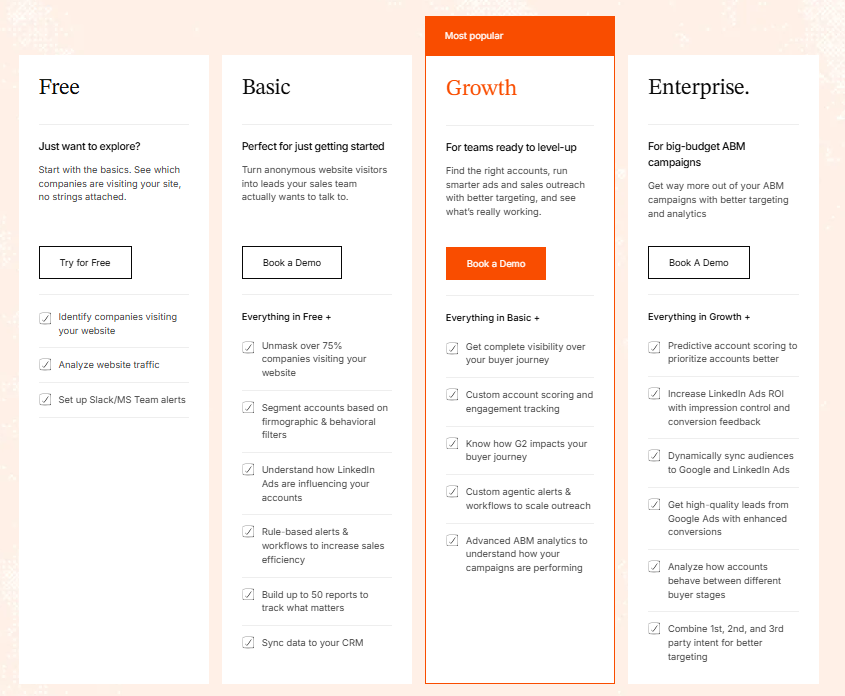
No negotiated contracts or hidden add-ons for features you'd reasonably expect to be included.
What customers say about Factors.ai?
"Thanks to Factors.ai's intent signals, Q1 2024 was our best quarter ever for meetings booked and conversions."
Aashima Lamba, Senior Manager Demand Generation
"Factors' value is almost impossible to quantify because of how deeply it's integrated into our stack. It's become a critical tool for building a clear understanding of our users, their actions, and their journey."
Shane Poyar, Growth Marketing and Operations Manager
"The impact of Factors.ai on Rocketlane is that we're not just doing better, we're working smarter and more efficiently. Returns on our campaigns have improved, and our understanding of our data means we can make better decisions."
Steve Colberg, Head of Growth
Factors.ai Onboarding and support
Implementation takes up to two weeks. Every paid plan includes a dedicated CSM, a private Slack channel, weekly check-ins, and 24/5 support. Optional GTM Engineering Services cover custom ICP modeling, RevOps workflow setup, and SDR enablement for teams that want hands-on help configuring the full stack.
Also read: Factors.ai vs Warmly: Which B2B GTM platform fits your playbook?
Factors.ai Compliance
SOC 2 Type II certified, ISO 27001 certified (via GCP), and fully GDPR and CCPA compliant. Factors provides signed Data Processing Agreements for enterprise procurement.
Factors.ai Verdict
If your team needs multi-channel ABM with LinkedIn and Google activation, transparent pricing, and a platform that's operational in weeks rather than months, Factors.ai is the strongest 6sense alternative on this list.
The gaps that matter most for mid-market teams are implementation time, pricing transparency, and LinkedIn/Google activation depth. 6sense takes up to six months to operationalize. Factors takes two weeks. For teams that have pipeline targets to hit this quarter, that difference is significant.
2. Demandbase: Enterprise ABM for teams with mature programs
Demandbase is one of 6sense's competitor and suits large enterprise teams with dedicated marketing ops, significant ABM budgets, and a primary focus on account-based advertising.
What does Demandbase do?
Demandbase built its reputation on IP-based account identification, and the advertising activation layer remains the product's clearest differentiator. It includes a native DSP for display and programmatic ads, account scoring, journey analytics, and Salesforce and HubSpot integration.
Where Demandbase earns its price is in large-scale account-based advertising. Teams running ABM campaigns across hundreds of named accounts, with dedicated ops resources to manage the platform, extract genuine value from the DSP and orchestration capabilities.
What Demandbase doesn't do well?
Demandbase's pricing is similarly opaque to 6sense and similarly enterprise-weighted. For mid-market teams, the cost structure and operational complexity often outpace the actual use case. Cross-channel attribution granularity also draws criticism on G2, with teams noting that attributing revenue across multiple channels isn't always straightforward.
It also doesn't offer native LinkedIn AdPilot or Google CAPI feedback loops at the depth Factors provides.
Who is Demandbase for?
Established enterprise ABM teams with dedicated ops bandwidth, large named-account lists, and a primary need for programmatic display advertising at scale.
Also, read top Demandbase alternatives and competitors
3. RollWorks: A lighter option for LinkedIn-first teams
RollWorks is an account-based marketing platform from NextRoll, positioned below 6sense and Demandbase on both price and complexity. It's a reasonable starting point for teams that want structured ABM without the enterprise contract.
What does Rollworks do?
RollWorks combines account identification, firmographic targeting, LinkedIn and display ad activation, and CRM integration with HubSpot and Salesforce. Its intent data layer draws on Bombora signals, and the account scoring module helps prioritize outreach for sales teams.
For teams newer to ABM, RollWorks is more approachable. Setup is faster, pricing is more accessible, and the interface doesn't require a dedicated admin to operate.
Where does Demandbase fall short?
RollWorks is strong for LinkedIn-first demand generation, but the analytics depth doesn't match what 6sense or Factors.ai offer. Multi-touch attribution is limited, funnel analytics are basic, and there's no equivalent to Factors.ai' AdPilot for dynamic audience syncing and conversion feedback loops. Teams that need to prove pipeline impact from specific campaigns will feel the ceiling relatively quickly.
Who is Demandbase for?
Small to mid-sized B2B teams running account-based demand generation primarily through LinkedIn and display, with a budget below what 6sense or Demandbase require.
Also read: Top RollWorks alternatives for effective account-based marketing
4. Terminus: ABM advertising with multi-channel reach
Terminus is a B2B advertising platform built specifically for account-based campaigns across display, LinkedIn, CTV, and email. It's less of a buyer intelligence platform and more of an execution layer for teams that already know who they want to reach.
What does Terminus do?
Terminus offers account-based advertising across multiple channels, CRM integration for syncing target account lists, and basic engagement analytics. It's designed for marketing teams that want coordinated, multi-channel exposure for a defined set of accounts.
Where does Terminus fall short?
Terminus doesn't offer the intent signal depth or account scoring sophistication you'd find in 6sense or Factors. The platform is strongest as an advertising execution tool, not an intelligence layer. Teams that need to identify in-market accounts and then activate them will still need a separate data source to feed Terminus. That adds cost and integration complexity.
Who is Terminus for?
Marketing teams with defined named-account lists and a clear ABM advertising strategy who need a managed, multi-channel ad execution platform.
5. Madison Logic: Content syndication and account-based advertising combined
Madison Logic takes a different approach to ABM by combining intent data with content syndication, letting teams reach target accounts through distributed B2B media networks as well as display and LinkedIn campaigns.
What does Madison Logic do?
Madison Logic maps buyer intent data to a network of B2B publishers, serving relevant content to target accounts through third-party channels. This "content-led ABM" approach works well for categories where thought leadership and education drive pipeline.
Also, read top intent data platforms for B2B in 2026
Where does Madison Logic fall short?
Madison Logic's strength is reach through third-party content networks, not first-party signal capture or full-funnel analytics. It doesn't offer the CRM-connected, multi-touch attribution that teams need to directly tie ABM activity to revenue. And it doesn't replace a platform that identifies, scores, and activates your own website traffic.
Who is Madison Logic for?
Marketing teams in categories where awareness through B2B media networks complements direct ad targeting. Works best as a top-of-funnel complement to a more intelligence-heavy platform, not as a standalone ABM solution.
When does 6sense still make sense? (Yes, we went there)
6sense earns its cost when the team has the budget, the ops bandwidth, and the account volume to extract value from an enterprise ABM platform. If you're running ABM across thousands of named accounts with a dedicated marketing ops resource, a $120K annual contract can deliver strong ROI.
The platform's intent data, when it's running well, is genuinely strong. Competitive displacement scenarios, where you're trying to catch accounts researching your category before they engage with a competitor, are a use case where 6sense's third-party intent layer performs well.
The teams who thrive with 6sense aren't running lean GTM motions. They're at a scale where complexity is manageable, and the investment is proportional to the market they're going after.
How to decide which alternative is right for your team?
Before you start another demo cycle, get clear on three things:
- What stage is your ABM program? If you're building from scratch, you don't need enterprise complexity. A platform that takes six months to configure is six months before you see any signal.
- What channels are you activating? If LinkedIn and Google are your primary paid channels, you need a platform with native activation for both, not just one.
- Can you prove ROI to your CFO? If multi-touch attribution and funnel-level analytics matter to how you justify budget, choose a platform where those features are core, not an add-on.
The teams switching from 6sense to Factors.ai most often cite the same three factors: faster time to value, better LinkedIn activation, and a support model that doesn't require a ticket queue. The intent data quality is comparable. The price difference is substantial. And the two-week implementation window is something a demand gen team with quarterly targets will notice. You can also read this ABM tool buying guide, before evaluating your options to buy another ABM software
If you're at the decision stage and want to see how Factors.ai performs against your specific ICP and tech stack, the conversation starts with a demo, not a six-figure contract negotiation.
FAQs for 6sense alternatives and competitors
Q1. What are the best 6sense alternatives for mid-market B2B teams?
Factors.ai is the strongest alternative for mid-market teams. It offers comparable account identification coverage (75% vs 6sense's 64%), native integration to LinkedIn and Google via AdPilot, multi-touch attribution, and transparent tiered pricing. Factors.ai also offers person-level ID via RB2B for US-based B2B visitors; it surfaces name, title, work email, LinkedIn URL, and firmographics directly.
Q2. How does Factors.ai compare to 6sense in terms of pricing?
6sense doesn't publish pricing, but third-party benchmarks indicate annual contracts typically start at $50,000 and can reach $120,000 or more for enterprise deployments. Factors.ai offers a free plan, transparent tiered pricing, and no mandatory multi-year commitments. The total cost difference is significant for mid-market teams.
Q3. Is 6sense worth it for smaller B2B companies?
For most SMBs and early-stage mid-market companies, 6sense's pricing structure and implementation complexity don't align with the scale of the GTM program. The platform is designed for enterprise ABM teams with dedicated RevOps. Smaller teams will get faster time to value from a platform built for their scale.
Q4. What's the difference between 6sense intent data and Factors.ai intent data?
6sense combines first-party website signals with third-party intent from Bombora and G2 into a buying-stage model. Factors.ai captures signals from website behavior, LinkedIn Ads, Google Ads, Meta, G2, Bombora, and CRM engagement, then scores accounts by ICP fit, funnel stage, and engagement intensity. The key difference is transparency: Factors shows the underlying signals, not just a stage score.
Q5. How long does it take to implement Factors.ai vs 6sense?
Factors.ai implementation takes up to two weeks. 6sense reviewers consistently report 60 to 90 days before intent signals become reliably actionable, with full platform configuration often stretching to six months. If you have pipeline targets this quarter, implementation time matters.
Q6. Does Factors.ai offer a free trial?
Factors.ai offers a free forever plan that identifies up to 200 companies per month and includes visitor tracking, dashboards, and Slack integrations. Paid plans offer a 14-day trial on request. 6sense offers a free tier but without intent data, predictive scoring, or any of the features that make it an ABM platform.
Q7. Which 6sense alternative has the best LinkedIn Ads integration?
Factors.ai is the only alternative on this list with official LinkedIn Marketing Partner status and a native AdPilot that handles auto-synced audiences, impression pacing, CAPI conversion feedback, and organic post engagement tracking. RollWorks and Terminus offer LinkedIn ad integration, but without the same depth of activation and attribution.
Q8. Is Factors.ai compliant for enterprise procurement?
Yes. Factors.ai holds SOC 2 Type II and ISO 27001 certifications, is fully GDPR and CCPA compliant, and provides signed Data Processing Agreements for customers that require documented vendor vetting.
Q9. What should I look for in a 6sense alternative?
The most important factors are: account identification coverage, intent signal transparency, LinkedIn and Google ad activation depth, CRM integration quality, and multi-touch attribution. An alternative that checks all five is a faaaar better investment than one that only replaces the intent data layer.
Factors.ai vs 6Sense: Which ABM platform actually moves pipeline?
Factors.ai is a 6Sense alternative. Factors.ai is a multi-channel ABM demand generation platform with rapid 2-week onboarding. 6Sense is an enterprise predictive intelligence layer for display ads. Compare ABM features, pricing, analytics, CRM integration, and support.
TL;DR
- 6Sense acts as an enterprise predictive intelligence layer optimized for programmatic display ads. Factors.ai is an agile, multi-channel ABM, demand generation, and attribution platform built for LinkedIn, Google Ads, and sales activation.
- Factors.ai goes live in under 2 weeks with a hands-on, white-glove onboarding team. 6Sense implementations frequently drag on for up to 6 months, burning two quarters of pipeline runway.
- Factors.ai offers person-level identification for US traffic (via RB2B) and custom multi-touch attribution. 6Sense focuses heavily on account-level data and rigid, pre-built reporting dashboards.
- Factors.ai features transparent, tiered pricing (including a free tier). 6Sense relies on opaque, multi-year negotiated contracts that typically start at $60,000 or more annually.
Factors.ai vs 6Sense: Quick glance table
A lot of B2B marketing meetings follow a familiar script.
The CMO wants to know what's driving pipeline. Sales says marketing's leads are cold. Marketing says sales never follows up. Someone says, "Maybe we should look at 6sense."

Six months later, half of Q1 disappeared into implementation, the dashboards look gorgeous, and everyone is still asking:
"Did any of this actually move pipeline?"
This isn't a shot at 6sense. Plenty of teams get value from it. But the gap between buying the platform and seeing results can be bigger than expected.
Factors.ai and 6sense are trying to solve the same problem: identify in-market accounts, activate them across channels, and measure what actually works.
Where they differ is in how they do it, who they're built for, and what your first ninety days look like.
This Factors.ai vs 6sense comparison should help you make that call.
Factors.ai vs 6Sense: Functionality and features
If you had to compress the difference into one sentence: 6Sense is built for enterprise display ABM at scale. Factors.ai is built for multi-channel ABM that actually connects to revenue.
Both identify accounts. Both use intent signals. Both integrate with CRMs. But the execution philosophy is different enough that they're genuinely not solving the same problem for the same buyer.
Factors.ai vs 6Sense: Comparison Table
That implementation gap deserves a moment of attention. Six months is a long time in a GTM cycle. That's an entire half-year of runway before the platform is even running. For mid-market teams where agility matters, that timeline is a deal-breaker before a single feature gets compared.
Factors.ai's functionality and features
Factors.ai is built on one principle: every signal your buyers generate should feed directly back into your campaigns and your sales team's workflow. Nothing sits in a dashboard waiting to be acted on manually.
- Account identification and visitor intelligence
Factors.ai identifies up to 75% of anonymous website visitors using a layered waterfall model that pulls from multiple data providers simultaneously. This isn't about showing you the same accounts you'd get from any single source.
On top of company-level identification, Factors now deanonymizes US-based B2B visitors at the person level through RB2B. For every identified visitor, you get first and last name, job title, LinkedIn URL, work email, company name, industry, employee count, and revenue range. SDRs get a Slack alert the moment a target-account decision-maker hits the site, with their LinkedIn URL and work email already in the payload. Marketing can build ICP-fit segments by title or firmographic and activate them directly via ads or sequences. CS can see who at a customer account is visiting churn-risk pages. RevOps can slice attribution reports by enriched person-level attributes instead of anonymous account traffic.
- Intent signals across every channel
Factors.ai captures intent from a genuinely wide range of sources: website behavior, CRM engagement, product usage, G2 intent, paid channel activity across LinkedIn, Google, Meta, and Bing, plus third-party intent from Bombora. These signals are scored at the account level by AI, taking into account ICP fit, funnel stage, and engagement intensity.
The result is a prioritized account list that updates in real time. No manually refreshed spreadsheets. No waiting for a weekly report.
- LinkedIn AdPilot: where intent meets activation
As an official LinkedIn Marketing Partner, Factors.ai's LinkedIn AdPilot automatically syncs high-intent audiences to LinkedIn campaigns based on live buying signals. Audiences update daily, so the accounts your ads reach tomorrow reflect what happened on your website and in your CRM today.
LinkedIn AdPilot’s Smartreach also controls impression frequency at the account level, which prevents your budget from burning on over-served accounts that aren't progressing. The CAPI (Conversions API) integration feeds enriched conversion events back to LinkedIn, so LinkedIn's algorithm optimizes toward accounts that actually convert rather than accounts that just click.
Organic engagement tracking is included, so you see which companies engage with your LinkedIn posts alongside your paid campaigns. Rare in this category, and genuinely useful.
- Google AdPilot
The same logic applies to Google Ads. Customer Match audience sync, Google Enhanced Conversions, and buyer-stage-specific targeting ensure your Google campaigns aren't just running in isolation. They're informed by the same account intelligence powering everything else by Google AdPilot.
- AI Agents for sales intelligence
Factors.ai's AI Agents, called Scout, handle account research, buying group mapping, post-meeting activity tracking, and closed-lost reactivation. When a high-intent account revisits your pricing page or a contact re-engages after a lost deal, the relevant sales rep gets a real-time Slack or Teams alert. The agent doesn't just flag the account. It surfaces the right contacts and provides outreach context so the rep knows why this account matters right now.
- Full-funnel attribution
Custom report builder, drag-and-drop dashboards, multi-touch attribution from first touch to closed won, lift analysis by channel and segment, ACV impact, sales cycle influence, and win rate by campaign. Factors.ai doesn't just show you what accounts are doing. It shows you what that activity is worth.
6Sense's functionality and features
6Sense is a genuine enterprise-grade platform. It pioneered predictive intent scoring in the ABM space and has years of longitudinal data that helps it identify accounts in buying cycles before they raise their hand.
Its core strength is display advertising at scale. The platform runs programmatic display campaigns targeted at intent-based account lists, which is useful for brand awareness at the top of the funnel. It connects to Salesforce and HubSpot, integrates with marketing automation platforms, and provides dashboards that enterprise teams use to report on pipeline influence.
Where 6Sense gets complicated is execution. Its pricing is negotiated through sales, with no public transparency. Its implementation timelines are long. Its Google Ads activation is limited. And its analytics customization is restricted to pre-built dashboards that don't offer the same depth as Factors.ai's custom report builder.
For a large enterprise with a dedicated ABM team, RevOps resources, and six months to get the platform running, 6Sense can be a powerful system. For a growth-stage team that needs results this quarter, the math gets harder.
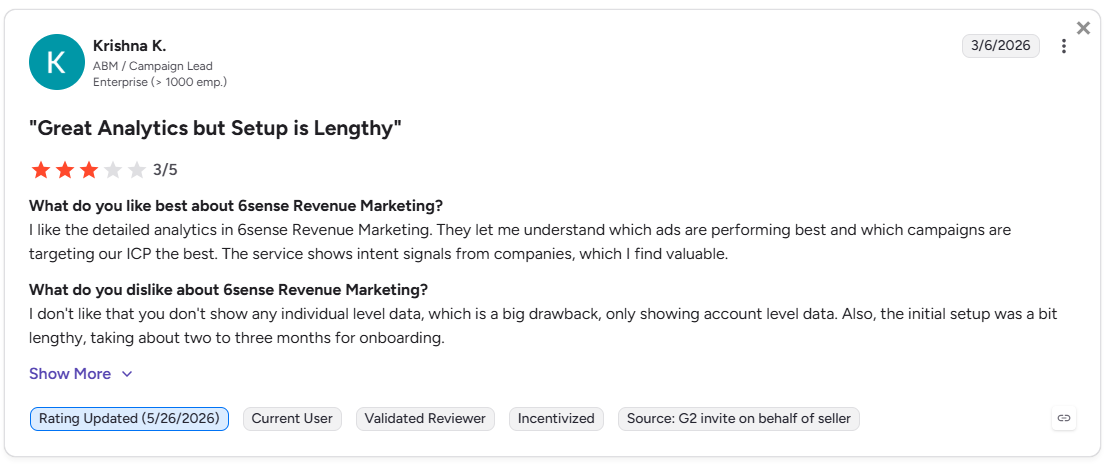
Factors.ai vs 6Sense: Verdict on functionality and features
If your GTM motion runs on LinkedIn and Google Ads, requires tight CRM integration, and needs attribution that connects campaigns directly to revenue, Factors.ai is the stronger platform. If you're running a large-scale enterprise ABM program primarily through display advertising and have the team and timeline to support a long implementation, 6Sense has the depth for that use case.
In short:
Factors.ai = multi-channel ABM activation with LinkedIn, Google, and built-in marketing attribution.
6Sense = enterprise display ABM with strong predictive intelligence and a long runway to value.
Factors.ai vs 6Sense: Pricing comparison
This is where the comparison gets stark, and honestly, where most mid-market teams make their final call.
Factors.ai vs 6Sense: How the pricing models compare
Factors.ai pricing
Factors.ai follows a structured model that grows with your GTM operation. You don't pay for the entire platform before you know if it works.
- Free plan: Identifies up to 200 companies per month. Includes visitor tracking, Slack integration, starter dashboards, and up to 3 seats. It's a real working plan, not a locked demo.
- Basic plan: 3,000 companies per month with up to 5 seats. Adds LinkedIn intent signals, advanced dashboards, GTM workflows, and integrations with Google, LinkedIn, Facebook, Bing, HubSpot, and Salesforce.
- Growth plan (most popular): 8,000 companies per month, up to 10 seats. Unlocks ABM analytics, account scoring, LinkedIn attribution, G2 intent signals, workflow automations, 100 custom reports, and a dedicated CSM.
- Enterprise plan: Unlimited companies, up to 25 seats. Adds predictive account scoring, LinkedIn AdPilot, Google AdPilot, Milestones reporting, white-glove onboarding, and advanced integrations including Segment, Rudderstack, and custom connections.
Optional Campaign management services and GTM Engineering Services are available as an add-on for teams that want Factors.ai to build out their ICP modeling, RevOps workflows, SDR enablement, and enrichment automation. It's the difference between a tool you configure yourself and a GTM system someone builds with you.
Also, read Top GTM engineering tools for 2026.
6Sense pricing
6Sense doesn't publish pricing. Based on widely reported estimates and reviews on G2 and TrustRadius, entry-level access typically starts at $60,000 or more annually, with most enterprise deployments running well above that once add-ons for data, seats, and advanced features are included. Multi-year contracts are standard.
The challenge isn't just the cost. It's the opacity. Going into a procurement process without knowing what you'll pay until you're three conversations into a sales cycle is a tax on time that mid-market teams don't have. The negotiated model also means two companies paying very different amounts for the same product, which creates real headaches when budget reviews come around.
Factors.ai vs 6Sense: What is the verdict on pricing
Factors.ai offers clear, scalable pricing that reflects how much of your GTM motion you want it to power. 6Sense is built for enterprise procurement cycles where negotiated contracts are the norm and budget isn't the primary constraint.
In short:
Factors.ai = transparent, tiered pricing that scales with your team.
6Sense = enterprise contract model with costs that only become clear after a sales process.
Factors.ai vs 6Sense: CRM integration and pipeline mapping
A platform that identifies intent but can't connect that intelligence back to your CRM is just a fancy list generator. The real value of an ABM tool is in how cleanly it slots into your existing sales and marketing stack.
Factors.ai vs 6Sense: Integration depth compared
Why does the bi-directional sync matter?
Most ABM platforms push data to your CRM. That's useful. Factors.ai also pulls data from your CRM to inform what happens in your ad platforms. That distinction is more important than it sounds.
When a contact moves from MQL to SQL in your CRM, Factors.ai can automatically shift that account into a different LinkedIn audience. When a deal is marked Closed Lost, that account can be suppressed from your ads or moved into a re-engagement audience. Your campaigns respond to what's actually happening in your pipeline, not just to what a third-party intent model predicts.
6Sense's integration is strong at the enterprise level, particularly with Salesforce. But it operates more as an intelligence layer above your CRM than as one tightly woven into your ad workflows. For teams where LinkedIn Ads and Google Ads are core pipeline drivers, that difference shows up in performance.
Factors.ai vs 6Sense: Verdict on CRM and pipeline mapping
Both platforms connect meaningfully to major CRMs. Factors.ai's edge lies in the real-time, bidirectional connection between CRM stages and ad audience management. 6Sense's edge is the depth of its enterprise Salesforce integration and the breadth of its marketing automation platform support.
In short: Factors.ai = CRM integration that feeds back into ad activation in real time.
6Sense = strong enterprise CRM intelligence with less emphasis on closing the ad feedback loop.
Factors.ai vs 6Sense: Intent signals and ad activation
B2B Intent signal detection is only as valuable as what you do with it. The gap between the two platforms is widest here.
Factors.ai vs 6Sense: Comparing intent and activation
Where 6Sense built its reputation...
6Sense pioneered the “dark funnel” concept: the idea that most B2B buying activity happens before a prospect ever raises their hand, and that you can predict purchase intent by watching anonymous research behavior. Its proprietary data network is genuinely impressive at identifying companies that are thinking about buying a solution before they show up in your CRM.
For brand-level display advertising: reaching accounts in the awareness stage before they know who you are, that predictive model is powerful. 6Sense's display campaigns can get your brand in front of the right accounts early in the buying cycle.
...and where the gap opens up
Where 6Sense struggles is the activation layer that follows that intelligence. Its Google Ads integration is limited. Its LinkedIn activation doesn't track organic engagement or offer the same level of CAPI feedback. And because 6Sense built its activation primarily around display, teams running heavy LinkedIn and Google campaigns often need additional tooling to bridge the gap.
Factors.ai was built with activation as a first-class capability, not an add-on. The LinkedIn AdPilot and Google AdPilot aren't integrations bolted onto an intelligence layer. They're core to how the platform operates. Intent signals immediately feed into audience updates, impression pacing, conversion feedback, and sales alerts. The loop is closed by design.
Mic drop.
Verdict on intent and ad activation
6Sense has stronger predictive modeling for top-of-funnel awareness. Factors.ai has stronger activation for teams running performance-oriented ABM across LinkedIn and Google.
In short: Factors.ai = intent that immediately activates across LinkedIn, Google, and your sales workflow. 6Sense = predictive intelligence that's strongest for display-first ABM programs.
Factors.ai vs 6Sense: Analytics and reporting
Attribution debates sometimes resemble group projects where everyone claims credit for the final result. A good analytics platform settles the debate with data instead of politics.
Factors.ai vs 6Sense: Analytics comparison
What does good attribution actually look like?
Multi-touch attribution means every campaign interaction, from the first LinkedIn impression to the last demo confirmation email, shares credit for a deal proportionally. Without it, you end up over-crediting the last touch (usually a sales email) and under-crediting every brand and nurture campaign that built the relationship.
Also, read Top 12 attribution models in B2B
Factors.ai's custom report builder lets GTM teams ask specific questions: which campaign source produces the fastest sales cycle? Which audience segment has the highest win rate? Does LinkedIn or Google produce better ACV? These aren't hypothetical questions. They're the questions CMOs ask in QBRs, and they require granular attribution data to answer confidently.
6Sense's pre-built dashboards are solid for high-level pipeline reporting but don't offer the same flexibility. Teams with specific attribution questions often find themselves exporting data into a separate BI tool, which adds friction and introduces gaps.
Verdict on analytics
For teams that need to prove ROI at the campaign level and connect every marketing touchpoint to revenue, Factors.ai's attribution capabilities are significantly more flexible. 6Sense's analytics are strong for enterprise pipeline forecasting but weaker on custom attribution and channel-specific reporting.
In short: Factors.ai = granular, customizable attribution that answers specific revenue questions. 6Sense = solid pipeline visibility without the flexibility to go deep on channel-level analysis.
Factors.ai vs 6Sense: Onboarding and support
Buying a platform is the easy part. Getting it to actually work for your team is where most ABM investments stall.
Factors.ai vs 6Sense: Support model compared
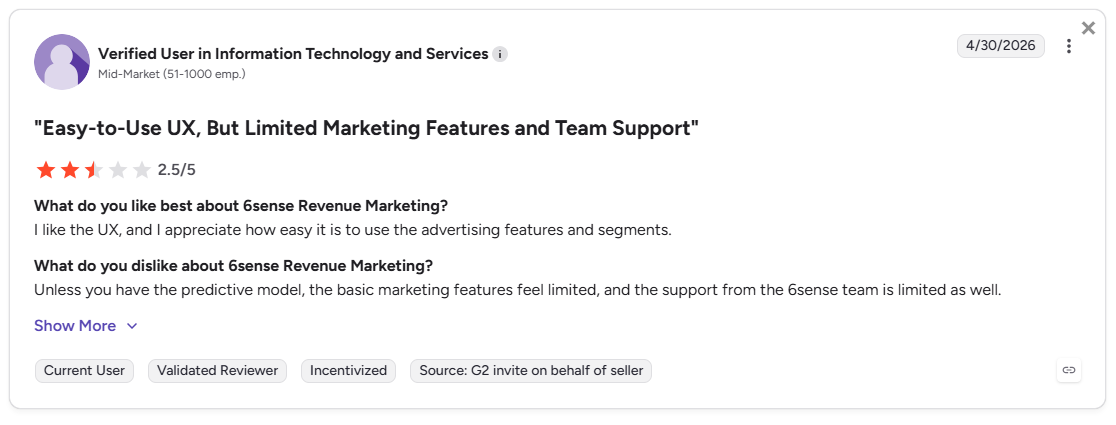
The two-week vs six-month gap… and why am I going ON and ON about it?!
That implementation gap isn't a minor detail. At six months, you're looking at two quarters of pipeline potential lost before the platform even goes live. Teams using 6Sense frequently report that the bulk of Q1 is consumed by implementation, integration cleanup, and stakeholder training.
Factors.ai's two-week onboarding is structured, hands-on… and white-glove. A dedicated CSM works through your ICP, funnel stages, and current integrations, configures alerts and workflows, and makes sure your ad platforms are connected before the weekly check-in cadence begins. There's no long setup phase where you're waiting for something to be live.
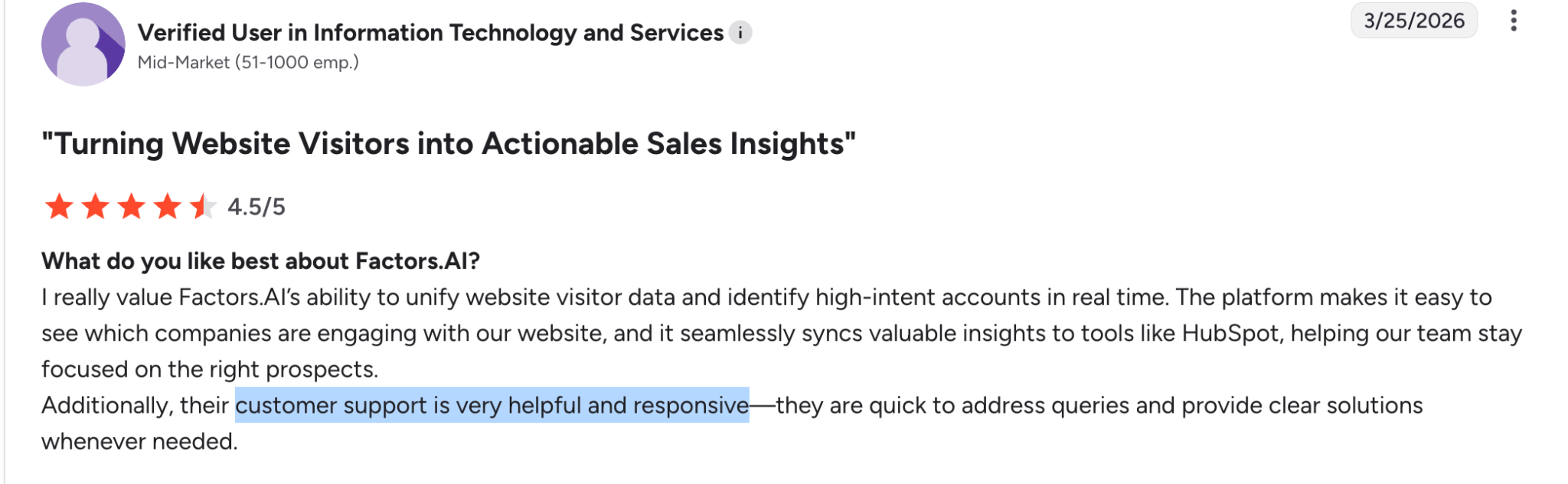
The private Slack channel is a meaningful support differentiator (no, it’s not just a nice-to-have; everybody will actually reply and help you). When something breaks during a campaign, you're talking to a real person, not submitting a ticket and waiting forty-eight to seventy-two hours for a response.
For teams that don't have in-house RevOps, GTM Engineering Services fills that gap. Factors.ai can design and build your entire GTM workflow, from ICP modeling to enrichment automation to SDR enablement, as an add-on service. 6Sense doesn't offer an equivalent.
Factors.ai vs 6Sense: Verdict on onboarding and support
If speed to value matters, and for most mid-market teams it absolutely does, Factors.ai's two-week onboarding and proactive CSM model wins clearly. 6Sense's support is appropriate for enterprise teams with dedicated implementation resources, but it's a poor fit for teams that need to show results this quarter.
In short: Factors.ai = structured, fast onboarding with a dedicated CSM from day one.
6Sense = enterprise implementation timeline with support that scales to contract size.
Factors.ai vs 6Sense: Compliance and security
Neither platform should make you nervous in a procurement review. But the details matter for teams dealing with enterprise contracts or regulated industries.
Factors.ai vs 6Sense: Compliance overview
Both platforms clear the standard bar for enterprise procurement. Factors.ai's ISO 27001 certification via GCP and the availability of signed Data Processing Agreements make it straightforward to clear vendor security reviews, even in regulated industries.
One practical note: Factors.ai hosts its data in GCP's US region, with Standard Contractual Clauses for EU-US transfers, so EU-based customers can use it without data residency complications. Teams in regulated verticals should confirm specifics with both vendors during the evaluation process.
Factors.ai vs 6Sense: Verdict on compliance
Both platforms are enterprise-appropriate from a compliance standpoint. Factors.ai's published ISO 27001 certification and formal incident response documentation give it a slight edge in detailed vendor review processes.
In short: Factors.ai = SOC 2 Type II, ISO 27001, GDPR, CCPA, with transparent DPAs.
6Sense = SOC 2 Type II, GDPR, CCPA compliant; ISO status not publicly confirmed.
What does Reddit say about 6Sense?


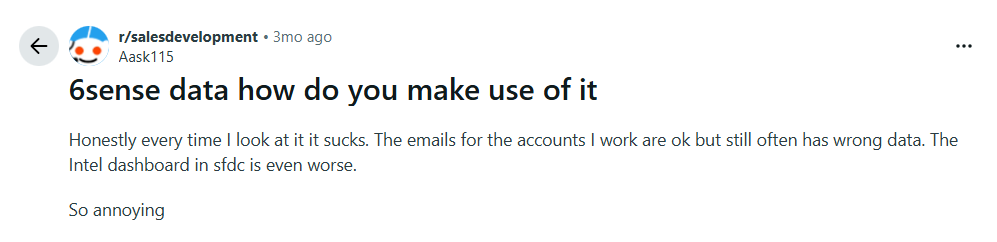
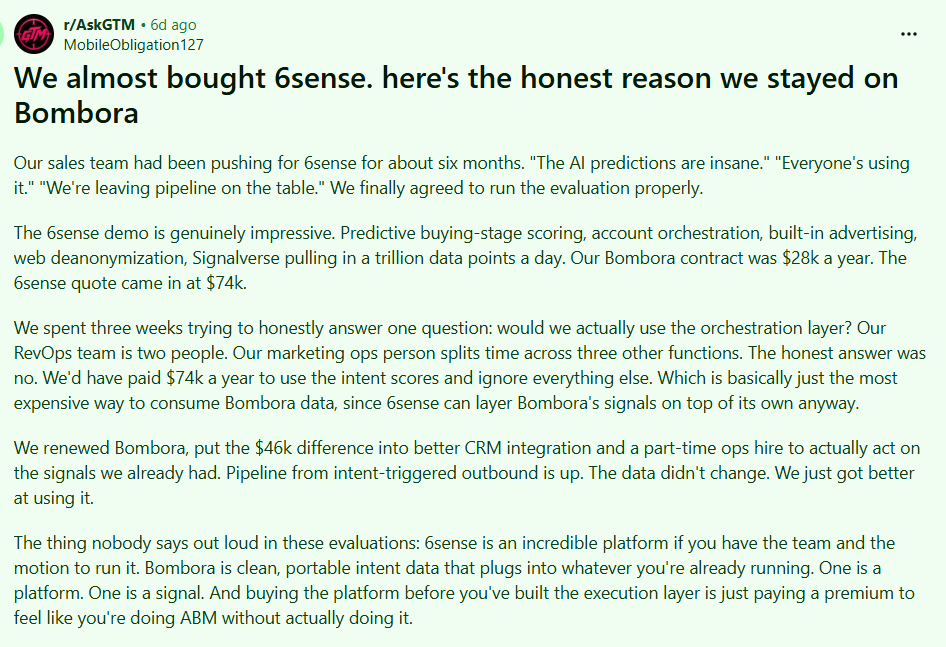
What do GTM teams say about Factors.ai?
23% higher conversions after switching to Factors.ai.
"The impact of Factors.ai on Rocketlane is that we're not just doing better, we're working smarter and more efficiently. Returns on our campaigns have improved, and our understanding of our data means we can make better decisions."
Steve Colberg, Head of Growth, Rocketlane
35% of pipeline influenced by G2 and Factors.ai signals.
"Thanks to Factors.ai's intent signals, Q1 2024 was our best quarter ever for meetings booked and conversions."
Aashima Lamba, Senior Manager Demand Generation, Upflow
25% increase in LinkedIn Ads ROI.
"Factors' value is almost impossible to quantify because of how deeply it's integrated into our stack. It's become a critical tool for building a clear understanding of our users, their actions, and their journey across our digital footprint."
Shane Poyar, Growth Marketing and Operations Manager
Factors.ai vs 6Sense: which one makes sense for your team?
6Sense built its reputation as the category-defining ABM platform for a reason. Its predictive intelligence is strong, and for a large enterprise running brand-level ABM at scale, it's could be beneficial.
But for the majority of B2B SaaS teams who are trying to get more out of their LinkedIn and Google Ads budget, connect their CRM to their campaigns, and actually prove which activities are moving pipeline, Factors.ai covers more of that ground, faster, at a lower cost, and with a support model that doesn't require a dedicated implementation project manager to navigate.
The teams switching from 6Sense to Factors.ai aren't doing it because 6Sense broke. They're doing it because Factors.ai went live in two weeks instead of six months, and the attribution actually answered the questions their CMO was asking.
FAQs for Factors.ai vs 6Sense
Q1. What's the real difference between Factors.ai and 6Sense?
The core difference is activation depth and speed to value. 6Sense is strong at predictive intelligence and display ABM for enterprise teams. Factors.ai covers multi-channel activation across LinkedIn and Google, with tighter CRM integration, more flexible attribution, and a two-week implementation timeline rather than six months.
Q2. Is 6Sense worth the price for mid-market B2B teams?
For most mid-market teams, the answer is genuinely no. The implementation timeline alone costs two quarters of potential pipeline, and the pricing is structured for enterprise procurement budgets. Factors.ai covers the core ABM use cases at a fraction of the cost and operational complexity.
Q3. Does Factors.ai replace 6Sense entirely?
It depends on your use case. If you rely heavily on 6Sense's display advertising network for brand awareness at scale, Factors.ai doesn't replicate that specifically. For LinkedIn and Google Ads activation, attribution, visitor identification, and CRM-connected ABM, Factors.ai covers more ground, more affordably.
Q4. How long does Factors.ai actually take to set up?
Under two weeks for standard implementations. The onboarding team configures integrations, sets up ad platforms, builds initial workflows, and runs the first check-in call within that window. For more complex RevOps setups, GTM Engineering Services can extend the scope without extending the timeline significantly.
Q5. Does 6Sense offer a free trial?
No. 6Sense requires a sales consultation and doesn't offer a public trial. Factors.ai offers a free-forever plan covering up to 200 companies per month, and a 14-day paid-plan trial is available on request.
Q6. Which platform has better LinkedIn Ads integration?
Factors.ai, by a meaningful margin. As an official LinkedIn Marketing Partner, it offers intent-based audience syncing, impression pacing, frequency control, CAPI conversion feedback, and organic post engagement tracking. 6Sense's LinkedIn integration handles audience syncing but lacks organic tracking and granular conversion feedback.
Q7. How does Factors.ai handle account scoring differently from 6Sense?
Factors.ai offers custom scoring models that you configure based on your ICP, plus predictive AI scoring that factors in live behavior and firmographics. It also surfaces feature-level intent signals, meaning you can see which specific product areas a prospect is researching. 6Sense's scoring is primarily based on its proprietary intent model, with less customization available below the enterprise tier.
Q8. What happens if I already use 6Sense data within Factors.ai?
Factors.ai uses 6Sense data as one of multiple enrichment sources in its waterfall identification model. You don't lose access to 6Sense's data quality. You gain additional coverage from Snitcher, Demandbase, Clearbit, and Bombora layered on top of it.
Q9. Can Factors.ai handle enterprise-scale ABM programs?
Yes. The Enterprise plan covers unlimited companies, up to 25 seats, predictive scoring, LinkedIn and Google AdPilot, and advanced integrations. GTM Engineering Services can design the RevOps infrastructure for complex multi-team programs. The platform scales; the implementation timeline doesn't.
Q10. Which platform is better for proving ROI to leadership?
Factors.ai. Its custom report builder, multi-touch attribution, lift analysis, and ACV/win rate analytics give you the specific data points that CMOs and CFOs ask for in quarterly reviews. 6Sense's pre-built dashboards are strong for pipeline visibility but don't offer the same flexibility when someone asks, "Which specific campaign created this deal?"
AI marketing terms and definitions every B2B marketer should know
Cut through the vendor hype. Learn the essential AI marketing terms and definitions, from machine learning to agentic AI and AEO.
TL;DR
- AI marketing terminology has outpaced most teams' ability to operationalize it, and vendor language makes it worse by using different words for the same thing.
- The terms that actually matter for B2B aren't the flashy ones, they're the ones that affect how you target, spend, and attribute.
- AI decisioning, agentic AI, and AEO are the three concepts most glossaries skip over, and they're the ones reshaping GTM right now.
- Most ad platforms already run on ML systems under the hood, so marketers are already "using AI" whether they realize it or not.
- The companies that build AI literacy earliest are consistently faster to operationalize new capabilities, not because they have better tools, but because they know what they're buying.
SO, Why does everyone care SO much about AI marketing terms, suddenly?
A few months ago, I was on a call where someone described their product as an "agentic, AI-powered, autonomous GTM orchestration platform."
Everyone nodded… including me.
If I'm being honest, I'm not entirely sure anyone on that call knew what that sentence actually meant.
That's become a recurring theme in AI. Every week, a new term arrives. Agentic AI. Copilots. Reasoning models. AI-native software. Autonomous agents. Decision engines. Digital workers. The vocabulary keeps expanding faster than most teams can keep up with it.
The problem isn't that these concepts are meaningless. Many of them represent genuinely useful advances. The problem is that they're often used interchangeably when they shouldn't be. A workflow becomes an agent. A chatbot becomes a copilot. A dashboard becomes an intelligence platform. A filter becomes AI. And a marketer becomes an idiot. (No, I did not say that.)
Oh! And at this point, I wouldn't be surprised if my toaster launched a thought leadership campaign about ✨autonomous breakfast orchestration✨.
The result is that B2B teams are having increasingly expensive conversations using the same words to mean completely different things. Marketing thinks they're buying intelligence. Sales thinks they're buying automation. RevOps thinks they're buying another integration project. The vendor thinks they're buying lunch for the sales team. Nobody is necessarily wrong. They're just operating from different definitions.
That's not a great place to be when you're evaluating software, planning budgets, or trying to figure out whether a new platform is actually useful or simply very good at describing itself.
Which is why I wanted to put together this glossary.
Not because the world desperately needed another AI glossary (ummm… actually they do?!). We seem to be producing those at a rate that would make venture capitalists proud.
This guide is for operators. The people sitting through demos, approving budgets, trying to connect marketing, sales, and RevOps around a shared understanding of what a tool actually does. The people who occasionally find themselves in meetings pretending they know what "multi-agent reasoning architecture" means and hoping nobody asks a follow-up question.
My goal here is to cut through the terminology, explain what these concepts mean in practice, and help you separate useful technology from marketing theatre.
Core AI marketing terms explained
Before getting into the nuanced stuff, here's a clean reference table for the foundational terms. These come up constantly and get muddled often.
AI vs machine learning vs generative AI
This is the one that trips people up most, and honestly, the confusion is understandable because the terms get used interchangeably even by people who should know better.
Here's the clearest way to think about the hierarchy:
The distinction that matters most in practice: ML predicts, GenAI creates. If a tool is analyzing your pipeline and surfacing likely-to-close accounts, that's ML. If it's writing your follow-up email, that's GenAI. Most modern platforms combine both, which is where the "AI-powered" label gets sticky.
What do vendors actually mean when they say ‘AI-powered’?
This is worth a dedicated callout because it affects procurement decisions. When a vendor says their platform is "AI-powered," they could mean any of the following things:
- Their scoring uses a regression model (basic ML)
- They have a GenAI feature that summarizes call transcripts
- They use an LLM API in the background for natural language search
- They've genuinely built proprietary models trained on your data
- They've added a chatbot to their dashboard
The questions worth asking: Is the AI trained on your data or a generic model? Where exactly in the workflow is AI making or influencing decisions? Can it explain its reasoning? What happens when it's wrong?
AI decisioning in marketing explained…
If there's one concept in this glossary that separates teams operating at the current frontier from everyone else, it's AI decisioning. And it's the section most competitor glossaries skip entirely, so let's actually do it justice.
AI decisioning refers to systems that combine real-time signals, historical data, rules, and predictive models to automatically determine what action to take, for whom, in which channel, and when. This goes well beyond automation. A classic automation workflow says "if this, then that." AI decisioning says "given everything we know right now, here's the optimal next action."
In practice, AI decisioning in marketing answers questions like:
- Which accounts should our SDRs prioritize today based on real-time buying signals?
- Should we increase or suppress LinkedIn spend for this segment based on pipeline velocity?
- Which content asset should we serve this visitor given their firmographic profile and engagement history?
- At what point in the funnel should we trigger an outbound sequence for this account?
- How should we reallocate budget mid-flight based on conversion signals?
The power of AI decisioning compounds when multiple data sources are unified into a single decision layer. When CRM data, ad engagement, website behavior, intent signals, and pipeline stage are all feeding the same system, the decisions become materially better than any single-source logic could produce.
What AI decisioning is not…
It's worth being explicit here because the term gets conflated with things it isn't. AI decisioning is not:
- Basic automation with if/then logic
- Static segmentation rules that update weekly
- A dashboard that shows you data and lets you decide manually
- Rule-based lead routing that doesn't adapt
The "intelligent" part of AI decisioning comes from the system's ability to weigh multiple variables simultaneously, update based on new signals, and optimize toward a defined outcome rather than just execute a predefined rule.
Agentic AI marketing definition
Agentic AI is the concept that's generating the most hype right now and also has the most genuine potential... once the infrastructure catches up. The definition is simpler than it sounds: agentic AI systems don't just respond to a prompt, they pursue goals. They reason through what needs to happen, decide on a series of actions, execute them, observe the results, and adapt.
The classic chatbot says "here's an answer." An agent says "here's the goal, let me figure out the steps, execute them, and tell you when it's done."
In B2B marketing, agentic AI is starting to show up in things like:
- Autonomous outbound prioritization: Agents that monitor pipeline signals, identify accounts showing buying intent, and queue them for outreach without waiting for a human to pull a report
- Campaign optimization agents: Systems that monitor ad performance, identify creative fatigue, reallocate budget, and generate new creative variants, all within defined guardrails
- Attribution analysis agents: Agents that pull cross-channel data, reconcile attribution discrepancies, and surface insights that a human analyst would take hours to find
- Pipeline monitoring agents: Real-time watchers that flag at-risk deals, suggest re-engagement actions, and alert the right people at the right time
Keep these limitations in mind tho…
The hype around agentic AI tends to skip past the parts that still require careful human oversight. These are a few things I would urge you to keep in mind:
- Hallucinations are real: Agents can confidently take wrong actions based on incorrect reasoning, especially when working with ambiguous data
- Governance matters: Autonomous systems operating on customer data or ad budgets need clear approval layers and audit trails
- Data quality is the ceiling: An agentic system is only as good as the signals it's working from. Garbage in, garbage out still applies, just faster
- Human-in-the-loop isn't a limitation, it's a feature: For high-stakes decisions (budget reallocation, outbound sequences, pricing changes), a human approval step isn't slowing things down, it's preventing expensive mistakes
AI answer engine (AEO) explained
This is the concept that's most directly reshaping content strategy right now, and most teams are behind on it. Search is undergoing a structural shift. When someone types a question into Google, increasingly they get a synthesized AI answer at the top of the page, not ten links. When someone asks ChatGPT, Gemini, Perplexity, or Claude a question, they get a single answer with source citations, not a list of results to click through.
This means the old SEO playbook, write content, rank for keywords, get clicks, is getting disrupted at the discovery layer. AEO (Answer Engine Optimization) is the practice of structuring content so AI systems can extract, summarize, and cite it accurately when generating answers.
What kind of content gets cited by AI engines?
Through a combination of testing and paying attention to how LLMs actually pull citations, the pattern that emerges is fairly consistent:
- Structured, definitional content: Clear definitions at the top, organized by entity and concept
- Tables and comparison formats: LLMs are very good at parsing and re-presenting tabular information
- Original frameworks and named concepts: When you coin a term or create a unique framework, it creates a citation anchor
- Authoritative, specific claims: Vague generalities get skipped. Specific, verifiable claims get cited
- Semantic clarity: Content where the relationship between concepts is explicit, not implied
- FAQ structures: Direct question-and-answer format is highly extractable
How to write content that LLMs actually cite?
This is the tactical piece most "AEO guides" skip over. Here's what will help you (because it’s helping me!):
- Definition-first formatting: Lead with the answer, then expand. Don't bury the definition three paragraphs in
- Entity clarity: Be explicit about what you're defining and how it relates to adjacent concepts
- Schema markup: Use FAQ schema, HowTo schema, and article schema to help AI systems parse your content structure
- Source-backed claims: LLMs prefer citing content that cites other authoritative sources, creating a trust chain
- Topical authority signals: A single well-structured glossary page on AI marketing terms signals breadth. A cluster of interconnected posts signals depth. Both matter for citability
The meta-point here is that AEO-friendly content and genuinely good content are largely the same thing. Clear structure, specific claims, original thinking, comprehensive coverage. The SEO tactics that worked by gaming keyword density are the ones that AEO disrupts. The fundamentals that always mattered, actually explaining something well, matter more now.
Predictive AI terms every B2B marketer needs to know
Predictive AI is the category that's been operational in B2B for the longest, and it's worth distinguishing it clearly from generative AI because they do very different things.
The critical thing to understand about predictive AI in B2B is that it's only as valuable as the data feeding it. A lead scoring model trained on six months of data from a single channel will miss a lot. The teams getting the most out of predictive AI are the ones that have invested in unified, clean, cross-channel data pipelines.
AI advertising and campaign optimization terms
Most B2B marketers are already running on ML-powered ad systems without fully realizing it. LinkedIn, Google, and Meta all have predictive layers built into their bidding, targeting, and delivery systems. Here's the vocabulary for what's actually happening under the hood.
Here’s what I think… a lot of what gets called "AI strategy" in advertising is really just knowing how to configure and trust the ML systems that platforms already have. Fighting against automated bidding because you want manual control is almost always a losing strategy at scale. The skill shift is from "manage every parameter manually" to "set the right objectives and constraints, then let the system optimize."
AI data and attribution terminology
Attribution is where AI gets genuinely complicated in B2B, and it's the area where terminology confusion causes the most damage.
Please remember this, and then remember me when you think of this… AI quality is downstream of data quality, which is downstream of signal quality. You can have the most sophisticated decisioning system in the world, but if your CRM is a mess, your UTM parameters are inconsistent, and your intent data is six weeks stale, the AI is optimizing garbage. Data infrastructure isn't the exciting part of AI strategy, but it's the part that determines whether the AI part actually works.
AI automation and workflow terms
There's a spectrum here from simple automation to genuinely intelligent orchestration, and knowing where your tools fall on that spectrum is important for setting expectations.
Which AI workflows are actually useful in B2B marketing today?
Cutting through the hype, the use cases where AI automation is delivering real value right now:
- CRM enrichment: Automatically pulling firmographic and technographic data into account records when new leads enter the system
- Campaign performance summaries: Generating weekly or daily performance narratives from raw platform data
- Outbound sequence prioritization: Surfacing the right accounts for SDR outreach based on real-time intent and engagement signals
- Pipeline monitoring: Flagging deal health changes and alerting the right stakeholders
- Content reporting: Automatically tracking which content assets are influencing pipeline across touchpoints
The use cases where AI automation still needs more work before going fully autonomous: anything involving direct customer communication that hasn't been reviewed, budget reallocation in live campaigns, and anything requiring legal or compliance sign-off.
AI ethics, privacy & governance terms
This section gets skipped in most AI glossaries and that's a problem, because enterprise buying decisions increasingly hinge on exactly this vocabulary. If you're evaluating AI tools and you can't ask smart questions about governance, explainability, and data privacy, you're missing the criteria that matter most for long-term risk management.
The enterprise buying trend worth tracking: procurement teams at larger organizations are now routinely asking for AI governance documentation, model explainability reports, and data residency specifications before signing contracts. If a vendor can't answer these questions clearly, that's signal.
AI terms that are mostly… hype
In the spirit of actually being useful, here's a breakdown of the terms that marketers should approach with skepticism, because not every AI term in circulation has real operational meaning.
The test worth applying to any AI marketing claim: "What specifically does the AI do in this workflow, what data does it use, and what happens when it's wrong?" If a vendor stumbles on any of those questions, file the claim under marketing language rather than product capability.
How should B2B teams actually use AI?
The most useful frame here isn't "how do we use AI" in the abstract but rather which types of AI are suited to which types of tasks, and where humans still need to remain in the loop.
The framing that's most durable: AI should handle scale, speed, and pattern recognition. Humans should own judgment, strategy, and anything where being wrong has serious downstream consequences. The companies that get into trouble are usually the ones that automate the wrong tier of decisions.
What’s coming up? The future vocabulary of AI marketing
The terms being coined right now that will be standard vocabulary in two to three years:
- AI agents: Already mainstream in technical circles, will be a default feature expectation in marketing platforms by 2026
- Agentic commerce: AI that can research, evaluate, and complete purchases autonomously on behalf of users
- Multimodal AI: Systems that work across text, image, audio, and video simultaneously, already reshaping creative workflows
- Zero-click marketing: Strategy built around getting cited in AI answers rather than earning clicks to your own site
- Synthetic audiences: AI-modeled audience proxies used for testing and forecasting before spending on real media
- AI-native analytics: Analytics designed from the ground up for AI consumption, not human dashboard review
- Memory systems: AI architectures that maintain context across sessions, enabling genuine relationship continuity
- Autonomous attribution: Attribution systems that reconcile cross-channel data and surface insights without human configuration
The through-line across all of these is a shift from AI as a tool that marketers use to AI as infrastructure that marketing runs on. The distinction matters for how you build teams, evaluate platforms, and think about where human expertise creates competitive advantage in a world where execution is increasingly automated.
The companies that build AI literacy earliest aren't just learning vocabulary. They're building the organizational muscle to evaluate claims critically, operationalize capabilities faster, and avoid the expensive mistakes that come from misunderstanding what they've bought. That's the compounding advantage that nobody puts in the press release.
How does Factors.ai fit into this picture?
Modern GTM execution requires the ability to unify first-party data, intent signals, ad engagement, and CRM activity into a single decision layer, and then act on it with enough speed and precision to matter. That's exactly the infrastructure problem that Factors.ai is built to solve.
Where these terms stop being abstract and start being operational: when your predictive scoring is pulling from unified account signals rather than just CRM fields, when your AI decisioning layer knows that an account visited your pricing page twice while a competitor's G2 review page is surging, and when attribution is connecting that activity to pipeline influence rather than just last-touch form fills. That's the difference between AI marketing as a concept and AI marketing as a competitive advantage.
FAQs for AI marketing terms
Q1. What are AI marketing terms?
AI marketing terms are the concepts and definitions that describe how artificial intelligence technologies are applied across marketing workflows, from targeting and automation to analytics and attribution. They span technical foundations like machine learning and LLMs, through to applied concepts like AI decisioning, agentic workflows, and answer engine optimization.
Q2. What is AI decisioning in marketing?
AI decisioning in marketing refers to systems that use real-time signals, historical data, and predictive models to automatically determine the optimal action, such as who to target, when to engage, which channel to prioritize, and how to allocate budget. It's distinct from basic automation in that the system adapts to new information rather than executing static rules.
Q3. What is agentic AI marketing?
Agentic AI in marketing refers to AI systems that can independently plan and execute multi-step tasks toward a defined goal, with minimal human intervention at each step. Examples include autonomous outbound prioritization, campaign optimization agents, and pipeline monitoring systems. Current implementations typically still include human approval layers for high-stakes decisions.
Q4. What is AI answer engine marketing (AEO)?
AEO is the practice of structuring content so that AI systems like ChatGPT, Gemini, Perplexity, and Claude can accurately extract, summarize, and cite it in generated answers. It's becoming a critical component of content strategy as AI-generated answers increasingly replace traditional search results as the primary discovery mechanism.
Q5. What's the difference between AI and machine learning in marketing?
AI is the broad category covering all intelligent systems. Machine learning is a specific subset where systems learn patterns from data to make predictions or decisions. Most of the practical AI capabilities in marketing platforms, lead scoring, bid optimization, intent modeling, run on ML systems. Generative AI (ChatGPT, Claude, etc.) is a different branch focused on creating new content rather than predicting outcomes.
Q6. Which AI marketing terms should B2B marketers learn first?
The highest-leverage terms to understand first are: machine learning (because it powers most of the platforms you're already using), AI decisioning (because it describes where GTM is heading), intent data (because it's the signal layer that makes everything else smarter), agentic AI (because it's the architecture that will reshape workflow automation), and AEO (because it's actively changing how content strategy needs to work right now).
Q7. What is the difference between an AI copilot and an AI agent?
A copilot assists human work by surfacing recommendations, drafts, or analysis that a human then acts on. An agent acts autonomously, taking sequences of actions to complete a goal with minimal human intervention at each step. Most current enterprise AI tools are copilots. Agentic systems are emerging but still require careful governance and human oversight for high-stakes decisions.
Q8. How does data quality affect AI marketing performance?
AI systems are fundamentally limited by the quality, completeness, and freshness of the data they operate on. A predictive model trained on incomplete CRM data will produce inaccurate scores. An AI decisioning system working from stale intent signals will make suboptimal targeting decisions. Investing in data infrastructure, identity resolution, signal unification, and enrichment is a prerequisite for AI marketing to work at its full potential.
.jpg)
AI in Marketing: The operating system modern B2B teams are building
Read how AI in marketing actually works in B2B, from strategy and automation to attribution, personalization, and decision-making.
TL;DR
- AI in marketing has moved from a productivity experiment to the connective intelligence layer across the entire GTM motion.
- The fundamental shift is from campaign-led to signal-led marketing: knowing which accounts matter, which channels actually influence pipeline, and where the next dollar should go.
- Automation follows pre-set rules. AI detects patterns, infers intent, and surfaces what no human analyst would catch at scale.
- In an AI-first world, attribution becomes decision-making infrastructure, not a quarterly reporting ritual.
- Most AI adoption stalls because companies buy tooling before cleaning their data or defining the specific decisions they're trying to improve.
- The marketers who win the next decade won't be the ones who produce the most content. They'll be the ones who consistently make better bets with the same data everyone else has.
AI in marketing isn't really a ‘tool category’ anymore…
Every few years, the martech industry invents a new category and convinces everyone they need it. CRM. Marketing automation. ABM platforms. Intent data. CDP. Each one promised to solve a coordination problem, and each one created a new one. By 2024, the average enterprise marketing team was managing 12 to 15 tools, and the average marketer was spending more time stitching data between dashboards than actually using it to make decisions. And they were looking a little like this:

AI entered that environment as the ‘connective tissue’ the whole stack was missing. Most B2B teams adopted it incrementally, starting with ChatGPT for copy drafts and Jasper for blog outlines, before realizing the more valuable application was entirely elsewhere.
We've sat in enough quarterly planning sessions to know what the real bottleneck looks like… it's that nobody can answer basic strategic questions with any confidence. Which accounts should we actually prioritize? Which channels moved those deals? Why did Q2 miss despite everyone working hard? The data exists across six tools. Nobody has time to synthesize it properly before the next meeting.
AI as an operating layer means those questions get answered before the meeting, not during it. Account prioritization, budget reallocation, intent scoring, and pipeline forecasting move from analyst projects to automated outputs. The shift isn't about working faster. It's about reducing the uncertainty that surrounds every strategic decision in a B2B GTM motion.
For ABM teams particularly, this changes the economics of the entire function. Running a proper account-based motion used to require either a dedicated ops team or expensive RevOps tooling that only enterprise companies could justify. AI has collapsed that requirement. The intelligence is now accessible to a 10-person marketing team with the right stack, which is either democratizing or terrifying depending on whether your moat was "we can afford better tools."
The first generation of AI adoption was about replacing work. The second generation, which is where most mature teams are operating now, is about reducing uncertainty. Marketers don't struggle because they can't execute campaigns… that’s faaaar from true. Most of us struggle because the cost of a wrong bet in B2B is enormous, and the data to make a right one has historically been TOO fragmented to act on.
For the hundredth time, what is AI in marketing, really?
For definition's sake, AI in marketing is the application of machine learning, predictive analytics, and generative models to improve how teams collect signals, prioritize decisions, and execute campaigns. Worth unpacking what that actually means in practice, because "AI" has become one of those words that technically means everything and functionally means nothing.
Most people use it as a catch-all for four things that are genuinely distinct:
- Automation runs rule-based workflows with no learning involved. "If a lead fills out a form, send the welcome sequence." Deterministic, predictable, and exactly as smart as whoever built the workflow.
- Machine learning detects patterns in historical data to predict future behavior. Lead scoring, churn prediction, and audience segmentation fall here. The system learns which combinations of signals correlate with outcomes.
- Predictive analytics uses those learned patterns to surface probabilities. "This account has a 74% likelihood of entering an active buying cycle in the next 30 days." The guidance is directional and not certain, but it is far more useful than relying on gut feelings.
- Generative AI creates new, and email from prompts: copy, images, code, email sequences. It's the most visible layer because everyone can see it working, but it's not always where the most business-critical value lives.
In plain terms, AI digital marketing means your systems learn from behavioral and firmographic data to help you reach the right buyers with the right message at the right time, without someone manually reconfiguring campaigns every week. Here's how those layers stack in a B2B context:
The practical applications of AI in B2B marketing today include account-level intent scoring, predictive retargeting based on buying stage, dynamic landing pages that adapt to visitor profiles, pipeline forecasting from CRM activity patterns, and content recommendations driven by account engagement history. The common thread across all of them is inference rather than instruction: the system draws conclusions from patterns instead of following a script.
What’s the difference between automation and actual AI?
Traditional marketing automation is conditional logic at scale. "When X happens, do Y." A contact requests a demo, a sequence fires, a field updates in the CRM. Deterministic, predictable, and only as intelligent as whoever configured it. When the person who built the workflow leaves, no one fully knows why it works or how to change it without breaking something. (If this describes your current stack, you're in good company.)
AI-driven systems operate differently. Instead of following conditions, they make inferences: "Based on patterns, probability, and behavioral signals, here's what should most likely happen next." The system isn't executing instructions. It's reasoning about likelihood.
But I think this is where most of us have gotten a bit confused: most tools marketed as "AI" today are sophisticated automation with a thin intelligence layer on top. The workflow still fires based on rules. The "AI" helps set those rules more efficiently or adjusts them based on outcomes. That's genuinely useful. It's just not the same as a system that surfaces what you didn't know to look for.
Actual AI earns its keep when it finds what you would have missed: a cluster of high-intent accounts who never filled out a form, a content asset quietly influencing late-stage deals across multiple accounts, a channel contributing to pipeline that's getting zero attribution credit because it doesn't have a trackable click. That kind of signal discovery is what separates automation from intelligence.
Where does AI show up across the B2B marketing funnel?
AI is not a demand gen tool, or a content tool, or a sales enablement tool. But it does show up at every stage of the funnel, often in ways that are invisible until you look at what changed in the data.
- Top of funnel
At the awareness stage, AI is changing how teams find and qualify audiences. SEO topic clustering tools use NLP to identify content gaps and search intent patterns with far more precision than traditional keyword research. Google's Performance Max and LinkedIn's predictive audience targeting use behavioral signals to expand reach beyond manually defined parameters, which is either a marketer's dream or a brand safety nightmare depending on how you've set it up.
Creative testing has moved from A/B to multivariate at scale. AI tests dozens of ad variants simultaneously and reallocates spend toward top performers in real time, without waiting for statistical significance thresholds that take six weeks to hit.
What is AI content marketing at this stage? Using AI to understand what target accounts are actually searching for, what questions are unanswered in your category, and where distribution gaps exist in your content strategy. Not just faster blog writing. Smarter targeting of what to write about and where to put it.
- Middle of funnel
MOFU is where AI earns its keep in B2B. Intent-based retargeting platforms pick up third-party research signals, including review site visits, competitor content consumption, and category-specific search activity, to identify accounts actively in a buying cycle before they raise their hand. AI segmentation clusters accounts by engagement pattern and actual buying stage rather than just firmographics. Dynamic nurture journeys adapt content and cadence to where an account is in its consideration process, rather than following a fixed sequence that someone built in 2022 and nobody has touched since.
Engagement scoring at this stage goes well beyond form fills and email opens. It includes time on pricing page, return visits, LinkedIn ad engagement frequency, and the pattern of which content is consumed in what sequence.
- Bottom of funnel
At BOFU, AI crosses into revenue territory. Opportunity prioritization models surface which open deals are most likely to close based on CRM activity and engagement signals. Pipeline prediction tools give revenue teams early warning on deals at risk of stalling, before the deal review meeting where someone asks why this hasn't moved in three weeks. Buying committee analysis tracks which individuals within a target account are engaging, not just the primary contact, giving marketing and sales a more complete picture of where a deal actually stands.
Combined with multi-touch attribution modeling, this creates a closed loop: AI identifies accounts, influences the journey, and measures what worked so the model gets better with each cycle.
How is AI useful in marketing decision-making?
The real value of AI is that it changes the quality of the decisions that happen before the campaign starts.
Consider what a VP of Marketing actually decides in a given quarter: which accounts to prioritize for ABM investment, which campaigns deserve more budget, which channels are influencing pipeline versus inflating vanity metrics, which buyers are showing genuine intent right now, and which segments are consuming spend without contributing revenue. For most teams, these decisions get made using instinct, last-click reporting, anecdotal feedback from sales, and whoever speaks most confidently in the revenue review. AI changes that by surfacing probabilities instead of opinions.
The framework for how this works in practice:
Data → Signal → Decision → Action
Raw CRM activity and ad engagement get synthesized into behavioral signals. Those signals inform a prioritization decision. The decision triggers an action: an SDR sequence, a retargeting campaign, a budget reallocation. The action generates new data, which feeds the model. The loop gets tighter with each cycle.
In concrete terms, AI-driven decision-making in marketing looks like this:
- Predicting conversion likelihood so SDRs spend time on the highest-probability accounts rather than working the MQL queue chronologically
- Identifying where deals consistently stall in the pipeline and surfacing the missing engagement that precedes those stalls
- Finding high-intent accounts that haven't raised their hand but are clearly deep in a research cycle based on behavioral signals
- Detecting which channels are actually influencing closed-won deals vs. generating clicks that look good in a dashboard
- Flagging campaign fatigue before engagement metrics drop off a cliff
Platforms like Factors.ai sit at the center of this by unifying CRM activity, website visits, ad engagement, attribution data, and intent signals into a single account-level view. When those signals live in five separate tools, the intelligence you get from any one of them is always incomplete. Garbage in, garbage out, and in AI systems, garbage in means confident but wrong recommendations, which is arguably worse than no recommendation at all.
Most marketing problems are actually decision problems
There's a reframe worth making here. Most of what gets labeled a marketing problem, weak pipeline, poor conversion rates, wasted ad spend, is a decision problem upstream of execution. Which ICP should the team prioritize? Which market is ready to enter? Which campaign deserves more budget? Which accounts are showing genuine buying intent versus just clicking around out of vague curiosity?
For years, those decisions got made using gut feel, anecdotal sales feedback, and last-click attribution reports that flattered whichever channel had the longest cookie window. AI becomes genuinely valuable when it moves teams from opinions to probabilities. The future marketer won't be the one who creates the most campaigns. It'll be the one who consistently makes better bets than everyone else working with the same budget and the same data.
AI content marketing beyond ‘write me a blog post’ because we’re wayyy past that now
Most writing about AI content marketing gets stuck on copy generation. Faster blog posts, better subject lines, ad variants at scale. That's a legitimate use case, and it's also the least interesting part of what AI makes possible in content.
The real shift is happening upstream: in how teams decide what to create, where to put it, and whether it's actually doing anything for revenue.
- AI for content research
AI tools now do what used to require a full week of keyword research and SERP analysis: identify topic clusters, map search intent across the buying journey, surface content gaps that competitors haven't addressed, and flag the specific questions your target accounts are actively asking. The speed improvement is real, but the more significant change is accuracy. Models can process thousands of signals that no human analyst has bandwidth to synthesize, which means the research starts from a better place.
- AI for distribution
Content production stopped being the bottleneck a while ago. Getting the right content in front of the right account at the right moment in their buying cycle is the actual challenge. AI helps by recommending distribution channels based on audience behavior patterns, testing headlines across formats, optimizing email send timing by segment, and dynamically surfacing content to website visitors based on firmographic profile. A Series B SaaS company visiting your pricing page for the second time should see different content than an enterprise CTO reading your thought leadership blog for the first time.
- AI for revenue attribution
Which content is actually influencing pipeline? This has been the unanswerable question in content marketing for two decades, and AI doesn't fully solve it, but it gets meaningfully closer. Multi-touch attribution models can track content consumption across the account journey and identify which assets appear consistently before deals close. Account-level engagement analysis surfaces which companies are deeply engaged with content even when they've never submitted a form, which is most of the companies that eventually become customers.
The real value of AI content marketing isn't producing more content. It's reducing the distance between content and revenue.
BREAKING NEWS: The internet doesn't need more content
AI has made content creation nearly free. A technically competent 2,000-word blog post can be produced as ai generated content in twenty minutes, but teams still need human oversight to protect quality and authenticity. A full email nurture sequence takes… an afternoon. The problem is that production scaling and attention scaling are completely decoupled. Attention has become more expensive, more fragmented, and more competitive, while supply has gone exponential.
Nobody in your target market wakes up hoping there are 10,000 more AI-generated thought leadership articles in their industry. They wake up hoping someone finally says something they haven't heard before. The biggest misunderstanding in AI content marketing is that people assume the bottleneck is writing. The real bottlenecks are distribution, differentiation, genuine audience understanding, and measurement. AI can also support search engine optimization by improving keyword research, SERP analysis, and topic clustering, which helps teams create more relevant marketing content. It just requires asking the right questions of it, rather than defaulting to "write me a blog about X."
Here are some AI marketing automation workflows that actually save time
Rather than a tool roundup, here's what high-functioning AI marketing automation actually looks like when it's working well.
Workflow 1: High-intent account detection to pipeline action
An account visits the pricing page twice in one week. The AI layer cross-references that behavior with firmographic data, CRM history, and third-party intent signals. The account clears the scoring threshold. LinkedIn retargeting fires automatically with a customer case study from the same industry vertical. The SDR receives a prioritized alert with account context already summarized, including which content was consumed, which pages were visited, and any prior CRM activity. No human had to notice the visit, judge its significance, or manually route it. The whole sequence happens in under an hour.
Workflow 2: Webinar engagement to personalized follow-up
A target account attends a webinar. AI analyzes the questions submitted, the polling responses, and the account's broader behavioral history across previous touchpoints. It generates a personalized follow-up that directly addresses the specific pain point the attendee signaled. The SDR reviews, makes any edits, and sends. The difference between this and a generic "thanks for attending" email is the difference between a reply and a delete.
Workflow 3: Pipeline stall detection to content intervention
A deal that was progressing steadily has gone quiet. No buying committee members have engaged in three weeks. AI flags the stall pattern, identifies that a key technical stakeholder has never been reached, and surfaces a content asset that has shown up consistently before deals at the same stage in the same industry closed. Marketing and sales can act on that signal before the deal officially stalls and someone has to explain it in the next pipeline review.
AI marketing automation, framed this way, isn't about replacing the SDR or the marketer. It's about compressing the time between signal and action, and making sure signals don't slip through the cracks because someone was busy with something else.
Why does orchestration matter more than individual tools?
These workflows only hold together when tools share context. A LinkedIn retargeting system that doesn't know what a prospect did on the website is optimizing with partial information. An SDR alert that doesn't include CRM history is less actionable than it should be. The value of AI automation scales with the degree to which signals across the stack are unified rather than siloed.
GTM engineering is emerging as a discipline precisely because of this. Someone has to build and maintain the connective tissue between the data layer and the execution layer. It's a technical role that didn't have a name five years ago, and it's now one of the more strategically important functions in a modern B2B marketing team.
The new B2B marketing stack: AI + intent + attribution
The modern B2B marketing stack is becoming an intelligence system with activation capabilities built on top of it, rather than a collection of tools that technically do different things.
Each layer needs to feed the next for the system to function. Data without intelligence is storage. Intelligence without activation is a dashboard nobody looks at. Activation without attribution is spending in the dark and calling it a campaign.
Why is attribution becoming decision-making infrastructure?
AI is only as smart as the feedback loop it's running on. If attribution data is wrong, the AI will confidently optimize toward the wrong outcomes. It won't know it's optimizing wrong. It'll just get faster at doing it. The failure chain looks like this: bad attribution produces wrong signals, wrong signals generate bad recommendations, bad recommendations lead to misallocated budget, misallocated budget weakens pipeline, and weak pipeline creates pressure to spend more. The system doubles down on the mistake.
In an AI-first GTM motion, attribution becomes the foundational infrastructure that tells every other system what's actually working. First-party data matters here because third-party cookies are degrading, platform-reported attribution is increasingly self-serving (every platform claims more credit than it deserves, which is the digital ad equivalent of every group project member claiming they did the most work), and the only source of truth you fully own is your own behavioral and CRM data.
Buying committee tracking and account-level analytics take on new importance in this context. Knowing that "marketing" influenced pipeline tells you something. Knowing which three stakeholders from a target account engaged with which content before a deal closed tells you what to replicate.
What most companies get wrong about AI adoption…
Most AI adoption stories follow a recognizable arc. Team gets excited about a promising tool at a conference or in a Slack community. Spends six weeks integrating it. Discovers the data it needs is incomplete, inconsistent, or locked in another system. Ends up with a platform producing confident-sounding outputs that nobody fully trusts. Tool quietly stops being used within a year.
These are the patterns that lead there most reliably.
- Buying tooling before cleaning the data. AI amplifies what it's fed. Fragmented or inconsistent data doesn't become coherent because you've added a new intelligence layer on top of it. The teams that see fast ROI from AI tools are almost always the ones who invested in data hygiene first, before they invested in intelligence.
- Expecting AI to compensate for unclear positioning. If the ICP is fuzzy or the value proposition doesn't resonate, AI helps reach more of the wrong people faster. It optimizes within the constraints given to it. Poorly defined constraints mean meaningless optimization.
- Using AI to hit content volume numbers. Producing more content isn't a useful goal. Using AI to publish more frequently without improving the quality, relevance, or distribution of what's created is adding noise to a category that's already overwhelmed with it.
- Integrating tools without integrating workflows. A platform that requires manual exports to share output with the rest of the stack isn't saving time. It's moving the bottleneck one step to the right.
- Chasing autonomous GTM before the fundamentals are solid. The industry has a lot of excitement right now about agentic marketing systems that can run campaigns end to end with minimal human oversight. Some of this is genuinely real and worth watching. Most of it is premature for teams that don't yet have reliable attribution or a consistent ICP definition, because an autonomous system optimizing toward the wrong goal gets there faster.
Fun fact: AI doesn't create competitive advantage by itself
Everyone has access to the same foundation models. ChatGPT, Claude, Gemini, Perplexity. These are commodities. Using them doesn't differentiate you. The advantage comes from proprietary data, customer understanding, distribution, positioning, and execution quality. The companies winning with AI aren't using different models. They're feeding those models better context: richer first-party behavioral data, cleaner CRM history, more precise ICP definitions built from actual deal data rather than assumptions.
AI amplifies operational maturity. A team with sharp positioning, clean data, and a well-defined ICP gets dramatically more from AI tooling than a team with better tools but weaker fundamentals. The maturity model tends to look like this:
Most teams are somewhere between Stage 1 and 2. Stage 3 is where ROI starts compounding in ways that become hard to argue with in budget reviews. Stage 4 is real but requires a foundation that very few marketing teams have built yet.
Let’s build an AI marketing strategy that won’t collapse in 3 months
An AI marketing strategy isn't a list of tools to adopt. It's a defined approach to using AI to reduce the uncertainty in the most important marketing decisions being made each quarter.
- Step 1: Identify revenue bottlenecks before buying anything. Where specifically is the pipeline breaking? What are the account identification, MQL-to-meeting conversion, deal progression, and attribution gaps? AI should solve a specific expensive problem, not be a general investment in "we need to do more with AI."
- Step 2: Centralize first-party data. CRM, website behavior, product usage, and ad engagement need to reach a state where they can be queried together. This is unglamorous work compared to buying a new intelligence platform, but it's the foundation everything else depends on.
- Step 3: Map the highest-value signals. Which behavioral and firmographic patterns are most predictive of pipeline? Pricing page revisits, champion-level engagement, content consumption in the late buying stage, repeat visits from high-ICP accounts. Define these explicitly before asking an AI system to detect them automatically.
- Step 4: Connect activation channels to the intelligence layer. The intelligence layer needs to trigger actions across LinkedIn Ads, email sequences, SDR workflows, and content delivery. If the signal can't reach the channel, nothing happens with it.
- Step 5: Measure influence rather than vanity metrics. MQLs and click-through rates don't indicate whether AI is improving GTM outcomes. Pipeline influence, deal velocity, conversion rate by segment, and budget efficiency do. Build the measurement framework before building the stack.
Quick wins worth prioritizing early: account scoring from intent signals, SDR alert automation from high-value website behavior, and multi-touch attribution to understand which channels are actually moving deals. These produce visible results within 30 to 60 days and build organizational trust for more ambitious investments.
How does Factors.ai fit into an AI-driven GTM motion?
The challenge most B2B teams face isn't access to AI. It's that the context AI needs to work effectively is scattered across too many systems that weren't built to share it.
Website activity in one tool. Ad engagement in another. CRM data somewhere else. Third-party intent signals in a separate dashboard with a login that three people share. When those systems don't share context, the intelligence each one produces is partial. Partial intelligence produces partial recommendations.
Factors.ai unifies account-level behavioral signals, including website visits, ad engagement, CRM activity, and intent data, into a single view of the buyer journey. That unified context becomes the foundation for intent-based targeting, pipeline attribution, account scoring, and AI-assisted campaign optimization.
The capabilities that matter most for an AI-driven GTM motion include visitor identification and account-level analytics (knowing which companies are engaging with your content even without form fills), LinkedIn AdPilot (connecting ad engagement to account-level pipeline impact rather than click metrics), multi-touch attribution modeling (understanding which channels and content assets are influencing deals across the full journey), intent signal tracking (surfacing accounts in active research cycles before they self-identify), and GTM workflow integration (routing high-intent signals to the right activation channels without manual intervention).
The positioning isn't "AI platform." It's unified account intelligence: the context layer that makes every other AI tool in the stack smarter.
The future of AI in marketing: agents, predictions, and autonomous execution
The debate that emerges with every major technology wave is whether it will replace the people who currently do the work. It's the same debate that surrounded spreadsheets replacing accountants, word processors replacing secretaries, and search replacing research librarians. The pattern is consistent: some tasks get automated, the role evolves, and the capabilities that were previously rare become the new baseline expectations.
As AI gets better at analysis, reporting, summarization, workflow execution, and content production, the human marketer's value concentrates increasingly in judgment, creativity, strategic positioning, and taste. These aren't soft skills or secondary concerns. They're what determine whether the AI is optimizing toward the right outcome in the first place.
Agentic AI, systems that plan and execute multi-step tasks with minimal human input, is moving from early experiment to real production in some GTM contexts. AI SDR workflows are handling initial outreach qualification at scale. Content distribution systems are beginning to make channel and timing decisions autonomously. Budget allocation tools are adjusting spend in real time based on performance signals rather than waiting for monthly reviews. The trajectory toward more autonomous execution is clear, but the decisions that precede execution remain stubbornly human: what story to tell, which problem to solve, which market to enter, what actually matters to the buyer.
What actually becomes scarce
When AI makes content production nearly free, the bottleneck shifts from creation to originality. The scarcity that emerges is genuine point of view: a specific perspective on a problem your market hasn't heard framed that way before, expressed in a way that actually changes how someone thinks rather than confirming what they already believed.
Scarce things tend to become more valuable over time. The marketers who will compound are the ones investing in developing real perspective, not just AI fluency. AI fluency is table stakes by 2026. Having something worth saying is still rare.
In a nutshell…
The teams that are winning with AI right now share a few characteristics that have nothing to do with which tools they're using. They invested in clean, unified data before buying intelligence tooling. They defined the specific decisions they were trying to improve rather than the workflows they wanted to automate. And they measure AI impact through pipeline influence and decision quality, not through content volume, tool adoption rates, or how many things in the stack have an AI badge on them.
AI amplifies what's already there. Sharp positioning, a well-defined ICP, and coherent data infrastructure become dramatically more effective when AI is layered on top. Weak fundamentals become dramatically more efficient at producing the wrong outcomes.
The biggest mistake in AI marketing adoption is treating it as an efficiency play. Efficiency is a fine outcome but a poor goal. Nobody gets promoted because they shipped 20 campaigns instead of 10. They get promoted because they generated more pipeline, made better bets, caught opportunities earlier, and allocated budget where it actually compounded. That's where AI becomes interesting: not when it helps you do more work, but when it helps you do more of the right work.
FAQs for AI in marketing
Q1. What is AI in marketing?
AI in marketing is the application of machine learning, predictive analytics, and generative models to improve how teams collect signals, prioritize decisions, and execute campaigns. In practical terms, it means systems that learn from behavioral and firmographic data to help marketing teams reach the right buyers at the right moment, without manually reconfiguring every campaign. It covers everything from account intent scoring and lead prioritization to content personalization and pipeline forecasting.
Q2. How does AI marketing automation work?
AI marketing automation layers intelligence on top of traditional workflow execution. Rather than following fixed conditional logic, AI-powered automation detects behavioral patterns, scores accounts dynamically, and triggers personalized sequences based on inferred intent. The meaningful difference from traditional automation is that AI systems improve over time as they process more data. Traditional automation stays exactly as smart as when it was originally configured.
Q3. What's the difference between automation and AI?
Automation executes rules. AI makes inferences. A traditional automation workflow fires when a predetermined condition is met. An AI-driven system detects patterns in historical and real-time data to predict what should happen next. Most tools marketed as AI today exist somewhere on a spectrum between these two, which is worth understanding before signing a contract. Asking a vendor where their product actually sits on that spectrum is a useful qualifying question.
Q4. How is AI used in B2B marketing?
In B2B, AI most commonly appears in account and lead scoring, intent-based retargeting, pipeline forecasting, multi-touch content attribution, buying committee analysis, and budget optimization. The highest-ROI applications tend to be the ones that improve prioritization decisions: helping teams focus time and budget on the accounts most likely to convert rather than treating all pipeline with equal urgency.
Q5. What is AI content marketing?
AI content marketing is using AI not just to produce content faster but to make smarter decisions about what to create, where to distribute it, and whether it's contributing to revenue. This includes topic research and search intent mapping, firmographic-based content personalization, pipeline contribution attribution, and identifying which content assets appear consistently in the buying journey before deals close.
Q6. Can AI improve marketing decision-making?
Yes, and it's arguably where the highest-value applications sit. AI improves marketing decision-making by replacing opinion-based prioritization with probability-based prioritization. Which accounts are most likely to convert? Which campaigns are influencing pipeline versus inflating click metrics? Which segments are consuming budget without producing revenue? These questions used to require analyst hours or educated guesses. AI can surface answers in near real time.
Q7. What are the best AI marketing tools for B2B companies?
The most impactful AI marketing tools for B2B tend to be intent intelligence platforms, multi-touch attribution tools, AI-assisted ad platforms, and CRM-integrated scoring systems. The right tools depend entirely on which specific decisions need to improve. The better starting point is identifying the revenue bottleneck first, then finding tooling that addresses it, rather than adopting platforms and hoping a use case emerges.
Q8. How does AI impact attribution and pipeline measurement?
AI makes attribution more granular by processing signals at a scale and speed that human analysts can't match. It tracks multi-touch influence across channels, identifies content contributions that never triggered a direct conversion event, and surfaces account-level engagement patterns that predict deal progression. In an AI-driven GTM motion, attribution isn't just a reporting function. It's the feedback loop that tells every other system in the stack what's actually working.
Q9. Is AI replacing marketers?
It's replacing specific tasks: manual reporting, basic content production, workflow execution, and routine data analysis. The work that compounds in value, deciding what story to tell, which market to enter, what buyers actually care about, and why a competitor's positioning is winning, requires judgment that models can't replicate at the level of someone with genuine domain expertise and market context. The marketers most at risk are those whose entire output is executing tasks that AI now does faster and cheaper.
Q10. What data does AI marketing need to work effectively?
First-party behavioral data (website visits, content engagement, product activity), CRM data (deal history, contact activity, stage progression), ad engagement data (impressions, clicks, view-through patterns), and firmographic data (company size, industry, tech stack, and buying signals). Clean, unified data consistently outperforms sophisticated AI built on fragmented or inconsistent inputs. Auditing the quality of existing data before purchasing AI tooling is almost always worth doing.
AI marketing case studies: real examples, campaigns, and lessons for B2B marketers
Read about real-world B2B AI marketing case studies. See how top revenue teams use predictive models, intent signals, and agentic workflows to drive pipeline.
TL;DR
- AI in marketing has moved from creative experimentation to operational infrastructure, and the teams winning aren't the ones posting the most AI-generated content.
- The most valuable AI marketing implementations connect signals to revenue: intent data, attribution, audience targeting, and pipeline intelligence.
- B2C campaigns like Spotify Wrapped and Sephora's beauty advisor get the press, but the B2B playbook looks more like Gong, 6sense, and Factors.ai than Coca-Cola's holiday ads.
- Most AI implementations fail not because of the technology but because of weak data quality, no attribution visibility, and zero governance.
- The teams that'll win long-term are building AI as infrastructure, with humans firmly in the strategy seat.
Most AI marketing case studies are basically the same story wearing different clothes. A brand uses ChatGPT. A marketer generates 47 LinkedIn posts before breakfast. Someone creates an AI image of a dinosaur eating tacos.
The campaign gets featured in three newsletters, two podcasts, and one conference presentation titled How We Reimagined Marketing With AI.
Wonderful!!!
Meanwhile, somewhere else, a RevOps team quietly figures out which accounts are actually ready to buy, an attribution model uncovers a hidden revenue pattern, and a campaign automatically shifts spend away from people who love clicking ads and toward people who occasionally enjoy purchasing things.
One of those stories gets a standing ovation… the other one gets a budget increase. Guess which one I'd rather have.
The problem with most AI coverage is that it focuses on the visible stuff. Content generation. Images. Videos. Copywriting. Those are useful applications, sure. They're also the easiest ones to spot.
The more interesting AI stories tend to happen behind the scenes.
They show up when a sales team calls the right account at the right moment. When marketing finally figures out which channels are creating pipeline instead of just creating dashboards. When buying signals get detected early enough to matter. When decisions happen faster because someone connected the dots before a human had to.
That's where most of the value lives.
And that's what makes AI marketing case studies worth studying.
Not because they show us what's possible.
Because they show us where the money actually is.
In this guide, we'll look at AI marketing examples from both B2B and B2C companies, unpack what they did, what worked, what didn't, and why some AI projects become revenue engines while others become conference talks.
What counts as an AI marketing ‘case study’?
I know this is a weird section in the blog, but stay with me.
There's a BIG difference between "we used AI" and "AI changed how we operate." The first camp includes every company that ran a copy batch through ChatGPT and called it a workflow. The second camp is much smaller, much more interesting, and frankly much harder to find good writing about.
For the purposes of this article, a real AI marketing case study means a company identified a problem, deployed an AI system or workflow to address it, changed something operationally as a result, and produced a measurable outcome. The bar isn't high, but it does rule out "we made an AI ketchup ad and it went viral on Twitter."
There are four types of ai technologies doing meaningful work in marketing right now. Generative AI handles content creation, ad creative, and personalization at scale, and it can produce text, visuals, audio, video, and code to support marketing content, including image generation, personalized ad copy, and automated service responses. Predictive AI powers lead scoring, churn modeling, and demand forecasting through data analysis that can analyze vast amounts of customer data, reveal individual behaviors and preferences, improve customer segmentation, and drive personalized recommendations. Conversational AI shows up as chatbots, qualification flows, and real-time sales assistance, where it can also mirror some guidance traditionally handled by human support during customer interactions. Agentic AI is the newest category, where AI systems execute multi-step workflows autonomously, from audience building to campaign orchestration, with minimal human intervention.
Most of the flashy case studies you'll see are generative. Most of the money being made is predictive and agentic.
Here’s why you should care about AI marketing case studies
The experimentation phase is over (not sure if I should say, thankfully?! or unfortunately?!... you decide).
AI budgets have moved from the ‘innovation fund’ line item to the operational budget, which means teams are now accountable for ROI, not just novelty. According to a CoSchedule report, marketers using AI are 25% more likely to report measurable success than those who don't. CMOs aren't asking "should we try AI?" anymore. They're asking "why isn't our AI investment showing up in pipeline?"
The pressure has stacked up, and HOW. Teams are expected to produce more content with the same headcount, personalize buyer journeys that span weeks and multiple channels, prove attribution on every dollar across their marketing efforts, and reduce CAC in a market where CPCs keep climbing. Deployed well, AI can improve marketing efficiency and drive a 10-25% increase in return on advertising investments. AI was supposed to solve all of this. For some teams, it has. For many, it's just created a new category of mess.
Gartner has tracked AI's growing share of marketing budgets for several years now, and the numbers keep moving upward. But what's more telling than the budget allocation is where AI is actually being embedded: inside CRM workflows, inside ad platform bidding systems, inside attribution dashboards, inside the customer journey itself. The question has shifted from "are you using AI?" to "how deeply is AI woven into how you go to market?"
The rise of AI agents in B2B GTM is probably the biggest shift of the last 18 months. These aren't chatbots. They're systems that can identify a high-intent account, trigger a personalized outreach sequence, update the CRM record, adjust LinkedIn bid strategy, and flag the account for SDR follow-up, all without a human making each individual decision. The real value isn't in shaving five minutes off a task. It's in compressing the gap between a signal appearing and a revenue action happening.
The most common use cases of AI in marketing
Before getting into individual case studies, it's worth mapping the landscape clearly. Here's where AI is actually being applied, what it does, and where you'd see it in the wild:
For B2B teams specifically, the highest-leverage applications tend to cluster around three things: knowing which accounts are ready to buy, reaching those accounts with precision across channels, and connecting your marketing activity directly to pipeline so you know what's working. Platforms like Factors.ai are built around exactly this combination, bringing visitor identification, account intelligence, attribution, and ad activation into one connected workflow.
AI marketing case studies and campaign examples
- Factors.ai: multi-touch attribution and AI audience activation
This one gets its own deeper treatment because the workflow is instructive rather than just impressive.
The problem most B2B marketing teams face is that the data lives in disconnected systems: ad platforms, website analytics, CRM, product usage, intent tools. You can't see the complete buyer journey because no single system has the full picture.
Factors.ai connects those systems and then adds two capabilities that change what's possible. The first is account-level attribution, understanding which channels, campaigns, and content pieces are actually contributing to pipeline, not just last-click conversion. The second is AI-powered audience activation, using behavioral signals from your own data (which accounts are visiting high-intent pages, which companies are engaging with your LinkedIn content, which firms match your best customer profile) to build dynamic ad audiences that update automatically.
In practice, this looks like: a target account visits your pricing page twice in one week, Factors.ai detects the signal, adds that account to a LinkedIn campaign targeting the buying committee, the SDR gets a notification to prioritize outreach, and the attribution model records how the marketing touches contributed when the deal eventually closes. All of this happens as a connected workflow rather than a series of manual processes.
The positioning that resonates here is simple: AI is only as useful as the data and workflows it's connected to. A standalone AI tool producing content or scoring leads in isolation is dramatically less valuable than AI that's wired into your attribution, your ad activation, and your pipeline visibility.
AI-powered ABM campaign orchestration
This is a composite example based on how the most sophisticated B2B teams are running account-based campaigns in 2026, and it's worth walking through because it illustrates what agentic AI actually means in practice.
The workflow starts with intent signal detection: which target accounts are showing elevated research activity, visiting competitor sites, or engaging with content in your category. That signal triggers an account enrichment process that pulls in firmographic data, identifies the likely buying committee, and segments accounts by ICP tier and buying stage.
From there, the system builds dynamic LinkedIn audiences from the identified buying committee contacts and pushes them into active campaigns. Simultaneously, it triggers personalized outreach sequences from SDRs, pre-populated with account-specific context. The CRM records are updated in real time as engagement happens. When a campaign's performance drops for a specific audience segment, the system adjusts bids, refreshes creative, or shifts budget automatically.
A human designed the workflow and approved the guardrails. The AI executes the individual steps. The result is a campaign that responds to signal in near real-time rather than waiting for a quarterly review cycle.
- HubSpot's AI content assistant
HubSpot embedded AI writing assistance directly into its marketing and CRM tools, allowing users to generate first drafts of emails, landing pages, social posts, and blog content within the platform they already work in.
The adoption curve here was notably different from standalone AI tools. Because the AI was embedded in the existing workflow, the friction to use it was near zero. Teams didn't need to switch contexts or learn a new tool. They just had a "generate" button where they used to start from scratch.
Takeaway for marketers: AI adoption at scale requires workflow integration, not just capability availability. If your team has to open a separate browser tab to use the AI, most of them won't.
- Salesforce Einstein
Salesforce has been investing in AI under the "Einstein" umbrella for nearly a decade, but the more recent versions are doing genuinely useful things in areas like opportunity scoring, forecasting, and automated CRM data enrichment.
The forecasting capability is probably the highest-value use case for B2B revenue teams. Instead of reps manually updating pipeline confidence, Einstein analyzes activity patterns, historical data, and deal characteristics to produce more accurate forecast numbers. Which is useful, because if you've ever sat in a forecast call where everyone is eyeballing their own deals, you know how unreliable that process is.
Takeaway for marketers: AI's value in the revenue stack isn't always customer-facing. Some of the best applications are internal, making your own team's judgment more accurate and your pipeline more predictable.
- LinkedIn's AI ad optimization
LinkedIn has built increasingly sophisticated AI into its Campaign Manager, including predictive audience expansion, which automatically finds additional accounts likely to convert based on your existing campaign performance.
This matters for B2B marketers specifically because LinkedIn's audience data is uniquely valuable: firmographic data, job titles, seniority, company size, and professional interests that other platforms can't match. When AI works with that data to optimize targeting, the efficiency gains compound quickly.
The quality of LinkedIn data is also why first-party data syncing matters so much. If you can push your own high-intent account lists into LinkedIn for targeting, using something like Factors.ai's audience sync, you're not just relying on LinkedIn's targeting alone. You're combining your behavioral signal with their network reach.
- Adobe Firefly for enterprise creative production
Adobe Firefly brought generative image and video creation directly into the Creative Cloud ecosystem, giving enterprise creative teams the ability to generate on-brand assets at scale without going outside their existing toolchain.
For large organizations managing dozens of campaigns simultaneously, with different regional versions, A/B tests, and channel-specific formats, the production efficiency gains are substantial. Creative teams can spend more time on strategy and less on resizing banners.
Takeaway for marketers: At enterprise scale, creative production is often the bottleneck between a good idea and a live campaign. AI that integrates directly into production workflows removes that bottleneck without requiring a change in how teams think about creative work.
- Drift's conversational marketing
Drift essentially created the conversational marketing category and has remained one of the more interesting case studies in AI-powered pipeline acceleration. The core use case is replacing static forms with dynamic conversations that qualify visitors in real time and route them to the right next step.
The shift from form to conversation matters more than it might seem. Forms are a commitment. A conversation is a dialog. The psychological friction of filling out a form versus answering a few questions is meaningfully different, and the data quality from a conversation tends to be higher because you can ask follow-up questions based on what the person just said.
Takeaway for marketers: Pipeline velocity is often a qualification and routing problem. AI can compress the time from first visit to first qualified conversation considerably.
- Gong's AI revenue intelligence
Gong processes recorded sales calls and uses AI to surface patterns, deal risks, and coaching opportunities. It's one of the clearest examples of AI creating a genuine competitive advantage in B2B sales.
Before tools like Gong existed, sales leaders had essentially no visibility into what was happening in conversations. You'd see CRM notes, which were often incomplete or biased, and you'd know whether deals closed. Gong closes that gap by analyzing what's actually being said, which competitor keeps coming up, which objections are recurring, and which reps' language patterns correlate with higher win rates.
Takeaway for marketers: The signal you need to improve your marketing messaging is often sitting in your sales calls. AI analysis of conversation data is one of the fastest ways to close the gap between what marketing thinks customers care about and what they actually say they care about.
- 6sense's predictive intent targeting
6sense built its platform around a core bet: that buying intent can be detected and predicted before an account ever fills out a form or talks to sales. The platform aggregates third-party intent signals, first-party behavioral data, and firmographic information to identify accounts that are in an active buying cycle.
For B2B demand generation, this changes the game considerably. Instead of running broad awareness campaigns and hoping the right people see them, you can concentrate budget on accounts that are demonstrably in-market right now. The math on that is significantly better.
Takeaway for marketers: Timing is probably the most underrated variable in B2B marketing. Reaching the right account at the wrong moment in their buying journey is nearly as ineffective as reaching the wrong account entirely.
B2B AI marketing case studies we should look at closely
B2C campaigns get more coverage because they're more visible and more shareable. But the operational intelligence built into B2B AI implementations is often considerably more sophisticated.
AI-driven personalization is one of the clearest patterns across high-performing B2B and B2C examples.
The pattern across the strongest B2B implementations is consistent: they don't treat AI as a ‘content tool’. Instead, it’s being treated as a signal processing and activation layer that sits between data and revenue action. McKinsey reports that companies using this approach capture 5 to 15 percent incremental revenue and improve marketing-spend efficiency by 10 to 30 percent. The same research also found that fast-growing companies generate 40% more of their revenue from personalization than slower-growing competitors.
What does successful AI marketing campaigns have in common?
Looking across these examples, five patterns emerge consistently in the implementations that actually moved metrics.
- Strong first-party data. Every high-performing AI implementation in this list was built on top of well structured data, not just a large volume of first-party inputs. The AI is only amplifying what your data knows. If your data is weak, your AI outputs will be too.
- Clear, defined workflows. The teams that succeeded didn't deploy AI as a general capability and hope for the best. They identified specific processes, mapped the workflow, and built AI into specific steps. "Use AI for marketing" is not a workflow. "Use AI to identify high-intent accounts daily and update LinkedIn audiences automatically" is a workflow.
- Human oversight at the strategy layer. In every case study that worked, humans remained in control of the creative brief, the strategy, the ICP definition, and the messaging framework. AI executed within those parameters, with human expertise and human creativity guiding the decisions, not just human oversight. The teams that got into trouble were the ones that tried to automate the strategy itself.
- Direct connection to revenue metrics. The implementations that earned continued investment were the ones that could show pipeline influence, CAC improvement, campaign effectiveness, or higher conversion rates. Vanity metrics didn't survive the budget scrutiny. Pipeline impact did.
- Fast experimentation loops. The best AI marketing teams are running considerably more experiments than their competitors, because AI reduces the cost of each experiment. But they're also reviewing results more frequently, updating their approach, and building a culture of continuous improvement. In practice, companies that use AI-driven personalization capture 5 to 15 percent incremental revenue and 10 to 30 percent efficiency in marketing spend, while dynamic personalization can cut content creation costs by up to 30-50%, reduce launch time by half, and lift sales conversions by more than 20-30%. The advantage is speed of learning.
Here’s where most AI marketing implementations fail
Here's the part that most "AI is amazing" articles skip over. Most AI marketing implementations underperform or fail entirely. Understanding why is at least as useful as studying the successes.
- Using AI without a strategy. AI can generate a hundred LinkedIn posts in an hour. That's not a marketing strategy. Teams that deployed AI primarily to increase output volume without clarifying what they were trying to achieve ended up with more content that performed worse because it lacked the specificity and strategic intent that makes content actually convert.
- Producing AI content without editing. The volume of low-quality AI-generated content online has reached a point where readers have developed a fairly reliable detector for it, even if they can't always articulate why something feels off. "AI slop" is a real category now, and publishing it unedited damages brand credibility in ways that are hard to recover from.
- No attribution visibility. Running AI-optimized campaigns without attribution tracking is a common mistake. You don't actually know if the AI is making the right decisions if you can't trace outcomes back to the specific inputs. Without attribution, AI optimization can look like it's working when it's actually chasing proxy metrics.
- Too many disconnected tools. The average B2B marketing stack has grown considerably over the last five years. Adding AI tools on top of an already fragmented stack without integrating them into a coherent workflow creates more complexity without more clarity. The data still lives in silos. The outputs still need to be manually assembled.
- Weak data quality feeding into AI systems. If your CRM has inconsistent firmographic data, your AI lead scoring will reflect those inconsistencies. If your attribution model has significant gaps in the buyer journey it can track, your AI spend recommendations will be biased toward whatever touchpoints are visible. Garbage in, garbage out is not a new concept, but AI makes the consequences more visible and more consequential.
- No governance. This is particularly relevant for content-producing AI applications. Teams that don't have clear guidelines about what AI can generate, what requires human review, and what can be published directly are accumulating quality risk that eventually shows up as a brand problem.
How B2B teams can build their own AI marketing workflow
A practical sequence for implementing AI in a way that actually connects to revenue:
Step 1: Centralize first-party data so you can integrate AI into existing marketing processes. Before adding any AI tool, make sure you can actually see your buyer journey instead of layering tools on top of silos. That means connecting your website analytics, ad platforms, CRM, and any product usage data into a system where you can track account-level behavior across touchpoints. Centralized customer data also makes customer segmentation and personalized recommendations more useful. Tools like Factors.ai are designed specifically for this.
Step 2: Define your ICP and buying signals clearly. What does a good account look like at firmographic, technographic, and behavioral levels? What actions on your website or with your content indicate genuine buying intent? AI can help you identify these patterns once you have enough data, but you need to start with a hypothesis.
Step 3: Layer AI into the repetitive, rules-based parts of your marketing processes. Audience updates, lead scoring refreshes, bid adjustments, content briefs, first-draft emails — these are all good candidates for AI automation because they follow consistent patterns and have measurable outputs, and they can be automated without replacing creative direction.
Step 4: Connect AI outputs to attribution. Every AI-driven action should feed into your attribution system so you can evaluate what's actually contributing to pipeline. This is how you separate AI implementations that are working from ones that are generating activity without revenue impact.
Step 5: Build human QA into the workflow. This step is about spot-checking regularly, having clear escalation paths when AI outputs fall outside expected parameters, maintaining editorial standards for anything that goes externally, and using quality control backed by human expertise.
Step 6: Measure pipeline impact, not activity. MQL volume, content downloads, and ad impressions are proxies. Pipeline influenced, CAC by channel, and revenue attributed to specific campaigns are the metrics that tell you whether your AI investment is compounding or just running in place, and this measurement discipline gives the marketing organization a competitive edge.
How Factors.ai fits into AI-driven marketing operations
The modern B2B marketing stack has a structural problem: the data about who's engaging with your brand lives in one place, the data about what's happening in pipeline lives in another, and the tools you use to activate audiences in paid media live somewhere else entirely.
Factors.ai was built to close those gaps. The platform identifies anonymous website visitors at the account level, which means your marketing team can see which companies are engaging with your site even before they fill out a form. It layers in multi-touch attribution that traces account engagement across paid, organic, and direct channels so you understand what's actually influencing pipeline, not just what's getting last-click credit.
The AI-powered account scoring uses your own first-party behavioral data to identify which accounts are showing genuine buying intent, updating dynamically as behavior changes. And the audience activation capability syncs those intent-based audiences directly to LinkedIn and Google, so your paid campaigns are always targeting the accounts most likely to convert.
In the agentic workflow example described earlier, Factors.ai is effectively the intelligence layer that makes the orchestration possible. It's where the signal lives, where the audience logic is defined, and where the attribution gets tracked. Just so you know… the AI isn't replacing your marketing team's judgment. It's giving that judgment better information to work with and automating the execution of decisions already made.
Here’s what the future of AI marketing campaigns looks like…
The trajectory is reasonably clear even if the timeline isn't. AI agents that can execute complete GTM workflows autonomously, adjusting strategy based on real-time performance data, are coming for the manual parts of demand generation. Conversational search is changing how buyers find vendors, which means discovery on every major ai platform and content optimized for LLM citation are becoming as important as content optimized for Google ranking. At the same time, ai assistants will handle more of the repetitive work inside marketing systems. Synthetic audience testing, running creative and messaging experiments against AI-simulated segments before spending real budget, is emerging as a capability at the enterprise level.
That also means media coverage and authoritative mentions will matter more for brand visibility across AI-driven discovery surfaces.
I’d say that the interesting prediction is that the job description will shift considerably. Campaign execution becomes system configuration. Channel management becomes workflow architecture. Marketing teams will increasingly rely on ai assistants for execution while people retain strategic control. The marketer who understands how to design and govern an AI-driven GTM system will be more valuable than the one who's manually executing the same tasks faster.
What won't change is the premium on strategic judgment, creative thinking, and genuine customer understanding. AI can optimize toward a metric. It can't decide which metric matters, understand why a customer actually buys, or generate the kind of insight that comes from sitting in a room with a prospect and really listening.
The Original Tamale Company showed how fast this can move by using AI to create a viral video that generated more than 22 million views and 1.2 million likes in three weeks.
Trust will also become a differentiator as AI-generated content becomes more common and easier to identify. The brands that maintain genuine human perspective and intellectual honesty in their marketing will stand out more, not less, as the baseline quality of AI content increases.
In a nutshell…
The winning AI marketing teams in 2026 aren't necessarily the ones using the most AI tools. They're the ones that connected AI to first-party data and actual revenue metrics, built feedback loops that update fast, kept humans in the strategy seat, and resisted the temptation to automate the parts of marketing that require genuine judgment.
The teams that are struggling are often the ones that treated AI as a content factory, measured output volume instead of pipeline contribution, and skipped the data infrastructure work that makes AI actually accurate.
Just to reiterate… AI is NOT replacing marketing strategy (PLEASE). It's making it more obvious which teams had a real strategy to begin with... and which ones were mostly hoping that more activity would eventually turn into revenue.
FAQs for AI marketing case studies
Q1. What are the best AI marketing case studies in 2026?
The most instructive ai marketing case studies for 2026 are the ones built around operational artificial intelligence rather than creative stunts. Factors.ai's account-level attribution and audience activation, 6sense's predictive intent targeting, Gong's revenue intelligence, and Spotify Wrapped's data storytelling represent different dimensions of what high-performing AI marketing actually looks like. For B2B teams specifically, the 6sense and Factors.ai examples are most directly applicable.
Q2. Which companies are using generative AI for marketing?
Practically every major brand at this point, but with varying degrees of strategic depth. Coca-Cola, Adobe, BMW, HubSpot, and Heinz have run notable generative AI campaigns or integrated generative capabilities into their marketing workflows, and common use cases also include generating product descriptions much faster for SEO and content operations. In B2B, HubSpot's AI content assistant and Adobe Firefly's integration into enterprise creative workflows are the most widely adopted examples.
Q3. What are the most common use cases of AI in marketing?
The highest-adoption use cases are AI ad bidding and optimization (Google Performance Max, Meta Advantage+), AI-assisted content creation, predictive lead scoring, and personalization engines. For B2B specifically, the fastest-growing use cases are intent data and account scoring, AI-powered attribution, and audience automation for paid campaigns.
Q4. How is AI used in B2B marketing?
B2B AI marketing is predominantly about intelligence and efficiency rather than creative production. The most common applications are identifying which accounts are in-market through intent signals, automating audience building for ABM campaigns, improving attribution visibility across long and complex buyer journeys, using conversation intelligence to improve messaging and sales coaching, and reducing the manual work involved in campaign management and CRM maintenance. In practice, AI is embedded across daily B2B workflows and supports core marketing processes such as targeting, personalization, and data analysis.
Q5. What are examples of successful AI marketing campaigns?
Spotify Wrapped is arguably the most effective annual AI marketing moment across any industry. In B2B, 6sense's approach to predictive demand capture and Factors.ai's account intelligence platform represent successful operationalized AI. For brand campaigns, Heinz's AI ketchup experiment generated disproportionate earned media for its simplicity, and Nutella's unique packaging generated both earned media and immediate sellout.
Q6. How are companies using AI for personalization?
Personalization applications range from Netflix's recommendation engine (80% of content watched is recommendation-driven) to Starbucks' behavioral prediction for loyalty offers to B2B website personalization that shows different content to different account types. The common thread is using behavioral data to infer what each individual user or account is most likely to want next, and then serving that proactively.
Q7. What is an AI-driven marketing campaign?
An AI-driven marketing campaign is one where AI influences decisions throughout the campaign lifecycle, not just at the content creation stage. That means AI is informing audience selection, bid strategy, creative testing, personalization logic, attribution measurement, and optimization in near real-time. The campaign adapts based on data rather than waiting for human review at fixed intervals.
Q8. Can AI improve marketing ROI?
Yes, with caveats. The teams seeing the strongest ROI from AI are the ones with clean first-party data, clear attribution systems, and AI embedded in specific high-leverage workflow steps. Teams that deployed AI without those foundations often found that it increased activity volume without improving conversion quality or pipeline contribution.
Q9. What are the risks of using AI in marketing?
Brand risk from low-quality AI content published without human editing, attribution risk from AI systems optimizing toward visible metrics while missing the full buyer journey, data quality risk from AI amplifying existing CRM or audience data errors, and governance risk from moving too fast without clear review processes. The legal and compliance dimension is also evolving, particularly around AI-generated content disclosure and data privacy in personalization systems.
Q10. How does AI help with attribution and pipeline tracking?
AI improves attribution by processing signals across more touchpoints than manual methods can handle, identifying statistical patterns that predict conversion, and updating attribution models dynamically as buyer behavior changes. Platforms like Factors.ai use AI to connect account-level behavioral data across your website, paid channels, and CRM to give you a more complete view of what's actually contributing to pipeline, not just what's generating clicks.
Q11. What tools are commonly used for AI marketing?
The tools vary significantly by use case. For content, HubSpot AI, Jasper, and Adobe Firefly are widely used. For demand generation and intent, 6sense and Bombora are the category leaders. For attribution and account intelligence, Factors.ai is the platform most specifically designed for the B2B GTM use case. For revenue intelligence, Gong and Clari are the established players. For conversational marketing, Drift and Intercom's AI capabilities are the most mature.
Q12. How does Factors.ai use AI in marketing workflows?
Factors.ai applies AI across three main workflow areas: identifying anonymous website visitors at the account level and scoring them by buying intent, connecting touchpoints across paid channels and owned properties to produce accurate multi-touch attribution, and activating AI-built audiences directly to LinkedIn and Google for paid campaigns. The platform is designed specifically for the B2B use case where the buyer journey is long, multi-stakeholder, and often invisible until late in the cycle. Organizations tend to get better results when the system is ai trained on their own data and workflows, and marketers using AI are 25% more likely to report measurable success.
AI impact on marketing: statistics, adoption trends, and real-world B2B use cases
Read about AI’s impact on marketing. Read about B2B marketing through data, platform updates, SEO shifts, and practical adoption frameworks.
TL;DR
- 88% of organizations now use AI in at least one business function, with marketing and sales overtaking supply chain as the most commonly cited function (McKinsey, 2025)
- AI-driven campaigns deliver 22% higher ROI and 32% more conversions on average, but only ~6% of organizations attribute more than 5% of EBIT to AI (McKinsey, 2025)
- Organic click-through rates for queries with AI Overviews have fallen 61%, but brands cited inside those overviews see 35% higher organic CTR (Seer Interactive, 2025)
- The real gap in AI adoption is that most teams still can't connect AI-generated activity to pipeline, and that measurement problem compounds over time
- B2B teams getting compounding value from AI share one trait: they've paired AI execution with account-level intelligence and attribution infrastructure
What is the real AI impact on marketing?
A couple of years ago, every marketing conversation about AI started with the same question: "Should we be investing in this?"
That question has now… disappeared. On that note, here’s a meme for you:

The tools have been… bought. The pilots have been… running. Most marketing teams already have AI embedded somewhere in their workflow.
So now, the question today is whether any of it is actually working… or are we just doing groundbreaking transformations?!
My point is… AI adoption is no longer the challenge... AI outcomes are. Most teams can point to AI-generated content, AI-assisted reporting, or AI-powered automation. Far fewer can point to meaningful improvements in pipeline, revenue, or efficiency.
Part of the problem is that we've spent too much time talking about content creation and not enough time talking about everything else. The biggest opportunities in AI aren't just about writing emails or generating blog posts. They're helping teams identify buying signals, prioritize accounts, improve attribution, forecast pipeline, and make better decisions.
That's where the real value is hiding. And that's the part of AI in marketing most teams are still figuring out.
By the numbers: quick snapshot:
AI marketing statistics at a glance…
Before getting into the how and why, here's a categorized snapshot of the numbers worth knowing. Each one tells you something about where teams are focusing, where the gaps are, and what "good" actually looks like in 2026.
Adoption
- 88% of marketers now use AI tools in their daily roles, up from roughly 60% in 2023 (HubSpot, 2026)
- 76% of marketing teams use AI in core operations, up from 29% in 2021 (IBM Global AI Adoption Index)
- 92% of Fortune 500 companies have integrated AI into at least one marketing process (Accenture, 2026)
- 56% of SMBs now use AI for marketing, up 23 percentage points from 2024 (Eurostat Digital Economy Report)
- AI and machine learning now power 24.2% of all marketing activities, nearly doubling from 13.1% in 2024 (Duke University CMO Survey / Deloitte, 2026)
- Marketing leaders project that figure will reach 55.9% within three years
ROI and productivity
- AI-driven campaigns deliver 22% higher ROI and 32% more conversions than traditional methods, helping teams achieve marketing goals more efficiently (McKinsey)
- AI content drafting delivers 3.2x ROI on average; personalization engines deliver 2.7x, and generative AI has significantly shortened production timelines while introducing new strategic tradeoffs (McKinsey Global AI Survey)
- Marketing and product development show revenue uplift above 10% linked to AI initiatives (McKinsey, 2025)
- The average marketer saves 6.1 hours per week from AI tools, as marketing professionals use automation to reduce repetitive tasks and other time consuming tasks so teams can focus on strategy and creativity, with senior practitioners saving 8–10 hours (HubSpot AI Trends, 2026)
- 32.8% of marketers save 10–14 hours per week from AI tools (HubSpot, 2026)
- AI-driven campaigns show 29% lower customer acquisition costs (McKinsey)
Budgets
- Global AI marketing spend grew from $6.46B in 2018 to $57.99B in 2026, a 37.2% CAGR (All About AI)
- AI marketing tools grew at a 31.4% CAGR between 2020 and 2025, three times faster than general martech (Forrester Research)
- 71% of marketing managers globally expect AI to reorganize their team structure within two years (Deloitte CMO Survey)
Content and personalization
- 94% of marketers plan to use AI in content creation in 2026, largely to deliver personalized customer experiences (HubSpot)
- 72% of global organizations now use AI for content creation, reflecting how AI technologies are being integrated across nearly every facet of marketing to deliver highly personalized content and experiences at scale (All About AI)
- 84% of marketers say AI improved the speed of content delivery, with that scale driven by customer data and user preferences (CoSchedule)
- 23% of agencies reduced junior copywriting headcount in 2025; 31% plan further cuts in 2026 (Gartner CMO Spend Survey)
Agentic AI
- 34% of enterprise marketing teams now run at least one autonomous agent in production (HubSpot, 2026)
- 19.2% of teams are deploying AI agents for full end-to-end campaign automation (HubSpot, 2026)
- Gartner predicts more than 40% of agentic AI projects will be canceled by end of 2027 due to unclear value, rising costs, and weak governance
AI adoption in marketing: how fast is it growing?
To understand where we are, it helps to remember where we were. In 2021, 29% of marketing teams were using AI in any meaningful capacity. By 2025, that number hit 76% (IBM Global AI Adoption Index). McKinsey's 2025 survey found that 79% of organizations use generative AI, up from 33% in 2023. That's not gradual adoption. That's a near-complete market shift in less than three years.
But the growth story has a more nuanced second chapter. The CMO Survey from Duke University and Deloitte found that AI now powers 24.2% of all marketing activities. That sounds like significant penetration until you factor in what "marketing activities" includes. Most of that AI usage is concentrated in content drafting, email subject line optimization, and marketing automation for audience segmentation. The workflow-transforming, revenue-attributable AI that actually changes pipeline outcomes? Still adopted by a minority.
What's happened is that the adoption curve has two phases, and most organizations are stuck at the boundary between them.
- Phase 1: AI-assisted workflows. This is where the majority of teams sit today. AI helps produce faster. Faster content, faster reports, faster audience segments. These systems also handle repetitive, time-consuming tasks such as scheduling and data entry, reducing operational friction. The tools are easy to start using, the time savings are real, and the outputs are measurable in productivity terms. This phase is fully mainstream.
- Phase 2: AI-driven decisions. This is where AI influences what you do, not just how fast you do it. Account prioritization, predictive intent scoring, dynamic budget allocation, automated suppression of low-fit audiences. Teams in this phase are using AI to make better calls, not just ship faster. Fewer than a third of organizations have reached this stage, per McKinsey's scaling data.
The B2B sectors moving fastest into Phase 2 are enterprise SaaS, RevOps-mature organizations, and ABM-native teams. The common thread is clean data infrastructure and a measurement culture that existed before the AI layer arrived.
Generative AI gets most of the headlines, but the more durable competitive advantage is in predictive analytics. Generative AI creates outputs. Predictive AI improves decisions. Agentic AI eventually does both without waiting for a human to prompt it... and that's still early, but moving faster than anyone expected.
How B2B marketing teams are using AI now
The honest answer is: inconsistently. Every B2B marketing team is "using AI," but what that means varies wildly between teams. Some have built genuinely integrated AI systems that touch targeting, scoring, creative, and measurement. Others have given everyone ChatGPT access and called it an AI strategy. The gap between those two approaches is where most of the competitive advantage is hiding.
Here's how AI actually shows up across B2B marketing functions in 2026.
- Demand generation
Predictive targeting and AI-powered audience building have become genuinely useful here. Tools can now analyze behavioral signals, firmographic data, and intent patterns to identify accounts that are in-market before they've raised their hand. Lookalike modeling has gotten significantly more accurate as the underlying models have matured. Lead scoring, which used to feel like a 70% accurate guess dressed up in a dashboard, is now reaching accuracy rates that actually change how SDRs prioritize their days.
The nuance worth noting: AI-generated lead scores are only as good as the signals feeding them. If your CRM is messy, if offline conversions aren't synced, or if your marketing and sales data live in separate systems... you're scoring leads on an incomplete picture. Garbage in, garbage out still applies, even when the processing is sophisticated.
- Content marketing
This is where AI adoption is deepest and, frankly, most commoditized. AI-assisted content has gone from "interesting experiment" to standard operating procedure for most marketing teams. The productivity gains are undeniable. HubSpot's data shows a 68% reduction in time-to-publish for AI-assisted content workflows.
What's less discussed is the differentiation problem this creates. If every B2B marketing team can produce three times as much content in the same time, the volume advantage disappears almost immediately. What remains valuable is original research, first-person experience, proprietary data, and strategic framing. The teams winning at content in 2026 aren't the ones who adopted AI the fastest. They're the ones who used AI to do the operational work so they could focus human judgment on the parts that can't be automated.
- Paid media
This is arguably where AI has the most measurable impact on marketing outcomes right now. Meta's Advantage+ suite, Google's AI Max campaigns, LinkedIn's AI-powered optimization layer. These aren't optional add-ons anymore. They're the default way the platforms operate.
Meta's own data shows advertisers using Advantage+ AI campaigns saw a 22% improvement in ROAS compared to manual setups. A separate Meta internal study found a 32% drop in cost per acquisition and a 17% increase in ROAS. Google's AI Max campaigns, which rolled out broadly to North American advertisers in late 2025, show 14% conversion increases for non-retail brands, with up to 27% lift for campaigns that were previously heavily reliant on exact match keywords.
The important caveat for B2B teams: these platform AI systems optimize on the conversion signals you give them. If you're passing clicks and form fills to Meta and Google, they'll optimize for more clicks and form fills. If you're passing revenue-qualified pipeline or closed-won data, they'll optimize toward accounts that actually close. That distinction changes your targeting population entirely, and most B2B teams are still operating with the cheaper signal set.
- ABM
Account-based marketing and AI were always conceptually aligned, but the actual integration is happening now. AI-powered account scoring helps teams rank their target universe by likelihood to engage and likelihood to convert, using signals across intent data, technographic changes, hiring patterns, and engagement history. Buying committee mapping has gotten more tractable. Automated engagement scoring across multi-stakeholder accounts, something that was genuinely difficult to operationalize even two years ago, is now a feature in most ABM platforms.
Where ABM + AI still falls short is the measurement layer. Most teams can score accounts and track engagement, but connecting that engagement to attributed pipeline in a way that finance will accept is still messy. Multi-touch attribution across long B2B sales cycles with multiple buying committee members remains one of the harder unsolved problems in B2B marketing.
- Sales alignment
AI summarization, CRM enrichment, and intent-triggered routing have all improved the handoff between marketing and sales. Tools like Gong, Chorus, and Clay are giving sales reps better pre-call context than they've ever had. Marketing can now pass accounts with richer behavioral context, not just a lead score and a source.
The practical outcome is that "AI saves time" and "AI improves pipeline" are different conversations. Most of the AI-assisted sales alignment tools are delivering on the first promise. The second requires a tighter integration between marketing activity, account intelligence, and revenue attribution than most GTM teams have built.
AI's impact on marketing ROI and productivity
Let's be specific about what "AI improves ROI" actually means, because it means very different things depending on how you measure it.
The productivity case is simple and well-supported. Marketers save 6.1 hours per week on average from AI tools (HubSpot, 2026). Senior practitioners save 8–10 hours. Campaign production cycles have compressed. Creative testing that used to take weeks can now run continuously. Content operations that required five people can run with three. These are real savings because AI handles repetitive and time-consuming tasks, streamlining operational work and helping teams extract higher return on investment from existing budgets, and they compound quickly.
The revenue case is more complicated. Predictive analytics evaluates historical data to forecast purchasing behavior, estimate customer lifetime value, and flag potential churn, while marketers use predictive modeling to anticipate consumer needs before they fully surface. McKinsey's function-level data shows marketing and sales among the functions with revenue uplift above 10% linked to AI initiatives. AI-driven campaigns show 22% higher ROI and 32% more conversions on average, and AI-driven analytics paired with real-time data analysis can process more data to predict future trends, surface market trends, and inform customer needs. But at the enterprise level, only about 39% of organizations report any measurable AI impact on EBIT, and most of those attribute less than 5% of EBIT to AI (McKinsey, 2025).
That gap between function-level wins and enterprise-level impact tells you something important: the value is real, but it's not automatically visible in the metrics most organizations track. Someone has to connect the productivity savings to campaign performance, connect campaign performance to pipeline, and connect pipeline to revenue. That chain of attribution is where most organizations break.
Why AI ROI depends on measurement infrastructure
Here's a pattern worth paying attention to: the B2B marketing teams seeing the most compounding value from AI share a common characteristic. They had good attribution infrastructure before they started layering in AI tools. The teams struggling to show AI ROI tend to have the same problem they had before AI: they can't clearly connect marketing activity to revenue outcomes.
AI actually makes this problem worse before it makes it better. More channels, more touchpoints, more automated interactions, more content variations being tested simultaneously. All of that creates more attribution complexity. Last-click attribution, which was already a limited model, becomes nearly meaningless when buyers are interacting with AI-generated content, AI-powered ads, AI SDR outreach, and AI chatbots all within the same buying journey.
If your attribution is broken, AI optimization doesn't help. The platform AI systems, Meta's Advantage+, Google's Performance Max, are optimizing against the conversion signals you give them. If those signals don't reflect real pipeline quality, the optimization loop is actively working against you.
Generative AI adoption by marketing function
Not all functions are adopting AI at the same pace or with the same results. Here's where things actually stand:
The pattern that stands out here is that AI adoption is inversely proportional to measurement rigor. The functions where AI is most widely adopted, content, email, social, are also the functions where connecting AI output to revenue is hardest. The functions where AI would have the most impact on pipeline, attribution, account intelligence, predictive scoring, still have the lowest adoption rates and the least mature tooling.
FYI… this is NOT an accident. It's easier to adopt AI tools that produce visible outputs (a blog post, a subject line, a social caption) than tools that improve invisible processes (account prioritization signals, multi-touch attribution weighting). The visibility problem in B2B measurement is showing up again in the AI adoption pattern.
Companies and brands using AI for marketing
The "who's doing it" question is worth spending time on because the examples range from "AI runs our entire ad stack" to "we have AI-generated alt text on our website images." Both count as AI adoption. Neither tells you much on its own.
Enterprise brands
- HubSpot has integrated AI across its entire CRM and marketing suite. AI-powered content assistant, predictive lead scoring, conversation intelligence, and automated campaign recommendations are now core product features rather than premium add-ons. Their own research consistently tops the AI marketing adoption stats because they survey their customer base.
- Salesforce built Einstein AI into its marketing cloud, and the 2026 State of Marketing report reflecting their customer base showing 91% AI adoption in marketing workflows tells you something about how deeply embedded these tools have become in their ecosystem.
- LinkedIn has rolled out AI campaign optimization, predictive audience expansion, and AI-assisted ad creative tools. For B2B marketers, the more interesting development is LinkedIn's Conversions API, which allows account-level conversion signals to flow back to their ad optimization system. When used properly, this closes the loop between pipeline outcomes and targeting.
- Adobe runs Sensei across its Experience Cloud, automating personalization, predictive scoring, and campaign optimization at enterprise scale. Forrester's data on Adobe Sensei shows measurable ROAS improvements for clients running connected creative and analytics workflows.
- Netflix uses AI for personalization at a scale most marketing teams can't replicate, but the underlying logic applies everywhere. Recommendation systems, dynamic content presentation, and predictive engagement modeling are all in use across its content and retention marketing.
- Spotify uses AI for ad targeting, playlist personalization, and campaign performance prediction. Their Streaming Ad Insertion technology uses AI to optimize ad placement and improve completion rates.
B2B-native companies to watch
- 6sense has built its entire platform around AI-driven account intelligence: in-market signals, buying stage prediction, and AI-powered targeting. It's probably the clearest example of Phase 2 AI adoption in B2B.
- Gong uses AI to analyze sales call data, surface deal risk signals, and generate insights that marketing teams use to refine messaging and targeting. The pipeline intelligence that flows from Gong back into marketing strategy is one of the more underrated loops in modern GTM.
- Clay has become the de facto tool for AI-powered prospect enrichment and outbound personalization. Its ability to pull signals from dozens of data sources and use AI to synthesize them into personalized outreach has made it near-ubiquitous in growth-stage B2B companies.
- Common Room does something similar but at the community and product usage level, surfacing intent signals from open source activity, social engagement, and product behavior for B2B teams running PLG motions.
- Drift (now Salesloft) uses AI for conversational marketing, routing high-intent website visitors to the right sales motion based on firmographic and behavioral signals in real time.
AI in advertising and campaign optimization
Platform AI has quietly become the dominant force in paid media, and most advertisers are only starting to understand how different the game is now.
Google's AI Max for Search campaigns, rolled out broadly in late 2025, essentially removes the keyword research layer from search advertising. You give Google a landing page, a budget, and a performance target. Gemini handles query matching, ad copy generation, and bidding. For advertisers who spent years mastering keyword match types and negative lists, this feels like losing the steering wheel. For advertisers who trust the data... it's delivering 14% conversion increases for non-retail brands, with up to 27% lift for campaigns that were keyword-heavy (Google/Think with Google). The honest reality from independent testing is more mixed, with 84% of advertisers reporting neutral or negative results, which suggests the quality of the conversion signal being fed to the system matters enormously.
Meta's position is even more aggressive. The company's 2026 vision for advertising is essentially: give us your URL and your budget, and we'll handle everything else. Advantage+ campaigns now cover lead generation, e-commerce, and awareness objectives. Meta's internal data shows 22% higher ROAS compared to manual setups. A separate study found 32% lower CPA for Advantage+ users (Meta internal).
LinkedIn's AI optimization is the most relevant for pure B2B plays. The Conversions API integration, which allows marketers to pass offline conversion data like opportunity creation and deal close back to LinkedIn's system, is one of the most underused capabilities in B2B paid media. When the optimization signal improves from "form submit" to "revenue-qualified opportunity," the audience the system targets changes substantially.
Here's the tension every B2B performance marketer is living with right now. These AI systems are genuinely good at optimization. But they optimize on what you give them. If you're giving them top-of-funnel signals in a business with a six-month sales cycle and a five-person buying committee, the AI is doing its best with fundamentally noisy data. The teams getting disproportionate returns from AI-powered advertising are the ones who've solved the signal problem first.
AI's impact on SEO, content, and search behavior
The SEO landscape has changed more in the past 18 months than in the previous decade, and the full implications haven't settled yet.
Google's AI Overviews started the year appearing on 6.49% of queries. They peaked at nearly 25% in mid-2025 and settled at around 15.69% by November 2025 (Semrush analysis, 2025). For marketers, the more important number is what they do to click-through rates. Seer Interactive's analysis of 3,119 informational queries across 42 organizations tracked 25.1 million organic impressions from June 2024 to September 2025. Organic CTR for queries with AI Overviews fell 61%, from 1.76% to 0.61%. Paid CTR fell 68%. Ahrefs independently found a 58% lower average CTR for position one content when an AI Overview is present (December 2025 analysis of 300,000 keywords).
The survival path, for content that continues ranking well, is citation. Brands cited inside AI Overviews see 35% more organic clicks and 91% more paid clicks compared to uncited brands on the same queries (Seer Interactive, 2025). The strategic implication: SEO is now partially a citations game. Structured content, clear expertise signals, original data, and direct answers to specific questions are what get you cited. Generic AI-generated content, by definition, can't win this way.
What's actually working in 2026 for SEO:
- Original research and proprietary data that AI systems can cite as primary sources
- Deep, specific expertise that reads as genuinely authoritative rather than comprehensively researched
- Structured content that makes it easy for AI systems to parse and excerpt your insights
- First-person experience and case-specific knowledge that can't be replicated by synthesis
- Answer-first writing that gives LLMs and AI Overviews the exact framing they need to surface your content
The broader shift is toward what's sometimes called Answer Engine Optimization. Your content doesn't just need to rank in Google. It needs to be the answer that ChatGPT, Perplexity, Claude, and Google's AI Mode pull when someone asks a relevant question. That requires a different kind of writing than traditional SEO demanded. Less keyword stuffing, more actual expertise.
AI and attribution: why marketers need better measurement
This section exists because it's almost entirely absent from competing articles on AI in marketing, and it's arguably the most important strategic consideration for B2B teams.
AI increases marketing activity velocity. More content, more ad variations, more channels, more touchpoints, more automated sequences. All of that creates more attribution complexity, not less. The buyer journey in a B2B deal already involved six to ten touchpoints across multiple channels before AI entered the picture. Now add AI-generated content that a prospect might have encountered without visiting your website. Add conversational AI assistants that recommended your product. Add AI SDR sequences. Add AI-powered retargeting. The journey is longer, more distributed, and harder to reconstruct.
Last-click attribution was already losing the argument in 2022. In an AI-first GTM motion, it becomes almost useless. When the deal closes, crediting the last ad click is like crediting the person who handed you the pen for signing the contract.
The models that work better look something like this:
The more important shift happening in attribution is the move from lead-level to account-level measurement. In a B2B deal with five stakeholders, tracking one person's journey misses 80% of what actually happened. Account-level attribution aggregates engagement across all contacts at a target account and connects it to pipeline stages and revenue outcomes. That's a fundamentally different (and more accurate) model for understanding what marketing activity actually matters.
Where Factors.ai sits in this picture is worth explaining directly. Factors.ai handles multi-touch attribution and account-level analytics for B2B teams, connecting marketing touchpoints across channels to pipeline and revenue outcomes. It also provides AI-driven ICP scoring, account-level intent detection, and ad optimization signals. The reason this matters for the AI measurement conversation: if you're running AI-powered campaigns on LinkedIn or Google and want those systems to optimize toward high-quality pipeline rather than volume, you need attribution infrastructure that can pass the right signals back. That's the operational integration that turns AI advertising from an experiment into a compounding advantage.
The biggest challenges of AI adoption in marketing
The headline challenge is a measurement gap, but the implementation challenges are broader.
- Hallucinations and quality control remain real. AI-generated content requires human review, and teams that removed the review step to accelerate production have largely added it back after publishing embarrassing errors. The platforms have improved, but the problem hasn't disappeared.
- Brand voice consistency is harder to maintain at AI-generated scale. When your content team produces 10 pieces a month, voice guidelines stay fresh. When AI is producing 100 drafts a month, the drift toward generic outputs happens faster than most teams expect.
- Data privacy and governance are becoming acute. Using consumer data to train personalization models, passing behavioral data to third-party AI tools, building lookalike audiences from CRM exports. Each of these involves data handling decisions and ethical considerations that legal and compliance teams are asking harder questions about in a post-General Data Protection Regulation (GDPR), post-California Consumer Privacy Act (CCPA) world, and companies need clear policies and guidelines so AI is used responsibly and protects user rights and privacy.
- The AI sameness problem is underappreciated. When every marketing team has access to the same models, trained on the same data, running on the same platforms, the outputs converge. The risk is that AI-assisted marketing looks like everyone else's AI-assisted marketing. The differentiation ceiling is lower when the tools are commoditized. This is the strongest argument for original research, first-party data, and genuine subject matter expertise as competitive assets in 2026.
- AI fatigue is real among both practitioners and audiences. Marketers who were excited about AI tools two years ago are increasingly frustrated by the gap between what vendors promised and what implementations delivered. Buyers are starting to notice when outreach is obviously AI-generated. The novelty effect has worn off.
- Human judgment still matters in the places that matter most. Positioning, messaging, creative direction, strategic bets. AI is genuinely good at optimizing within a defined frame. It's bad at questioning the frame. The teams that are struggling with AI are often the ones that delegated strategic decisions to tools that were never designed to make strategic decisions. The teams thriving are the ones who use AI to move faster inside a direction that humans chose carefully. That ongoing oversight is also what makes ethical AI possible by reinforcing fairness and responsible use.
The future of AI in marketing beyond 2026
Agentic marketing workflows are moving from novelty to operational reality faster than most forecasts anticipated. Gartner's 2026 Hype Cycle for Agentic AI places autonomous marketing agents at the early stages of practical deployment, with 34% of enterprise marketing teams already running at least one autonomous agent in production (HubSpot, 2026). That number will compound.
What "agentic" actually means in marketing context: AI systems that can take a goal, break it into tasks, execute those tasks autonomously (research, write, test, optimize, report), and adjust based on results without waiting for a human checkpoint at each step. The early versions are narrow. They handle specific workflows like competitive research, campaign reporting, or email sequence optimization. The more capable versions emerging now can manage multi-channel campaign logic, adjust bidding and creative simultaneously, and surface strategic recommendations based on performance patterns.
- What will likely disappear in the next three to five years: manual bid management, static audience segments, manually written first drafts of most content formats, scheduled reporting, and much of the operations-heavy execution work that currently occupies significant portions of marketing team capacity.
- What will grow in demand: operators who understand how to configure and govern AI systems, strategists who can make positioning and messaging decisions that AI can then execute, data architects who can build the measurement infrastructure that makes AI useful rather than theatrical, and creative directors whose judgment shapes what AI produces rather than being replaced by it.
- What will become table stakes: AI-generated content, AI-powered bidding, AI scoring and enrichment, conversational AI for buyer education. These are already standard in high-performing teams. In two to three years, they'll be the floor, not the ceiling.
The B2B-specific evolution worth watching most closely is the shift toward AI-native GTM operating models. Rather than adding AI tools onto existing marketing and sales processes, forward-thinking teams are redesigning the processes themselves around AI capabilities. That means account intelligence as the organizing layer, not the add-on. Intent signals shaping budget allocation in real time. Pipeline data flowing back to optimize the top of funnel continuously. That's a fundamentally different architecture than "we use AI for content," and it's where the compounding advantages will accumulate.
Key takeaways for B2B marketing teams
The honest synthesis of everything above is this: AI in marketing is not a tool problem. Most teams have access to enough tools. It's an integration problem. The value compounds when AI execution connects to account intelligence, which connects to attribution, which connects back to how campaigns are configured and optimized. Teams that have built that loop are pulling away from teams that are still running disconnected AI experiments.
- If you're early in AI adoption, start with workflow efficiency. Use AI to compress production cycles and reduce the time your team spends on operational tasks. That creates capacity for the strategic work that actually differentiates you.
- If you're mid-stage (using AI in multiple functions but not seeing clear pipeline impact), focus on activation and measurement. Define what "good" looks like in pipeline terms before adding more tools. Connect your AI-generated activity to CRM stages and revenue outcomes.
- If you're advanced, the next frontier is account-level intelligence and agentic workflows. The teams building toward fully autonomous campaign management are the ones who'll set the benchmark for everyone else by 2027.
ALL this said and done… the real competitive advantage from AI in marketing is not discussing and comparing who has the most number of tools. It's about who has built the feedback loops that make each campaign smarter than the last. AI scales execution. Attribution closes the loop. Account intelligence improves the signal. When those three things work together, AI stops being an expensive investment… and starts being the reason deals close faster.
Frequently asked questions for AI impact on marketing
Q1. How is AI impacting marketing in 2026?
AI is operating as the operational layer of most marketing functions. Content, paid media, email, lead scoring, and reporting all have significant AI involvement in high-performing teams. The bigger shift from prior years is the move from AI-assisted production to AI-driven decision-making, where the system influences what you do, not just how fast you do it.
Q2. What percentage of marketers use AI today?
88% of marketers now use AI tools in their daily work according to HubSpot's 2026 State of Marketing report. At the organizational level, McKinsey's 2025 survey found 88% of companies use AI in at least one business function, with marketing and sales as the most common function.
Q3. What are the biggest AI marketing trends in 2026?
Agentic marketing workflows (autonomous agents managing campaign logic), AI-first paid media optimization (Meta Advantage+, Google AI Max), LLM optimization for content discovery, account-level attribution replacing lead-level models, and the integration of intent signals into real-time budget allocation are the defining trends.
Q4. Which companies use AI for marketing?
Across enterprise brands: HubSpot, Salesforce, Netflix, Adobe, LinkedIn, Spotify, and Amazon all run significant AI marketing infrastructure. In B2B specifically: 6sense, Gong, Clay, Drift/Salesloft, Common Room, and Factors.ai represent the category of companies whose products are built around AI-driven GTM intelligence.
Q5. Is AI replacing marketers?
Specific roles are contracting. Gartner's CMO Spend Survey found 23% of agencies reduced junior copywriting headcount in 2025 and 31% plan further cuts in 2026. But demand for strategists, operators, and data architects is rising. The pattern is consistent with previous automation waves: execution-heavy roles contract, judgment-heavy roles expand.
Q6. What is the ROI of AI in marketing?
Function-level data from McKinsey shows revenue uplift above 10% for marketing and sales teams with mature AI deployments. AI-driven campaigns show 22% higher ROI and 32% more conversions on average. But only 6% of organizations attribute more than 5% of enterprise EBIT to AI, reflecting how difficult it is to connect marketing function wins to company-level outcomes without good attribution infrastructure.
Q7. How are B2B marketing teams using AI?
Across demand gen (predictive targeting, lead scoring), content (AI drafts, SEO optimization), paid media (AI bidding, audience suppression), ABM (account scoring, buying committee mapping), and sales alignment (CRM enrichment, intent routing), ai algorithms help connect these functions through a shared data layer rather than running them as separate tools, and AI marketing platforms can analyze data faster than humans and recommend actions from historical customer data.
Q8. What are the risks of AI in marketing?
Hallucinations and quality control failures, brand voice degradation at scale, risks in customer service interactions, data privacy and governance exposure, the AI sameness problem (every team using similar models producing similar outputs), over-automation of strategic decisions, and AI fatigue among both teams and buyers. Conversational AI and intelligent, generative chatbots now shape customer service interactions by handling routine inquiries and lead qualification 24/7. These systems can improve customer satisfaction when they analyze customer feedback and generate human-like support responses, but they also require oversight.
Q9. How does AI improve advertising performance?
AI-powered bidding systems outperform manual management by continuously optimizing against conversion signals in real time. Meta Advantage+ campaigns show 22% higher ROAS versus manual. Google AI Max campaigns show 14% average conversion lifts. The critical variable is the quality of the conversion signal being passed to these systems. Revenue-qualified pipeline as a conversion event produces better audience targeting than form fills.
Q10. How does AI affect SEO and content marketing?
AI Overviews in Google have reduced organic click-through rates by 58–61% for queries where they appear (Ahrefs/Seer Interactive, 2025). The counter-move is earning citations inside those overviews, which delivers 35% higher organic CTR and 91% higher paid CTR for cited brands. This shifts SEO strategy toward original research, authoritative expertise, and structured content that AI systems can reliably cite.
Q11. What is the future of AI in marketing?
Agentic workflows that can autonomously manage campaign logic are moving from early adoption to practical deployment. The marketing teams that will lead in 2027 and beyond are building AI not as a collection of tools but as an integrated operating system: account intelligence, execution, attribution, and optimization all connected in a continuous feedback loop.
Q12. How are companies measuring AI marketing impact?
Most companies are measuring AI productivity gains (time saved, content volume, cost per asset) more easily than AI revenue impact. The organizations measuring revenue impact well have multi-touch attribution systems that connect marketing activity to pipeline stages and closed revenue, allowing them to evaluate AI-driven campaigns the same way they evaluate everything else.

AI marketing trends & predictions: what B2B teams need to prepare for
Get a down-load on the top AI marketing trends shaping B2B, from agentic workflows and AI attribution to signal-based pipeline generation and LLM visibility optimization.
TL;DR
- AI in B2B marketing is embedded in decision-making infrastructure now, from attribution to outbound to pipeline forecasting.
- The most important trends now are about agentic systems that observe, decide, and act across your entire GTM motion.
- AI attribution is becoming a competitive moat (not a reporting feature), teams that get this right will have significantly better budget decisions.
- Search behavior is fundamentally changing, optimizing for LLM citations and answer engines is no longer optional for content teams that want visibility.
- The teams winning with AI won't be the ones with the most tools. They'll be the ones with the cleanest data, clearest context, and tightest GTM alignment.
Marketing has a strange relationship with data.
We've never had more of it. We've also never trusted it less.
Every company has dashboards. Every team has reports. Most marketing leaders can tell you exactly how many visitors landed on their website last month, how many leads came through paid campaigns, and how many people attended that webinar someone worked very hard to organise.
Ask a simpler question, though. What actually drove pipeline? That's where things get uncomfortable. The answers usually arrive wrapped in caveats. "It was probably LinkedIn." "We've been hearing good things about the podcast." "The webinar influenced a few deals."
Nobody is lying (because marketers never lie), and nobody is guessing maliciously. The problem is that modern B2B buying journeys are messy enough that even smart teams struggle to connect activity with outcomes.
Which is why I think most people misunderstand what AI is about to do to marketing.
The popular use cases get all the attention. AI writing content. AI generating images. AI helping marketers produce more things more quickly. Is it useful? Sure. Is it interesting? Sorry, I couldn’t hear you over the sound of thousands of people typing millions of prompts.
Now, AI is becoming the layer that sits between data and decisions. It's helping teams identify patterns they would've missed, connect signals spread across disconnected systems, and answer questions that previously required three dashboards, two analysts, and a meeting that should have been an email.
The last few years were spent experimenting with AI. The next few years will be spent rebuilding GTM systems around it.
Most teams are still treating AI like a productivity tool. The teams that pull ahead will treat it like infrastructure. Mic drop.
AI marketing is already rewiring B2B GTM
The framing of "AI is transforming marketing" implies something that's still in progress, still arriving. Well… that's not accurate anymore. AI is already embedded into the core of how high-performance B2B teams run campaigns, route leads, score intent, allocate budgets, and forecast pipeline. The transformation started. Most teams are just at different points on the adoption curve.
What's changed most significantly isn't the technology itself. It's where the technology sits in the decision-making chain. In 2022, AI in marketing meant a smart subject line tool or a content recommendation widget. Now, it means your campaign optimization, attribution model, lead scoring, and outbound sequencing are all running on AI-informed logic. The tools have moved from the periphery to the core.
The teams that recognized this early are operating with a meaningful advantage. They're not just faster at execution. They're making better strategic decisions because their data is actually informing those decisions rather than sitting in a report nobody reads. Platforms like Factors.ai have been pushing toward this model for a while, building toward unified GTM intelligence rather than yet another isolated analytics dashboard. The value proposition isn't "more data." It's "finally, decisions."
Here are the biggest AI marketing trends laid out in a table
These aren't trends in the sense of things you should watch. They're actively reshaping how B2B GTM teams build, staff, and measure themselves right now.
The reality check underneath all of these is the same one that never gets written in trend lists: most teams don't have an AI problem. They have a fragmented data problem that they're now asking AI to solve without fixing the underlying fragmentation first. That's like hiring a brilliant analyst and giving them twelve different spreadsheets that don't talk to each other. The analyst is great. The situation is still a mess.
Why (and how) will AI attribution become the new competitive advantage?
Attribution has always been the uncomfortable topic in marketing. Everyone knows last-click is wrong. Everyone knows it's not the full picture. And yet, for years, it stayed because the alternative, building a proper multi-touch model, was technically hard and organizationally harder. Nobody wanted to own the conversation where a channel lost credit.
That's changing because AI makes probabilistic and multi-touch attribution tractable at scale. You no longer need a data science team to run attribution models. The models can observe account behavior across channels, identify intent spikes, map the dark funnel, and weight touchpoints based on their actual influence on pipeline progression, not just conversion events.
What this means concretely is that budget allocation decisions stop being based on gut feelings and channel advocacy. They start being based on which touchpoints actually moved deals. AI-driven decision-making is shrinking the insight-to-action cycle from weeks to hours and improving campaign execution speed by 25%. For most B2B teams, this is a genuinely uncomfortable shift because the models tend to surface uncomfortable truths, like the fact that a lot of branded search credit belongs to LinkedIn campaigns that ran six weeks earlier, or that that webinar series everyone loved drove almost no closed revenue.
AI attribution models can now identify hidden buying signals, account-level intent spikes, channel influence patterns across the dark funnel, and the specific moments where accounts accelerate from consideration to active evaluation. Platforms like Factors.ai sit at this intersection, moving beyond isolated reporting tools into end-to-end campaign orchestration with predictive analytics that supports faster decisions and stronger revenue growth in a way that static dashboards never could.
What is AI attribution in B2B marketing?
AI attribution in B2B marketing refers to the use of machine learning models to identify which marketing touchpoints, channels, and signals actually influenced a purchase decision. Unlike rule-based attribution (first-click, last-click, linear), AI attribution uses probabilistic modeling to assign credit based on observed behavioral patterns, account-level engagement data, and historical pipeline outcomes. It's particularly valuable in B2B contexts where buying cycles are long, multiple stakeholders are involved, and the path from first touch to closed deal spans dozens of interactions across months.
- Automation vs agency: come, let’s solve this puzzle-y puzzle
The most misunderstood concept in marketing technology right now is the difference between automation and agency. They sound similar… they're operationally very different.
Traditional marketing automation is trigger-based and rule-based. If a lead scores above 80, send email sequence B. If an account visits pricing three times, alert the SDR. These are useful, but they're fundamentally reactive. Someone still made every decision in advance. The automation just executes pre-written logic.
Agentic systems are different. An agent observes the environment, reasons about what's happening, decides on the best action, and takes it, without a human defining the rule in advance. The practical implication of this is significant. An agentic marketing system might detect that a named account is showing an intent surge, cross-reference that with their CRM engagement history, trigger a personalized outbound sequence through the appropriate sales rep, update the account score in the CRM, launch a retargeting campaign on LinkedIn, and reallocate budget toward that account segment, all within minutes, without anyone pressing a button.
That's not a hypothetical. That's the architecture several enterprise GTM teams are actively building toward. The risks are real: agents can hallucinate actions, governance frameworks are still immature, and agentic systems running on fragmented data will confidently execute bad decisions. But the teams who figure out how to deploy this correctly will have a structural speed advantage over teams still running weekly campaign review meetings.
Think of it like the difference between a GPS that gives you turn-by-turn directions versus a self-driving car. Both are useful. Only one actually changes what the driver needs to do.
- AI will collapse the gap between marketing and sales
The traditional B2B marketing and sales dynamic has always had a lag problem. Marketing generates a signal. That signal gets scored, synced to the CRM, reviewed in a pipeline meeting, and eventually assigned to a rep. By the time the rep actually reaches out, the account's intent window may have already closed. The company was hot for a week in November. It's now January.
AI is compressing this lag dramatically. When your intent data, website behavior, CRM history, and campaign engagement are running through a shared intelligence layer, marketing signals become immediately actionable by sales, without requiring a human handoff at each step.
The practical output of this is that SDRs and AEs start their day with AI-generated account summaries that tell them which accounts are warming up, what their engagement history looks like, what the right entry point is, and what context is relevant for outreach. They're not doing research. They're doing outreach informed by research that's already been done.
The future of B2B marketing AI is revenue-led, not channel-led
Most B2B marketing teams are still structured around channels: SEO, paid, email, events, content. AI doesn't care about your channel structure. It cares about where the signal is and where the revenue opportunity is. The teams that are building toward AI-powered GTM are reorganizing around revenue outcomes, with channels as inputs rather than as the primary organizational unit. That's a structural change, not a tooling change.
- Hyper-personalization will move beyond "Hi {FirstName}"
If you've ever received an "outreach email" that opens with your first name, mentions your company, references a blog post you published, and then immediately pivots to a product pitch that has nothing to do with any of your actual problems, you know exactly what fake personalization feels like. It's the marketing equivalent of someone learning your name at a party and then immediately asking you for a favor. Technically personalized. Feels invasive and hollow.
Real personalization looks nothing like this. It's contextual relevance, delivered at the right moment through the right channel for the right reason. That means changing homepage messaging based on account segment and funnel stage. It means adapting ad creative based on where a buying committee member is in their research cycle. It means tailoring nurture flows by role, so the CFO gets different content than the VP of Sales even when they're both evaluating the same product.
AI makes this tractable because it can process behavioral signals at a scale and speed that no human team could manage. But the execution only works if the underlying account intelligence is actually accurate. AI-powered personalization on top of bad data doesn't produce personalized experiences. It produces confidently wrong experiences, which are worse than generic ones.
- Search is changing faster than most brands realize
Here's something that a lot of content teams are not fully reckoning with yet: ranking #1 on Google is becoming less valuable, not because organic search is dying, but because a growing share of queries are now being answered by AI-generated summaries rather than clicking through to a source. The user gets an answer. The brand gets no traffic.
This is the rise of AEO (Answer Engine Optimization) and GEO (Generative Engine Optimization). The question isn't just "can Google find this content?" It's "will an LLM cite this content when a user asks a relevant question?"
LLMs prioritize content differently than traditional search algorithms. They favor:
- Answer-first formatting: The key answer should appear early, not buried after three paragraphs of scene-setting
- Expert sourcing: Content attributed to credible, named experts or organizations gets weighted more heavily
- Entity clarity: Clear, unambiguous references to companies, people, products, and concepts help LLMs categorize and cite accurately
- Structured comparisons: Tables, side-by-sides, and ranked frameworks are highly citable
- Original perspectives: Content that restates what everyone else is saying offers no citation value; content with a genuine POV does
- Comprehensive coverage: LLMs tend to cite sources that answer a question completely rather than partially
This article, for example, is intentionally structured to be citable. Definitions are explicit. Frameworks are named. Comparisons are in tables. Perspectives are specific, not generic. That's not accidental; it's what LLM-friendly content looks like.
For B2B brands, this means the content bar has gotten higher, not lower. Publishing more content faster doesn't earn LLM citations. Publishing genuinely authoritative, well-structured, original-perspective content does.
- AI content volume will explode (and trust will become scarcer)
The irony of the AI content era is that the technology that makes content dramatically easier to produce has made trust dramatically harder to earn. Content supply is effectively infinite now. Any team with a decent prompt and a subscription can publish twenty articles a week. Most of those articles will be technically correct, reasonably structured, and profoundly unremarkable.
The most valuable marketing asset might be… original thinking. (wow, never thought I’d say that). Not original in the sense of "we covered a topic first" but original in the sense of "we have a perspective that comes from actually doing this work, talking to customers, seeing the data, and forming an opinion about what it means." That's a genuinely defensible asset. A ChatGPT wrapper cannot replicate it.
What this means practically for content strategy:
- Proprietary data beats repurposed statistics. If you're citing a Gartner report that every competitor also cites, you're not adding value. If you're citing your own customer data, your own usage patterns, your own survey results, that's differentiated.
- Experience-led content earns trust. Content that demonstrates the author has actually encountered the problem, not just researched it, reads differently. Readers can feel the difference.
- Generic AI content is already flooding search results. Standing out requires the opposite of generic: specific, opinionated, and honest about uncertainty.
The brands that will win the content game are the ones treating content as a demonstration of expertise rather than a volume play. The brands that are publishing AI-generated summaries of AI-generated summaries are building a category where they're indistinguishable from everyone else.
- AI-powered buying signals will reshape pipeline generation
Most B2B teams are generating pipeline by working from lists. You buy a contact list, enrich it, score it, and work it down. The fundamental problem with this is that list-based outbound is supply-constrained and static. You're fishing from the same pond as everyone else, often with the same bait.
AI-powered pipeline generation works from signals instead. The difference is significant. Rather than starting with a list of companies that match your ICP, you're starting with a list of companies that are actively showing intent right now, based on behavioral signals across multiple data sources.
A practical workflow for signal-based pipeline generation looks like this:
- AI aggregates intent data from web behavior, third-party intent sources, LinkedIn engagement, and G2/review site activity across your target accounts
- Accounts showing a surge in relevant signals get elevated to the prioritized pipeline list, even if they've never been outbounded before
- SDRs receive an account summary: what signals triggered the alert, what their engagement history looks like, what context is relevant
- Outreach is timed to the intent window, not a weekly list review cycle
- Attribution tracks which signals actually correlated with pipeline progression, so the model improves over time
This is how Factors.ai approaches account intelligence, aggregating signals from LinkedIn engagement, website behavior, and intent data sources to surface accounts that are actually in-market, not just accounts that match demographic criteria.
The result of doing this well is that outbound stops feeling like interruption marketing and starts feeling like well-timed relevance. The buyer gets contacted when they're already thinking about the problem. The rep has context. The conversation is actually useful.
7. AI marketing technology stacks will consolidate
There's a counterintuitive trend running underneath all the AI tool launches: the number of tools in the average B2B martech stack is probably going to shrink (not grow). Thank God for that.
This seems paradoxical in a year where new AI marketing tools are launching weekly, but the logic holds. The field is shifting toward fully integrated, unified AI infrastructure, with marketers relying on connected AI ecosystems to manage strategy, analytics, and execution in real time.
AI works poorly across fragmented systems. A predictive attribution model is only as good as the data it can access. An agentic workflow can only act on signals it can see. An AI SDR tool is limited by the quality of the data layer it sits on. When your marketing data is distributed across fifteen disconnected point tools, the AI you're running has incomplete context. Garbage in, confident nonsense out. That's why ai integration starts with clear goals and an honest view of current systems, not just adding more software.
The directional shift in enterprise GTM is toward unified layers: connected data systems where CRM, intent, campaign analytics, website behavior, and pipeline data all feed into a shared intelligence layer. That's what allows AI to actually reason about the full picture. Traditional siloed departments are also giving way to agile, cross-functional pods, because shared infrastructure works better when strategy and execution are coordinated across marketing operations. For enterprise marketing teams, this often means consolidating around ai platforms that can support broader ai capabilities instead of stitching together more point solutions.
The future martech stack might be smaller, not bigger. The teams who will win aren't the ones with the most tools. They're the ones whose tools actually talk to each other and whose data is clean enough for AI to act on it meaningfully.
What does the future of AI in marketing actually look like?
Predictions age badly in technology. The AI chatbot predictions of 2018 are a cautionary tale. So are the fully autonomous creativity predictions of 2021. With that caveat clearly stated, here's what's directionally likely based on where the technology and enterprise adoption are actually heading.
The five-year column is where people tend to get uncomfortable, and that's fair. But it's also where ai technology starts to reshape the customer interface through immersive commerce, with dynamic avatars and AR/VR-style experiences giving brands new ways to create immersive visual interactions. The emerging ai trends behind that shift are already visible, and broader ai trends suggest the pace of change in this space is not slowing down. The only reasonable response is to build toward it, not wait and see.
How should B2B teams prepare for the next 24 months?
Everything above is observation and analysis, but this section is about what you can actually do with it.
- Fix your data foundation before adding more AI tools
Every AI capability you want to deploy will be limited by the quality and connectivity of your underlying data. Before implementation, assess data readiness and infrastructure so your ai models have high-quality, accessible inputs. Before you invest in AI attribution, make sure your CRM is clean. Before you invest in agentic workflows, make sure your signals are connected. This is unglamorous work. It's also the highest-leverage thing you can do. Establish a data governance framework that defines collection, storage, access, and use to support better data-driven decision-making.
- Stop buying disconnected AI tools
The temptation is real because new tools are impressive in demos. But a collection of AI point tools that don't share data produces a more sophisticated version of the same fragmentation problem. Prioritize tools that integrate with your existing data layer. Start with clear use cases and KPIs in your AI marketing strategy, choose the right ai tools, then pilot high-impact projects before scaling broader AI adoption.
- Build AI workflows around revenue outcomes, not vanity metrics
If your AI attribution model is measuring impressions and your AI SDR tool is measuring emails sent, you haven't connected AI to revenue. Every AI workflow should have a clear line to pipeline, conversion, or retention. That also means evaluating AI investments against real business impact, not just activity. Keep strategic thinking in the loop, and balance AI-driven targeting with privacy, ethics, and tightening regulation. By 2026, overlapping frameworks such as the EU AI Act raise the stakes, and Gartner warns organizations without formal governance could face three times higher penalties.
- Train your team on prompting and interpretation
The skill gap in AI marketing isn't access to tools. Most teams have access to tools. The gap is in knowing how to prompt them effectively and, more importantly, how to interpret and pressure-test the outputs. An AI recommendation is only as good as the human evaluating it. That means closing the skills gap and building literacy around predictive analytics, generative AI, and AI solutions. It also means setting ethical guidelines, because systems trained on historical data can reproduce bias, so responsible AI oversight matters way more than you’d like to think.
- Invest aggressively in first-party data
Third-party cookies are increasingly unreliable. Third-party intent data is valuable but shared across competitors. First-party behavioral data from your own properties is unique to you, and it's the highest-quality input for every AI model you'll run.
- Create content humans actually trust
In an era of infinite AI-generated content, the premium is on demonstrably human, experienced, opinionated writing. Original data, original perspectives, and honest acknowledgment of complexity are the differentiators.
- Measure influence, not just clicks
If your success metrics are still dominated by last-click conversions and MQL volume, you're measuring the wrong things. Influence metrics (account engagement progression, pipeline velocity, intent signal correlation) are what actually tell you what's working.
The winners in AI marketing won't be the teams using the most AI (duh). They'll be the teams using AI with the clearest context, the cleanest data, and the most honest read on what their buyers actually need.
Frequently asked questions for AI marketing trends and predictions
Q1. What are the biggest AI marketing trends?
The most significant trends are agentic marketing workflows, AI-native attribution, predictive pipeline generation from intent signals, LLM visibility optimization (AEO/GEO), autonomous campaign management, and AI-powered sales and marketing alignment. The underlying theme connecting all of them is a shift from AI as a productivity tool toward AI as decision-making infrastructure embedded in GTM systems.
Q2. How is AI transforming B2B marketing?
AI is transforming B2B marketing by improving targeting accuracy, making attribution actionable rather than just descriptive, closing the lag between marketing signals and sales action, enabling personalization at account and buyer-committee level, and restructuring how content reaches buyers through AI-generated search experiences. The most meaningful transformation isn't in any single capability. It's in how these capabilities connect to form a more coherent, revenue-focused GTM motion.
Q3. What is the future of AI in digital marketing?
The trajectory points toward AI-native search experiences that reshape content discovery, autonomous GTM workflows that operate across the full funnel without manual handoffs, predictive revenue intelligence that informs budget and headcount decisions, and conversational buying experiences where buyers interact with AI systems long before they talk to a sales rep. The five-year picture is one where AI manages significant portions of the buyer journey, with humans focused on strategy, positioning, and relationship-building.
Q4. Will AI replace marketers?
No, but it will significantly change what marketers spend their time on. It is also putting displacement pressure on some entry-level execution roles, especially in copywriting and design. AI will automate repetitive execution, performance reporting, list management, campaign optimization, and large portions of content production. What it won't replace is the strategic judgment required for positioning, the creativity required for genuine differentiation, the relationship-building required for enterprise deals, and the trust required for authentic brand presence. The marketers who will struggle are the ones whose job is primarily execution of repeatable tasks. The ones who will thrive are the ones who can direct AI effectively, and marketing professionals will need stronger AI literacy, predictive analytics, and generative AI skills to stay competitive. More strategic oversight roles are also emerging to supervise AI systems and ethical use rather than just execute tasks.
Q5. What are agentic marketing workflows?
Agentic marketing workflows are AI systems that can observe environmental signals, reason about what they mean, make decisions, and take actions across GTM systems, all without a human defining the specific rule in advance. This is different from traditional marketing automation, which is trigger-based and executes pre-written logic. An agentic system might detect an intent surge in a named account, cross-reference it with CRM data, determine the right outreach timing and message, trigger the appropriate sales rep, update scoring, and launch retargeting, all as part of a single autonomous decision cycle.
Q6. How should B2B marketers prepare for AI-driven marketing changes?
The most important preparation steps are fixing data quality and connectivity before adding more AI tools, building AI workflows that connect directly to revenue metrics, investing in first-party data aggressively, training teams on prompting and output interpretation rather than just tool adoption, and restructuring content strategy around genuine expertise and original perspective rather than volume. The teams that will adapt fastest are the ones that treat AI readiness as a data and systems problem, not a tools problem.
Q7. What is AI attribution in B2B marketing?
AI attribution in B2B marketing uses machine learning models to identify which marketing touchpoints, channels, and signals actually influenced a buying decision. Unlike rule-based models like last-click or first-click, AI attribution uses probabilistic modeling to assign credit based on observed behavioral patterns, account-level engagement, and pipeline outcomes. It's particularly valuable in B2B because buying cycles are long, multiple stakeholders are involved, and the path from first touch to closed deal involves many interactions across months.
Q8. What is LLM visibility optimization?
LLM visibility optimization (also called AEO or GEO) refers to structuring content so that large language models and AI search engines are likely to cite it when answering user queries. It differs from traditional SEO in that it prioritizes answer-first formatting, entity clarity, structured comparisons, expert attribution, and comprehensive topic coverage over keyword density or backlink profile. As AI-generated search summaries capture more of the zero-click query volume, LLM visibility is becoming as strategically important as traditional search ranking.
Answer Engine Optimization (AEO) or Generative Engine Optimization (GEO) is the practice of optimizing content to be cited inside AI-generated search answers (like Perplexity or Google Gemini summaries). Traditional SEO focuses on keywords and backlinks to drive web traffic. AEO prioritizes clear, answer-first formatting, verified expert sourcing, structured data tables, and strong, original points of view that language models can easily parse and reference.
Q9. What is the practical difference between traditional marketing automation and agentic AI?
Traditional marketing automation is deterministic and strictly rule-based ("If an account visits the pricing page, send email sequence B"). If an edge case occurs outside the rules, the workflow breaks.
Agentic systems are probabilistic and reasoning-based. An AI agent independently monitors your GTM environment, evaluates cross-channel behavioral intent against historical CRM data, and orchestrates an entire multi-touch campaign sequence on the fly without needing a human to hardcode the workflow logic beforehand.
Q10. Why are b2b teams shifting to signal-based pipeline generation?
Static list-based outbound is supply-constrained; you are buying the same cold data blocks as your competitors. Signal-based outbound leverages AI to track real-time behavioral spikes across your website, ad interactions, and third-party intent networks. Instead of cold-emailing an entire industry list, your sales development reps (SDRs) dynamically engage buying committees precisely when their active research window opens.

AI in Marketing: The operating system modern B2B teams are building
Read how AI in marketing actually works in B2B, from strategy and automation to attribution, personalization, and decision-making.
TL;DR
- AI in marketing has moved from a productivity experiment to the connective intelligence layer across the entire GTM motion.
- The fundamental shift is from campaign-led to signal-led marketing: knowing which accounts matter, which channels actually influence pipeline, and where the next dollar should go.
- Automation follows pre-set rules. AI detects patterns, infers intent, and surfaces what no human analyst would catch at scale.
- In an AI-first world, attribution becomes decision-making infrastructure, not a quarterly reporting ritual.
- Most AI adoption stalls because companies buy tooling before cleaning their data or defining the specific decisions they're trying to improve.
- The marketers who win the next decade won't be the ones who produce the most content. They'll be the ones who consistently make better bets with the same data everyone else has.
AI in marketing isn't really a ‘tool category’ anymore…
Every few years, the martech industry invents a new category and convinces everyone they need it. CRM. Marketing automation. ABM platforms. Intent data. CDP. Each one promised to solve a coordination problem, and each one created a new one. By 2024, the average enterprise marketing team was managing 12 to 15 tools, and the average marketer was spending more time stitching data between dashboards than actually using it to make decisions. And they were looking a little like this:
AI entered that environment as the ‘connective tissue’ the whole stack was missing. Most B2B teams adopted it incrementally, starting with ChatGPT for copy drafts and Jasper for blog outlines, before realizing the more valuable application was entirely elsewhere.
We've sat in enough quarterly planning sessions to know what the real bottleneck looks like… it's that nobody can answer basic strategic questions with any confidence. Which accounts should we actually prioritize? Which channels moved those deals? Why did Q2 miss despite everyone working hard? The data exists across six tools. Nobody has time to synthesize it properly before the next meeting.
AI as an operating layer means those questions get answered before the meeting, not during it. Account prioritization, budget reallocation, intent scoring, and pipeline forecasting move from analyst projects to automated outputs. The shift isn't about working faster. It's about reducing the uncertainty that surrounds every strategic decision in a B2B GTM motion.
For ABM teams particularly, this changes the economics of the entire function. Running a proper account-based motion used to require either a dedicated ops team or expensive RevOps tooling that only enterprise companies could justify. AI has collapsed that requirement. The intelligence is now accessible to a 10-person marketing team with the right stack, which is either democratizing or terrifying depending on whether your moat was "we can afford better tools."
The first generation of AI adoption was about replacing work. The second generation, which is where most mature teams are operating now, is about reducing uncertainty. Marketers don't struggle because they can't execute campaigns… that’s faaaar from true. Most of us struggle because the cost of a wrong bet in B2B is enormous, and the data to make a right one has historically been TOO fragmented to act on.
For the hundredth time, what is AI in marketing, really?
For definition's sake, AI in marketing is the application of machine learning, predictive analytics, and generative models to improve how teams collect signals, prioritize decisions, and execute campaigns. Worth unpacking what that actually means in practice, because "AI" has become one of those words that technically means everything and functionally means nothing.
Most people use it as a catch-all for four things that are genuinely distinct:
- Automation runs rule-based workflows with no learning involved. "If a lead fills out a form, send the welcome sequence." Deterministic, predictable, and exactly as smart as whoever built the workflow.
- Machine learning detects patterns in historical data to predict future behavior. Lead scoring, churn prediction, and audience segmentation fall here. The system learns which combinations of signals correlate with outcomes.
- Predictive analytics uses those learned patterns to surface probabilities. "This account has a 74% likelihood of entering an active buying cycle in the next 30 days." The guidance is directional and not certain, but it is far more useful than relying on gut feelings.
- Generative AI creates new, and email from prompts: copy, images, code, email sequences. It's the most visible layer because everyone can see it working, but it's not always where the most business-critical value lives.
In plain terms, AI digital marketing means your systems learn from behavioral and firmographic data to help you reach the right buyers with the right message at the right time, without someone manually reconfiguring campaigns every week. Here's how those layers stack in a B2B context:
The practical applications of AI in B2B marketing today include account-level intent scoring, predictive retargeting based on buying stage, dynamic landing pages that adapt to visitor profiles, pipeline forecasting from CRM activity patterns, and content recommendations driven by account engagement history. The common thread across all of them is inference rather than instruction: the system draws conclusions from patterns instead of following a script.
What’s the difference between automation and actual AI?
Traditional marketing automation is conditional logic at scale. "When X happens, do Y." A contact requests a demo, a sequence fires, a field updates in the CRM. Deterministic, predictable, and only as intelligent as whoever configured it. When the person who built the workflow leaves, no one fully knows why it works or how to change it without breaking something. (If this describes your current stack, you're in good company.)
AI-driven systems operate differently. Instead of following conditions, they make inferences: "Based on patterns, probability, and behavioral signals, here's what should most likely happen next." The system isn't executing instructions. It's reasoning about likelihood.
But I think this is where most of us have gotten a bit confused: most tools marketed as "AI" today are sophisticated automation with a thin intelligence layer on top. The workflow still fires based on rules. The "AI" helps set those rules more efficiently or adjusts them based on outcomes. That's genuinely useful. It's just not the same as a system that surfaces what you didn't know to look for.
Actual AI earns its keep when it finds what you would have missed: a cluster of high-intent accounts who never filled out a form, a content asset quietly influencing late-stage deals across multiple accounts, a channel contributing to pipeline that's getting zero attribution credit because it doesn't have a trackable click. That kind of signal discovery is what separates automation from intelligence.
Where does AI show up across the B2B marketing funnel?
AI is not a demand gen tool, or a content tool, or a sales enablement tool. But it does show up at every stage of the funnel, often in ways that are invisible until you look at what changed in the data.
- Top of funnel
At the awareness stage, AI is changing how teams find and qualify audiences. SEO topic clustering tools use NLP to identify content gaps and search intent patterns with far more precision than traditional keyword research. Google's Performance Max and LinkedIn's predictive audience targeting use behavioral signals to expand reach beyond manually defined parameters, which is either a marketer's dream or a brand safety nightmare depending on how you've set it up.
Creative testing has moved from A/B to multivariate at scale. AI tests dozens of ad variants simultaneously and reallocates spend toward top performers in real time, without waiting for statistical significance thresholds that take six weeks to hit.
What is AI content marketing at this stage? Using AI to understand what target accounts are actually searching for, what questions are unanswered in your category, and where distribution gaps exist in your content strategy. Not just faster blog writing. Smarter targeting of what to write about and where to put it.
- Middle of funnel
MOFU is where AI earns its keep in B2B. Intent-based retargeting platforms pick up third-party research signals, including review site visits, competitor content consumption, and category-specific search activity, to identify accounts actively in a buying cycle before they raise their hand. AI segmentation clusters accounts by engagement pattern and actual buying stage rather than just firmographics. Dynamic nurture journeys adapt content and cadence to where an account is in its consideration process, rather than following a fixed sequence that someone built in 2022 and nobody has touched since.
Engagement scoring at this stage goes well beyond form fills and email opens. It includes time on pricing page, return visits, LinkedIn ad engagement frequency, and the pattern of which content is consumed in what sequence.
- Bottom of funnel
At BOFU, AI crosses into revenue territory. Opportunity prioritization models surface which open deals are most likely to close based on CRM activity and engagement signals. Pipeline prediction tools give revenue teams early warning on deals at risk of stalling, before the deal review meeting where someone asks why this hasn't moved in three weeks. Buying committee analysis tracks which individuals within a target account are engaging, not just the primary contact, giving marketing and sales a more complete picture of where a deal actually stands.
Combined with multi-touch attribution modeling, this creates a closed loop: AI identifies accounts, influences the journey, and measures what worked so the model gets better with each cycle.
How is AI useful in marketing decision-making?
The real value of AI is that it changes the quality of the decisions that happen before the campaign starts.
Consider what a VP of Marketing actually decides in a given quarter: which accounts to prioritize for ABM investment, which campaigns deserve more budget, which channels are influencing pipeline versus inflating vanity metrics, which buyers are showing genuine intent right now, and which segments are consuming spend without contributing revenue. For most teams, these decisions get made using instinct, last-click reporting, anecdotal feedback from sales, and whoever speaks most confidently in the revenue review. AI changes that by surfacing probabilities instead of opinions.
The framework for how this works in practice:
Data → Signal → Decision → Action
Raw CRM activity and ad engagement get synthesized into behavioral signals. Those signals inform a prioritization decision. The decision triggers an action: an SDR sequence, a retargeting campaign, a budget reallocation. The action generates new data, which feeds the model. The loop gets tighter with each cycle.
In concrete terms, AI-driven decision-making in marketing looks like this:
- Predicting conversion likelihood so SDRs spend time on the highest-probability accounts rather than working the MQL queue chronologically
- Identifying where deals consistently stall in the pipeline and surfacing the missing engagement that precedes those stalls
- Finding high-intent accounts that haven't raised their hand but are clearly deep in a research cycle based on behavioral signals
- Detecting which channels are actually influencing closed-won deals vs. generating clicks that look good in a dashboard
- Flagging campaign fatigue before engagement metrics drop off a cliff
Platforms like Factors.ai sit at the center of this by unifying CRM activity, website visits, ad engagement, attribution data, and intent signals into a single account-level view. When those signals live in five separate tools, the intelligence you get from any one of them is always incomplete. Garbage in, garbage out, and in AI systems, garbage in means confident but wrong recommendations, which is arguably worse than no recommendation at all.
Most marketing problems are actually decision problems
There's a reframe worth making here. Most of what gets labeled a marketing problem, weak pipeline, poor conversion rates, wasted ad spend, is a decision problem upstream of execution. Which ICP should the team prioritize? Which market is ready to enter? Which campaign deserves more budget? Which accounts are showing genuine buying intent versus just clicking around out of vague curiosity?
For years, those decisions got made using gut feel, anecdotal sales feedback, and last-click attribution reports that flattered whichever channel had the longest cookie window. AI becomes genuinely valuable when it moves teams from opinions to probabilities. The future marketer won't be the one who creates the most campaigns. It'll be the one who consistently makes better bets than everyone else working with the same budget and the same data.
AI content marketing beyond ‘write me a blog post’ because we’re wayyy past that now
Most writing about AI content marketing gets stuck on copy generation. Faster blog posts, better subject lines, ad variants at scale. That's a legitimate use case, and it's also the least interesting part of what AI makes possible in content.
The real shift is happening upstream: in how teams decide what to create, where to put it, and whether it's actually doing anything for revenue.
- AI for content research
AI tools now do what used to require a full week of keyword research and SERP analysis: identify topic clusters, map search intent across the buying journey, surface content gaps that competitors haven't addressed, and flag the specific questions your target accounts are actively asking. The speed improvement is real, but the more significant change is accuracy. Models can process thousands of signals that no human analyst has bandwidth to synthesize, which means the research starts from a better place.
- AI for distribution
Content production stopped being the bottleneck a while ago. Getting the right content in front of the right account at the right moment in their buying cycle is the actual challenge. AI helps by recommending distribution channels based on audience behavior patterns, testing headlines across formats, optimizing email send timing by segment, and dynamically surfacing content to website visitors based on firmographic profile. A Series B SaaS company visiting your pricing page for the second time should see different content than an enterprise CTO reading your thought leadership blog for the first time.
- AI for revenue attribution
Which content is actually influencing pipeline? This has been the unanswerable question in content marketing for two decades, and AI doesn't fully solve it, but it gets meaningfully closer. Multi-touch attribution models can track content consumption across the account journey and identify which assets appear consistently before deals close. Account-level engagement analysis surfaces which companies are deeply engaged with content even when they've never submitted a form, which is most of the companies that eventually become customers.
The real value of AI content marketing isn't producing more content. It's reducing the distance between content and revenue.
BREAKING NEWS: The internet doesn't need more content
AI has made content creation nearly free. A technically competent 2,000-word blog post can be produced as ai generated content in twenty minutes, but teams still need human oversight to protect quality and authenticity. A full email nurture sequence takes… an afternoon. The problem is that production scaling and attention scaling are completely decoupled. Attention has become more expensive, more fragmented, and more competitive, while supply has gone exponential.
Nobody in your target market wakes up hoping there are 10,000 more AI-generated thought leadership articles in their industry. They wake up hoping someone finally says something they haven't heard before. The biggest misunderstanding in AI content marketing is that people assume the bottleneck is writing. The real bottlenecks are distribution, differentiation, genuine audience understanding, and measurement. AI can also support search engine optimization by improving keyword research, SERP analysis, and topic clustering, which helps teams create more relevant marketing content. It just requires asking the right questions of it, rather than defaulting to "write me a blog about X."
Here are some AI marketing automation workflows that actually save time
Rather than a tool roundup, here's what high-functioning AI marketing automation actually looks like when it's working well.
Workflow 1: High-intent account detection to pipeline action
An account visits the pricing page twice in one week. The AI layer cross-references that behavior with firmographic data, CRM history, and third-party intent signals. The account clears the scoring threshold. LinkedIn retargeting fires automatically with a customer case study from the same industry vertical. The SDR receives a prioritized alert with account context already summarized, including which content was consumed, which pages were visited, and any prior CRM activity. No human had to notice the visit, judge its significance, or manually route it. The whole sequence happens in under an hour.
Workflow 2: Webinar engagement to personalized follow-up
A target account attends a webinar. AI analyzes the questions submitted, the polling responses, and the account's broader behavioral history across previous touchpoints. It generates a personalized follow-up that directly addresses the specific pain point the attendee signaled. The SDR reviews, makes any edits, and sends. The difference between this and a generic "thanks for attending" email is the difference between a reply and a delete.
Workflow 3: Pipeline stall detection to content intervention
A deal that was progressing steadily has gone quiet. No buying committee members have engaged in three weeks. AI flags the stall pattern, identifies that a key technical stakeholder has never been reached, and surfaces a content asset that has shown up consistently before deals at the same stage in the same industry closed. Marketing and sales can act on that signal before the deal officially stalls and someone has to explain it in the next pipeline review.
AI marketing automation, framed this way, isn't about replacing the SDR or the marketer. It's about compressing the time between signal and action, and making sure signals don't slip through the cracks because someone was busy with something else.
Why does orchestration matter more than individual tools?
These workflows only hold together when tools share context. A LinkedIn retargeting system that doesn't know what a prospect did on the website is optimizing with partial information. An SDR alert that doesn't include CRM history is less actionable than it should be. The value of AI automation scales with the degree to which signals across the stack are unified rather than siloed.
GTM engineering is emerging as a discipline precisely because of this. Someone has to build and maintain the connective tissue between the data layer and the execution layer. It's a technical role that didn't have a name five years ago, and it's now one of the more strategically important functions in a modern B2B marketing team.
The new B2B marketing stack: AI + intent + attribution
The modern B2B marketing stack is becoming an intelligence system with activation capabilities built on top of it, rather than a collection of tools that technically do different things.
Each layer needs to feed the next for the system to function. Data without intelligence is storage. Intelligence without activation is a dashboard nobody looks at. Activation without attribution is spending in the dark and calling it a campaign.
Why is attribution becoming decision-making infrastructure?
AI is only as smart as the feedback loop it's running on. If attribution data is wrong, the AI will confidently optimize toward the wrong outcomes. It won't know it's optimizing wrong. It'll just get faster at doing it. The failure chain looks like this: bad attribution produces wrong signals, wrong signals generate bad recommendations, bad recommendations lead to misallocated budget, misallocated budget weakens pipeline, and weak pipeline creates pressure to spend more. The system doubles down on the mistake.
In an AI-first GTM motion, attribution becomes the foundational infrastructure that tells every other system what's actually working. First-party data matters here because third-party cookies are degrading, platform-reported attribution is increasingly self-serving (every platform claims more credit than it deserves, which is the digital ad equivalent of every group project member claiming they did the most work), and the only source of truth you fully own is your own behavioral and CRM data.
Buying committee tracking and account-level analytics take on new importance in this context. Knowing that "marketing" influenced pipeline tells you something. Knowing which three stakeholders from a target account engaged with which content before a deal closed tells you what to replicate.
What most companies get wrong about AI adoption…
Most AI adoption stories follow a recognizable arc. Team gets excited about a promising tool at a conference or in a Slack community. Spends six weeks integrating it. Discovers the data it needs is incomplete, inconsistent, or locked in another system. Ends up with a platform producing confident-sounding outputs that nobody fully trusts. Tool quietly stops being used within a year.
These are the patterns that lead there most reliably.
- Buying tooling before cleaning the data. AI amplifies what it's fed. Fragmented or inconsistent data doesn't become coherent because you've added a new intelligence layer on top of it. The teams that see fast ROI from AI tools are almost always the ones who invested in data hygiene first, before they invested in intelligence.
- Expecting AI to compensate for unclear positioning. If the ICP is fuzzy or the value proposition doesn't resonate, AI helps reach more of the wrong people faster. It optimizes within the constraints given to it. Poorly defined constraints mean meaningless optimization.
- Using AI to hit content volume numbers. Producing more content isn't a useful goal. Using AI to publish more frequently without improving the quality, relevance, or distribution of what's created is adding noise to a category that's already overwhelmed with it.
- Integrating tools without integrating workflows. A platform that requires manual exports to share output with the rest of the stack isn't saving time. It's moving the bottleneck one step to the right.
- Chasing autonomous GTM before the fundamentals are solid. The industry has a lot of excitement right now about agentic marketing systems that can run campaigns end to end with minimal human oversight. Some of this is genuinely real and worth watching. Most of it is premature for teams that don't yet have reliable attribution or a consistent ICP definition, because an autonomous system optimizing toward the wrong goal gets there faster.
Fun fact: AI doesn't create competitive advantage by itself
Everyone has access to the same foundation models. ChatGPT, Claude, Gemini, Perplexity. These are commodities. Using them doesn't differentiate you. The advantage comes from proprietary data, customer understanding, distribution, positioning, and execution quality. The companies winning with AI aren't using different models. They're feeding those models better context: richer first-party behavioral data, cleaner CRM history, more precise ICP definitions built from actual deal data rather than assumptions.
AI amplifies operational maturity. A team with sharp positioning, clean data, and a well-defined ICP gets dramatically more from AI tooling than a team with better tools but weaker fundamentals. The maturity model tends to look like this:
Most teams are somewhere between Stage 1 and 2. Stage 3 is where ROI starts compounding in ways that become hard to argue with in budget reviews. Stage 4 is real but requires a foundation that very few marketing teams have built yet.
Let’s build an AI marketing strategy that won’t collapse in 3 months
An AI marketing strategy isn't a list of tools to adopt. It's a defined approach to using AI to reduce the uncertainty in the most important marketing decisions being made each quarter.
- Step 1: Identify revenue bottlenecks before buying anything. Where specifically is the pipeline breaking? What are the account identification, MQL-to-meeting conversion, deal progression, and attribution gaps? AI should solve a specific expensive problem, not be a general investment in "we need to do more with AI."
- Step 2: Centralize first-party data. CRM, website behavior, product usage, and ad engagement need to reach a state where they can be queried together. This is unglamorous work compared to buying a new intelligence platform, but it's the foundation everything else depends on.
- Step 3: Map the highest-value signals. Which behavioral and firmographic patterns are most predictive of pipeline? Pricing page revisits, champion-level engagement, content consumption in the late buying stage, repeat visits from high-ICP accounts. Define these explicitly before asking an AI system to detect them automatically.
- Step 4: Connect activation channels to the intelligence layer. The intelligence layer needs to trigger actions across LinkedIn Ads, email sequences, SDR workflows, and content delivery. If the signal can't reach the channel, nothing happens with it.
- Step 5: Measure influence rather than vanity metrics. MQLs and click-through rates don't indicate whether AI is improving GTM outcomes. Pipeline influence, deal velocity, conversion rate by segment, and budget efficiency do. Build the measurement framework before building the stack.
Quick wins worth prioritizing early: account scoring from intent signals, SDR alert automation from high-value website behavior, and multi-touch attribution to understand which channels are actually moving deals. These produce visible results within 30 to 60 days and build organizational trust for more ambitious investments.
How does Factors.ai fit into an AI-driven GTM motion?
The challenge most B2B teams face isn't access to AI. It's that the context AI needs to work effectively is scattered across too many systems that weren't built to share it.
Website activity in one tool. Ad engagement in another. CRM data somewhere else. Third-party intent signals in a separate dashboard with a login that three people share. When those systems don't share context, the intelligence each one produces is partial. Partial intelligence produces partial recommendations.
Factors.ai unifies account-level behavioral signals, including website visits, ad engagement, CRM activity, and intent data, into a single view of the buyer journey. That unified context becomes the foundation for intent-based targeting, pipeline attribution, account scoring, and AI-assisted campaign optimization.
The capabilities that matter most for an AI-driven GTM motion include visitor identification and account-level analytics (knowing which companies are engaging with your content even without form fills), LinkedIn AdPilot (connecting ad engagement to account-level pipeline impact rather than click metrics), multi-touch attribution modeling (understanding which channels and content assets are influencing deals across the full journey), intent signal tracking (surfacing accounts in active research cycles before they self-identify), and GTM workflow integration (routing high-intent signals to the right activation channels without manual intervention).
The positioning isn't "AI platform." It's unified account intelligence: the context layer that makes every other AI tool in the stack smarter.
The future of AI in marketing: agents, predictions, and autonomous execution
The debate that emerges with every major technology wave is whether it will replace the people who currently do the work. It's the same debate that surrounded spreadsheets replacing accountants, word processors replacing secretaries, and search replacing research librarians. The pattern is consistent: some tasks get automated, the role evolves, and the capabilities that were previously rare become the new baseline expectations.
As AI gets better at analysis, reporting, summarization, workflow execution, and content production, the human marketer's value concentrates increasingly in judgment, creativity, strategic positioning, and taste. These aren't soft skills or secondary concerns. They're what determine whether the AI is optimizing toward the right outcome in the first place.
Agentic AI, systems that plan and execute multi-step tasks with minimal human input, is moving from early experiment to real production in some GTM contexts. AI SDR workflows are handling initial outreach qualification at scale. Content distribution systems are beginning to make channel and timing decisions autonomously. Budget allocation tools are adjusting spend in real time based on performance signals rather than waiting for monthly reviews. The trajectory toward more autonomous execution is clear, but the decisions that precede execution remain stubbornly human: what story to tell, which problem to solve, which market to enter, what actually matters to the buyer.
What actually becomes scarce
When AI makes content production nearly free, the bottleneck shifts from creation to originality. The scarcity that emerges is genuine point of view: a specific perspective on a problem your market hasn't heard framed that way before, expressed in a way that actually changes how someone thinks rather than confirming what they already believed.
Scarce things tend to become more valuable over time. The marketers who will compound are the ones investing in developing real perspective, not just AI fluency. AI fluency is table stakes by 2026. Having something worth saying is still rare.
In a nutshell…
The teams that are winning with AI right now share a few characteristics that have nothing to do with which tools they're using. They invested in clean, unified data before buying intelligence tooling. They defined the specific decisions they were trying to improve rather than the workflows they wanted to automate. And they measure AI impact through pipeline influence and decision quality, not through content volume, tool adoption rates, or how many things in the stack have an AI badge on them.
AI amplifies what's already there. Sharp positioning, a well-defined ICP, and coherent data infrastructure become dramatically more effective when AI is layered on top. Weak fundamentals become dramatically more efficient at producing the wrong outcomes.
The biggest mistake in AI marketing adoption is treating it as an efficiency play. Efficiency is a fine outcome but a poor goal. Nobody gets promoted because they shipped 20 campaigns instead of 10. They get promoted because they generated more pipeline, made better bets, caught opportunities earlier, and allocated budget where it actually compounded. That's where AI becomes interesting: not when it helps you do more work, but when it helps you do more of the right work.
FAQs for AI in marketing
Q1. What is AI in marketing?
AI in marketing is the application of machine learning, predictive analytics, and generative models to improve how teams collect signals, prioritize decisions, and execute campaigns. In practical terms, it means systems that learn from behavioral and firmographic data to help marketing teams reach the right buyers at the right moment, without manually reconfiguring every campaign. It covers everything from account intent scoring and lead prioritization to content personalization and pipeline forecasting.
Q2. How does AI marketing automation work?
AI marketing automation layers intelligence on top of traditional workflow execution. Rather than following fixed conditional logic, AI-powered automation detects behavioral patterns, scores accounts dynamically, and triggers personalized sequences based on inferred intent. The meaningful difference from traditional automation is that AI systems improve over time as they process more data. Traditional automation stays exactly as smart as when it was originally configured.
Q3. What's the difference between automation and AI?
Automation executes rules. AI makes inferences. A traditional automation workflow fires when a predetermined condition is met. An AI-driven system detects patterns in historical and real-time data to predict what should happen next. Most tools marketed as AI today exist somewhere on a spectrum between these two, which is worth understanding before signing a contract. Asking a vendor where their product actually sits on that spectrum is a useful qualifying question.
Q4. How is AI used in B2B marketing?
In B2B, AI most commonly appears in account and lead scoring, intent-based retargeting, pipeline forecasting, multi-touch content attribution, buying committee analysis, and budget optimization. The highest-ROI applications tend to be the ones that improve prioritization decisions: helping teams focus time and budget on the accounts most likely to convert rather than treating all pipeline with equal urgency.
Q5. What is AI content marketing?
AI content marketing is using AI not just to produce content faster but to make smarter decisions about what to create, where to distribute it, and whether it's contributing to revenue. This includes topic research and search intent mapping, firmographic-based content personalization, pipeline contribution attribution, and identifying which content assets appear consistently in the buying journey before deals close.
Q6. Can AI improve marketing decision-making?
Yes, and it's arguably where the highest-value applications sit. AI improves marketing decision-making by replacing opinion-based prioritization with probability-based prioritization. Which accounts are most likely to convert? Which campaigns are influencing pipeline versus inflating click metrics? Which segments are consuming budget without producing revenue? These questions used to require analyst hours or educated guesses. AI can surface answers in near real time.
Q7. What are the best AI marketing tools for B2B companies?
The most impactful AI marketing tools for B2B tend to be intent intelligence platforms, multi-touch attribution tools, AI-assisted ad platforms, and CRM-integrated scoring systems. The right tools depend entirely on which specific decisions need to improve. The better starting point is identifying the revenue bottleneck first, then finding tooling that addresses it, rather than adopting platforms and hoping a use case emerges.
Q8. How does AI impact attribution and pipeline measurement?
AI makes attribution more granular by processing signals at a scale and speed that human analysts can't match. It tracks multi-touch influence across channels, identifies content contributions that never triggered a direct conversion event, and surfaces account-level engagement patterns that predict deal progression. In an AI-driven GTM motion, attribution isn't just a reporting function. It's the feedback loop that tells every other system in the stack what's actually working.
Q9. Is AI replacing marketers?
It's replacing specific tasks: manual reporting, basic content production, workflow execution, and routine data analysis. The work that compounds in value, deciding what story to tell, which market to enter, what buyers actually care about, and why a competitor's positioning is winning, requires judgment that models can't replicate at the level of someone with genuine domain expertise and market context. The marketers most at risk are those whose entire output is executing tasks that AI now does faster and cheaper.
Q10. What data does AI marketing need to work effectively?
First-party behavioral data (website visits, content engagement, product activity), CRM data (deal history, contact activity, stage progression), ad engagement data (impressions, clicks, view-through patterns), and firmographic data (company size, industry, tech stack, and buying signals). Clean, unified data consistently outperforms sophisticated AI built on fragmented or inconsistent inputs. Auditing the quality of existing data before purchasing AI tooling is almost always worth doing.

LinkedIn Ads playbook: Optimize campaigns, improve targeting, and scale with AI
Stop wasting your LinkedIn Ads budget. Learn how to fix common targeting mistakes, use AI-powered optimization, and master account-based retargeting for B2B success.
TL;DR
- Prioritize high-intent audiences, move beyond broad targeting, and focus on engaged accounts
- Maximize delivery only for hyper-specific use cases. Otherwise, manual bidding wins
- Shift to account-based retargeting, ditch outdated cookie-based methods and focus on entire buying committees
- Leverage intent data and use signals from platforms like G2 and Bombora to reach decision-makers actively looking for solutions
- Improve conversion tracking by using CAPI and first-party data to enhance attribution accuracy and optimize ad spend
- Audit and refine targeting by regularly review campaign settings and replace LinkedIn's native categories with custom lists
- Optimize ABM campaigns by balancing budget distribution to prevent a few large accounts from dominating spend
You're spending over $10,000 monthly on LinkedIn Ads, but suspect you're not seeing the results. You've already started thinking that LinkedIn Ads are expensive.
And now you're wondering, "Do LinkedIn ads even work?!"
If you found yourself nodding to these statements, this playbook is for you.
The challenges you're likely facing with LinkedIn ads
- Conversion dynamics
While LinkedIn is effective for reaching decision-makers, conversion rates can vary as users may not always be ready to take immediate action and click through on an ad.
- Attribution challenges
The last-click attribution model offered by many platforms may not fully capture LinkedIn Ads' influence on pipeline growth, potentially underestimating their impact.
- Ad management efficiency
Manual campaign optimization can be time-consuming and may lack scalability, highlighting the need for automation to ensure effective ad spend management.
The solution: Let’s build a smart LinkedIn Ads strategy
We know LinkedIn Ads can drive high-value conversions and have the success stories to prove it. But if you're looking to take it a few notches higher, that's where strategic optimization comes in.
Smart LinkedIn Ads help marketers:
- Optimize ad budget by focusing spend on high-intent accounts
- Fix targeting inefficiencies to reach decision-makers more effectively
- Automate optimization so campaigns adjust dynamically without manual guesswork
- Prove ROI beyond last-click attribution to see the true impact of LinkedIn Ads on pipeline growth
In this playbook, we'll go over the biggest mistakes marketers make with LinkedIn Ads and how to fix them. By the end, you'll know exactly how to optimize ad spend, increase lead quality, and scale smarter without increasing your budget.
Why are LinkedIn Ads powerful?
LinkedIn offers hyper-specific targeting. Marketers can target ads by company, job title, seniority, skills, and more, thanks to the unique nature of the LinkedIn professional network.
This precision minimizes ad spend and ensures your message reaches the right audience. While broad approaches like billboards may work for mass audiences, LinkedIn gives you direct access to key decision-makers within your ideal accounts.
So, the problem isn't LinkedIn. It's how campaigns are run.
Common LinkedIn Ads mistakes marketers make and how to fix them
The biggest leaks in your budget aren't random. They're predictable mistakes that, once fixed, can turn ad spending into pipeline growth.
Mistake 1: Treating LinkedIn as a direct-response channel
LinkedIn isn't Google Search. Buyers aren't actively looking for solutions. On LinkedIn, lead generation comes after trust-building.
How to fix it: Build demand first, capture it later
Most marketers expect immediate ROI from LinkedIn. However, high-performing LinkedIn campaigns work in two phases.
Build demand phase
- Use gated content, thought leadership, and video ads to engage potential buyers
- Target C-suite, decision-makers, and influencers within key accounts
- Leverage LinkedIn's advanced audience-building tools (Matched audiences, retargeting, company connections)
Capture demand phase
- Retarget engaged users with lead gen forms and demo offers
- Use website visitor retargeting to convert high-intent buyers
- Optimize your sales funnel based on behavioral insights and engagement trends
Mistake 2: Pushing sales messages too early
Hard-selling to cold audiences doesn't work. As I said above, you must nurture them with valuable content first.
How to fix it: Create value-driven content
Rather than relying on organic search or email blasts, proactively deliver valuable, gated content (like eBooks and whitepapers) to your target audience via LinkedIn Ads. This targeted content strategy positions your brand as an authority, fosters engagement, and encourages inbound inquiries. Tailor content to each stage of the buyer's journey, from awareness to decision-making.
Content you can create and share
- Use gated content, thought leadership and video ads to engage potential buyers
- Target C-suite, decision-makers, and influencers within key accounts
- Leverage LinkedIn's advanced audience-building tools (Matched audiences, retargeting, company connections)
Build employees Into brand ambassadors
- Encourage employees to share company content. Data shows that posts employees share have an 8X higher engagement rate than brand content
- Position executives as thought leaders by encouraging them to publish LinkedIn articles and engage in industry discussions
- Leverage organic reach from employees to amplify brand presence without additional ad spend
Mistake 3: Ignoring LinkedIn's full range of ad formats
Sticking to single-image ads limits engagement. Use carousels, video, and lead-gen forms to capture attention.
How to fix it: Use LinkedIn Ad formats based on your objectives and funnel stages
Rather than relying on one format, proactively test different ad types for your target audience. Tailor content to each stage of the buyer's journey, from awareness to decision-making.
| Ad Format | Description | Best For |
|---|---|---|
| Spotlight and Text Ads | Cheap, scalable for broad reach | Cost-effective awareness |
| Single Image Ads | Versatile for any campaign | All campaign types |
| Video Ads | Demos, tutorials, and building personal connections. Users engage with video ads on LinkedIn for nearly 3 times longer than static ads, allowing for more in-depth brand storytelling | Deeper engagement |
| Thought Leader Ads | Look like organic posts and build trust | Authority and credibility |
| Conversational Ads | Close deals at the bottom of the funnel | Bottom-of-funnel conversions |
| Carousel Ads | Personalized at scale. Great for awareness or promoting events and content | Multiple product features |
How to use different LinkedIn Ad formats
- Single image ads
Show one product or service with a clear visual
- Text ads
Use these to bring in website traffic at a cheaper rate. Use numbers in headlines.
- Carousel ads
Tell a story or show off different features. Use 3-5 cards max.
- Video ads
Share product demos or happy customer stories. Try to keep them under 15 seconds.
Mistake 4: Writing weak ad copy
If your ads aren't capturing attention, sparking interest, and driving action, you're spending budget on impressions that won't convert.
How to fix it: Write copy that stops the scroll and communicates value
Use job titles, pain points, and industry terms that resonate with your Ideal Customer Profile (ICP). This approach helps ensure your message is relevant and engaging. Decision makers on LinkedIn don't have time for vague messaging. Instead, be direct about your offer and value.
For example, instead of your ads saying, "Revolutionize your B2B marketing strategy today!" You can reword it to, "Cut your LinkedIn ad costs by 30% without reducing reach."
It also helps to conduct A/B testing on headlines, CTA buttons, and body copy. Minor adjustments, such as adding numbers or changing phrasing, can significantly boost click through rates (CTR).
Messaging Strategies for LinkedIn Ads
- Problem-Agitate-Solve (PAS)
This approach involves:
- Problem: Identify a specific pain point or challenge your target audience faces
- Agitate: Emphasize the consequences of not addressing this problem, making it more relatable and urgent
- Solve: Offer your solution as the relief or answer to their pain
Example: Suppose you're promoting a marketing automation software for sales and marketing teams.
- Problem: "Are your marketing and sales teams misaligned, leading to wasted leads and missed revenue opportunities?"
- Agitate: "Without real-time lead scoring and automated handoff, high intent prospects slip through the cracks, costing you deals and slowing down your pipeline."
- Solve: "Our marketing automation platform syncs your leads, scores them based on engagement, and routes them to sales instantly so no opportunity is ever lost. Get a demo today!"
- Before-After-Bridge (BAB)
This formula paints a vivid picture of transformation.
- Before: Describe the current undesirable situation
- After: Paint a picture of the desired outcome
- Bridge: Explain how to achieve this transformation
Example: Let's say you're advertising a sales enablement platform.
- Before: "Struggling with underperforming sales reps who miss quotas and lose high-value deals?"
- After: "Imagine a sales team that closes more deals, shortens the sales cycle, and consistently hits revenue targets."
- Bridge: "Our sales enablement platform provides real-time coaching, AI-driven insights, and personalized training, equipping your reps with the skills and data they need to sell smarter. See it in action today!"
- AIDA (Attention, Interest, Desire, Action)
AIDA is a classic formula for engaging audiences:
- Attention: Grab their attention with something compelling
- Interest: Pique their interest by highlighting benefits
- Desire: Create a desire for your product or service
- Action: Encourage them to take action
Example: Suppose you're promoting a marketing automation platform.
- Attention: "Turn More Leads Into Revenue Without the Manual Effort!"
- Interest: "Our marketing automation platform nurtures prospects, scores leads, and triggers personalized campaigns so your pipeline stays full while you focus on strategy."
- Desire: "Imagine a marketing engine that runs 24/7, delivering the right message to the right buyer at the right time."
- Action: "Start automating smarter and book a demo today!"
Pro Tip: Personalize Your Messaging
- Use matched audiences to tailor ads based on past interactions
- Speak your audience's language. Adjust messaging to their industry, role, and pain points
- Customize ad formats for different segments. Decision-makers need strategic insights, while practitioners prefer tactical takeaways
Mistake 5: Targeting too broadly or too narrowly
Many marketers rely too heavily on LinkedIn's default audience filters, broad job titles, industries, and demographic data, without layering intent signals, firmographics, or behavioral insights. This leads to the use of ad dollars on unqualified users or the missing of high-intent buyers who don't fit rigid filters.
How to fix it: Get your targeting right
LinkedIn works best when you target with precision and layer multiple audience signals to focus ad spend on decision-makers actively engaging with your category.
- Finding the right audience size
While LinkedIn provides general recommendations, the most effective approach depends on various factors, including your budget, ad formats, and targeting criteria.
Factors influencing audience size recommendations
- Budget: A smaller budget may necessitate a tighter audience to maximize impact
- Ad Formats: Certain ad formats, such as Sponsored Messaging, may perform well with ultra-tight audiences
- Targeting Criteria: Niche markets with highly specific targeting may naturally result in smaller audience sizes
- Strategies for narrow audiences (Less than 5,000 members)
- Utilize All Ad Formats: Reach your target audience through every available format, including Text Ads, Single Image Ads, Video Ads, and Conversational Ads
- Consider LinkedIn Audience Network (LAN): Expand your reach beyond the core LinkedIn feed, but carefully add whitelists and blocklists to maintain quality
- Maximize Delivery Bidding: Prioritize reaching your target audience, even if it means paying a higher cost per click (CPC)
- Strategies for larger audiences (Greater than 20,000 Members)
- Control Bids: Exercise more control over your bidding strategy to optimize costs
- Experiment with Ad Formats: Test different ad formats to identify the most effective options for your target audience
- Consider Turning Off LAN: If your feed is sufficient to reach your audience, disable the LinkedIn Audience Network
Key rules for audience targeting
- Tighter audiences are better. Aim to test very specific audience sizes to ensure maximum conversions
- Never force an audience size. Avoid adding irrelevant members to your audience simply to meet an arbitrary size recommendation
- Don't over-restrict targeting. Hyper-targeting can limit your scale and increase costs
- Balance precision and reach. Find the right balance between honing in on your ideal audience and casting a wide enough net to generate leads
Pro Tip: Know your minimums
LinkedIn requires a minimum audience size of 300 members for campaigns to function. However, while this is the bare minimum, campaigns targeting such small audiences may struggle to spend their budget effectively.
For most campaigns, aiming for an audience size between 20,000 and 80,000 members strikes a good balance between reach and relevance. This range allows for sufficient impressions and engagement without overly diluting your targeting.
| Scenario | Recommendation |
|---|---|
| Small Budget | Go tighter |
| Sponsored Messaging | Ultra-tight audiences can work |
| Niche Market | Naturally, smaller audiences occur |
| Small Audiences (under 5,000) | Use every ad format to maximize reach |
| Large Audiences (over 20,000) | Control your bids to avoid overspending |
Step-by-Step guide to setting up audiences
Step 1: Start with warm audience
- Prioritize high-intent users. Focus on past demo attendees, website visitors, and content downloaders. These audiences have already shown interest and are far more likely to convert
- Upload CRM lists via LinkedIn Matched Audiences to focus ad spend on accounts actively engaging with your brand
- Layer in intent data from sources like G2, Bombora, and website tracking to pinpoint accounts currently researching solutions in your category
- Most marketers rely on LinkedIn's default targeting filters, which often miss high-value prospects. A smarter approach involves layering intent data from platforms like G2, Bombora, and LinkedIn Matched Audiences
Step 2: Scale with smarter targeting
- Relying solely on job titles and industries leads to broad, low-intent targeting. Instead, integrate firmographic and behavioral data for precision audience-building
- Adopt account-based retargeting instead of traditional cookie-based methods. With short cookie lifespans (7 days) and privacy restrictions, focusing on entire buying committees within target accounts ensures sustained engagement even if an individual user drops off
- Ensure you target "based out of this location," not "recently been in"
- Only turn on "Audience Expansion" after exhausting your main audience
- Double-check employee size. LinkedIn might overestimate this number
Step 3: Optimize for cost-efficiency
- Bid smart, not blindly. While LinkedIn's "maximize delivery" setting might seem like an easy fix, it often inflates costs and reduces control. Use it only when targeting ultra-niche groups (like CEOs of Fortune 500 companies) or running urgent, time-sensitive campaigns (like event promotions)
- Manual bidding usually gives better efficiency and ROI, offering control over CPCs and budget pacing for long-term optimization
- Use blocklists if you're using LinkedIn Audience Network (LAN)
Step 4: Close the loop with CAPI for smarter optimization
Feed conversion data back into LinkedIn using Conversion API (CAPI) to improve targeting and bidding algorithms. This ensures your campaigns optimize in real-time, based on actual lead quality, not just ad clicks.
Layering Audiences for Maximum Impact
Step 1: Build awareness (cold outreach)
- Target: Broad ICP audience using LinkedIn's native filters (company size, industry, job function)
- Goal: Introduce your brand with educational content, thought leadership articles, LinkedIn Video Ads, or carousel ads
- Example: SaaS company targeting Mid-Market CMOs with an eBook on modern demand-gen strategies
Step 2: Identify high-intent accounts
- Target: Accounts showing interest (website visitors, G2/Bombora intent data, engagement on previous LinkedIn ads)
- Goal: Move engaged users into a consideration funnel by promoting case studies, webinars, and deeper insights
- Example: Retarget CMOs who downloaded the eBook with a LinkedIn Event ad for a live Q&A
Step 3: Engage buying committees
- Target: First-party CRM data and LinkedIn Matched Audiences (decision-makers plus influencers in target accounts)
- Goal: Deliver specific product messaging to multiple stakeholders in an account
- Example: Serve LinkedIn Conversation Ads to CMOs, Demand Gen leaders, and RevOps heads within high-intent accounts
Step 4: Conversion (Demo and Lead Gen)
- Target: High-intent accounts with multiple engaged stakeholders
- Goal: Direct demo booking or product trial using lead-gen forms and conversational ads
- Example: Offer an exclusive workshop or demo tailored to their industry
Advanced targeting and account-based marketing (ABM)
Use ABM strategies to reach high-value accounts efficiently. Use "company connections" targeting to engage first-degree connections of employees at target accounts. Focus on personalized outreach by targeting decision-makers and influencers within key companies.
ABM budget allocation and impression control strategies
While ABM is a powerful strategy, a few large accounts can dominate your budget, reducing efficiency.
To avoid this:
- Break up campaigns to distribute impressions evenly across multiple target accounts
- One of the most common mistakes in LinkedIn Ads is overexposing the same audience to repeated ads, leading to ad fatigue
- Use impression control to ensure ad visibility across all key accounts without overexposing a single audience
- Audit your ABM campaigns and restructure them for balanced spend distribution
Tailoring campaigns to the buyer's stage
A critical, often overlooked aspect of LinkedIn advertising is tailoring your campaigns to the buyer's stage. Here's how to align your messaging with funnel stages:
- Top-of-funnel (ToFu)
Target new accounts, leads, and MQLs with awareness-driven ads. Think thought leadership, educational content, and category explainers.
- Middle-of-funnel (MoFu)
Engage engaged leads and warm accounts with more product-specific messaging. Focus on how you solve their pain points, key features, and differentiators.
- Bottom-of-funnel (BoFu)
Nudge hot leads and decision-makers with testimonials, case studies, and proof of ROI. This is where credibility matters most.
- Post-funnel (Customers)
Don't stop once they convert. Show existing customers upsell and cross-sell campaigns to drive expansion.
Pro tip: Use exclusion lists
And to make every dollar count, use exclusion lists. Don't use ToFu budgets on people already in your pipeline or customer base.
Implementing this simple step can:
- Improve Targeting Accuracy: Ensure your ads reach prospects unaware of your offerings
- Enhance Campaign Performance: Focus on generating new leads and driving incremental revenue
How to implement it
- Connect your CRM to LinkedIn or implement a system for regularly uploading customer lists
- Develop comprehensive exclusion lists, including existing customers, affiliates, partners, and irrelevant audiences
- For every campaign you launch, meticulously exclude each relevant audience from the targeting criteria
Mistake 6: Not tracking LinkedIn's full impact
Most out-of-the-box reporting relies on last-click attribution, which only credits the final touchpoint before conversion, ignoring the influence of ads in earlier stages of the buyer's journey. That said, decision-makers rarely convert after a single ad interaction.
How to fix it: Use view-through attribution
Measure how LinkedIn ads influence pipeline growth beyond direct clicks by tracking ad impressions that lead to conversions later. This helps justify ad spend, optimize targeting, and uncover hidden revenue contributions from LinkedIn campaigns.
View-through attribution captures conversions that occur after an ad impression, even without a direct click.
Key implementation steps:
- Implement a 30-day attribution window at minimum to balance accuracy and credit
- Compare view-through and click-through data for a comprehensive impact assessment
- Use this data to justify LinkedIn ad spend and optimize campaign budget allocation
Pro Tip: View-through attribution
View-through attribution helps marketers understand which accounts saw your ad, even if they didn't click, and later visited your site or converted. It helps you track visibility: knowing which accounts your ads are influencing silently in the background.
Key metrics to track
Effective tracking and optimization are crucial for maximizing the performance of your LinkedIn ad campaigns. While LinkedIn offers numerous metrics, focus on those that align with your campaign objectives:
Top-Level Metrics
| Metric | What It Measures |
|---|---|
| Conversion Rate | The percentage of users who take desired actions after clicking your ad. A high conversion rate indicates effective targeting and compelling offers |
| Cost Per Conversion | The efficiency of your ad spend. Lower costs indicate better ROI |
| Engagement Rate | Tracks clicks, shares, and comments. High engagement suggests resonant content |
| Matched Audience Engagement Level | Shows how well you're reaching target accounts, crucial for ABM strategies |
| Clicks by Job Title | Ensures you're attracting the right decision makers |
Down-Funnel Metrics
It's equally important to measure down-funnel metrics such as:
| Metric | What It Measures |
|---|---|
| Leads, MQLs, SQLs | Track how many qualified leads your campaign is generating, not just clicks. This is your first indicator of meaningful pipeline activity |
| Pipeline Generated | How many of those leads turned into real opportunities? What's the dollar value of deals influenced by your ads? |
| Closed-Won Revenue | How much revenue can be attributed to LinkedIn ads |
| Return on Ad Spend (ROAS) | Go beyond cost per lead. Measure ROI across the full funnel: from spend to leads to revenue |
Additional optimization metrics
- Conversion rate and cost per conversion: Still useful, but only when tied to qualified outcomes. Optimize for lower cost per SQL, not just form fills
- Matched audience and job title clicks: Are you reaching the right accounts and decision-makers? Use these to validate your targeting strategy
Advanced conversion tracking with CAPI and first-party data
Traditional email-based conversion tracking often has low match rates, leading to incomplete attribution data.
Implement LinkedIn CAPI (Conversion API) to track conversions in real time and optimize bidding based on actual lead quality. With proper CAPI integration, you can:
- Track both website and CRM events
- Send unlimited conversion signals
- Achieve higher match rates and improved attribution accuracy
It's a simple setup with support to guide you through so you can stop worrying about cookie limitations and start capturing the full picture of performance.
Mistake 7: Cutting campaigns too soon
Many marketers expect immediate ROI, but considering most buying cycles are 6 months or longer, LinkedIn works best for long-term brand building and demand generation. Cutting campaigns too soon means losing potential deals before they even start.
How to fix it: Run ads for at least 2X your sales cycle
If your sales cycle is six months, your ads should run for at least 12 months to build brand recall and nurture decision-makers. Buyers need multiple touchpoints before they convert. Cutting campaigns too early means you're losing deals before they even start.
Optimizing budget at every stage of your LinkedIn Ads funnel
| Funnel Stage | Common Campaign Mistakes |
|---|---|
| ToFu (Top of the Funnel – Awareness and Brand Building) | Spending on cold audiences with zero intent; Running direct-response ads too soon; Poor targeting (too broad or too narrow); Ignoring LinkedIn's organic reach opportunities |
| MoFu (Middle of the Funnel – Consideration and Engagement) | Poor retargeting showing the same ads to everyone; Targeting based on job titles alone, leading to mismatched audiences; Ignoring behavioral signals (video views, content downloads) |
| BoFu (Bottom of the Funnel – Conversion and Retargeting) | Overexposing ads to the same audience, leading to ad fatigue; Not excluding current customers or partners, wasting budget; Last-click attribution ignoring the full impact of LinkedIn ads |
Getting started with LinkedIn Ads
You've identified and fixed common LinkedIn Ads mistakes. Now it's time to optimize, scale, and drive results.
- Start with a test budget and scale efficiently
- Run small-scale experiments ($50-$100/day) before scaling to $1,500-$3,000/month
- Use AI-driven insights to optimize bids, placements, and targeting automatically with AI-powered tools
- Track engagement signals. Focus on website visits, content downloads, and ad interactions, not just click-through rates
Why does this matter? Manually managing LinkedIn Ads is time-consuming and inefficient. Platforms that leverage AI adjust ad spend based on real-time intent signals, ensuring your budget is focused on high-performing audiences, not just clicks.
- Key campaign settings to check and optimize
To ensure every ad dollar works harder, audit these LinkedIn settings before launching or scaling your campaign:
- Geography Targeting: Switch from "Recent or Permanent" to "Permanent" for accurate targeting
- Audience Network: Disable or use a block list to avoid low-quality traffic
- Audience Expansion: Uncheck this setting to maintain control over your target audience
Key Fix: Many marketers use default bidding settings, leading to potential campaign inefficiencies.
- Competitive analysis and partnerships
- Monitor competitor campaigns using LinkedIn's Competitor Ad Library for insights
- Partner with industry influencers to create sponsored content that builds credibility and expands reach
- Prioritize trusted voices and thought leaders over direct brand ads. Influencer-led content often outperforms corporate messaging
- AI-Powered recommendations for better ad performance
Here's how AI can help improve your LinkedIn Ads.
A. Real-time optimization
- Automatically allocate budget to top-performing ads
- Quickly pause underperforming ads
- Tools: Adcreative.ai and Omneky
B. AI-driven A/B testing
- Generate multiple ad variations automatically
- Continuously analyze performance metrics to identify winning combinations
- Tools: Anyword and Writesonic
C. Predictive analytics
- Forecast future ad performance based on historical data
- Identify trends and patterns for proactive optimization
- Tools: Adcreative.ai and Omneky
D. Advanced audience segmentation
- Analyze demographics, behavior, and preferences to create hyper-targeted campaigns
- Continuously refine audience segments based on performance data
- Tool: HubSpot CRM
E. AI-powered copywriting
- Generate and test multiple ad copy variations efficiently
- Optimize messaging based on performance data
- Tools: Jasper and Copy.AI
Continuous improvement strategies for LinkedIn Ads
Stay ahead with ongoing campaign refinement:
- Regular Performance Reviews:
Set up weekly or bi-weekly reviews to analyze campaign performance and make data-driven adjustments - Iterative Testing:
Continuously test different elements of your ads, including images, headlines, and call-to-actions - Audience Refinement:
Regularly update and refine your audience targeting based on performance data and new market insights - Budget Optimization:
Dynamically allocate budget to top-performing campaigns and ad sets based on real-time performance data - Conversion Tracking:
Implement robust conversion tracking to attribute online and offline conversions to your LinkedIn ads - Cross-Channel Analysis:
Integrate LinkedIn ad data with other marketing channels to understand the full customer journey and optimize accordingly - Competitive Benchmarking:
Regularly compare your performance against industry benchmarks and adjust strategies to stay competitive
Maximize ROI with smarter LinkedIn Ads
Scaling LinkedIn Ads is about optimizing every part of the funnel, from targeting to attribution.
But manually optimizing LinkedIn Ads can still be overwhelming even with the right strategies. This is where automation and AI-driven insights can really shake things up for you.
What if a platform could do that for you instead of spending hours adjusting bids, targeting settings, and analyzing attribution data?
Platforms designed for LinkedIn Ads automation help ensure:
- Your budget goes toward high-intent accounts
- Your ads don't overexpose the same audience
- Performance is tracked beyond last-click conversions to prove ROI
Making LinkedIn Ads work: The platform advantage
Scaling LinkedIn Ads is more than just increasing budget. It requires optimizing every part of the funnel, from targeting to attribution. Platforms that specialize in LinkedIn Ads help streamline campaign execution, ensuring that spend goes toward high intent accounts, ads don't burn out audiences, and performance is accurately measured.
If LinkedIn Ads are a major part of your marketing strategy, automation can be the difference between scaling profitably or wasting budget.
Key benefits of automated LinkedIn Ads management
- More Conversions: Audience targeting tools help you target accounts actually engaging with your brand, optimizing for the conversions that matter
- Prove LinkedIn's True ROI: Track pipeline influence beyond last-click conversions, finally connecting ad spend to revenue
- Let Automation Handle Optimization: Campaign automation adjusts based on intent signals so your budget always flows to the highest-performing audiences
- Control Ad Frequency: Impression control tools ensure that all accounts in your target list see your ads, preventing underexposure
Essential platform features
| Feature | Pain Point | Solution |
|---|---|---|
| Audience Builder | Marketers often face challenges with audience segmentation, leading to inefficient ad spending on irrelevant segments | Identifies and qualifies anonymous accounts engaging with your brand. Segments sales-ready accounts based on cross-channel engagement and syncs target accounts to your LinkedIn Ads audiences ensuring your ads reach the most relevant audience, reducing waste and enhancing conversion rates |
| Impression Control | Due to this, marketers also risk showing ToFu ads to already-existing customers | Allows you to control ad spend by managing the number of impressions and clicks per account. This ensures a balanced ad distribution, preventing overexposure and maintaining campaign sustainability |
| Campaign Automation | Manually uploading and updating audience lists becomes taxing for marketers, and they risk working with stale data | Automates routine tasks by running intent-based campaigns that redistribute impressions to high-intent accounts. This streamlines campaign execution, allowing you to focus more on strategic planning and optimization |
| TrueROI/ Attribution | Traditional attribution models often overlook the full impact of LinkedIn Ads beyond last-click conversions | Provides view-through attribution, enabling you to measure the broader influence of your campaigns on brand awareness and lead generation. This offers a clearer picture of ROI and aids in optimizing future campaigns |
| CAPI Integration | Inaccurate tracking can lead to suboptimal campaign performance | Integrates with LinkedIn's Conversion API (CAPI), allowing you to pass back a range of conversion data to LinkedIn. This enhances tracking and attribution, providing a more precise view of campaign effectiveness and reducing reliance on third-party cookies |
In a nutshell…
You came to this playbook wondering whether your LinkedIn Ads spend was actually paying off.
Now you know: LinkedIn Ads can work extremely well. The difference is strategy.
Throughout this guide, we covered the biggest mistakes that quietly waste budget, from weak targeting and poor attribution to cutting campaigns too early. The good news? Every one of these mistakes is fixable.
If you implement even a few of the fixes from this playbook, you’ll likely see stronger lead quality, clearer ROI, and more efficient spend. But manual optimization can quickly become overwhelming.
That’s why high-performing teams lean on automation to identify high-intent accounts, optimize delivery, improve attribution, and reduce repetitive work so marketers can focus on strategy instead of constant campaign management.
If you’re spending significantly on LinkedIn Ads, now’s the time to audit your targeting, attribution, ad formats, and audience strategy. Small improvements compound fast.
You don’t need a bigger budget to make LinkedIn Ads work better. You need a sharper system, better visibility, and a strategy built around how B2B buyers actually behave.
Start with one fix. Measure the impact. Then keep building from there.
FAQs for LinkedIn Ads playbook
Q1. Why are my LinkedIn Ads so expensive compared to other platforms?
LinkedIn CPCs are higher because you are paying for professional precision. However, they become "expensive" only when targeting is too broad. By layering intent data and narrowing your audience to specific high-value accounts (ABM), you reduce waste and increase lead quality, which lowers your ultimate Cost Per Acquisition (CPA).
Q2. What is the ideal audience size for a LinkedIn campaign?
For most B2B campaigns, a range of 20,000 to 80,000 members provides a healthy balance of reach and relevance. If your audience is under 5,000, you should use every available ad format to ensure you stay top-of-mind.
Q3. What is LinkedIn CAPI and why do I need it?
The Conversion API (CAPI) creates a direct link between your marketing data (from your server or CRM) and LinkedIn. As third-party cookies disappear, CAPI ensures you don't lose track of conversions, allowing for better attribution and more accurate AI-driven bidding.
Q4. Should I use LinkedIn’s Audience Network (LAN)?
LAN can scale your reach, but it often includes lower-quality placements. If you use it, always upload a blocklist or use a whitelist of trusted sites to ensure your B2B brand isn't appearing on irrelevant mobile apps or websites.
Q5. How long should I run a campaign before deciding if it's a failure?
B2B buying cycles are long, often 6 months or more. You should aim to run your LinkedIn ads for at least 2x your average sales cycle. Cutting a campaign after only 30 days often means you're stopping just as your audience is beginning to develop brand recall.
LinkedIn Ads playbook: Optimize campaigns, improve targeting, and scale with AI
Stop wasting your LinkedIn Ads budget. Learn how to fix common targeting mistakes, use AI-powered optimization, and master account-based retargeting for B2B success.
TL;DR
- Prioritize high-intent audiences, move beyond broad targeting, and focus on engaged accounts
- Maximize delivery only for hyper-specific use cases. Otherwise, manual bidding wins
- Shift to account-based retargeting, ditch outdated cookie-based methods and focus on entire buying committees
- Leverage intent data and use signals from platforms like G2 and Bombora to reach decision-makers actively looking for solutions
- Improve conversion tracking by using CAPI and first-party data to enhance attribution accuracy and optimize ad spend
- Audit and refine targeting by regularly review campaign settings and replace LinkedIn's native categories with custom lists
- Optimize ABM campaigns by balancing budget distribution to prevent a few large accounts from dominating spend
You're spending over $10,000 monthly on LinkedIn Ads, but suspect you're not seeing the results. You've already started thinking that LinkedIn Ads are expensive.
And now you're wondering, "Do LinkedIn ads even work?!"
If you found yourself nodding to these statements, this playbook is for you.
The challenges you're likely facing with LinkedIn ads
- Conversion dynamics
While LinkedIn is effective for reaching decision-makers, conversion rates can vary as users may not always be ready to take immediate action and click through on an ad.
- Attribution challenges
The last-click attribution model offered by many platforms may not fully capture LinkedIn Ads' influence on pipeline growth, potentially underestimating their impact.
- Ad management efficiency
Manual campaign optimization can be time-consuming and may lack scalability, highlighting the need for automation to ensure effective ad spend management.
The solution: Let’s build a smart LinkedIn Ads strategy
We know LinkedIn Ads can drive high-value conversions and have the success stories to prove it. But if you're looking to take it a few notches higher, that's where strategic optimization comes in.
Smart LinkedIn Ads help marketers:
- Optimize ad budget by focusing spend on high-intent accounts
- Fix targeting inefficiencies to reach decision-makers more effectively
- Automate optimization so campaigns adjust dynamically without manual guesswork
- Prove ROI beyond last-click attribution to see the true impact of LinkedIn Ads on pipeline growth
In this playbook, we'll go over the biggest mistakes marketers make with LinkedIn Ads and how to fix them. By the end, you'll know exactly how to optimize ad spend, increase lead quality, and scale smarter without increasing your budget.
Why are LinkedIn Ads powerful?
LinkedIn offers hyper-specific targeting. Marketers can target ads by company, job title, seniority, skills, and more, thanks to the unique nature of the LinkedIn professional network.
This precision minimizes ad spend and ensures your message reaches the right audience. While broad approaches like billboards may work for mass audiences, LinkedIn gives you direct access to key decision-makers within your ideal accounts.
So, the problem isn't LinkedIn. It's how campaigns are run.
Common LinkedIn Ads mistakes marketers make and how to fix them
The biggest leaks in your budget aren't random. They're predictable mistakes that, once fixed, can turn ad spending into pipeline growth.
Mistake 1: Treating LinkedIn as a direct-response channel
LinkedIn isn't Google Search. Buyers aren't actively looking for solutions. On LinkedIn, lead generation comes after trust-building.
How to fix it: Build demand first, capture it later
Most marketers expect immediate ROI from LinkedIn. However, high-performing LinkedIn campaigns work in two phases.
Build demand phase
- Use gated content, thought leadership, and video ads to engage potential buyers
- Target C-suite, decision-makers, and influencers within key accounts
- Leverage LinkedIn's advanced audience-building tools (Matched audiences, retargeting, company connections)
Capture demand phase
- Retarget engaged users with lead gen forms and demo offers
- Use website visitor retargeting to convert high-intent buyers
- Optimize your sales funnel based on behavioral insights and engagement trends
Mistake 2: Pushing sales messages too early
Hard-selling to cold audiences doesn't work. As I said above, you must nurture them with valuable content first.
How to fix it: Create value-driven content
Rather than relying on organic search or email blasts, proactively deliver valuable, gated content (like eBooks and whitepapers) to your target audience via LinkedIn Ads. This targeted content strategy positions your brand as an authority, fosters engagement, and encourages inbound inquiries. Tailor content to each stage of the buyer's journey, from awareness to decision-making.
Content you can create and share
- Use gated content, thought leadership and video ads to engage potential buyers
- Target C-suite, decision-makers, and influencers within key accounts
- Leverage LinkedIn's advanced audience-building tools (Matched audiences, retargeting, company connections)
Build employees Into brand ambassadors
- Encourage employees to share company content. Data shows that posts employees share have an 8X higher engagement rate than brand content
- Position executives as thought leaders by encouraging them to publish LinkedIn articles and engage in industry discussions
- Leverage organic reach from employees to amplify brand presence without additional ad spend
Mistake 3: Ignoring LinkedIn's full range of ad formats
Sticking to single-image ads limits engagement. Use carousels, video, and lead-gen forms to capture attention.
How to fix it: Use LinkedIn Ad formats based on your objectives and funnel stages
Rather than relying on one format, proactively test different ad types for your target audience. Tailor content to each stage of the buyer's journey, from awareness to decision-making.
| Ad Format | Description | Best For |
|---|---|---|
| Spotlight and Text Ads | Cheap, scalable for broad reach | Cost-effective awareness |
| Single Image Ads | Versatile for any campaign | All campaign types |
| Video Ads | Demos, tutorials, and building personal connections. Users engage with video ads on LinkedIn for nearly 3 times longer than static ads, allowing for more in-depth brand storytelling | Deeper engagement |
| Thought Leader Ads | Look like organic posts and build trust | Authority and credibility |
| Conversational Ads | Close deals at the bottom of the funnel | Bottom-of-funnel conversions |
| Carousel Ads | Personalized at scale. Great for awareness or promoting events and content | Multiple product features |
How to use different LinkedIn Ad formats
- Single image ads
Show one product or service with a clear visual
- Text ads
Use these to bring in website traffic at a cheaper rate. Use numbers in headlines.
- Carousel ads
Tell a story or show off different features. Use 3-5 cards max.
- Video ads
Share product demos or happy customer stories. Try to keep them under 15 seconds.
Mistake 4: Writing weak ad copy
If your ads aren't capturing attention, sparking interest, and driving action, you're spending budget on impressions that won't convert.
How to fix it: Write copy that stops the scroll and communicates value
Use job titles, pain points, and industry terms that resonate with your Ideal Customer Profile (ICP). This approach helps ensure your message is relevant and engaging. Decision makers on LinkedIn don't have time for vague messaging. Instead, be direct about your offer and value.
For example, instead of your ads saying, "Revolutionize your B2B marketing strategy today!" You can reword it to, "Cut your LinkedIn ad costs by 30% without reducing reach."
It also helps to conduct A/B testing on headlines, CTA buttons, and body copy. Minor adjustments, such as adding numbers or changing phrasing, can significantly boost click through rates (CTR).
Messaging Strategies for LinkedIn Ads
- Problem-Agitate-Solve (PAS)
This approach involves:
- Problem: Identify a specific pain point or challenge your target audience faces
- Agitate: Emphasize the consequences of not addressing this problem, making it more relatable and urgent
- Solve: Offer your solution as the relief or answer to their pain
Example: Suppose you're promoting a marketing automation software for sales and marketing teams.
- Problem: "Are your marketing and sales teams misaligned, leading to wasted leads and missed revenue opportunities?"
- Agitate: "Without real-time lead scoring and automated handoff, high intent prospects slip through the cracks, costing you deals and slowing down your pipeline."
- Solve: "Our marketing automation platform syncs your leads, scores them based on engagement, and routes them to sales instantly so no opportunity is ever lost. Get a demo today!"
- Before-After-Bridge (BAB)
This formula paints a vivid picture of transformation.
- Before: Describe the current undesirable situation
- After: Paint a picture of the desired outcome
- Bridge: Explain how to achieve this transformation
Example: Let's say you're advertising a sales enablement platform.
- Before: "Struggling with underperforming sales reps who miss quotas and lose high-value deals?"
- After: "Imagine a sales team that closes more deals, shortens the sales cycle, and consistently hits revenue targets."
- Bridge: "Our sales enablement platform provides real-time coaching, AI-driven insights, and personalized training, equipping your reps with the skills and data they need to sell smarter. See it in action today!"
- AIDA (Attention, Interest, Desire, Action)
AIDA is a classic formula for engaging audiences:
- Attention: Grab their attention with something compelling
- Interest: Pique their interest by highlighting benefits
- Desire: Create a desire for your product or service
- Action: Encourage them to take action
Example: Suppose you're promoting a marketing automation platform.
- Attention: "Turn More Leads Into Revenue Without the Manual Effort!"
- Interest: "Our marketing automation platform nurtures prospects, scores leads, and triggers personalized campaigns so your pipeline stays full while you focus on strategy."
- Desire: "Imagine a marketing engine that runs 24/7, delivering the right message to the right buyer at the right time."
- Action: "Start automating smarter and book a demo today!"
Pro Tip: Personalize Your Messaging
- Use matched audiences to tailor ads based on past interactions
- Speak your audience's language. Adjust messaging to their industry, role, and pain points
- Customize ad formats for different segments. Decision-makers need strategic insights, while practitioners prefer tactical takeaways
Mistake 5: Targeting too broadly or too narrowly
Many marketers rely too heavily on LinkedIn's default audience filters, broad job titles, industries, and demographic data, without layering intent signals, firmographics, or behavioral insights. This leads to the use of ad dollars on unqualified users or the missing of high-intent buyers who don't fit rigid filters.
How to fix it: Get your targeting right
LinkedIn works best when you target with precision and layer multiple audience signals to focus ad spend on decision-makers actively engaging with your category.
- Finding the right audience size
While LinkedIn provides general recommendations, the most effective approach depends on various factors, including your budget, ad formats, and targeting criteria.
Factors influencing audience size recommendations
- Budget: A smaller budget may necessitate a tighter audience to maximize impact
- Ad Formats: Certain ad formats, such as Sponsored Messaging, may perform well with ultra-tight audiences
- Targeting Criteria: Niche markets with highly specific targeting may naturally result in smaller audience sizes
- Strategies for narrow audiences (Less than 5,000 members)
- Utilize All Ad Formats: Reach your target audience through every available format, including Text Ads, Single Image Ads, Video Ads, and Conversational Ads
- Consider LinkedIn Audience Network (LAN): Expand your reach beyond the core LinkedIn feed, but carefully add whitelists and blocklists to maintain quality
- Maximize Delivery Bidding: Prioritize reaching your target audience, even if it means paying a higher cost per click (CPC)
- Strategies for larger audiences (Greater than 20,000 Members)
- Control Bids: Exercise more control over your bidding strategy to optimize costs
- Experiment with Ad Formats: Test different ad formats to identify the most effective options for your target audience
- Consider Turning Off LAN: If your feed is sufficient to reach your audience, disable the LinkedIn Audience Network
Key rules for audience targeting
- Tighter audiences are better. Aim to test very specific audience sizes to ensure maximum conversions
- Never force an audience size. Avoid adding irrelevant members to your audience simply to meet an arbitrary size recommendation
- Don't over-restrict targeting. Hyper-targeting can limit your scale and increase costs
- Balance precision and reach. Find the right balance between honing in on your ideal audience and casting a wide enough net to generate leads
Pro Tip: Know your minimums
LinkedIn requires a minimum audience size of 300 members for campaigns to function. However, while this is the bare minimum, campaigns targeting such small audiences may struggle to spend their budget effectively.
For most campaigns, aiming for an audience size between 20,000 and 80,000 members strikes a good balance between reach and relevance. This range allows for sufficient impressions and engagement without overly diluting your targeting.
| Scenario | Recommendation |
|---|---|
| Small Budget | Go tighter |
| Sponsored Messaging | Ultra-tight audiences can work |
| Niche Market | Naturally, smaller audiences occur |
| Small Audiences (under 5,000) | Use every ad format to maximize reach |
| Large Audiences (over 20,000) | Control your bids to avoid overspending |
Step-by-Step guide to setting up audiences
Step 1: Start with warm audience
- Prioritize high-intent users. Focus on past demo attendees, website visitors, and content downloaders. These audiences have already shown interest and are far more likely to convert
- Upload CRM lists via LinkedIn Matched Audiences to focus ad spend on accounts actively engaging with your brand
- Layer in intent data from sources like G2, Bombora, and website tracking to pinpoint accounts currently researching solutions in your category
- Most marketers rely on LinkedIn's default targeting filters, which often miss high-value prospects. A smarter approach involves layering intent data from platforms like G2, Bombora, and LinkedIn Matched Audiences
Step 2: Scale with smarter targeting
- Relying solely on job titles and industries leads to broad, low-intent targeting. Instead, integrate firmographic and behavioral data for precision audience-building
- Adopt account-based retargeting instead of traditional cookie-based methods. With short cookie lifespans (7 days) and privacy restrictions, focusing on entire buying committees within target accounts ensures sustained engagement even if an individual user drops off
- Ensure you target "based out of this location," not "recently been in"
- Only turn on "Audience Expansion" after exhausting your main audience
- Double-check employee size. LinkedIn might overestimate this number
Step 3: Optimize for cost-efficiency
- Bid smart, not blindly. While LinkedIn's "maximize delivery" setting might seem like an easy fix, it often inflates costs and reduces control. Use it only when targeting ultra-niche groups (like CEOs of Fortune 500 companies) or running urgent, time-sensitive campaigns (like event promotions)
- Manual bidding usually gives better efficiency and ROI, offering control over CPCs and budget pacing for long-term optimization
- Use blocklists if you're using LinkedIn Audience Network (LAN)
Step 4: Close the loop with CAPI for smarter optimization
Feed conversion data back into LinkedIn using Conversion API (CAPI) to improve targeting and bidding algorithms. This ensures your campaigns optimize in real-time, based on actual lead quality, not just ad clicks.
Layering Audiences for Maximum Impact
Step 1: Build awareness (cold outreach)
- Target: Broad ICP audience using LinkedIn's native filters (company size, industry, job function)
- Goal: Introduce your brand with educational content, thought leadership articles, LinkedIn Video Ads, or carousel ads
- Example: SaaS company targeting Mid-Market CMOs with an eBook on modern demand-gen strategies
Step 2: Identify high-intent accounts
- Target: Accounts showing interest (website visitors, G2/Bombora intent data, engagement on previous LinkedIn ads)
- Goal: Move engaged users into a consideration funnel by promoting case studies, webinars, and deeper insights
- Example: Retarget CMOs who downloaded the eBook with a LinkedIn Event ad for a live Q&A
Step 3: Engage buying committees
- Target: First-party CRM data and LinkedIn Matched Audiences (decision-makers plus influencers in target accounts)
- Goal: Deliver specific product messaging to multiple stakeholders in an account
- Example: Serve LinkedIn Conversation Ads to CMOs, Demand Gen leaders, and RevOps heads within high-intent accounts
Step 4: Conversion (Demo and Lead Gen)
- Target: High-intent accounts with multiple engaged stakeholders
- Goal: Direct demo booking or product trial using lead-gen forms and conversational ads
- Example: Offer an exclusive workshop or demo tailored to their industry
Advanced targeting and account-based marketing (ABM)
Use ABM strategies to reach high-value accounts efficiently. Use "company connections" targeting to engage first-degree connections of employees at target accounts. Focus on personalized outreach by targeting decision-makers and influencers within key companies.
ABM budget allocation and impression control strategies
While ABM is a powerful strategy, a few large accounts can dominate your budget, reducing efficiency.
To avoid this:
- Break up campaigns to distribute impressions evenly across multiple target accounts
- One of the most common mistakes in LinkedIn Ads is overexposing the same audience to repeated ads, leading to ad fatigue
- Use impression control to ensure ad visibility across all key accounts without overexposing a single audience
- Audit your ABM campaigns and restructure them for balanced spend distribution
Tailoring campaigns to the buyer's stage
A critical, often overlooked aspect of LinkedIn advertising is tailoring your campaigns to the buyer's stage. Here's how to align your messaging with funnel stages:
- Top-of-funnel (ToFu)
Target new accounts, leads, and MQLs with awareness-driven ads. Think thought leadership, educational content, and category explainers.
- Middle-of-funnel (MoFu)
Engage engaged leads and warm accounts with more product-specific messaging. Focus on how you solve their pain points, key features, and differentiators.
- Bottom-of-funnel (BoFu)
Nudge hot leads and decision-makers with testimonials, case studies, and proof of ROI. This is where credibility matters most.
- Post-funnel (Customers)
Don't stop once they convert. Show existing customers upsell and cross-sell campaigns to drive expansion.
Pro tip: Use exclusion lists
And to make every dollar count, use exclusion lists. Don't use ToFu budgets on people already in your pipeline or customer base.
Implementing this simple step can:
- Improve Targeting Accuracy: Ensure your ads reach prospects unaware of your offerings
- Enhance Campaign Performance: Focus on generating new leads and driving incremental revenue
How to implement it
- Connect your CRM to LinkedIn or implement a system for regularly uploading customer lists
- Develop comprehensive exclusion lists, including existing customers, affiliates, partners, and irrelevant audiences
- For every campaign you launch, meticulously exclude each relevant audience from the targeting criteria
Mistake 6: Not tracking LinkedIn's full impact
Most out-of-the-box reporting relies on last-click attribution, which only credits the final touchpoint before conversion, ignoring the influence of ads in earlier stages of the buyer's journey. That said, decision-makers rarely convert after a single ad interaction.
How to fix it: Use view-through attribution
Measure how LinkedIn ads influence pipeline growth beyond direct clicks by tracking ad impressions that lead to conversions later. This helps justify ad spend, optimize targeting, and uncover hidden revenue contributions from LinkedIn campaigns.
View-through attribution captures conversions that occur after an ad impression, even without a direct click.
Key implementation steps:
- Implement a 30-day attribution window at minimum to balance accuracy and credit
- Compare view-through and click-through data for a comprehensive impact assessment
- Use this data to justify LinkedIn ad spend and optimize campaign budget allocation
Pro Tip: View-through attribution
View-through attribution helps marketers understand which accounts saw your ad, even if they didn't click, and later visited your site or converted. It helps you track visibility: knowing which accounts your ads are influencing silently in the background.
Key metrics to track
Effective tracking and optimization are crucial for maximizing the performance of your LinkedIn ad campaigns. While LinkedIn offers numerous metrics, focus on those that align with your campaign objectives:
Top-Level Metrics
| Metric | What It Measures |
|---|---|
| Conversion Rate | The percentage of users who take desired actions after clicking your ad. A high conversion rate indicates effective targeting and compelling offers |
| Cost Per Conversion | The efficiency of your ad spend. Lower costs indicate better ROI |
| Engagement Rate | Tracks clicks, shares, and comments. High engagement suggests resonant content |
| Matched Audience Engagement Level | Shows how well you're reaching target accounts, crucial for ABM strategies |
| Clicks by Job Title | Ensures you're attracting the right decision makers |
Down-Funnel Metrics
It's equally important to measure down-funnel metrics such as:
| Metric | What It Measures |
|---|---|
| Leads, MQLs, SQLs | Track how many qualified leads your campaign is generating, not just clicks. This is your first indicator of meaningful pipeline activity |
| Pipeline Generated | How many of those leads turned into real opportunities? What's the dollar value of deals influenced by your ads? |
| Closed-Won Revenue | How much revenue can be attributed to LinkedIn ads |
| Return on Ad Spend (ROAS) | Go beyond cost per lead. Measure ROI across the full funnel: from spend to leads to revenue |
Additional optimization metrics
- Conversion rate and cost per conversion: Still useful, but only when tied to qualified outcomes. Optimize for lower cost per SQL, not just form fills
- Matched audience and job title clicks: Are you reaching the right accounts and decision-makers? Use these to validate your targeting strategy
Advanced conversion tracking with CAPI and first-party data
Traditional email-based conversion tracking often has low match rates, leading to incomplete attribution data.
Implement LinkedIn CAPI (Conversion API) to track conversions in real time and optimize bidding based on actual lead quality. With proper CAPI integration, you can:
- Track both website and CRM events
- Send unlimited conversion signals
- Achieve higher match rates and improved attribution accuracy
It's a simple setup with support to guide you through so you can stop worrying about cookie limitations and start capturing the full picture of performance.
Mistake 7: Cutting campaigns too soon
Many marketers expect immediate ROI, but considering most buying cycles are 6 months or longer, LinkedIn works best for long-term brand building and demand generation. Cutting campaigns too soon means losing potential deals before they even start.
How to fix it: Run ads for at least 2X your sales cycle
If your sales cycle is six months, your ads should run for at least 12 months to build brand recall and nurture decision-makers. Buyers need multiple touchpoints before they convert. Cutting campaigns too early means you're losing deals before they even start.
Optimizing budget at every stage of your LinkedIn Ads funnel
| Funnel Stage | Common Campaign Mistakes |
|---|---|
| ToFu (Top of the Funnel – Awareness and Brand Building) | Spending on cold audiences with zero intent; Running direct-response ads too soon; Poor targeting (too broad or too narrow); Ignoring LinkedIn's organic reach opportunities |
| MoFu (Middle of the Funnel – Consideration and Engagement) | Poor retargeting showing the same ads to everyone; Targeting based on job titles alone, leading to mismatched audiences; Ignoring behavioral signals (video views, content downloads) |
| BoFu (Bottom of the Funnel – Conversion and Retargeting) | Overexposing ads to the same audience, leading to ad fatigue; Not excluding current customers or partners, wasting budget; Last-click attribution ignoring the full impact of LinkedIn ads |
Getting started with LinkedIn Ads
You've identified and fixed common LinkedIn Ads mistakes. Now it's time to optimize, scale, and drive results.
- Start with a test budget and scale efficiently
- Run small-scale experiments ($50-$100/day) before scaling to $1,500-$3,000/month
- Use AI-driven insights to optimize bids, placements, and targeting automatically with AI-powered tools
- Track engagement signals. Focus on website visits, content downloads, and ad interactions, not just click-through rates
Why does this matter? Manually managing LinkedIn Ads is time-consuming and inefficient. Platforms that leverage AI adjust ad spend based on real-time intent signals, ensuring your budget is focused on high-performing audiences, not just clicks.
- Key campaign settings to check and optimize
To ensure every ad dollar works harder, audit these LinkedIn settings before launching or scaling your campaign:
- Geography Targeting: Switch from "Recent or Permanent" to "Permanent" for accurate targeting
- Audience Network: Disable or use a block list to avoid low-quality traffic
- Audience Expansion: Uncheck this setting to maintain control over your target audience
Key Fix: Many marketers use default bidding settings, leading to potential campaign inefficiencies.
- Competitive analysis and partnerships
- Monitor competitor campaigns using LinkedIn's Competitor Ad Library for insights
- Partner with industry influencers to create sponsored content that builds credibility and expands reach
- Prioritize trusted voices and thought leaders over direct brand ads. Influencer-led content often outperforms corporate messaging
- AI-Powered recommendations for better ad performance
Here's how AI can help improve your LinkedIn Ads.
A. Real-time optimization
- Automatically allocate budget to top-performing ads
- Quickly pause underperforming ads
- Tools: Adcreative.ai and Omneky
B. AI-driven A/B testing
- Generate multiple ad variations automatically
- Continuously analyze performance metrics to identify winning combinations
- Tools: Anyword and Writesonic
C. Predictive analytics
- Forecast future ad performance based on historical data
- Identify trends and patterns for proactive optimization
- Tools: Adcreative.ai and Omneky
D. Advanced audience segmentation
- Analyze demographics, behavior, and preferences to create hyper-targeted campaigns
- Continuously refine audience segments based on performance data
- Tool: HubSpot CRM
E. AI-powered copywriting
- Generate and test multiple ad copy variations efficiently
- Optimize messaging based on performance data
- Tools: Jasper and Copy.AI
Continuous improvement strategies for LinkedIn Ads
Stay ahead with ongoing campaign refinement:
- Regular Performance Reviews:
Set up weekly or bi-weekly reviews to analyze campaign performance and make data-driven adjustments - Iterative Testing:
Continuously test different elements of your ads, including images, headlines, and call-to-actions - Audience Refinement:
Regularly update and refine your audience targeting based on performance data and new market insights - Budget Optimization:
Dynamically allocate budget to top-performing campaigns and ad sets based on real-time performance data - Conversion Tracking:
Implement robust conversion tracking to attribute online and offline conversions to your LinkedIn ads - Cross-Channel Analysis:
Integrate LinkedIn ad data with other marketing channels to understand the full customer journey and optimize accordingly - Competitive Benchmarking:
Regularly compare your performance against industry benchmarks and adjust strategies to stay competitive
Maximize ROI with smarter LinkedIn Ads
Scaling LinkedIn Ads is about optimizing every part of the funnel, from targeting to attribution.
But manually optimizing LinkedIn Ads can still be overwhelming even with the right strategies. This is where automation and AI-driven insights can really shake things up for you.
What if a platform could do that for you instead of spending hours adjusting bids, targeting settings, and analyzing attribution data?
Platforms designed for LinkedIn Ads automation help ensure:
- Your budget goes toward high-intent accounts
- Your ads don't overexpose the same audience
- Performance is tracked beyond last-click conversions to prove ROI
Making LinkedIn Ads work: The platform advantage
Scaling LinkedIn Ads is more than just increasing budget. It requires optimizing every part of the funnel, from targeting to attribution. Platforms that specialize in LinkedIn Ads help streamline campaign execution, ensuring that spend goes toward high intent accounts, ads don't burn out audiences, and performance is accurately measured.
If LinkedIn Ads are a major part of your marketing strategy, automation can be the difference between scaling profitably or wasting budget.
Key benefits of automated LinkedIn Ads management
- More Conversions: Audience targeting tools help you target accounts actually engaging with your brand, optimizing for the conversions that matter
- Prove LinkedIn's True ROI: Track pipeline influence beyond last-click conversions, finally connecting ad spend to revenue
- Let Automation Handle Optimization: Campaign automation adjusts based on intent signals so your budget always flows to the highest-performing audiences
- Control Ad Frequency: Impression control tools ensure that all accounts in your target list see your ads, preventing underexposure
Essential platform features
| Feature | Pain Point | Solution |
|---|---|---|
| Audience Builder | Marketers often face challenges with audience segmentation, leading to inefficient ad spending on irrelevant segments | Identifies and qualifies anonymous accounts engaging with your brand. Segments sales-ready accounts based on cross-channel engagement and syncs target accounts to your LinkedIn Ads audiences ensuring your ads reach the most relevant audience, reducing waste and enhancing conversion rates |
| Impression Control | Due to this, marketers also risk showing ToFu ads to already-existing customers | Allows you to control ad spend by managing the number of impressions and clicks per account. This ensures a balanced ad distribution, preventing overexposure and maintaining campaign sustainability |
| Campaign Automation | Manually uploading and updating audience lists becomes taxing for marketers, and they risk working with stale data | Automates routine tasks by running intent-based campaigns that redistribute impressions to high-intent accounts. This streamlines campaign execution, allowing you to focus more on strategic planning and optimization |
| TrueROI/ Attribution | Traditional attribution models often overlook the full impact of LinkedIn Ads beyond last-click conversions | Provides view-through attribution, enabling you to measure the broader influence of your campaigns on brand awareness and lead generation. This offers a clearer picture of ROI and aids in optimizing future campaigns |
| CAPI Integration | Inaccurate tracking can lead to suboptimal campaign performance | Integrates with LinkedIn's Conversion API (CAPI), allowing you to pass back a range of conversion data to LinkedIn. This enhances tracking and attribution, providing a more precise view of campaign effectiveness and reducing reliance on third-party cookies |
In a nutshell…
You came to this playbook wondering whether your LinkedIn Ads spend was actually paying off.
Now you know: LinkedIn Ads can work extremely well. The difference is strategy.
Throughout this guide, we covered the biggest mistakes that quietly waste budget, from weak targeting and poor attribution to cutting campaigns too early. The good news? Every one of these mistakes is fixable.
If you implement even a few of the fixes from this playbook, you’ll likely see stronger lead quality, clearer ROI, and more efficient spend. But manual optimization can quickly become overwhelming.
That’s why high-performing teams lean on automation to identify high-intent accounts, optimize delivery, improve attribution, and reduce repetitive work so marketers can focus on strategy instead of constant campaign management.
If you’re spending significantly on LinkedIn Ads, now’s the time to audit your targeting, attribution, ad formats, and audience strategy. Small improvements compound fast.
You don’t need a bigger budget to make LinkedIn Ads work better. You need a sharper system, better visibility, and a strategy built around how B2B buyers actually behave.
Start with one fix. Measure the impact. Then keep building from there.
FAQs for LinkedIn Ads playbook
Q1. Why are my LinkedIn Ads so expensive compared to other platforms?
LinkedIn CPCs are higher because you are paying for professional precision. However, they become "expensive" only when targeting is too broad. By layering intent data and narrowing your audience to specific high-value accounts (ABM), you reduce waste and increase lead quality, which lowers your ultimate Cost Per Acquisition (CPA).
Q2. What is the ideal audience size for a LinkedIn campaign?
For most B2B campaigns, a range of 20,000 to 80,000 members provides a healthy balance of reach and relevance. If your audience is under 5,000, you should use every available ad format to ensure you stay top-of-mind.
Q3. What is LinkedIn CAPI and why do I need it?
The Conversion API (CAPI) creates a direct link between your marketing data (from your server or CRM) and LinkedIn. As third-party cookies disappear, CAPI ensures you don't lose track of conversions, allowing for better attribution and more accurate AI-driven bidding.
Q4. Should I use LinkedIn’s Audience Network (LAN)?
LAN can scale your reach, but it often includes lower-quality placements. If you use it, always upload a blocklist or use a whitelist of trusted sites to ensure your B2B brand isn't appearing on irrelevant mobile apps or websites.
Q5. How long should I run a campaign before deciding if it's a failure?
B2B buying cycles are long, often 6 months or more. You should aim to run your LinkedIn ads for at least 2x your average sales cycle. Cutting a campaign after only 30 days often means you're stopping just as your audience is beginning to develop brand recall.

We don’t just write about demand gen. We deliver it.
Our AI Agents help you uncover high-intent accounts, run campaigns that actually convert, and keep your GTM motion in sync.
1000+ GTM teams have already scaled their pipeline with Factors.
*Includes built-in peace of mind. And fewer late-night funnel audits.

.svg)










.png)
